Oscillation, activation, expression (original) (raw)
- News & Views
- Published: 30 April 1998
Calcium signalling
Nature volume 392, pages 863–865 (1998) Cite this article
- 607 Accesses
- 57 Citations
- Metrics details
Increased concentrations of free Ca2+ within the cytosol of living cells lead to the activation of arrays of both rapid and sustained events. These, and the events that cause them, can vary considerably under different conditions. As well as stable increases, most cells — both excitable and non-excitable — can develop oscillations in the concentration of cytosolic Ca2+. These trains of Ca2+ spikes occur at much lower frequencies than those of membrane action potentials. But how do cells interpret these rises in the concentration of Ca2+?
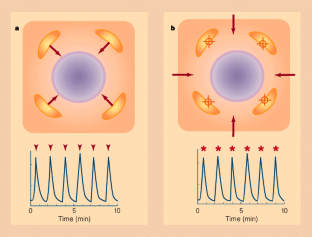
Oscillations in the concentration of cytosolic Ca2+ have attracted considerable attention, and hypotheses of frequency coding were proposed a decade ago1. But the experimental evidence has remained weak2, and the physiological significance of the phenomenon is still questioned. On pages 933 and 936 of this issue, however, Dolmetsch et al.3 and Li et al.4 report highly original experiments in which oscillations were generated by new procedures, bypassing the complexities of cell heterogeneity and activation of surface receptors. The results clearly show that oscillations and their frequencies can be specific for gene activation, not only in terms of efficiency, but also of selectivity. Nothing of this kind has ever been demonstrated before, and these reports open a new field in Ca2+ signalling.
This is a preview of subscription content, access via your institution
Access options
Subscribe to this journal
Receive 52 print issues and online access
$199.00 per year
only $3.83 per issue
Buy this article
- Purchase on SpringerLink
- Instant access to the full article PDF.
USD 39.95
Prices may be subject to local taxes which are calculated during checkout
Additional access options:
Figure 1: New procedures for generating homogeneous oscillations in the concentration of cytosolic Ca2+.
References
- Berridge, M. J., Cobbold, P. H. & Cuthbertson, K. S. R. Phil. Trans. R. Soc. Lond. 320, 325–343 (1988).
Google Scholar - Tsien, R. W. & Tsien, R. Y. Annu. Rev. Cell Biol. 6, 715–760 (1990).
Google Scholar - Dolmetsch, R. E., Xu, K. & Lewis, R. S. Nature 392, 933–936 (1998).
Article ADS CAS Google Scholar - Li, W., Llopis, J., Whitney, M., Zlokarnik, G. & Tsien, R. Y. Nature 392, 936–941 (1998).
Article ADS CAS Google Scholar - Zlokarnik, G. et al. Science 279, 84–88 (1998).
Google Scholar - Crabtree, G. R. & Clipstone, N. A. Annu. Rev. Biochem. 63, 1045–1083 (1994).
Google Scholar - Timmerman, L. A., Clipstone, N. A., Ho, S. N., Northrop, J. P. & Crabtree, G. R. Nature 383, 837–840 (1996).
Article ADS CAS Google Scholar - Dolmetsch, R. E., Lewis, R. S., Goodnow, C. C. & Healy, J. I. Nature 386, 855–858 (1997).
Article ADS CAS Google Scholar
Author information
Authors and Affiliations
- the Department of Pharmacology, University of Milan, and at DIBIT, Scientific Institute San Raffaele, Via Olgettina 58, 20132, Milan, Italy
Jacopo Meldolesi
Rights and permissions
About this article
Cite this article
Meldolesi, J. Oscillation, activation, expression.Nature 392, 863–865 (1998). https://doi.org/10.1038/31804
- Issue date: 30 April 1998
- DOI: https://doi.org/10.1038/31804