Rice, microbes and methane (original) (raw)
- News & Views
- Published: 27 January 2000
Global change
Nature volume 403, pages 375–377 (2000) Cite this article
- 5269 Accesses
- 222 Citations
- 3 Altmetric
- Metrics details
Methane is present at about only 1.8 parts per million in the atmosphere, but is a key player there — it is a greenhouse gas, it is central to atmospheric oxidation chemistry, and it is ultimately a source of stratospheric water vapour, which influences ozone depletion. Moreover, the concentration of methane is increasing rapidly. Hence the interest in the paper by Bodelier et al., on page 421of this issue1, which deals with methane emissions from rice paddies.
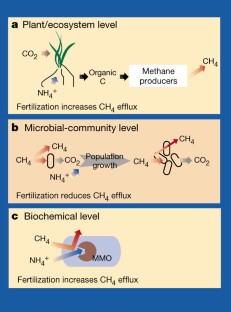
Most of the methane in the Earth's atmosphere comes from biological processes, and rice paddies are one of the main sources. A large fraction of the methane produced in rice soils is consumed, however, being oxidized to carbon dioxide by methane oxidizing bacteria (methanotrophs) in the soil, and so never makes it to the atmosphere. In upland soils, ammonium, which is formed naturally but is also a major constituent of nitrogen fertilizers, can inhibit methane oxidation and methanotroph growth. It has been a common assumption that this should occur in other ecosystems as well. So it comes as a surprise that Bodelier et al. find that, in rice-paddy soils, ammonium actually stimulates methane oxidation and methanotroph growth. This phenomenon may dominate the overall response of methane cycling to fertilization in rice-paddy ecosystems.
This is a preview of subscription content, access via your institution
Relevant articles
Open Access articles citing this article.
Activity and Identification of Methanotrophic Bacteria in Arable and No-Tillage Soils from Lublin Region (Poland)
- Anna Szafranek-Nakonieczna
- , Agnieszka Wolińska
- … Mieczysław Błaszczyk
Microbial Ecology Open Access 01 September 2018
Access options
Subscribe to this journal
Receive 52 print issues and online access
$199.00 per year
only $3.83 per issue
Buy this article
- Purchase on SpringerLink
- Instant access to the full article PDF.
USD 39.95
Prices may be subject to local taxes which are calculated during checkout
Additional access options:
Figure 1: Effects of ammonium fertilizer on methane dynamics in a rice ecosystem.
The alternative text for this image may have been generated using AI.
References
- Bodelier, P. L. E., Roslev, P., Henckel, T. & Frenzel, P. Nature 403, 421–424 (1999).
Article ADS Google Scholar - Neue, H. U. Soil Use Mgmt 13, 258–267 (1997).
Article Google Scholar - Banik, A., Sen, M. & Sen, S. P. Biol. Fertil. Soil 21, 319–322 (1996).
Article CAS Google Scholar - Dunfield, P. & Knowles, R. Appl. Environ. Microbiol. 61, 3129–3135 (1995).
CAS PubMed PubMed Central Google Scholar - Gulledge, J. & Schimel, J. P. Appl. Environ. Microbiol. 64, 4291–4298 (1998).
CAS PubMed PubMed Central Google Scholar - Amann, R. I., Ludwig, W. & Schliefer, K.-H Microbiol. Rev. 59, 143– 169 (1995).
CAS PubMed PubMed Central Google Scholar - Schimel, J. P. & Gulledge, J. Global Change Biol. 4, 745–758 (1998).
Article ADS Google Scholar
Author information
Authors and Affiliations
- Department of Ecology, Evolution and Marine Biology, University of California, Santa Barbara, 93106, California, USA
Joshua Schimel
Corresponding author
Correspondence toJoshua Schimel.
Rights and permissions
About this article
Cite this article
Schimel, J. Rice, microbes and methane.Nature 403, 375–377 (2000). https://doi.org/10.1038/35000325
- Issue date: 27 January 2000
- DOI: https://doi.org/10.1038/35000325