Influenza virus propagation is impaired by inhibition of the Raf/MEK/ERK signalling cascade (original) (raw)
- Brief Communication
- Published: 15 February 2001
- Thorsten Wolff2,
- Christina Ehrhardt3,
- Gerd Hobom4,
- Oliver Planz5,
- Ulf R. Rapp3 &
- …
- Stephan Ludwig3
Nature Cell Biology volume 3, pages 301–305 (2001) Cite this article
- 4529 Accesses
- 488 Citations
- 117 Altmetric
- Metrics details
Abstract
Influenza A viruses are important worldwide pathogens in humans and different animal species. The functions of most of the ten different viral proteins of this negative-strand RNA virus have been well elucidated1. However, little is known about the virus-induced intracellular signalling events that support viral replication. The Raf/MEK/ERK cascade is the prototype of mitogen-activated protein (MAP) kinase cascades and has an important role in cell growth, differentiation and survival2,3,4,5. Investigation of the function of this pathway has been facilitated by the identification of specific inhibitors such as U0126, which blocks the cascade at the level of MAPK/ERK kinase (MEK)6,7,8. Here we show that infection of cells with influenza A virus leads to biphasic activation of the Raf/MEK/ERK cascade. Inhibition of Raf signalling results in nuclear retention of viral ribonucleoprotein complexes (RNPs), impaired function of the nuclear-export protein (NEP/NS2) and concomitant inhibition of virus production. Thus, signalling through the mitogenic cascade seems to be essential for virus production and RNP export from the nucleus during the viral life cycle.
This is a preview of subscription content, access via your institution
Access options
Subscribe to this journal
Receive 12 print issues and online access
$259.00 per year
only $21.58 per issue
Buy this article
- Purchase on SpringerLink
- Instant access to the full article PDF.
USD 39.95
Prices may be subject to local taxes which are calculated during checkout
Additional access options:
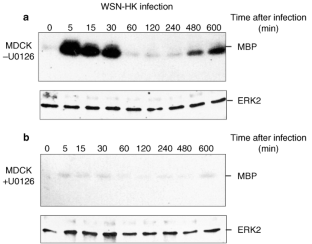
Figure 1: Infection with influenza A virus results in biphasic activation of ERK that is inhibited by U0126.
The alternative text for this image may have been generated using AI.
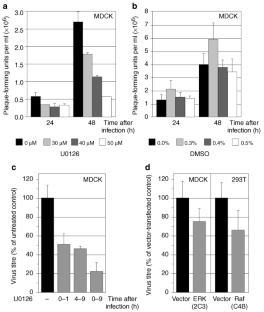
Figure 2: U0126 impairs propagation of influenza A virus in MDCK cells.
The alternative text for this image may have been generated using AI.
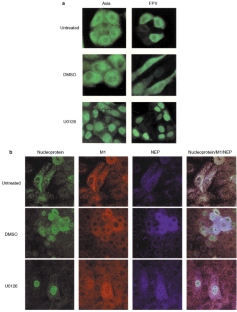
Figure 3: U0126 inhibits nuclear export of viral RNPs in late stages of the replication cycle.
The alternative text for this image may have been generated using AI.
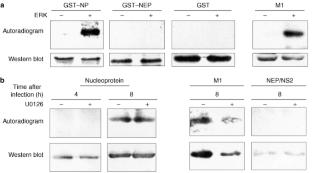
Figure 4: In vitro and in vivo phosphorylation of influenza nucleoprotein, M1 and NEP/NS2.
The alternative text for this image may have been generated using AI.
References
- Lamb, R. A. & Krug, R. M. in Fields Virology (eds Fields, B. N. et al.) 1353–1395 (Lippincott-Raven, Philadelphia, 1996).
Google Scholar - Daum, G., Eisenmann-Tappe, I., Fries, H-W., Troppmair, J. & Rapp, U. R. Trends Biochem. Sci. 19, 474–480 (1994).
Article CAS Google Scholar - Cano, E. & Mahadevan, L. C. Trends Biochem. Sci. 20, 117–122 (1995).
Article CAS Google Scholar - Cohen, P. Trends Cell Biol. 7, 353–361 (1997).
Article CAS Google Scholar - Robinson, M. J. & Cobb, M. H. Curr. Opin. Cell Biol. 9, 180–186 (1997).
Article CAS Google Scholar - Duncia, J. V. et al. Bioorg. Med. Chem. Lett. 8, 2839–2844 (1998).
Article CAS Google Scholar - Favata, M. F. et al. J. Biol. Chem. 273, 18623–18632 (1998).
Article CAS Google Scholar - DeSilva, D. R. et al. J. Immunol. 160, 4175–4181 (1998).
CAS PubMed Google Scholar - Benn, J., Su, F., Doria, M. & Schneider, R. J. J. Virol. 70, 4978–4985 (1996).
CAS PubMed PubMed Central Google Scholar - Bruder, J. T. & Kovesdi, I. J. Virol. 71, 398–404 (1997).
CAS PubMed PubMed Central Google Scholar - Popik, W. & Pitha, P. M. Virology 252, 210–217 (1998).
Article CAS Google Scholar - Rodems, S. M. & Spector, D. H. J. Virol. 72, 9173–9180 (1998).
CAS PubMed PubMed Central Google Scholar - Scholtissek, C. & Muller, K. Arch. Virol. 100, 27–35 (1988).
Article CAS Google Scholar - Whittaker, G., Bui, M. & Helenius, A. J. Virol. 70, 2743–2756 (1996).
CAS PubMed PubMed Central Google Scholar - O'Neill, R. E., Talon, J. & Palese, P. EMBO J. 17, 288–296 (1998).
Article CAS Google Scholar - Kistner, O., Müller, K. & Scholtissek, C. J. Gen. Virol. 70, 2421–2431 (1989).
Article CAS Google Scholar - Gregoriades, A., Guzman, G. G. & Paoletti, E. Virus Res. 16, 27–41 (1990).
Article CAS Google Scholar - Richardson, J. C. & Akkina, R. K. Arch. Virol. 116, 69–80 (1991).
Article CAS Google Scholar - Fischer, U., Huber, J., Boelens, W. C., Mattaj, I. W. & Luhrmann, R. Cell 82, 475–483 (1995).
Article CAS Google Scholar - Hope, T. J., Huang, X. J., McDonald, D. & Parslow, T. G. Proc. Natl Acad. Sci. USA 87, 7787–7791 (1990).
Article CAS Google Scholar - Scholtissek, C. & Müller, K. Arch. Virol. 119, 111–118 (1991).
Article CAS Google Scholar - Sebolt-Leopold, J. S. et al. Nature Med. 5, 810–816 (1999).
Article CAS Google Scholar - Ludwig, S. et al. Mol. Cell. Biol. 16, 6687–6697 (1996).
Article CAS Google Scholar
Acknowledgements
We thank P. Palese, R. Rott, C. Scholtissek and P. Staeheli for various influenza virus strains, T. Parslow for the pDM128 plasmid, I. Böhle and H. Häfner for technical assistance, and A. Hoffmeyer, S. Feller, J. Troppmair, G. Neumann, M. Camargo and R. Rott for discussions and critical reading of the manuscipt. This work was supported by grants from the Deutsche Forschungsgemeinschaft and the Fonds der Chemischen Industrie.
Author information
Authors and Affiliations
- Institut für Virologie, Fachbereich Veterinärmedizin, Justus-Liebig Universität, Giessen, D-35392, Germany
Stephan Pleschka - Robert Koch Institut, Berlin, D-13353, Germany
Thorsten Wolff - Institut für Medizinische Strahlenkunde und Zellforschung, Julius-Maximilians Universität, Würzburg, D-97078, Germany
Christina Ehrhardt, Ulf R. Rapp & Stephan Ludwig - Institut für Mikrobiologie und Molekularbiologie, Justus-Liebig Universität, Giessen, D-35392, Germany
Gerd Hobom - Bundesforschungsanstalt für Viruserkrankungen der Tiere, Tübingen, D-72076, Germany
Oliver Planz
Authors
- Stephan Pleschka
- Thorsten Wolff
- Christina Ehrhardt
- Gerd Hobom
- Oliver Planz
- Ulf R. Rapp
- Stephan Ludwig
Corresponding author
Correspondence toStephan Ludwig.
Supplementary information
Download plugins (download PDF )
Figure S1. U0126 does not affect vRNA synthesis, transcriptional activity of the viral RDRP or accumulation of viral proteins. RNA isolated from MDCK cells that were infected with WSN-HK or FPV and treated with 50 μM U0126 or DMSO was spotted onto nylon membranes and hybridized with specific probes for nucleoprotein vRNA and mRNA/cRNA, M1 vRNA or GAPDH. The amounts of specific vRNAs synthesized in WSN-HK- or FPV-infected cells in the presence or absence of U0126 were determined in Dot-Blot analyses. b, MDCK cells were incubated with the indicated concentrations of U0126 or DMSO before, during and after infection with transfectant WSN-HK-CAT carrying an extra vRNA-like segment encoding the CAT reporter gene. After 16 h cells were lysed and analysed for CAT activity as an indicator of transcriptional activity of vRDRP. c, MDCK cells were infected with FPV (MOI = 10) in the presence or absence of 50 µM U0126 before, during and after infection. Cell lysates were analysed by western blotting for expression of influenza nucleoprotein, M1 and NS1 at different time points after infection. As a loading control, the same membranes were reblotted with a specific antiserum against ERK2. (PDF 454 kb)
Figure S2. Inhibition of the Raf/MEK/ERK signalling cascade interferes with the nuclear-export activity of NEP/NS2. HeLa cells were transfected with pcDNA3-Rev(1–69)NEP, pDM128 for CAT expression through an RRE-containing mRNA and pCMV-Luc for constitutive expression of firefly luciferase. After 5 h cells were treated with 40, 50 or 60 μM U0126 or the solvent equivalent of 0.6% DMSO. After 25 h cell lysates, normalized for protein content, were assayed for CAT and luciferase activity. CAT activities shown are means from duplicate transfections nor-malized on luciferase values with the solvent control designated as 100%. Data are representative of several independent experiments. b, HeLa cells were transfected as in a together with empty vector or with plasmids expressing dominant negative forms of Raf (Raf(C4B)) or ERK2 (ERK(2B3)) and assayed for reporter-gene activites as in a. CAT activities shown are means of triplicate transfections normalized for luciferase values with the vector control designated as 100%.
Rights and permissions
About this article
Cite this article
Pleschka, S., Wolff, T., Ehrhardt, C. et al. Influenza virus propagation is impaired by inhibition of the Raf/MEK/ERK signalling cascade.Nat Cell Biol 3, 301–305 (2001). https://doi.org/10.1038/35060098
- Received: 22 September 1999
- Revised: 31 August 2000
- Accepted: 18 October 2000
- Published: 15 February 2001
- Issue date: March 2001
- DOI: https://doi.org/10.1038/35060098