Large-scale forest girdling shows that current photosynthesis drives soil respiration (original) (raw)
- Letter
- Published: 14 June 2001
- Anders Nordgren1,
- Nina Buchmann2,
- Andrew F. S. Taylor3,
- Alf Ekblad1 nAff6,
- Mona N. Högberg1,
- Gert Nyberg1,
- Mikaell Ottosson-Löfvenius1 &
- …
- David J. Read4
Nature volume 411, pages 789–792 (2001) Cite this article
- 7658 Accesses
- 1679 Citations
- 24 Altmetric
- Metrics details
Abstract
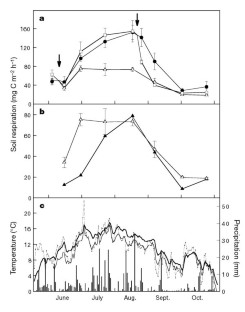
The respiratory activities of plant roots, of their mycorrhizal fungi and of the free-living microbial heterotrophs (decomposers) in soils are significant components of the global carbon balance, but their relative contributions remain uncertain1,2. To separate mycorrhizal root respiration from heterotrophic respiration in a boreal pine forest, we conducted a large-scale tree-girdling experiment, comprising 9 plots each containing about 120 trees. Tree-girdling involves stripping the stem bark to the depth of the current xylem at breast height terminating the supply of current photosynthates to roots and their mycorrhizal fungi without physically disturbing the delicate root–microbe–soil system. Here we report that girdling reduced soil respiration within 1–2 months by about 54% relative to respiration on ungirdled control plots, and that decreases of up to 37% were detected within 5 days. These values clearly show that the flux of current assimilates to roots is a key driver of soil respiration; they are conservative estimates of root respiration, however, because girdling increased the use of starch reserves in the roots. Our results indicate that models of soil respiration should incorporate measures of photosynthesis and of seasonal patterns of photosynthate allocation to roots.
This is a preview of subscription content, access via your institution
Access options
Subscribe to this journal
Receive 52 print issues and online access
$199.00 per year
only $3.83 per issue
Buy this article
- Purchase on SpringerLink
- Instant access to the full article PDF.
USD 39.95
Prices may be subject to local taxes which are calculated during checkout
Additional access options:
Figure 1: Soil respiration in the different tree-girdling treatments in Scots pine forest at Åheden in relation to meteorological data.
The alternative text for this image may have been generated using AI.
References
- Grace, J. & Rayment, M. Respiration in the balance. Nature 404, 819–820 (2000).
Article CAS Google Scholar - Hanson, P. J., Edwards, N. T., Garten, C. T. & Andrews, J. A. Separating root and soil microbial contributions to soil respiration: a review of methods and observations. Biogeochemistry 48, 115–146 (2000).
Article CAS Google Scholar - Malhi, Y., Baldocchi, D. D. & Jarvis, P. G. The carbon balance of tropical, temperate and boreal forests. Plant Cell Environ. 22, 715–740 (1999).
Article CAS Google Scholar - Valentini, R. et al. Respiration as the main determinant of carbon balance in European forests. Nature 404, 861–865 (2000).
Article ADS CAS Google Scholar - Goulden, M. L. et al. Sensitivity of boreal forest carbon balance to soil thaw. Science 279, 214–216 (1998).
Article ADS CAS Google Scholar - Lindroth, A., Grelle, A. & Morén, A. S. Long-term measurements of boreal forest carbon balance reveal large temperature sensitivity. Global Change Biol. 4, 443–450 (1998).
Article ADS Google Scholar - Post, W. M., Emanuel, W. R., Zinke, P. J. & Stangenberger, A. G. Soil carbon pools and world life zones. Nature 298, 156–159 (1982).
Article ADS CAS Google Scholar - Smith, S. E. & Read, D. J. Mycorrhizal Symbioses 2nd edn (Academic, San Diego, 1997).
Google Scholar - Söderström, B. & Read, D. J. Respiratory activity of intact and excised ectomycorrhizal mycelial systems growing in unsterile soil. Soil Biol. Biochem. 19, 231–236 (1987).
Article Google Scholar - Hansen, J., Türk, R., Vogg, G., Heim, R. & Beck, E. in Trees - Contributions to Modern Tree Physiology (eds Rennenberg, H., Eschrich, W. & Ziegler, H.) 97–108 (Backhuys, Leiden, 1997).
Google Scholar - Ericsson, A. & Persson, H. Seasonal changes in starch reserves and growth of fine roots of 20-year-old Scots pines. Ecol. Bull. 32, 239–250 (1980).
Google Scholar - Plamboeck, A. H., Grip, H. & Nygren, U. A hydrological tracer study of water uptake depth in a Scots pine forest under two different water regimes. Oecologia 119, 452–460 (1999).
Article ADS CAS Google Scholar - Ågren, G. I. et al. Annual carbon budget for a young Scots pine. Ecol. Bull. 32, 307–313 (1980).
Google Scholar - Edwards, N. T. & Ross-Todd, B. M. The effects of stem girdling on biogeochemical cycles within a mixed deciduous forest in eastern Tennessee. I. Soil solution chemistry, soil respiration, litterfall and root biomass studies. Oecologia 40, 247–257 (1979).
Article ADS CAS Google Scholar - Boone, R. D., Nadelhoffer, K. J., Canary, J. D. & Kaye, J. P. Roots exert a strong influence on the temperature sensitivity of soil respiration. Nature 396, 570–572 (1998).
Article ADS CAS Google Scholar - Craine, J. M., Wedin, D. A. & Chapin, F. S. III. Predominance of ecophysiological controls on soil CO2 flux in a Minnesota grassland. Plant Soil 207, 77–86 (1999).
Article Google Scholar - Högberg, P. & Ekblad, A. Substrate-induced respiration measured in situ in a C3-plant ecosystem using additions of C4-sucrose. Soil Biol. Biochem. 28, 1131–1138 (1996).
Article Google Scholar - Steen, E. & Larsson, K. Carbohydrates in roots and rhizomes of perennial grasses. New Phytol. 104, 339–346 (1986).
Article CAS Google Scholar
Acknowledgements
We gratefully acknowledge funding by the EU to P.H. and D.J.R. through the project FORCAST, by the Swedish Natural Sciences Research Council and Swedish National Energy Administration to P.H. and by the European Science Foundation to N.B. (LINKECOL); chemical analyses by A. Ohlsson and L. Skoglund; and technical assistance by G. Moen and L. Ohlsson.
Author information
Author notes
- Alf Ekblad
Present address: Department of Natural Sciences, Örebro University, SE-701 82, Örebro, Sweden
Authors and Affiliations
- Department of Forest Ecology, Section of Soil Science, SLU, Umeå, SE-901 83, Sweden
Peter Högberg, Anders Nordgren, Alf Ekblad, Mona N. Högberg, Gert Nyberg & Mikaell Ottosson-Löfvenius - Max-Planck Institute for Biogeochemistry, PO Box 100164, Jena, 07701, Germany
Nina Buchmann - Department of Forest Mycology and Pathology, SLU, PO Box 7026, Uppsala, SE-750 07, Sweden
Andrew F. S. Taylor - Department of Animal and Plant Sciences, University of Sheffield, Sheffield, S10 2TN, UK
David J. Read
Authors
- Peter Högberg
- Anders Nordgren
- Nina Buchmann
- Andrew F. S. Taylor
- Alf Ekblad
- Mona N. Högberg
- Gert Nyberg
- Mikaell Ottosson-Löfvenius
- David J. Read
Corresponding author
Correspondence toPeter Högberg.
Rights and permissions
About this article
Cite this article
Högberg, P., Nordgren, A., Buchmann, N. et al. Large-scale forest girdling shows that current photosynthesis drives soil respiration.Nature 411, 789–792 (2001). https://doi.org/10.1038/35081058
- Received: 01 December 2000
- Accepted: 29 March 2001
- Issue date: 14 June 2001
- DOI: https://doi.org/10.1038/35081058