phot1 and phot2 mediate blue light regulation of stomatal opening (original) (raw)
- Letter
- Published: 06 December 2001
- Michio Doi1 na1,
- Noriyuki Suetsugu2,3,
- Takatoshi Kagawa2,4 na1,
- Masamitsu Wada2,3 &
- …
- Ken-ichiro Shimazaki1
Nature volume 414, pages 656–660 (2001) Cite this article
- 9803 Accesses
- 870 Citations
- 10 Altmetric
- Metrics details
Abstract
The stomatal pores of higher plants allow for gaseous exchange into and out of leaves. Situated in the epidermis, they are surrounded by a pair of guard cells which control their opening in response to many environmental stimuli, including blue light1,2. Opening of the pores is mediated by K+ accumulation in guard cells through a K+ channel and driven by an inside-negative electrical potential3. Blue light causes phosphorylation and activation of the plasma membrane H+-ATPase that creates this potential1,2,4,5,6. Thus far, no blue light receptor mediating stomatal opening has been identified7, although the carotenoid, zeaxanthin, has been proposed2,8. Arabidopsis mutants deficient in specific blue-light-mediated responses have identified7,9,10,11,12,13,14 four blue light receptors, cryptochrome 1 (cry1), cryptochrome 2 (cry2), phot1 and phot2. Here we show that in a double mutant of phot1 and phot2 stomata do not respond to blue light although single mutants are phenotypically normal. These results demonstrate that phot1 and phot2 act redundantly as blue light receptors mediating stomatal opening.
This is a preview of subscription content, access via your institution
Access options
Subscribe to this journal
Receive 52 print issues and online access
$199.00 per year
only $3.83 per issue
Buy this article
- Purchase on SpringerLink
- Instant access to the full article PDF.
USD 39.95
Prices may be subject to local taxes which are calculated during checkout
Additional access options:
Figure 1: Analyses of Arabidopsis blue-light photoreceptor mutants.

The alternative text for this image may have been generated using AI.
Figure 2: Stomatal opening under blue light.
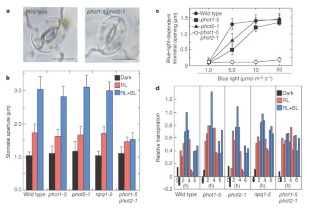
The alternative text for this image may have been generated using AI.
Figure 3: Amount of plasma membrane H+-ATPase, fusicoccin-induced stomatal opening, and blue light-dependent H+ extrusion in Arabidopsis blue light photoreceptor mutants.

The alternative text for this image may have been generated using AI.
References
- Assmann, S. M. Signal transduction in guard cells. Annu. Rev. Cell Biol. 9, 345–375 (1993).
Article CAS Google Scholar - Schroeder, J. I., Allen, G. J., Hugouvieux, V., Kwak, J. M. & Waner, D. Guard cell signal transduction. Annu. Rev. Plant Physiol. Plant Mol. Biol. 52, 627–658 (2001).
Article CAS Google Scholar - Schroeder, J. I., Raschke, K. & Neher, E. Voltage dependence of K+ channels in guard cell protoplasts. Proc. Natl Acad. Sci. USA 84, 4108–4112 (1987).
Article ADS CAS Google Scholar - Assmann, S. M., Simoncini, L. & Schroeder, J. I. Blue light activates electrogenic ion pumping in guard cell protoplasts of Vicia faba L. Nature 318, 285–287 (1985).
Article ADS CAS Google Scholar - Shimazaki, K., Iino, M. & Zeiger, E. Blue light-dependent proton extrusion by guard-cell protoplasts of Vicia faba. Nature 319, 324–326 (1986).
Article ADS CAS Google Scholar - Kinoshita, T. & Shimazaki, K. Blue light activates the plasma membrane H+-ATPase by phosphorylation of the C-terminus in stomatal guard cells. EMBO J. 18, 5548–5558 (1999).
Article CAS Google Scholar - Briggs, W. R. & Huala, E. Blue-light photoreceptors in higher plants. Annu. Rev. Cell Dev. 15, 33–62 (1999).
Article CAS Google Scholar - Zeiger, E. & Zhu, J. Role of zeaxanthin in blue light photoreception and modulation of light-CO2 interactions in guard cells. J. Exp. Bot. 49, 433–442 (1998).
Article Google Scholar - Ahmad, M. & Cashmore, A. R. HY4 gene of A. thaliana encodes a protein with characteristics of a blue-light photoreceptor. Nature 366, 162–166 (1993).
Article ADS CAS Google Scholar - Briggs, W. R. et al. The phototropin family of photoreceptors. Plant Cell 13, 993–997 (2001).
Article CAS Google Scholar - Huala, E. et al. Arabidopsis NPH1: A protein kinase with a putative redox-sensing domain. Science 278, 2121–2123 (1997).
Article ADS Google Scholar - Sakai, T. et al. Arabidopsis nph1 and npl1: Blue light receptors that mediate both phototropism and chloroplast relocation. Proc. Natl Acad. Sci. USA 98, 6969–6974 (2001).
Article ADS CAS Google Scholar - Kagawa, T. et al. Arabidopsis NPL1: A phototropin homolog controlling the chloroplast high-light avoidance response. Science 291, 2138–2141 (2001).
Article ADS CAS Google Scholar - Jarillo, J. A. et al. Phototropin-related NPL1 controls chloroplast relocation induced by blue light. Nature 410, 952–954 (2001).
Article ADS CAS Google Scholar - Baum, G., Long, J. C., Jenkins, G. I. & Trewavas, A. J. Stimulation of the blue light phototropic receptor NPH1 causes a transient increase in cytosolic Ca2+. Proc. Natl Acad. Sci. USA 96, 13554–13559 (1999).
Article ADS CAS Google Scholar - Shimazaki, K., Goh, C. H. & Kinoshita, T. Involvement of intracellular Ca2+ in blue light-dependent proton pumping in guard cell protoplasts from Vicia faba. Physiol. Plant. 105, 554–561 (1999).
Article CAS Google Scholar - Christie, J. M., Salomon, M., Nozue, K., Wada, M. & Briggs, W. R. LOV (light, oxygen, or voltage) domains of the blue light photoreceptor phototropin (nph1): Binding sites for the chromophore flavin mononucleotide. Proc. Natl Acad. Sci. USA 96, 8779–8783 (1999).
Article ADS CAS Google Scholar - Karlsson, P. E. Blue light regulation of stomata in wheat seedlings. II. Action spectrum and search for action dichroism. Physiol. Plant. 66, 207–210 (1986).
Article Google Scholar - Eisinger, W., Swartz, T. E., Bogomolni, R. A. & Taiz, L. The ultraviolet action spectrum for stomatal opening in broad bean. Plant Physiol. 122, 99–105 (2000).
Article CAS Google Scholar - Lasceve, G. et al. Arabidopsis contains at least four independent blue-light-activated signal transduction pathways. Plant Physiol. 120, 605–614 (1999).
Article CAS Google Scholar - Niyogi, K. K., Grossman, A. R. & Bjorkman, O. Arabidopsis mutants define a central role for the xanthrophyll cycle in the regulation of photosynthetic energy conversion. Plant Cell 10, 1121–1134 (1998).
Article CAS Google Scholar - Schwartz, A. & Zeiger, E. Metabolic energy for stomatal opening. Role of photophosphorylation and oxidative phosphorylation. Planta 161, 129–136 (1984).
Article CAS Google Scholar - Eckert, M. & Kaldenhoff, R. Light-induced stomatal movement of selected Arabidopsis thaliana mutants. J. Exp. Bot. 51, 1435–1442 (2000).
Article CAS Google Scholar - Ballio, A. et al. Fusicoccin: A new wilting toxin produced by Fusicoccum amygdali Del. Nature 203, 297 (1964).
Article ADS CAS Google Scholar - Willmer, C. & Fricker, M. D. Stomata 2nd edn (Chapman & Hall, London, 1996).
Book Google Scholar - Iino, M., Ogawa, T. & Zeiger, E. Kinetic properties of blue light response of stomata. Proc. Natl Acad. Sci. USA 82, 8019–8023 (1985).
Article ADS CAS Google Scholar - Chomczynski, P. & Sacchi, N. Single step-method of RNA isolation by acid guanidium thiocyanate-phenol-chloroform extraction. Anal. Biochem. 162, 156–159 (1987).
Article CAS Google Scholar - Merlot, S., Gosti, F., Guerrier, D., Vavasseur, A. & Giraudat, J. The ABI1 and ABI2 protein phosphatase 2C act in a negative feedback regulatory loop of the abscisic acid signalling pathway. Plant J. 25, 295–303 (2001).
Article CAS Google Scholar - Kondo, N. & Sugahara, K. Changes in transpiration rate of SO2-resistant and -sensitive plants with SO2 fumigation and the participation of abscisic acid. Plant Cell Physiol. 19, 365–373 (1978).
Article CAS Google Scholar - Bradford, M. M. A rapid sensitive method for the quantitation of microgram quantities of protein utilizing the principle of protein-dye binding. Anal. Biochem. 72, 248–254 (1976).
Article CAS Google Scholar
Acknowledgements
We thank J. Silverthorne for a critical reading of the manuscript. This work was supported in part by a grant from the research fellowships of the Japan Society for the Promotion of Science for Young Scientists to T. Kinoshita and N.S., a Grant-in-Aid for Scientific Research on Priority Areas from the Ministry of Education, Science, Sports and Culture of Japan to K.S. and M.W., and Kyushu University Interdisciplinary Programmes in Education and Projects in Research Development to K.S. This work was also supported partly by the PROBRAIN and NOVARTIS to M.W. and partly by a grant from PRESTO, Japan Science and Technology Corporation (T. Kagawa).
Author information
Author notes
- Toshinori Kinoshita, Michio Doi and Takatoshi Kagawa: These authors contributed equally to this work.
Authors and Affiliations
- Department of Biology, Faculty of Science, Kyushu University, Ropponmatsu, 810-8560, Fukuoka, Japan
Toshinori Kinoshita, Michio Doi & Ken-ichiro Shimazaki - Division of Biological Regulation and Photobiology, National Institute for Basic Biology, Okazaki, 444-8585, Japan
Noriyuki Suetsugu, Takatoshi Kagawa & Masamitsu Wada - Department of Biological Sciences, Graduate School of Science, Tokyo Metropolitan University, Tokyo, 192-0397, Japan
Noriyuki Suetsugu & Masamitsu Wada - Unit Process and Combined Circuit, PRESTO, Japan Science and Technology Corporation, 1-8, Honcho 4-chome, Kawaguchi, 332-0012, Saitama, Japan
Takatoshi Kagawa
Authors
- Toshinori Kinoshita
- Michio Doi
- Noriyuki Suetsugu
- Takatoshi Kagawa
- Masamitsu Wada
- Ken-ichiro Shimazaki
Corresponding author
Correspondence toKen-ichiro Shimazaki.
Rights and permissions
About this article
Cite this article
Kinoshita, T., Doi, M., Suetsugu, N. et al. phot1 and phot2 mediate blue light regulation of stomatal opening.Nature 414, 656–660 (2001). https://doi.org/10.1038/414656a
- Received: 03 August 2001
- Accepted: 09 October 2001
- Issue date: 06 December 2001
- DOI: https://doi.org/10.1038/414656a