Fgf8 signalling from the AER is essential for normal limb development (original) (raw)
- Letter
- Published: December 2000
Nature Genetics volume 26, pages 460–463 (2000)Cite this article
- 4129 Accesses
- 426 Citations
- 9 Altmetric
- Metrics details
Abstract
Vertebrate limb development depends on signals from the apical ectodermal ridge (AER), which rims the distal tip of the limb bud1. Removal of the AER in chick results in limbs lacking distal skeletal elements2,3. Fibroblast growth factor (FGF) proteins can substitute for the AER (refs 4–7), suggesting that FGF signalling mediates AER activity. Of the four mouse Fgf genes (Fgf4 , Fgf8, Fgf9, Fgf17) known to display AER-specific expression domains within the limb bud (AER-Fgfs), only Fgf8 is expressed throughout the AER. Moreover, Fgf8 expression precedes that of other AER-Fgfs (refs 8–13), suggesting that Fgf8 may perform unique functions early in limb development6,7. In mice, loss of function of Fgf4 (refs 13,14), Fgf9 (D. Ornitz, pers. comm.) or Fgf17 (ref. 15) has no effect on limb formation. We report here that inactivating Fgf8 in early limb ectoderm causes a substantial reduction in limb-bud size, a delay in Shh expression, misregulation of Fgf4 expression, and hypoplasia or aplasia of specific skeletal elements. Our data identify Fgf8 as the only known AER-Fgf individually necessary for normal limb development, and provide insight into the function of Fgf signalling from the AER in the normal outgrowth and patterning of the limb.
This is a preview of subscription content, access via your institution
Access options
Subscribe to this journal
Receive 12 print issues and online access
$259.00 per year
only $21.58 per issue
Buy this article
- Purchase on SpringerLink
- Instant access to the full article PDF.
USD 39.95
Prices may be subject to local taxes which are calculated during checkout
Additional access options:
Figure 1: Cre-mediated inactivation of Fgf8 in the limb bud.
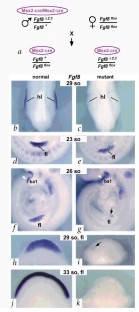
The alternative text for this image may have been generated using AI.
Figure 2: Abnormalities in Shh expression in early stage Msx2-cre; Fgf8 limb buds.

The alternative text for this image may have been generated using AI.
Figure 3: Gene expression in Msx2-cre;Fgf8 limb buds.
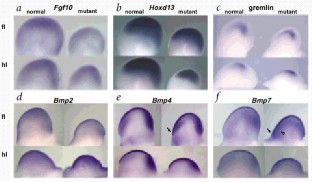
The alternative text for this image may have been generated using AI.
Figure 4: Misregulation of Fgf4 in Msx2-cre;Fgf8 limb buds.
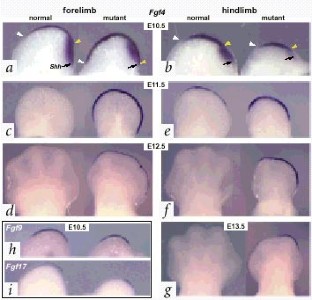
The alternative text for this image may have been generated using AI.
Figure 5: Skeletal abnormalities in Msx2-cre;Fgf8 limbs.

The alternative text for this image may have been generated using AI.
References
- Martin, G.R. The roles of FGFs in the early development of vertebrate limbs. Genes Dev. 12, 1571–1586 (1998).
Article CAS Google Scholar - Saunders, J.W. Jr The proximo-distal sequence of the origin of the parts of the chick wing and the role of the ectoderm. J. Exp. Zool. 108, 363–403 (1948).
Article Google Scholar - Summerbell, D. A quantitative analysis of the effect of excision of the AER from the chick limb bud. J. Embryol. Exp. Morph. 32, 651 –660 (1974).
CAS PubMed Google Scholar - Niswander, L., Tickle, C., Vogel, A., Booth, I. & Martin, G.R. FGF-4 replaces the apical ectodermal ridge and directs outgrowth and patterning of the limb. Cell 75, 579–587 (1993).
Article CAS Google Scholar - Fallon, J. et al. FGF-2: apical ectodermal ridge growth signal for chick limb development . Science 264, 104–107 (1994).
Article CAS Google Scholar - Crossley, P., Minowada, G., MacArthur, C. & Martin, G. Roles for FGF8 in the induction, initiation, and maintenance of chick limb development. Cell 84, 127– 136 (1996).
Article CAS Google Scholar - Vogel, A., Rodriguez, C. & Izpisúa-Belmonte, J.-C. Involvement of FGF-8 in initiation, outgrowth and patterning of the vertebrate limb. Development 122, 1737–1750 (1996).
CAS Google Scholar - Crossley, P.H. & Martin, G.R. The mouse Fgf8 gene encodes a family of polypeptides and is expressed in regions that direct outgrowth and patterning in the developing embryo. Development 121, 439–451 (1995).
CAS PubMed Google Scholar - Heikinheimo, M., Lawshé, A., Shackleford, G.M., Wilson, D.B. & MacArthur, C.A. Fgf-8 expression in the post-gastrulation mouse suggests roles in the development of the face, limbs, and central nervous system. Mech. Dev. 48, 129–138 (1994).
Article CAS Google Scholar - Mahmood, R. et al. A role for FGF-8 in the initiation and maintenance of vertebrate limb bud outgrowth. Curr. Biol. 5, 797– 806 (1995).
Article CAS Google Scholar - Ohuchi, H. et al. Involvement of androgen-induced growth factor (FGF-8) gene in mouse embryogenesis and morphogenesis. Biochem. Biophys. Res. Commun. 204, 882–888 ( 1994).
Article CAS Google Scholar - Niswander, L. & Martin, G.R. Fgf-4 expression during gastrulation, myogenesis, limb and tooth development in the mouse. Development 114, 755–768 (1992).
CAS PubMed Google Scholar - Sun, X. et al. Conditional inactivation of Fgf4 reveals complexity of signaling during limb bud development. Nature Genet. 25, 83–86 (2000).
Article CAS Google Scholar - Moon, A.M., Boulet, A.M. & Capecchi, M.R. Normal limb development in conditional mutants of Fgf4. Development 127, 989– 996 (2000).
CAS PubMed PubMed Central Google Scholar - Xu, J., Liu, Z. & Ornitz, D.M. Temporal and spatial gradients of Fgf8 and Fgf17 regulate proliferation and differentiation of midline cerebellar structures. Development 127, 1833– 1843 (2000).
CAS PubMed Google Scholar - Sun, X., Meyers, E.N., Lewandoski, M. & Martin, G.R. Targeted disruption of Fgf8 causes failure of cell migration in the gastrulating mouse embryo. Genes Dev. 13, 1834–1846 (1999).
Article CAS Google Scholar - Nagy, A. Cre recombinase: the universal reagent for genome tailoring. Genesis 26, 99–109 ( 2000).
Article CAS Google Scholar - Tickle, C. & Eichele, G. Vertebrate limb development. Annu. Rev. Cell Biol. 10, 121–152 (1994).
Article CAS Google Scholar - Zuniga, A., Haramis, A.P., McMahon, A.P. & Zeller, R. Signal relay by BMP antagonism controls the SHH/FGF4 feedback loop in vertebrate limb buds. Nature 401, 598– 602 (1999).
Article CAS Google Scholar - Capdevila, J., Tsukui, T., Rodriquez Esteban, C., Zappavigna, V. & Izpisua Belmonte, J.C. Control of vertebrate limb outgrowth by the proximal factor Meis2 and distal antagonism of BMPs by Gremlin. Mol. Cell 4, 839– 849 (1999).
Article CAS Google Scholar - Mercader, N. et al. Conserved regulation of proximodistal limb axis development by Meis1/Hth. Nature 402, 425– 429 (1999).
Article CAS Google Scholar - Pizette, S. & Niswander, L. BMPs negatively regulate structure and function of the limb apical ectodermal ridge. Development 126, 883–894 (1999).
CAS PubMed Google Scholar - Merino, R. et al. The BMP antagonist Gremlin regulates outgrowth, chondrogenesis and programmed cell death in the developing limb. Development 126, 5515–5522 (1999).
CAS PubMed Google Scholar - Wright, E. et al. The Sry-related gene Sox9 is expressed during chondrogenesis in mouse embryos. Nature Genet. 9, 15– 20 (1995).
Article CAS Google Scholar - McLeod, M.J. Differential staining of cartilage and bone in whole mouse fetuses by alcian blue and alizarin red S. Teratology 22, 299–301 (1980).
Article CAS Google Scholar - Moon, A.M. & Capecchi, M.R. Fgf8 is required for outgrowth and patterning of the limbs. Nature Genet. 26, 455–459 (2000).
Article CAS Google Scholar - Meyers, E.N., Lewandoski, M. & Martin, G.R. An Fgf8 mutant allelic series generated by Cre- and Flp-mediated recombination. Nature Genet. 18, 136–141 (1998).
Article CAS Google Scholar - Dahn, R.D. & Fallon, J.F. Interdigital regulation of digit identity and homeotic transformation by modulated BMP signaling. Science 289, 438–441 ( 2000).
Article CAS Google Scholar - Summerbell, D., Lewis, J.H. & Wolpert, L. Positional information in chick limb morphogenesis. Nature 244, 492–496 ( 1973).
Article CAS Google Scholar - Tabin, C.J. A developmental model for thalidomide defects. Nature 396, 322–323 (1998).
Article CAS Google Scholar
Acknowledgements
We thank D. Duboule, Genetics Institute, R. Harland, B. Hogan, N. Itoh, A. McMahon and D. Ornitz for plasmids from which probes were prepared; M. Embry and Z. Serrano for technical assistance; and E. Meyers, T. Yamaguchi and our colleagues in the Martin laboratory for discussion and critical readings of the manuscript. X.S. was the recipient of a postdoctoral fellowship from the American Cancer Society. This work was supported by an HHMI Research Resources Program grant (76296-549901) to the UCSF School of Medicine and NIH grant RO1 HD34380 (to G.R.M.).
Author information
Author notes
- Mark Lewandoski
Present address: Genetics of Vertebrate Development Section, Laboratory of Cancer and Developmental Biology, National Cancer Institute-FCRDC, Frederick, Maryland, USA
Authors and Affiliations
- Department of Anatomy and Program in Developmental Biology, School of Medicine, San Francisco, California , USA
Mark Lewandoski, Xin Sun & Gail R. Martin
Authors
- Mark Lewandoski
- Xin Sun
- Gail R. Martin
Corresponding author
Correspondence toGail R. Martin.
Supplementary information
Rights and permissions
About this article
Cite this article
Lewandoski, M., Sun, X. & Martin, G. Fgf8 signalling from the AER is essential for normal limb development .Nat Genet 26, 460–463 (2000). https://doi.org/10.1038/82609
- Received: 28 June 2000
- Accepted: 13 October 2000
- Issue date: December 2000
- DOI: https://doi.org/10.1038/82609