Observed variations of methane on Mars unexplained by known atmospheric chemistry and physics (original) (raw)
- Letter
- Published: 06 August 2009
Nature volume 460, pages 720–723 (2009)Cite this article
- 2896 Accesses
- 247 Citations
- 37 Altmetric
- Metrics details
Abstract
The detection of methane on Mars1,2,3 has revived the possibility of past or extant life on this planet, despite the fact that an abiogenic origin is thought to be equally plausible4. An intriguing aspect of the recent observations of methane on Mars is that methane concentrations appear to be locally enhanced and change with the seasons3. However, methane has a photochemical lifetime of several centuries, and is therefore expected to have a spatially uniform distribution on the planet5. Here we use a global climate model of Mars with coupled chemistry6,7,8 to examine the implications of the recently observed variations of Martian methane for our understanding of the chemistry of methane. We find that photochemistry as currently understood does not produce measurable variations in methane concentrations, even in the case of a current, local and episodic methane release. In contrast, we find that the condensation–sublimation cycle of Mars’ carbon dioxide atmosphere can generate large-scale methane variations differing from those observed. In order to reproduce local methane enhancements similar to those recently reported3, we show that an atmospheric lifetime of less than 200 days is necessary, even if a local source of methane is only active around the time of the observation itself. This implies an unidentified methane loss process that is 600 times faster than predicted by standard photochemistry. The existence of such a fast loss in the Martian atmosphere is difficult to reconcile with the observed distribution of other trace gas species. In the case of a destruction mechanism only active at the surface of Mars, destruction of methane must occur with an even shorter timescale of the order of ∼1 hour to explain the observations. If recent observations of spatial and temporal variations of methane are confirmed, this would suggest an extraordinarily harsh environment for the survival of organics on the planet.
This is a preview of subscription content, access via your institution
Access options
Subscribe to this journal
Receive 51 print issues and online access
$199.00 per year
only $3.90 per issue
Buy this article
- Purchase on SpringerLink
- Instant access to the full article PDF.
USD 39.95
Prices may be subject to local taxes which are calculated during checkout
Additional access options:
Figure 1: Column-averaged methane mixing ratio calculated by the global climate–chemical model.

The alternative text for this image may have been generated using AI.
Figure 2: Idealized tracer experiments.
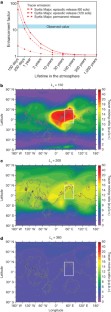
The alternative text for this image may have been generated using AI.
Figure 3: Maximum enhancement created by a local source of tracer in a column-averaged tracer field, as a function of tracer lifetime at the surface of Mars.

The alternative text for this image may have been generated using AI.
References
- Formisano, V., Atreya, S. K., Encrenaz, T., Ignatiev, N. & Giuranna, M. Detection of methane in the atmosphere of Mars. Science 306, 1758–1761 (2004)
Article ADS CAS Google Scholar - Krasnopolsky, V. A., Maillard, J. P. & Owen, T. C. Detection of methane in the martian atmosphere: evidence for life? Icarus 172, 537–547 (2004)
Article ADS CAS Google Scholar - Mumma, M. et al. Strong release of methane on Mars in northern summer 2003. Science 323, 1041–1045 (2009)
Article ADS CAS Google Scholar - Atreya, S. K., Mahaffy, P. R. & Wong, A. S. Methane and related trace species on Mars: origin, loss, implications for life, and habitability. Planet. Space Sci. 55, 358–369 (2007)
Article ADS CAS Google Scholar - Krasnopolsky, V. A. Some problems related to the origin of methane on Mars. Icarus 180, 359–367 (2006)
Article ADS CAS Google Scholar - Forget, F. et al. Improved general circulation models of the Martian atmosphere from the surface to above 80 km. J. Geophys. Res. 104, 24155–24176 (1999)
Article ADS CAS Google Scholar - Lefèvre, F., Lebonnois, S., Montmessin, F. & Forget, F. Three-dimensional modeling of ozone on Mars. J. Geophys. Res. 109 10.1029/2004JE002268 (2004)
- Lefèvre, F. et al. Heterogeneous chemistry in the atmosphere of Mars. Nature 454, 971–975 (2008)
Article ADS Google Scholar - Summers, M. E., Lieb, B. J., Chapman, E. & Yung, Y. L. Atmospheric biomarkers of subsurface life on Mars. Geophys. Res. Lett. 29 10.1029/2002GL015377 (2002)
- Wong, A. S., Atreya, S. K. & Encrenaz, T. Chemical markers of possible hot spots on Mars. J. Geophys. Res. 108 10.1029/2002JE002003 (2003)
- Solomon, S. et al. (eds) Climate Change 2007: The Physical Science Basis (Cambridge Univ. Press, 2007)
Google Scholar - Sprague, A. L. et al. Mars’ south polar Ar enhancement: a tracer for south polar meridional mixing. Science 306, 1364–1367 (2004)
Article ADS CAS Google Scholar - Sprague, A. L. et al. Mars’ atmospheric argon: tracer for understanding Martian atmospheric circulation and dynamics. J. Geophys. Res. 112 10.1029/2005JE002597 (2007)
- Forget, F., Millour, E., Montabone, L. & Lefèvre, F. Non-condensable gas enrichment and depletion in the martian polar regions. Presented at Third Workshop on Mars Modeling and Observations 〈http://www.lpi.usra.edu/meetings/modeling2008/pdf/9106.pdf〉 (2008)
Google Scholar - Mumma, M. et al. Absolute measurements of methane on Mars: the current status. Presented at Third Workshop on Mars Modeling and Observations 〈http://www.lpi.usra.edu/meetings/modeling2008/pdf/9099.pdf〉 (2008)
Google Scholar - Smith, M. D., Wolff, M. J., Clancy, R. T. & Murchie, S. L. Compact Reconnaissance Imaging Spectrometer observations of water vapor and carbon monoxide. J. Geophys. Res 114 10.1029/2008JE003288 (2009)
- Geminale, A., Formisano, V. & Giuranna, M. Methane in Martian atmosphere: average spatial, diurnal, and seasonal behaviour. Planet. Space Sci. 56, 1194–1203 (2008)
Article ADS CAS Google Scholar - Keir, R. S. et al. Methane and methane carbon isotope ratios in the Northeast Atlantic including the Mid-Atlantic Ridge (50°N). Deep-Sea Res. I 52, 1043–1070 (2005)
Article ADS CAS Google Scholar - Delory, G. T. et al. Oxidant enhancement in martian dust devils and storms: storm electric fields and electron attachment. Astrobiology 6, 451–462 (2006)
Article ADS CAS Google Scholar - Farrell, W. M., Delory, G. T. & Atreya, S. K. Martian dust storms as a possible sink of atmospheric methane. Geophys. Res. Lett. 33 10.1029/2006GL027210 (2006)
- Atreya, S. K. et al. Oxidant enhancement in Martian dust devils and storms: implications for life and habitability. Astrobiology 6, 439–450 (2006)
Article ADS CAS Google Scholar - Clancy, R. T., Sandor, B. J. & Moriarty-Schieven, G. H. A measurement of the 362 GHz absorption line of Mars atmospheric H2O2 . Icarus 168, 116–121 (2004)
Article ADS CAS Google Scholar - Smith, M. D. Interannual variability in TES atmospheric observations of Mars during 1999–2003. Icarus 167, 148–165 (2004)
Article ADS CAS Google Scholar - Kok, J. F. & Renno, N. O. Electrification of wind-blown sand on Mars and its implications for atmospheric chemistry. Geophys. Res. Lett. 36 10.1029/2008GL036691 (2009)
- Gough, R. V., Tolbert, M. A., McKay, C. P. & Toon, O. B. Methane adsorption on Martian soil analogs: a possible abiogenic explanation for methane variability. Presented at 40th Lunar and Planetary Science Conference 〈http://www.lpi.usra.edu/meetings/lpsc2009/pdf/1968.pdf〉 (2009)
Google Scholar - Hurowitz, J. A., Tosca, N. J., McLennan, S. M. & Schoonen, M. A. A. Production of hydrogen peroxide in Martian and lunar soils. Earth Planet. Sci. Lett. 255, 41–52 (2007)
Article ADS CAS Google Scholar - Davila, A. F. et al. Subsurface formation of oxidants on Mars and implications for the preservation of organic biosignatures. Earth Planet. Sci. Lett. 272, 456–463 (2008)
Article ADS CAS Google Scholar - Sander, S. P. et al. Chemical Kinetics and Photochemical Data for Use in Atmospheric Studies, Evaluation Number 15 (JPL Publication 06-2, Jet Propulsion Laboratory, 2006)
Google Scholar - Melnik, O. & Parrot, M. Electrostatic discharge in Martian dust storms. J. Geophys. Res. 103, 29107–29117 (1998)
Article ADS CAS Google Scholar - Montabone, L., Lewis, S. R. & Read, P. L. Interannual variability of Martian dust storms in assimilation of several years of Mars global surveyor observations. Adv. Space Res. 36, 2146–2155 (2005)
Article ADS Google Scholar
Acknowledgements
The LMD Martian global climate model has been developed with the support of CNRS, ESA and CNES. We thank R. M. Haberle and F. Montmessin for their contributions to an early phase of this work, as well as P.-Y. Meslin and R. Wordsworth for discussions.
Author Contributions F. L. and F. F. conceived the experiments and wrote the paper. F. L. performed the experiments.
Author information
Authors and Affiliations
- LATMOS,,
Franck Lefèvre - Laboratoire de Météorologie Dynamique, UPMC Université Paris 06, CNRS, Paris 75005, France ,
François Forget
Authors
- Franck Lefèvre
- François Forget
Corresponding author
Correspondence toFranck Lefèvre.
Supplementary information
PowerPoint slides
Rights and permissions
About this article
Cite this article
Lefèvre, F., Forget, F. Observed variations of methane on Mars unexplained by known atmospheric chemistry and physics.Nature 460, 720–723 (2009). https://doi.org/10.1038/nature08228
- Received: 18 January 2009
- Accepted: 12 June 2009
- Issue date: 06 August 2009
- DOI: https://doi.org/10.1038/nature08228