C4 grasses prosper as carbon dioxide eliminates desiccation in warmed semi-arid grassland (original) (raw)
- Letter
- Published: 03 August 2011
- Daniel R. LeCain1,
- Elise Pendall2,
- Dana M. Blumenthal1,
- Bruce A. Kimball3,
- Yolima Carrillo2,
- David G. Williams4,
- Jana Heisler-White4,
- Feike A. Dijkstra1,5 &
- …
- Mark West1
Nature volume 476, pages 202–205 (2011) Cite this article
- 6972 Accesses
- 472 Citations
- 85 Altmetric
- Metrics details
Subjects
Abstract
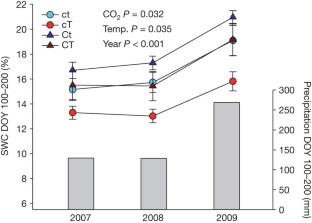
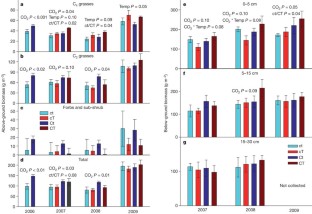
Global warming is predicted to induce desiccation in many world regions through increases in evaporative demand1,2,3. Rising CO2 may counter that trend by improving plant water-use efficiency4,5. However, it is not clear how important this CO2-enhanced water use efficiency might be in offsetting warming-induced desiccation because higher CO2 also leads to higher plant biomass, and therefore greater transpirational surface2,6,7. Furthermore, although warming is predicted to favour warm-season, C4 grasses, rising CO2 should favour C3, or cool-season plants8. Here we show in a semi-arid grassland that elevated CO2 can completely reverse the desiccating effects of moderate warming. Although enrichment of air to 600 p.p.m.v. CO2 increased soil water content (SWC), 1.5/3.0 °C day/night warming resulted in desiccation, such that combined CO2 enrichment and warming had no effect on SWC relative to control plots. As predicted, elevated CO2 favoured C3 grasses and enhanced stand productivity, whereas warming favoured C4 grasses. Combined warming and CO2 enrichment stimulated above-ground growth of C4 grasses in 2 of 3 years when soil moisture most limited plant productivity. The results indicate that in a warmer, CO2-enriched world, both SWC and productivity in semi-arid grasslands may be higher than previously expected.
This is a preview of subscription content, access via your institution
Access options
Subscribe to this journal
Receive 52 print issues and online access
$199.00 per year
only $3.83 per issue
Buy this article
- Purchase on SpringerLink
- Instant access to the full article PDF.
USD 39.95
Prices may be subject to local taxes which are calculated during checkout
Additional access options:
Figure 1: Responses of SWC to CO 2 and warming.
The alternative text for this image may have been generated using AI.
Figure 2: Plant biomass responses to CO 2 and warming.
The alternative text for this image may have been generated using AI.
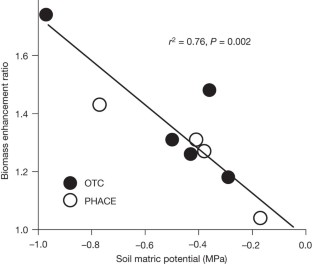
Figure 3: Response of biomass enhancement ratio to soil matric potential.
The alternative text for this image may have been generated using AI.
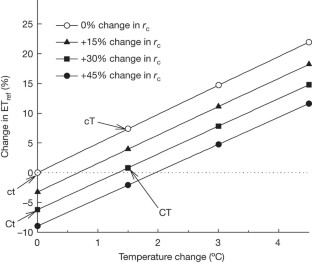
Figure 4: Percentage changes in ET ref for a grass surface as affected by temperature and changes in r c.
The alternative text for this image may have been generated using AI.
References
- Wang, G. Agricultural drought in a future climate: results from 15 global change models participating in the IPCC 4th assessment. Clim. Dyn. 25, 739–753 (2005)
Article Google Scholar - Seager, R. & Vecchi, G. A. Greenhouse warming and the 21st century hydroclimate of southwestern North America. Proc. Natl Acad. Sci. USA 107, 21277–21282 (2010)
Article ADS CAS Google Scholar - Woodhouse, C. A., Meko, D. M., MacDonald, G. M., Stahle, D. W. & Cook, E. R. A 1,200-year perspective of 21st century drought in southwestern North America. Proc. Natl Acad. Sci. USA 107, 21283–21288 (2010)
Article ADS CAS Google Scholar - Morgan, J. A. et al. Water relations in grassland and desert ecosystems exposed to elevated atmospheric CO2 . Oecologia 140, 11–25 (2004)
Article ADS CAS Google Scholar - Leakey, A. D. B. Rising atmospheric carbon dioxide concentration and the future of C4 crops for food and fuel. Proc. R. Soc. Lond. B 276, 2333–2343 (2009)
Article CAS Google Scholar - Frelich, L. E. & Reich, P. B. Will environmental changes reinforce the impact of global warming on the prairie–forest border of central North America? Front. Ecol. Environ 8, 371–378 (2010)
Article Google Scholar - Piao, S. et al. Changes in climate and land use have a larger direct impact than rising CO2 on global river runoff trends. Proc. Natl Acad. Sci. USA 104, 15242–15247 (2007)
Article ADS CAS Google Scholar - Ehleringer, J. R., Cerling, T. E. & Helliker, B. R. C-4 photosynthesis, atmospheric CO2 and climate. Oecologia 112, 285–299 (1997)
Article ADS Google Scholar - Asner, G. P., Elmore, A. J., Olander, L. P., Martin, R. E. & Harris, A. T. Grazing systems, ecosystem responses, and global change. Annu. Rev. Environ. Resour. 29, 261–299 (2004)
Article Google Scholar - Suttie, J. M., Reynolds, S. G. & Batello, C. Grasslands of the World (FAO, 2005)
Google Scholar - Noy-Meir, I. Desert ecosystems: environment and producers. Annu. Rev. Ecol. Syst. 4, 25–51 (1973)
Article Google Scholar - McNaughton, K. G. & Jarvis, P. G. Effects of spatial scale on stomatal control of transpiration. Agric. For. Meteorol. 54, 279–301 (1991)
Article ADS Google Scholar - Epstein, H. E. et al. The relative abundance of three plant functional types in temperate grasslands and shrublands of North and South America: effects of projected climate change. J. Biogeogr. 29, 875–888 (2002)
Article Google Scholar - Polley, H. W. Implications of rising atmospheric carbon dioxide concentration for rangelands. J. Range Mgmt 50, 562–577 (1997)
Article Google Scholar - Semmartin, M., Aguiar, M. R., Distel, R. A., Moretto, A. S. & Ghersa, C. M. Litter quality and nutrient cycling affected by grazing-induced species replacements along a precipitation gradient. Oikos 107, 148–160 (2004)
Article Google Scholar - Tieszen, L. L., Reed, B. C., Bliss, N. B., Wylie, B. K. & DeJong, D. D. NDVI, C3 and C4 production, and distributions in Great Plains grassland land cover classes. Ecol. Appl. 7, 59–78 (1997)
Google Scholar - Miglietta, F. et al. Free-air CO2 enrichment (FACE) of a poplar plantation: the POPFACE fumigation system. New Phytol. 150, 465–476 (2001)
Article Google Scholar - Kimball, B. A. et al. Infrared heater arrays for warming ecosystem field plots. Glob. Change Biol. 14, 309–320 (2008)
Article ADS Google Scholar - Derner, J. D. & Hart, R. H. Grazing-induced modifications to peak standing crop in northern mixed-grass prairie. Rangeland Ecol. Mgmt 60, 270–276 (2007)
Article Google Scholar - Hovenden M. J. et al. Influence of warming on soil water potential controls seedling mortality in perennial but not annual species in a temperate grassland. New Phytol. 180, 143–152 (2008)
Article Google Scholar - Morgan, J. A., Milchunas, D. G., LeCain, D. R., West, M. & Mosier, A. R. Carbon dioxide enrichment alters plant community structure and accelerates shrub growth in the shortgrass steppe. Proc. Natl Acad. Sci. USA 104, 14724–14729 (2007)
Article ADS CAS Google Scholar - Milchunas, D. G., Morgan, J. A., Mosier, A. R. & LeCain, D. R. Root dynamics and demography in shortgrass steppe under elevated CO2, and comments on minirhizotron methodology. Glob. Change Biol. 11, 1837–1855 (2005)
Article ADS Google Scholar - Luo, Y., Sherry, R., Zhou, X. & Wan, S. Terrestrial carbon-cycle feedback to climate warming: experimental evidence on plant regulation and impacts of biofuel feedstock harvest. Glob. Change Biol. Bioenergy 1, 62–74 (2009)
Article CAS Google Scholar - Dijkstra, F. A. et al. Contrasting effects of elevated CO2 and warming on nitrogen cycling in a semiarid grassland. New Phytol. 187, 426–437 (2010)
Article CAS Google Scholar - LeCain, D. R., Morgan, J. A., Mosier, A. R. & Nelson, J. A. Soil and plant water relations determine photosynthetic responses of C3 and C4 grasses in a semi-arid ecosystem under elevated CO2 . Ann. Bot. (Lond.) 92, 41–52 (2003)
Article CAS Google Scholar - Wand, S. J. E., Midgley, G. F., Jones, M. H. & Curtis, P. S. Responses of wild C4 and C3 grass (Poaceae) species to elevated atmospheric CO2 concentrations: a meta-analytic test of current therories and perceptions. Glob. Change Biol. 5, 723–741 (1999)
Article ADS Google Scholar - Meehl, G. A. et al. in Climate Change 2007: The Physical Science Basis. Contribution of Working Group I to the Fourth Assessment Report of the IPCC (eds Solomon, S. et al.) 747–845 (Cambridge Univ. Press, 2007)
Google Scholar - Kimball, B. A. in Irrigation of Agricultural Crops (Agronomy Monograph No. 30) 2nd edn (eds Lascano, R. J. & Sojka, R.E. ) 627–653 (American Society of Agronomy, Crop Science Society of America and Soil Science Society of America, 2007)
Google Scholar
Acknowledgements
We thank D. Smith for installation and operation of the PHACE experiment, E. Hardy for assistance in installation, A. Eden and C. Brooks for data collection and analysis, F. Miglietta for advice and help on installation of the FACE system, and R. Seager, A. Leakey, B. Cook and G. Wang for comments on the manuscript. The work was supported by the US Department of Agriculture-Agricultural Research Service Climate Change, Soils & Emissions Program, the US Department of Agriculture-Cooperative State Research, Education, and Extension Service Soil Processes Program (grant no. 2008-35107-18655), the US Department of Energy’s Office of Science (Biological and Environmental Research) through the Western Regional Center of the National Institute for Climatic Change Research at Northern Arizona University, and the National Science Foundation (DEB no. 1021559). Mention of commercial products is solely for the purpose of providing specific information and does not imply recommendation or endorsement by the USDA.
Author information
Authors and Affiliations
- USDA-ARS, Rangeland Resources Research Unit and Northern Plains Area, Fort Collins, 80526, Colorado, USA
Jack A. Morgan, Daniel R. LeCain, Dana M. Blumenthal, Feike A. Dijkstra & Mark West - Department of Botany and Program in Ecology, University of Wyoming, Laramie, 82071, Wyoming, USA
Elise Pendall & Yolima Carrillo - US Arid-Land Agricultural Research Center, USDA, Agricultural Research Service, Maricopa, Arizona 85238, USA ,
Bruce A. Kimball - Departments of Botany, Renewable Resources, and Program in Ecology, University of Wyoming, Laramie, 82071, Wyoming, USA
David G. Williams & Jana Heisler-White - Faculty of Agriculture, Food and Natural Resources, The University of Sydney, Sydney, 2006, New South Wales, Australia
Feike A. Dijkstra
Authors
- Jack A. Morgan
- Daniel R. LeCain
- Elise Pendall
- Dana M. Blumenthal
- Bruce A. Kimball
- Yolima Carrillo
- David G. Williams
- Jana Heisler-White
- Feike A. Dijkstra
- Mark West
Contributions
J.A.M., E.P., D.M.B., B.A.K., D.G.W. and M.W. conceived the study. J.A.M., D.R.L., E.P., D.M.B., Y.C., D.G.W., J.H.-W. and F.A.D. performed the experiment. B.A.K. designed the warming system and conducted the evapotranspiration analysis. J.A.M. wrote the paper and the remaining authors contributed to the writing. Statistical analyses using SAS/STAT software, version 9.2, Proc GLIMMIX were performed by M.W. and J.A.M. The regression analyses using JMP software were performed by D.M.B. and J.A.M. Figures were developed by D.R.L.
Corresponding author
Correspondence toJack A. Morgan.
Ethics declarations
Competing interests
The authors declare no competing financial interests.
Supplementary information
Supplementary Information (download PDF )
This file comprises 3 appendices: I Experimental Methods and System Performance; II Soil Water Content and III Global Change Treatments and Plant Responses. The file also contains Supplementary Figures 1-5 with legends, Supplementary Tables 1-2 and additional references. (PDF 613 kb)
PowerPoint slides
Rights and permissions
About this article
Cite this article
Morgan, J., LeCain, D., Pendall, E. et al. C4 grasses prosper as carbon dioxide eliminates desiccation in warmed semi-arid grassland.Nature 476, 202–205 (2011). https://doi.org/10.1038/nature10274
- Received: 17 December 2010
- Accepted: 07 June 2011
- Published: 03 August 2011
- Issue date: 11 August 2011
- DOI: https://doi.org/10.1038/nature10274
This article is cited by
Editorial Summary
Grassland responses to carbon dioxide
Elevated carbon dioxide and elevated temperature, the cause and consequence of climate change, are predicted to have opposing effects on plant productivity, with temperature increasing desiccation but CO2 increasing the efficiency of water use. The relative strengths of the two effects are, however, hard to predict. This experimental warming and elevated CO2 study shows that in semi-arid grassland, the CO2 effect can completely counter the warming effect. These findings have particular relevance to semi-arid and seasonally dry regions, which are expected to become even drier under climate change, and suggest that it is precisely these regions where elevated CO2 will do most to ameliorate the desiccating effects of climate change.