Strong contributors to network persistence are the most vulnerable to extinction (original) (raw)
- Letter
- Published: 14 September 2011
Nature volume 478, pages 233–235 (2011)Cite this article
- 7713 Accesses
- 331 Citations
- 60 Altmetric
- Metrics details
Subjects
Abstract
The architecture of mutualistic networks facilitates coexistence of individual participants by minimizing competition relative to facilitation1,2. However, it is not known whether this benefit is received by each participant node in proportion to its overall contribution to network persistence. This issue is critical to understanding the trade-offs faced by individual nodes in a network3,4,5. We address this question by applying a suite of structural and dynamic methods to an ensemble of flowering plant/insect pollinator networks. Here we report two main results. First, nodes contribute heterogeneously to the overall nested architecture of the network. From simulations, we confirm that the removal of a strong contributor tends to decrease overall network persistence more than the removal of a weak contributor. Second, strong contributors to collective persistence do not gain individual survival benefits but are in fact the nodes most vulnerable to extinction. We explore the generality of these results to other cooperative networks by analysing a 15-year time series of the interactions between designer and contractor firms in the New York City garment industry. As with the ecological networks, a firm's survival probability decreases as its individual nestedness contribution increases. Our results, therefore, introduce a new paradox into the study of the persistence of cooperative networks, and potentially address questions about the impact of invasive species in ecological systems and new competitors in economic systems.
This is a preview of subscription content, access via your institution
Access options
Subscribe to this journal
Receive 51 print issues and online access
$199.00 per year
only $3.90 per issue
Buy this article
- Purchase on SpringerLink
- Instant access to the full article PDF.
USD 39.95
Prices may be subject to local taxes which are calculated during checkout
Additional access options:
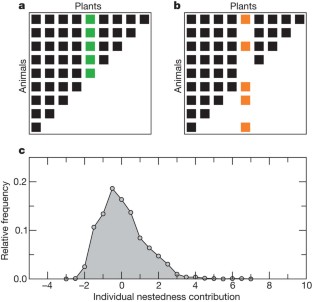
Figure 1: Nodes contribute to the nested architecture of the network in distinct proportions.
The alternative text for this image may have been generated using AI.
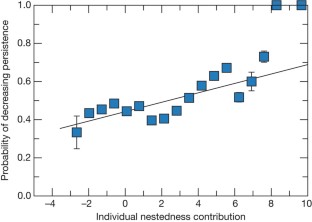
Figure 2: The extinction of stronger contributors leads to a decrease in network persistence.
The alternative text for this image may have been generated using AI.
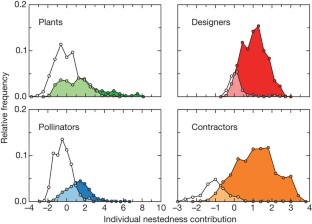
Figure 3: Strong contributors to nestedness are the most vulnerable to extinction.
The alternative text for this image may have been generated using AI.
References
- Bastolla, U. et al. The architecture of mutualistic networks minimizes competition and increases biodiversity. Nature 458, 1018–1020 (2009)
Article ADS CAS Google Scholar - Sugihara, G. & Ye, H. Cooperative network dynamics. Nature 458, 979–980 (2009)
Article ADS CAS Google Scholar - Rankin, D. J., Bargum, K. & Kokko, H. The tragedy of the commons in evolutionary biology. Trends Ecol. Evol. 22, 643–651 (2007)
Article Google Scholar - Leigh, E. G. How does selection reconcile individual advantage with the good of the group? Proc. Natl Acad. Sci. USA 74, 4542–4546 (1977)
Article ADS CAS Google Scholar - Falster, D. S. & Westoby, M. Plant height and evolutionary games. Trends Ecol. Evol. 18, 337–343 (2003)
Article Google Scholar - Axelrod, R. & Hamilton, W. D. The evolution of cooperation. Science 211, 1390–1396 (1981)
Article ADS MathSciNet CAS Google Scholar - Gintis, H., Bowles, S., Boyd, R. T., Fehr, E., eds. Moral Sentiments and Material Interests: The Foundations of Cooperation in Economic Life (MIT Press, 2005)
Book Google Scholar - Bascompte, J. Disentangling the web of life. Science 325, 416–419 (2009)
Article ADS MathSciNet CAS Google Scholar - May, R. M., Levin, S. A. & Sugihara, G. Complex systems: ecology for bankers. Nature 451, 893–895 (2009)
Article ADS Google Scholar - Haldane, A. G. & May, R. M. Systemic risk in banking ecosystems. Nature 469, 351–355 (2011)
Article ADS CAS Google Scholar - Saavedra, S., Reed-Tsochas, F. & Uzzi, B. A simple model of bipartite cooperation for ecological and organisational networks. Nature 457, 463–466 (2009)
Article ADS CAS Google Scholar - Saavedra, S., Powers, S., McCotter, T., Porter, M. A. & Mucha, P. J. Mutually-antagonistic interactions in baseball networks. Physica A 389, 1131–1141 (2010)
Article ADS Google Scholar - Fowler, J. H. & Christakis, N. Cooperative behavior cascades in human social networks. Proc. Natl Acad. Sci. USA 107, 5334–5338 (2010)
Article ADS CAS Google Scholar - Weyl, E. G., Frederickson, M. E., Yu, D. W. & Pierce, N. E. Economic contract theory tests models of mutualism. Proc. Natl Acad. Sci. USA 107, 15712–15716 (2010)
Article ADS CAS Google Scholar - Bascompte, J. & Jordano, P. The structure of plant-animal mutualistic networks: the architecture of biodiversity. Annu. Rev. Ecol. Evol. Syst. 38, 567–593 (2007)
Article Google Scholar - Bascompte, J., Jordano, P., Melián, C. J. & Olesen, J. M. The nested assembly of plant-animal mutualistic networks. Proc. Natl Acad. Sci. USA 100, 9383–9387 (2003)
Article ADS CAS Google Scholar - Rezende, E. L., Lavabre, J. E., Guimarães, P. R., Jordano, P. & Bascompte, J. Non-random coextinctions in phylogenetically structured mutualistic networks. Nature 448, 925–928 (2007)
Article ADS CAS Google Scholar - Saavedra, S., Reed-Tsochas, F. & Uzzi, B. Asymmetric disassembly and robustness in declining networks. Proc. Natl Acad. Sci. USA 10, 16466–16471 (2009)
Google Scholar - De Toni, A. & Nassimbeni, G. Supply networks: genesis, stability and logistics implications. A comparative analysis of two districts. Omega 23, 403–418 (1995)
Article Google Scholar - Uzzi, B. The sources and consequences of embeddedness for the economic performance of organizations: the network effect. Am. Sociol. Rev. 61, 674–698 (1996)
Article Google Scholar - Doeringer, J. & Crean, S. Can fast fashion save the US apparel industry? Socioecon. Rev. 4, 353–377 (1996)
Article Google Scholar - Almeida-Neto, M., Guimarães, P., Guimarães, P. R., Jr, Loyola, R. D. & Urlich, W. A consistent metric for nestedness analysis in ecological systems: reconciling concept and measurement. Oikos 117, 1227–1239 (2008)
Article Google Scholar
Acknowledgements
Funding was provided by the Kellogg School of Management, Northwestern University, the Northwestern University Institute on Complex Systems (NICO; to S.S. and B.U.), NUCATS grant UL1RR025741 (to S.S.), a CSIC-JAE postdoctoral fellowship (to D.B.S.), the Army Research Laboratory (under cooperative agreement W911NF-09-2-0053 to B.U.), and the European Research Council under the European Community's Seventh Framework Programme (FP7/2007-2013) through an Advanced Grant (grant agreement 268543 to J.B.). Figures were generated with PyGrace (http://pygrace.sourceforge.net).
Author information
Author notes
- Serguei Saavedra and Daniel B. Stouffer: These authors contributed equally to this work.
Authors and Affiliations
- Northwestern Institute on Complex Systems, Northwestern University, Evanston, 60208, Illinois, USA
Serguei Saavedra & Brian Uzzi - Kellogg School of Management, Northwestern University, Evanston, 60208, Illinois, USA
Serguei Saavedra & Brian Uzzi - Northwestern University Clinical and Translational Sciences Institute, Northwestern University, Chicago, 60611, Illinois, USA
Serguei Saavedra - Integrative Ecology Group, Estación Biológica de Doñana, CSIC, Calle Américo Vespucio s/n, E-41092 Sevilla, Spain ,
Daniel B. Stouffer & Jordi Bascompte - School of Biological Sciences, University of Canterbury, Christchurch 8140, New Zealand ,
Daniel B. Stouffer
Authors
- Serguei Saavedra
- Daniel B. Stouffer
- Brian Uzzi
- Jordi Bascompte
Contributions
S.S. and D.B.S. analysed the data and performed the simulations. S.S., D.B.S., B.U. and J.B. designed the study and wrote the manuscript.
Corresponding author
Correspondence toJordi Bascompte.
Ethics declarations
Competing interests
The authors declare no competing financial interests.
Supplementary information
PowerPoint slides
Rights and permissions
About this article
Cite this article
Saavedra, S., Stouffer, D., Uzzi, B. et al. Strong contributors to network persistence are the most vulnerable to extinction.Nature 478, 233–235 (2011). https://doi.org/10.1038/nature10433
- Received: 06 April 2011
- Accepted: 05 August 2011
- Published: 14 September 2011
- Issue date: 13 October 2011
- DOI: https://doi.org/10.1038/nature10433
This article is cited by
Editorial Summary
Network stalwarts not rewarded
Nodes in cooperative networks, such as those between plants and their pollinators or service providers and their contractors, form complex networks of interdependences. In these mutualistic networks, nodes that contribute to the nestedness of the network improve its stability. However, this study, using ecological data from 20 plant–pollinator networks and from socioeconomic networks, shows that these same nodes do not reap the benefits. In fact, the nodes that contribute the most to network persistence are also the most vulnerable to extinction.