Afternoon rain more likely over drier soils (original) (raw)
- Letter
- Published: 12 September 2012
- Richard A. M. de Jeu2,
- Françoise Guichard3,
- Phil P. Harris1 &
- …
- Wouter A. Dorigo4
Nature volume 489, pages 423–426 (2012) Cite this article
- 9842 Accesses
- 569 Citations
- 44 Altmetric
- Metrics details
Subjects
Abstract
Land surface properties, such as vegetation cover and soil moisture, influence the partitioning of radiative energy between latent and sensible heat fluxes in daytime hours. During dry periods, soil-water deficit can limit evapotranspiration, leading to warmer and drier conditions in the lower atmosphere1,2. Soil moisture can influence the development of convective storms through such modifications of low-level atmospheric temperature and humidity1,3, which in turn feeds back on soil moisture. Yet there is considerable uncertainty in how soil moisture affects convective storms across the world, owing to a lack of observational evidence and uncertainty in large-scale models4. Here we present a global-scale observational analysis of the coupling between soil moisture and precipitation. We show that across all six continents studied, afternoon rain falls preferentially over soils that are relatively dry compared to the surrounding area. The signal emerges most clearly in the observations over semi-arid regions, where surface fluxes are sensitive to soil moisture, and convective events are frequent. Mechanistically, our results are consistent with enhanced afternoon moist convection driven by increased sensible heat flux over drier soils, and/or mesoscale variability in soil moisture. We find no evidence in our analysis of a positive feedback—that is, a preference for rain over wetter soils—at the spatial scale (50–100 kilometres) studied. In contrast, we find that a positive feedback of soil moisture on simulated precipitation does dominate in six state-of-the-art global weather and climate models—a difference that may contribute to excessive simulated droughts in large-scale models.
This is a preview of subscription content, access via your institution
Access options
Subscribe to this journal
Receive 52 print issues and online access
$199.00 per year
only $3.83 per issue
Buy this article
- Purchase on SpringerLink
- Instant access to the full article PDF.
USD 39.95
Prices may be subject to local taxes which are calculated during checkout
Additional access options:
Figure 1: Preference for afternoon precipitation over soil moisture anomalies.
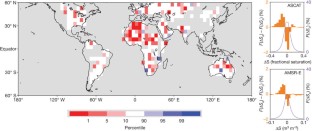
The alternative text for this image may have been generated using AI.
Figure 2: Sensitivities of pre-rain-event soil moisture to mean soil moisture and time of day.
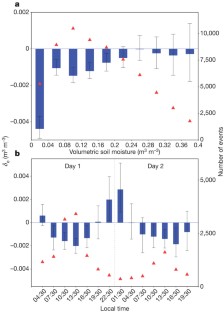
The alternative text for this image may have been generated using AI.
Figure 3: Simulated preference for afternoon precipitation over soil moisture anomalies.
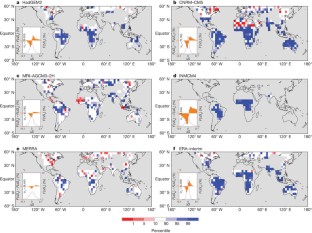
The alternative text for this image may have been generated using AI.
References
- Betts, A. K. & Ball, J. H. FIFE surface climate and site-average dataset 1987–89. J. Atmos. Sci. 55, 1091–1108 (1998)
Article ADS Google Scholar - Fischer, E. M. et al. Soil moisture-atmosphere interactions during the 2003 European summer heat wave. J. Clim. 20, 5081–5099 (2007)
Article ADS Google Scholar - Eltahir, E. A. B. A soil moisture-rainfall feedback mechanism. 1. Theory and observations. Wat. Resour. Res. 34, 765–776 (1998)
Article ADS Google Scholar - Koster, R. D. et al. Regions of strong coupling between soil moisture and precipitation. Science 305, 1138–1140 (2004)
Article CAS ADS Google Scholar - Goessling, H. F. & Reick, C. H. What do moisture recycling estimates tell us? Exploring the extreme case of non-evaporating continents. Hydrol. Earth Syst. Sci. 15, 3217–3235 (2011)
Article ADS Google Scholar - van der Ent, R. J., Savenije, H. H. G., Schaefli, B. & Steele-Dunne, S. C. Origin and fate of atmospheric moisture over continents. Wat. Resour. Res. 46, W09525 (2010)
Article ADS Google Scholar - Webster, P. J. Mechanisms of monsoon low-frequency variability - surface hydrological effects. J. Atmos. Sci. 40, 2110–2124 (1983)
Article ADS Google Scholar - Findell, K. L. & Eltahir, E. A. B. Atmospheric controls on soil moisture-boundary layer interactions. Part I: framework development. J. Hydrometeorol. 4, 552–569 (2003)
Article ADS Google Scholar - Ek, M. B. & Holtslag, A. A. M. Influence of soil moisture on boundary layer cloud development. J. Hydrometeorol. 5, 86–99 (2004)
Article ADS Google Scholar - Findell, K. L. & Eltahir, E. A. B. Atmospheric controls on soil moisture-boundary layer interactions. Part II: feedbacks within the continental United States. J. Hydrometeorol. 4, 570–583 (2003)
Article ADS Google Scholar - Ferguson, C. R. & Wood, E. F. Observed land–atmosphere coupling from satellite remote sensing and reanalysis. J. Hydrometeorol. 12, 1221–1254 (2011)
Article ADS Google Scholar - Ookouchi, Y., Segal, M., Kessler, R. C. & Pielke, R. A. Evaluation of soil moisture effects on the generation and modification of mesoscale circulations. Mon. Weath. Rev. 112, 2281–2292 (1984)
Article ADS Google Scholar - Cheng, W. Y. Y. & Cotton, W. R. Sensitivity of a cloud-resolving simulation of the genesis of a mesoscale convective system to horizontal heterogeneities in soil moisture initialization. J. Hydrometeorol. 5, 934–958 (2004)
Article ADS Google Scholar - Anthes, R. A. Enhancement of convective precipitation by mesoscale variations in vegetative covering in semi-arid regions. J. Clim. Appl. Meteorol. 23, 541–554 (1984)
Article ADS Google Scholar - Findell, K. L. & Eltahir, E. A. B. An analysis of the soil moisture-rainfall feedback, based on direct observations from Illinois. Wat. Resour. Res. 33, 725–735 (1997)
Article ADS Google Scholar - Taylor, C. M. & Lebel, T. Observational evidence of persistent convective-scale rainfall patterns. Mon. Weath. Rev. 126, 1597–1607 (1998)
Article ADS Google Scholar - Findell, K. L., Gentine, P., Lintner, B. R. & Kerr, C. Probability of afternoon precipitation in eastern United States and Mexico enhanced by high evaporation. Nature Geosci. 4, 434–439 (2011)
Article CAS ADS Google Scholar - Taylor, C. M. et al. Frequency of Sahelian storm initiation enhanced over mesoscale soil-moisture patterns. Nature Geosci. 4, 430–433 (2011)
Article CAS ADS Google Scholar - Wang, J. F. et al. Impact of deforestation in the Amazon basin on cloud climatology. Proc. Natl Acad. Sci. USA 106, 3670–3674 (2009)
Article CAS ADS Google Scholar - Carleton, A. M. et al. Synoptic circulation and land surface influences on convection in the Midwest US “corn belt” during the summers of 1999 and 2000. Part II: role of vegetation boundaries. J. Clim. 21, 3617–3641 (2008)
Article ADS Google Scholar - Santanello, J. A., Peters-Lidard, C. D. & Kumar, S. V. Diagnosing the sensitivity of local land–atmosphere coupling via the soil moisture–boundary layer interaction. J. Hydrometeorol. 12, 766–786 (2011)
Article ADS Google Scholar - Guo, Z. C. et al. GLACE: The Global Land-Atmosphere Coupling Experiment. Part II: analysis. J. Hydrometeorol. 7, 611–625 (2006)
Article ADS Google Scholar - Hohenegger, C., Brockhaus, P., Bretherton, C. S. & Schar, C. The soil moisture-precipitation feedback in simulations with explicit and parameterized convection. J. Clim. 22, 5003–5020 (2009)
Article ADS Google Scholar - Owe, M., de Jeu, R. & Holmes, T. Multisensor historical climatology of satellite-derived global land surface moisture. J. Geophys. Res. 113, F01002 (2008)
Article ADS Google Scholar - Bartalis, Z. et al. Initial soil moisture retrievals from the METOP-A Advanced Scatterometer (ASCAT). Geophys. Res. Lett. 34, L20401 (2007)
Article ADS Google Scholar - Joyce, R. J., Janowiak, J. E., Arkin, P. A. & Xie, P. CMORPH: a method that produces global precipitation estimates from passive microwave and infrared data at high spatial and temporal resolution. J. Hydrometeorol. 5, 487–503 (2004)
Article ADS Google Scholar - Dai, A. Precipitation characteristics in eighteen coupled climate models. J. Clim. 19, 4605–4630 (2006)
Article ADS Google Scholar - Guichard, F. et al. Modelling the diurnal cycle of deep precipitating convection over land with cloud-resolving models and single-column models. Q. J. R. Meteorol. Soc. 130, 3139–3172 (2004)
Article ADS Google Scholar - Zhang, Y. & Klein, S. A. Mechanisms affecting the transition from shallow to deep convection over land: inferences from observations of the diurnal cycle collected at the ARM southern Great Plains site. J. Atmos. Sci. 67, 2943–2959 (2010)
Article ADS Google Scholar - McCrary, R. R. & Randall, D. A. Great Plains drought in simulations of the twentieth century. J. Clim. 23, 2178–2196 (2010)
Article ADS Google Scholar
Acknowledgements
This research was partly funded by the European Union (FP6) WATCH Integrated Project (contract 036946), the UK National Centre for Earth Observation and the European Space Agency STSE Water Cycle Multi-mission Observation Strategy (WACMOS) project (ESRIN/contract number 22086/08/I-EC. We thank A. Beljaars, S. Seneviratne and D. Parker for discussions on this topic. We also thank the CMORPH, TRMM, PERSIANN and GPROF teams for the provision of their precipitation data, the World Climate Research Programme’s Working Group on Coupled Modelling, and the centres who provided modelling data in Figure 3.
Author information
Authors and Affiliations
- NERC Centre for Ecology and Hydrology, Maclean Building, Benson Lane, Crowmarsh Gifford, Wallingford OX10 8BB, UK,
Christopher M. Taylor & Phil P. Harris - Earth and Climate Cluster, Department of Earth Sciences, Vrije Universiteit Amsterdam, Faculty of Earth and Life Sciences, De Boelelaan 1085, 1081 HV Amsterdam, The Netherlands,
Richard A. M. de Jeu - CNRM-GAME (CNRS and Météo-France), 42 avenue Coriolis, 31057 Toulouse Cedex, France,
Françoise Guichard - Institute of Photogrammetry and Remote Sensing (I.P.F.), Vienna University of Technology, Gusshausstraße 27-29, 1040 Vienna, Austria,
Wouter A. Dorigo
Authors
- Christopher M. Taylor
- Richard A. M. de Jeu
- Françoise Guichard
- Phil P. Harris
- Wouter A. Dorigo
Contributions
C.M.T. and R.A.M.d.J. conceived the study, C.M.T. performed the analysis and wrote the paper, R.A.M.d.J. and W.A.D. provided expertise on soil moisture data sets, F.G. interpreted the convective responses in models and observations, and P.P.H. devised statistical tests. All authors discussed the results and edited the manuscript.
Corresponding author
Correspondence toChristopher M. Taylor.
Ethics declarations
Competing interests
The authors declare no competing financial interests.
Supplementary information
Supplementary Information (download PDF )
This file contains Supplementary Text, Supplementary Tables 1-4, Supplementary Figures 1-12 and additional references. (PDF 1509 kb)
Supplementary Data (download ZIP )
This zipped file contains a zipped file containing monthly mask files for ASCAT and AMSR-E soil moisture datasets and a text file which contains information on the content and format of the mask files. (ZIP 1763 kb)
PowerPoint slides
Rights and permissions
About this article
Cite this article
Taylor, C., de Jeu, R., Guichard, F. et al. Afternoon rain more likely over drier soils.Nature 489, 423–426 (2012). https://doi.org/10.1038/nature11377
- Received: 19 March 2012
- Accepted: 29 June 2012
- Published: 12 September 2012
- Issue date: 20 September 2012
- DOI: https://doi.org/10.1038/nature11377
This article is cited by
Editorial Summary
Rain in the afternoon
Soil moisture is known to influence precipitation across a range of scales in time and space, and most models suggest that wetter soils promote higher atmospheric moisture content and favour the local development of storms. But this analysis of global precipitation data from a combination of weather satellites shows that — especially in semi-arid regions — afternoon precipitation is more likely over dry soil than over wet soil. The findings suggest that current climate models may be missing fundamental processes regulating convection and land–atmosphere interactions.