Rapid coupling between ice volume and polar temperature over the past 150,000 years (original) (raw)
- Letter
- Published: 14 November 2012
- E. J. Rohling1,2,
- M. Bar-Matthews3,
- A. Ayalon3,
- M. Medina-Elizalde1 nAff6,
- C. Bronk Ramsey4,
- C. Satow5 &
- …
- A. P. Roberts2
Nature volume 491, pages 744–747 (2012) Cite this article
- 11k Accesses
- 583 Citations
- 108 Altmetric
- Metrics details
Subjects
Abstract
Current global warming necessitates a detailed understanding of the relationships between climate and global ice volume. Highly resolved and continuous sea-level records are essential for quantifying ice-volume changes. However, an unbiased study of the timing of past ice-volume changes, relative to polar climate change, has so far been impossible because available sea-level records either were dated by using orbital tuning or ice-core timescales, or were discontinuous in time. Here we present an independent dating of a continuous, high-resolution sea-level record1,2 in millennial-scale detail throughout the past 150,000 years. We find that the timing of ice-volume fluctuations agrees well with that of variations in Antarctic climate and especially Greenland climate. Amplitudes of ice-volume fluctuations more closely match Antarctic (rather than Greenland) climate changes. Polar climate and ice-volume changes, and their rates of change, are found to covary within centennial response times. Finally, rates of sea-level rise reached at least 1.2 m per century during all major episodes of ice-volume reduction.
This is a preview of subscription content, access via your institution
Access options
Subscribe to this journal
Receive 52 print issues and online access
$199.00 per year
only $3.83 per issue
Buy this article
- Purchase on SpringerLink
- Instant access to the full article PDF.
USD 39.95
Prices may be subject to local taxes which are calculated during checkout
Additional access options:
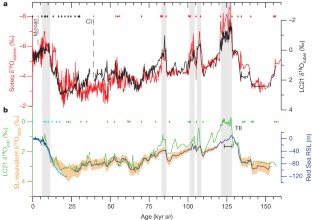
Figure 1: Correlation of Soreq Cave and eastern Mediterranean (LC21) δ 18 O signals and the Red Sea RSL record.
The alternative text for this image may have been generated using AI.
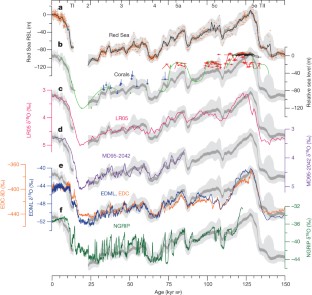
Figure 2: Comparison of probabilistic assessment of RSL with other sea-level reconstructions and with Antarctic and Greenland climate variability.
The alternative text for this image may have been generated using AI.
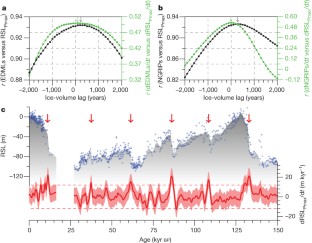
Figure 3: Lagged correlations of Antarctic and Greenland climate versus ice volume (sea-level), and rates of sea-level change over the last full glacial cycle.
The alternative text for this image may have been generated using AI.
References
- Siddall, M. et al. Sea-level fluctuations during the last glacial cycle. Nature 423, 853–858 (2003)
Article CAS ADS Google Scholar - Rohling, E. J. et al. Antarctic temperature and global sea level closely coupled over the past five glacial cycles. Nature Geosci. 2, 500–504 (2009)
Article CAS ADS Google Scholar - Hansen, J. et al. Climate change and trace gases. Phil. Trans. R. Soc. A 365, 1925–1954 (2007)
Article CAS ADS Google Scholar - Köhler, P. et al. What caused Earth’s temperature variations during the last 800,000 years? Data-based evidence on radiative forcing and constraints on climate sensitivity. Quat. Sci. Rev. 29, 129–145 (2010)
Article ADS Google Scholar - Shackleton, N. J., Hall, M. A. & Vincent, E. Phase relationships between millennial-scale events 64,000–24,000 years ago. Paleoceanography 15, 565–569 (2000)
Article ADS Google Scholar - Waelbroeck, C. et al. Sea-level and deep water temperature changes derived from benthic foraminifera isotopic records. Quat. Sci. Rev. 21, 295–305 (2002)
Article ADS Google Scholar - Bintanja, R., van de Wal, R. S. W. & Oerlemans, J. Modelled atmospheric temperatures and global sea levels over the past million years. Nature 437, 125–128 (2005)
Article CAS ADS Google Scholar - Cuffey, K. M. & Marshall, S. J. Substantial contribution to sea-level rise during the last interglacial from the Greenland ice sheet. Nature 404, 591–594 (2000)
Article CAS ADS Google Scholar - Otto-Bliesner, B. L. et al. Simulating Arctic climate warmth and icefield retreat in the Last Interglacial. Science 311, 1751–1753 (2006)
Article CAS ADS Google Scholar - Bar-Matthews, M., Ayalon, A., Gilmour, M., Matthews, A. & Hawkesworth, C. J. Sea–land oxygen isotopic relationships from planktonic foraminifera and speleothems in the Eastern Mediterranean region and their implication for paleorainfall during interglacial intervals. Geochim. Cosmochim. Acta 67, 3181–3199 (2003)
Article CAS ADS Google Scholar - Almogi-Labin, A. et al. Climatic variability during the last ∼90 ka of the southern and northern Levantine Basin as evident from marine records and speleothems. Quat. Sci. Rev. 28, 2882–2896 (2009)
Article ADS Google Scholar - Rohling, E. J. Environmental controls on salinity and δ18O in the Mediterranean. Paleoceanography 14, 706–715 (1999)
Article ADS Google Scholar - Manning, S. W. et al. Chronology for the Aegean Late Bronze Age 1700–1400 BC. Science 312, 565–569 (2006)
Article CAS ADS Google Scholar - De Vivo, B. et al. New constraints on the pyroclastic eruptive history of the Campanian volcanic plain (Italy). Mineral. Petrol. 73, 47–65 (2001)
Article CAS ADS Google Scholar - Bronk Ramsey, C. Deposition models for chronological records. Quat. Sci. Rev. 27, 42–60 (2008)
Article ADS Google Scholar - Stanford, J. D. et al. Sea-level probability for the last deglaciation: a statistical analysis of far-field records. Global Planet. Change 79, 193–203 (2011)
Article ADS Google Scholar - Trommer, G. et al. Sensitivity of Red Sea circulation to sea level and insolation forcing during the last interglacial. Clim. Past 7, 941–955 (2011)
Article Google Scholar - Lambeck, K. et al. Sea level and shoreline reconstructions for the Red Sea: isostatic and tectonic considerations and implications for hominin migration out of Africa. Quat. Sci. Rev. 30, 3542–3574 (2011)
Article ADS Google Scholar - Lisiecki, L. E. & Raymo, M. E. A Plio-Pleistocene stack of 57 globally distributed benthic δ18O records. Paleoceanography 20 PA1003 10.1029/2004PA001071 (2005)
Article ADS Google Scholar - Dansgaard, W. et al. Evidence for general instability of past climate from a 250-kyr ice-core record. Nature 364, 218–220 (1993)
Article ADS Google Scholar - Kopp, R. E., Simons, F. J., Mitrovica, J. X., Maloof, A. C. & Oppenheimer, M. Probabilistic assessment of sea level during the last interglacial stage. Nature 462, 863–868 (2009)
Article CAS ADS Google Scholar - Thompson, W. G., Curran, H. A., Wilson, M. A. & White, B. Sea-level oscillations during the last interglacial highstand recorded by Bahamas corals. Nature Geosci. 4, 684–687 (2011)
Article CAS ADS Google Scholar - Gregory, J. M., Huybrechts, P. & Raper, S. C. B. Threatened loss of the Greenland ice-sheet. Nature 428, 616 (2004)
Article CAS ADS Google Scholar - Chappell, J. Sea level changes forced ice breakouts in the Last Glacial cycle: new results from coral terraces. Quat. Sci. Rev. 21, 1229–1240 (2002)
Article ADS Google Scholar - Cutler, K. B. et al. Rapid sea-level fall and deep-ocean temperature change since the last interglacial period. Earth Planet. Sci. Lett. 206, 253–271 (2003)
Article CAS ADS Google Scholar - Thompson, W. G. & Goldstein, S. L. Open-system coral ages reveal persistent suborbital sea-level cycles. Science 308, 401–404 (2005)
Article CAS ADS Google Scholar - Dutton, A. & Lambeck, K. Ice volume and sea level during the last interglacial. Science 337, 216–219 (2012)
Article CAS ADS Google Scholar - EPICA Community Members. One-to-one coupling of glacial climate variability in Greenland and Antarctica. Nature 444, 195–198 (2006)
- Jouzel, J. et al. Orbital and millennial Antarctic climate variability over the past 800,000 years. Science 317, 793–797 (2007)
Article CAS ADS Google Scholar - North Greenland Ice Core Project Members. High-resolution record of Northern Hemisphere climate extending into the last interglacial period. Nature 431, 147–151 (2004)
Article Google Scholar - Svensson, A. et al. A 60 000 year Greenland stratigraphic ice core chronology. Clim. Past 4, 47–57 (2008)
Article Google Scholar - Parrenin, F. et al. The EDC3 chronology for the EPICA Dome C ice core. Clim. Past 3, 485–497 (2007)
Article Google Scholar
Acknowledgements
We thank A. Dutton for comments that improved the manuscript. S. Lee helped with the use of OxCal. This study contributes to UK Natural Environment Research Council (NERC) projects NE/H004424/1, NE/E01531X/1 and NE/I009906/1, to a Royal Society Wolfson Research Merit Award (E.J.R.), and to a 2012 Australian Laureate Fellowship FL120100050 (E.J.R.).
Author information
Author notes
- M. Medina-Elizalde
Present address: Present address: Centro de Investigación Científica de Yucatán, Unidad Ciencias del Agua, Calle 8, No. 39, Mz. 29, S.M. 64 Cancun, Quintana Roo, CP 77500, México.,
Authors and Affiliations
- School of Ocean and Earth Science, University of Southampton, National Oceanography Centre, European Way, Southampton SO14 3ZH, UK,
K. M. Grant, E. J. Rohling & M. Medina-Elizalde - Research School of Earth Sciences, The Australian National University, Canberra, ACT 0200, Australia
E. J. Rohling & A. P. Roberts - Geological Survey of Israel, 30 Malchei Israel Street, Jerusalem 95501, Israel,
M. Bar-Matthews & A. Ayalon - Research Laboratory for Archaeology and the History of Art, Dyson Perrins Building, University of Oxford, South Parks Road, Oxford OX1 3QY, UK,
C. Bronk Ramsey - Department of Geography, Queens Building, Royal Holloway University of London, Egham, Surrey, TW20 0EX, UK
C. Satow
Authors
- K. M. Grant
- E. J. Rohling
- M. Bar-Matthews
- A. Ayalon
- M. Medina-Elizalde
- C. Bronk Ramsey
- C. Satow
- A. P. Roberts
Contributions
K.M.G. led the study. E.J.R. designed the study, contributed to statistical analyses and co-wrote the paper. M.B.-M. and A.A. developed the Soreq Cave speleothem record. M.M.E. contributed to the interpretations. C.B.R. supported the Bayesian age modelling. C.S. contributed the LC21 tephrachronology. A.P.R. contributed to the discussion of results and manuscript refinement.
Corresponding author
Correspondence toK. M. Grant.
Ethics declarations
Competing interests
The authors declare no competing financial interests.
Supplementary information
PowerPoint slides
Rights and permissions
About this article
Cite this article
Grant, K., Rohling, E., Bar-Matthews, M. et al. Rapid coupling between ice volume and polar temperature over the past 150,000 years.Nature 491, 744–747 (2012). https://doi.org/10.1038/nature11593
- Received: 31 May 2012
- Accepted: 13 September 2012
- Published: 14 November 2012
- Issue date: 29 November 2012
- DOI: https://doi.org/10.1038/nature11593
This article is cited by
Editorial Summary
A 150,000-year sea-level record
Global sea level and the extent of the Greenland and Antarctic ice sheets are inextricably linked, but the precise timing of their changes has been unclear because it is difficult to obtain consistently and accurately dated long-term sea-level records. Here, the authors provide a markedly improved chronology of sea-level changes in the Red Sea during the past 150,000 years by cross-referencing to a more easily dateable record in the eastern Mediterranean. They find that sea level is linked to climate variation in both the Greenland and Antarctic ice sheets on a centennial scale, but more so to Antarctica. Sea level seems to lag the Antarctic climate by a few hundred years; it is tied more contemporaneously to Greenland's climate.