Elevated CO2 further lengthens growing season under warming conditions (original) (raw)
- Letter
- Published: 23 April 2014
- Heidi Steltzer2 na1,
- M. J. Trlica3,
- Gregory S. McMaster4,
- Allan A. Andales5,
- Dan R. LeCain6 &
- …
- Jack A. Morgan6
Nature volume 510, pages 259–262 (2014) Cite this article
- 15k Accesses
- 194 Citations
- 125 Altmetric
- Metrics details
Subjects
Abstract
Observations of a longer growing season through earlier plant growth in temperate to polar regions have been thought to be a response to climate warming1,2,3,4,5. However, data from experimental warming studies indicate that many species that initiate leaf growth and flowering earlier also reach seed maturation and senesce earlier, shortening their active and reproductive periods6,7,8,9,10. A conceptual model to explain this apparent contradiction11, and an analysis of the effect of elevated CO2—which can delay annual life cycle events12,13,14—on changing season length, have not been tested. Here we show that experimental warming in a temperate grassland led to a longer growing season through earlier leaf emergence by the first species to leaf, often a grass, and constant or delayed senescence by other species that were the last to senesce, supporting the conceptual model. Elevated CO2 further extended growing, but not reproductive, season length in the warmed grassland by conserving water, which enabled most species to remain active longer. Our results suggest that a longer growing season, especially in years or biomes where water is a limiting factor, is not due to warming alone, but also to higher atmospheric CO2 concentrations that extend the active period of plant annual life cycles.
This is a preview of subscription content, access via your institution
Access options
Subscribe to this journal
Receive 52 print issues and online access
$199.00 per year
only $3.83 per issue
Buy this article
- Purchase on SpringerLink
- Instant access to the full article PDF.
USD 39.95
Prices may be subject to local taxes which are calculated during checkout
Additional access options:
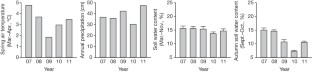
Figure 1: Interannual variation in climate and microclimate (2007–2011).
The alternative text for this image may have been generated using AI.
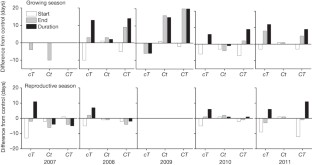
Figure 2: Effect of warming and elevated CO2 on growing and reproductive season length (2007–2011).
The alternative text for this image may have been generated using AI.
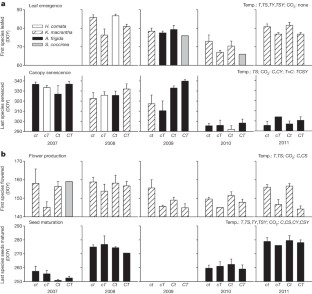
Figure 3: Effect of warming and elevated CO2 on timing of annual life cycle events (2007–2011).
The alternative text for this image may have been generated using AI.
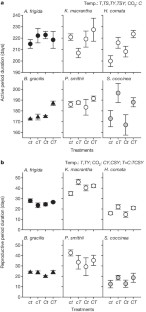
Figure 4: Effect of warming and elevated CO2 on the duration of species’ active and reproductive periods.
The alternative text for this image may have been generated using AI.
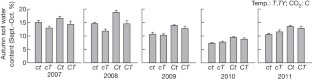
Figure 5: Effect of warming and elevated CO2 on autumn soil water content (5–25 cm, September–October, 2007–2011).
The alternative text for this image may have been generated using AI.
References
- Kim, Y., Kimball, J. S., Zhang, K. & McDonald, K. C. Satellite detection of increasing Northern Hemisphere non-frozen seasons from 1979 to 2008: implications for regional vegetation growth. Remote Sens. Environ. 121, 472–487 (2012)
Article ADS Google Scholar - Menzel, A. et al. European phenological response to climate change matches the warming pattern. Glob. Change Biol. 12, 1969–1976 (2006)
Article ADS Google Scholar - Myneni, R. B., Keeling, C. D., Tucker, C. J., Asrar, G. & Nemani, R. R. Increased plant growth in the northern latitudes from 1981 to 1991. Nature 386, 698–702 (1997)
Article ADS CAS Google Scholar - Parmesan, C. & Yohe, G. A globally coherent fingerprint of climate change impacts across natural systems. Nature 421, 37–42 (2003)
Article ADS CAS Google Scholar - Schwartz, M. D., Ahas, R. & Aasa, A. Onset of spring starting earlier across the Northern Hemisphere. Glob. Change Biol. 12, 343–351 (2006)
Article ADS Google Scholar - Hoffmann, A. A. et al. Phenological changes in six Australian subalpine plants in response to experimental warming and year-to-year variation. J. Ecol. 98, 927–937 (2010)
Article Google Scholar - Hollister, R. D., Webber, P. J. & Bay, C. Plant response to temperature in northern Alaska: implications for predicting vegetation change. Ecology 86, 1562–1570 (2005)
Article Google Scholar - Post, E. S., Pedersen, C., Wilmers, C. C. & Forchammer, M. C. Phenological sequences reveal aggregate life history response to climatic warming. Ecology 89, 363–370 (2008)
Article Google Scholar - Sherry, R. A. et al. Divergence of reproductive phenology under climate warming. Proc. Natl Acad. Sci. USA 104, 198–202 (2007)
Article ADS CAS Google Scholar - Zavaleta, E. S. et al. Plants reverse warming effect on ecosystem water balance. Proc. Natl Acad. Sci. USA 100, 9892–9893 (2003)
Article ADS CAS Google Scholar - Steltzer, H. & Post, E. Seasons and life cycles. Science 324, 886–887 (2009)
Article Google Scholar - Cleland, E. E., Chiariello, N. R., Loarie, S. R., Mooney, H. A. & Field, C. B. Diverse responses of phenology to global changes in a grassland ecosystem. Proc. Natl Acad. Sci. USA 103, 13740–13744 (2006)
Article ADS CAS Google Scholar - Körner, C. Plant CO2 responses: an issue of definition, time and resource supply. New Phytol. 172, 393–411 (2006)
Article Google Scholar - Springer, C. J. & Ward, J. K. Flowering time and elevated atmospheric CO2 . New Phytol. 176, 243–255 (2007)
Article CAS Google Scholar - Fitter, A. H. & Fitter, R. S. R. Rapid changes in flowering time in British plants. Science 296, 1689–1691 (2002)
Article ADS CAS Google Scholar - Aldridge, G., Inouye, D. W., Forrest, J. R. K., Barr, W. A. & Miller-Rushing, A. J. Emergence of a mid-season period of low floral resources in a montane meadow ecosystem associated with climate change. J. Ecol. 99, 905–913 (2011)
Article Google Scholar - Høye, T. T., Post, E., Schmidt, N. M., Trøjelsgaard, K. & Forchhammer, M. C. Shorter flowering seasons and declining abundance of flower visitors in a warmer Arctic. Nature Climate Change 3, 759–763 (2013)
Article ADS Google Scholar - Richardson, A. D. et al. Climate change, phenology, and phenological control of vegetation feedbacks to the climate system. Agric. For. Meteorol. 169, 156–173 (2013)
Article ADS Google Scholar - Morgan, J. A. et al. C4 grasses prosper as carbon dioxide eliminates desiccation in warmed semi-arid grassland. Nature 476, 202–205 (2011)
Article ADS CAS Google Scholar - Hovenden, M. J., Wills, K. E., Vander Schoor, J. K., Williams, A. L. & Newton, P. C. D. Flowering phenology in a species-rich temperate grassland is sensitive to warming but not elevated CO2 . New Phytol. 178, 815–822 (2008)
Article CAS Google Scholar - Breshears, D. D. et al. Regional vegetation die-off in response to global-change-type drought. Proc. Natl Acad. Sci. USA 102, 15144–15148 (2005)
Article ADS CAS Google Scholar - van Mantgem, P. J. et al. Widespread increase of tree mortality rates in the western United States. Science 323, 521–524 (2009)
Article ADS CAS Google Scholar - Fay, P. A. et al. Soil-mediated effects of subambient to increased carbon dioxide on grassland productivity. Nature Climate Change 2, 742–746 (2012)
Article CAS Google Scholar - Ainsworth, E. A. & Rogers, A. The response of photosynthesis and stomatal conductance to rising [CO2]: mechanisms and environmental interactions. Plant Cell Environ. 30, 258–270 (2007)
Article CAS Google Scholar - Ball, J. T., Woodrow, I. E. & Berry, J. A. in Progress in Photosynthesis Research (ed. Biggens, J. ) 221–224 (Martinus-Nijhoff, 1987)
Book Google Scholar - Kimball, B. A. et al. Infrared heater arrays for warming ecosystem field plots. Glob. Change Biol. 14, 309–320 (2008)
Article ADS Google Scholar - Miglietta, F. et al. Free-air CO2 enrichment (FACE) of a poplar plantation: the POPFACE fumigation system. New Phytol. 150, 465–476 (2001)
Article Google Scholar
Acknowledgements
The following individuals contributed to the installation and maintenance of the Prairie Heating and CO2 Enrichment (PHACE) project: D. Smith, D. Blumenthal, E. Pendall, E. Hardy, L. Griffith, A. Hansen, K. Corp, V. Banuelos, G. Tinnin, M. West, C. Brooks, M. Busick, D. Milchunas, G. Dunn and L. Ahuja. Funding for this work was supported by the US Department of Agriculture Agricultural Research Center (USDA-ARS) Climate Change, Soils & Emissions Program, by the US Department of Energy’s Office of Science through the Terrestrial Ecosystem Science Program, by the National Science Foundation (DEB no. 1021559) and by Colorado State University. D. Inouye provided comments that improved the manuscript.
Author information
Author notes
- Melissa Reyes-Fox and Heidi Steltzer: These authors contributed equally to this work.
Authors and Affiliations
- USDA-ARS, Soil Plant Nutrient Research Unit and Northern Plains Area, Fort Collins, 80526, Colorado, USA
Melissa Reyes-Fox - Department of Biology, Fort Lewis College, Durango, 81301, Colorado, USA
Heidi Steltzer - Department of Forest and Rangeland Stewardship, Colorado State University, Fort Collins, 80523, Colorado, USA
M. J. Trlica - USDA-ARS, Agricultural Systems Research Unit and Northern Plains Area, Fort Collins, 80526, Colorado, USA
Gregory S. McMaster - Department of Soil and Crop Sciences, Colorado State University, Fort Collins, 80523, Colorado, USA
Allan A. Andales - USDA-ARS, Rangeland Resources Research Unit, Fort Collins, 80526, Colorado, USA
Dan R. LeCain & Jack A. Morgan
Authors
- Melissa Reyes-Fox
- Heidi Steltzer
- M. J. Trlica
- Gregory S. McMaster
- Allan A. Andales
- Dan R. LeCain
- Jack A. Morgan
Contributions
M.R.-F., M.J.T., A.A.A., G.S.M. and J.A.M. designed the research. M.R.-F. and D.R.L. conducted the observations. J.A.M. oversaw the PHACE experiment. H.S. and M.R-F. analysed the data and wrote the manuscript. All authors contributed to revision of the manuscript.
Corresponding authors
Correspondence toMelissa Reyes-Fox or Heidi Steltzer.
Ethics declarations
Competing interests
The authors declare no competing financial interests.
Extended data figures and tables
Extended Data Figure 1 Climate and warming effect for 2007–2011.
a, b, Seasonal variation in precipitation and air temperature for the study site (a) and cumulative growing degree days (GDD) in control and warmed plots, averaged across CO2 levels (b) (means, n = 10 plots). Mean annual temperature (MAT) and total annual precipitation (TAP) are listed each year.
Extended Data Figure 2 Seasonal variation in soil water content for 2007–2011.
Values are means ± 1 s.e.m. for soil depth 5–25 cm (n = 5 plots). Mean annual soil water content (SWC) for control is represented by the horizontal grey line; vertical dashed lines show reproductive season timing for control.
Extended Data Table 1 ANOVA results for the timing of annual life cycle events 2007–2011
Extended Data Table 2 ANOVA results for the duration of species’ active and reproductive periods
Extended Data Table 3 ANOVA results for autumn soil water content
Supplementary information
PowerPoint slides
Rights and permissions
About this article
Cite this article
Reyes-Fox, M., Steltzer, H., Trlica, M. et al. Elevated CO2 further lengthens growing season under warming conditions.Nature 510, 259–262 (2014). https://doi.org/10.1038/nature13207
- Received: 04 November 2013
- Accepted: 05 March 2014
- Published: 23 April 2014
- Issue date: 12 June 2014
- DOI: https://doi.org/10.1038/nature13207
This article is cited by
Editorial Summary
Growing seasons lengthened by high CO2
Lengthening plant growing seasons in temperate and polar regions in recent years have been attributed to rising temperatures, but the effect on individual species can be to bring the growing season forward without actually lengthening it. In a series of warming and CO2 enrichment experiments in temperate grasslands in Wyoming, these authors show that temperature increase brings forward the growing season of early leafing species, whereas late-season species extend their life cycle, leading to a longer growing season. The latter effect is enhanced by elevated CO2, particularly when water availability is limited.