Producing more grain with lower environmental costs (original) (raw)
Abstract
Agriculture faces great challenges to ensure global food security by increasing yields while reducing environmental costs1,2. Here we address this challenge by conducting a total of 153 site-year field experiments covering the main agro-ecological areas for rice, wheat and maize production in China. A set of integrated soil–crop system management practices based on a modern understanding of crop ecophysiology and soil biogeochemistry increases average yields for rice, wheat and maize from 7.2 million grams per hectare (Mg ha−1), 7.2 Mg ha−1 and 10.5 Mg ha−1 to 8.5 Mg ha−1, 8.9 Mg ha−1 and 14.2 Mg ha−1, respectively, without any increase in nitrogen fertilizer. Model simulation and life-cycle assessment3 show that reactive nitrogen losses and greenhouse gas emissions are reduced substantially by integrated soil–crop system management. If farmers in China could achieve average grain yields equivalent to 80% of this treatment by 2030, over the same planting area as in 2012, total production of rice, wheat and maize in China would be more than enough to meet the demand for direct human consumption and a substantially increased demand for animal feed, while decreasing the environmental costs of intensive agriculture.
This is a preview of subscription content, access via your institution
Access options
Subscribe to this journal
Receive 52 print issues and online access
$199.00 per year
only $3.83 per issue
Buy this article
- Purchase on SpringerLink
- Instant access to the full article PDF.
USD 39.95
Prices may be subject to local taxes which are calculated during checkout
Additional access options:
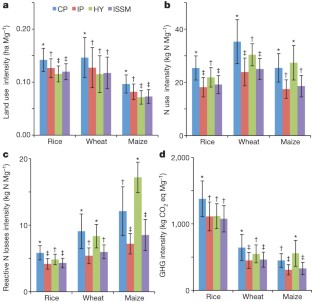
Figure 1: Reactive nitrogen losses and GHG emissions for four management treatments, based on empirical models of losses and life-cycle assessment.

The alternative text for this image may have been generated using AI.
Figure 2: Substantially increased yields can be produced with lower inputs of nitrogen fertilizer, and so lower human and environmental costs.
The alternative text for this image may have been generated using AI.
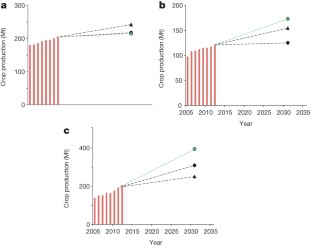
Figure 3: The projected demand of grain production for 2030 in China.
The alternative text for this image may have been generated using AI.
References
- Foley, J. A. et al. Solutions for a cultivated planet. Nature 478, 337–342 (2011)
Article ADS CAS Google Scholar - Tilman, D., Balzer, C., Hill, J. & Befort, B. L. Global food demand and the sustainable intensification of agriculture. Proc. Natl Acad. Sci. USA 108, 20260–20264 (2011)
Article ADS CAS Google Scholar - Audsley, E. et al. Harmonisation of Environmental Life Cycle Assessment for Agriculture. Final Report. Concerted Action MR3-CT94-2028 (Silsoe Research Institute, 1997)
- Alston, J. M., Beddow, J. M. & Pardey, P. G. Agricultural research, productivity, and food prices in the long run. Science 325, 1209–1210 (2009)
Article CAS Google Scholar - Grassini, P., Eskridge, K. M. & Cassman, K. G. Distinguishing between yield advances and yield plateaus in historical crop production trends. Nat. Commun. 4, 2918–2928 (2013)
Article ADS Google Scholar - Ray, D. K., Mueller, N. D., West, P. C. & Foley, J. A. Yield trends are insufficient to double global crop production by 2050. PLoS ONE 8, e66428 (2013)
Article ADS CAS Google Scholar - Ray, D. K. et al. Recent patterns of crop yield growth and stagnation. Nat. Commun. 3, 1293–1299 (2012)
Article ADS Google Scholar - Davidson, E. A. The contribution of manure and fertilizer nitrogen to atmospheric nitrous oxide since 1860. Nat. Geosci. 2, 659–662 (2009)
Article ADS CAS Google Scholar - Christopher, M. C. & Tilman, D. Loss of plant species after chronic low-level nitrogen deposition to prairie grasslands. Nature 451, 712–715 (2008)
Article ADS Google Scholar - Diaz, R. J. & Rosenberg, R. Spreading dead zones and consequences for marine ecosystems. Science 321, 926–929 (2008)
Article ADS CAS Google Scholar - Guo, J. H. et al. Significant acidification in major Chinese croplands. Science 327, 1008–1010 (2010)
Article ADS CAS Google Scholar - Statistics Division of the Food and Agriculture Organization of the United Nations Agriculture database. FAOSTAT http://faostat3.fao.org/faostat-gateway/go/to/home/E (29 July 2014)
- Cassman, K. G., Dobermann, A. & Walters, D. T. Agroecosystems, nitrogen-use efficiency, and nitrogen management. Ambio 31, 132–140 (2002)
Article Google Scholar - Zhang, F. S., Chen, X. P. & Vitousek, P. Chinese agriculture: an experiment for the world. Nature 497, 33–35 (2013)
Article ADS CAS Google Scholar - Chen, X. P. et al. Integrated soil–crop system management for food security. Proc. Natl Acad. Sci. USA 108, 6399–6404 (2011)
Article ADS CAS Google Scholar - Wart, J., Grassini, P. & Cassman, K. G. Impact of derived global weather data on simulated crop yields. Glob. Change Biol. 19, 3822–3834 (2013)
Article ADS Google Scholar - Tilman, D. et al. Forecasting agriculturally driven global environmental change. Science 292, 281–284 (2001)
Article ADS CAS Google Scholar - Dobermann, A. in IFA Int. Workshop on Enhanced-Efficiency Fertilizers, 28–30 June 2005, Frankfurt, Germany (International Fertilizer Industry Association, 2005)
Google Scholar - Cui, Z. L. et al. Closing the yield gap could reduce projected greenhouse gas emissions: a case study of maize production in China. Glob. Change Biol. 19, 2467–2477 (2013)
Article ADS Google Scholar - Grassini, P. & Cassman, K. G. High-yield maize with large net energy yield and small global warming intensity. Proc. Natl Acad. Sci. USA 109, 1074–1079 (2012)
Article ADS CAS Google Scholar - Zhang, W. F. et al. New technologies reduce greenhouse gas emissions from nitrogenous fertilizer in China. Proc. Natl Acad. Sci. USA 110, 8375–8380 (2013)
Article ADS CAS Google Scholar - Chien, S. H., Prochnow, L. I. & Cantarella, H. Recent developments of fertilizer production and use to improve nutrient efficiency and minimize environmental impacts. Adv. Agron. 102, 267–322 (2009)
Article CAS Google Scholar - National Bureau of Statistics of China. China Statistical Yearbook (China Statistics, 2013)
- Zwart, S. J. & Bastiaanssen, G. M. Review of measured crop water productivity values for irrigated wheat, rice, cotton and maize. Agric. Water Manage. 69, 115–133 (2004)
Article Google Scholar - Ma, L. et al. Environmental assessment of management options for nutrient flows in the food chain in China. Environ. Sci. Technol. 47, 7260–7268 (2013)
Article ADS CAS Google Scholar - Chen, X. P. et al. Synchronizing N supply from soil and fertilizer and N demand of winter wheat by an improved Nmin method. Nutr. Cycl. Agroecosyst. 74, 91–98 (2006)
Article Google Scholar - Denmead, O. T. in Gaseous Loss of Nitrogen from Plant-Soil Systems (eds Freney, J. R. & Simpson, J. R. ) 133–157 (Martinus Nijhoff, 1983)
Book Google Scholar - Braschkat, J., Mannheim, T., Horlacher, D. & Marschner, H. Measurement of ammonia emissions after liquid manure application: I. Construction of a wind tunnel system for measurements under field conditions. Z. Pflanz. Bodenkunde 156, 393–396 (1993)
Article CAS Google Scholar - Holland, E. et al. in Standard Soil Methods for Long-Term Ecological Research (eds Robertson, G. P., Coleman, D. C., Bledsoe, C. S. & Sollins, P. ) 185–201 (Oxford Univ. Press, 1999)
- Lehmann, J. & Schroth, G. in Trees, Crops and Soil Fertility: Concepts and Research Methods (eds Schroth, G. & Sinclair, F. L. ) 151–166 (CAB International, 2003)
Google Scholar - Zhao, R., Chen, X. & Zhang, F. Nitrogen cycling and balance in winter wheat/summer maize rotation system in Northern China [in Chinese]. Acta Pedol. Sin. 46, 684–697 (2009)
Google Scholar - Grassini, P. & Cassman, K. G. High-yield maize with large net energy yield and small global warming intensity. Proc. Natl Acad. Sci. USA 109, 1074–1079 (2012)
Article ADS CAS Google Scholar - Hou, P. et al. Grain yields in relation to N requirement: optimizing nitrogen management for spring maize grown in China. Field Crops Res. 129, 1–6 (2012)
Article Google Scholar - Yue, S. C. et al. Change in nitrogen requirement with increasing grain yield for winter wheat. Agron. J. 104, 1–7 (2012)
Article ADS Google Scholar - Intergovernmental Panel on Climate Change in 2006 IPCC Guidelines for National Greenhouse Gas Inventories 11.1–11.54. (National Greenhouse Gas Inventories, 2006)
- Feng, J. F. et al. Impacts of cropping practice on yield-scale greenhouse gas emission from rice fields in China: a meta-analysis. Agric. Water Manage. 164, 220–228 (2013)
Google Scholar - Smith, P. et al. in Climate Change 2007: Mitigation. Contribution of Working Group III to the Fourth Assessment Report of the Intergovernmental Panel on Climate Change (eds Metz, B. et al.) 497–540 (Cambridge Univ. Press, 2007)
- SAS Institute. SAS User’s Guide: Statistics. (SAS Institute, 1998)
- National Bureau of Statistics of China. Chinese Statistical Yearbook 2013. (China Statistics, 2013)
- National Bureau of Statistics of China. Nongken Agriculture Yearbook. (China Statistics, 2013)
Acknowledgements
We thank P. A. Matson, G. P. Robertson, I. Ortiz-Monasterio and G. Maltais-Landry for their comments on an earlier version of the manuscript or assistance during the manuscript revision, and we thank C. L. Kou, D. S. Tan, Z. M. Wang, Z. A. Lin, X. Y. Zhang, J. L. Gao and Y. Zhu for joining field experiments. We also acknowledge all those who provided local assistance or technical help to the Integrated Nutrient Management Network in China. This work was financially supported by the Chinese National Basic Research Program (2009CB118600), the Innovative Group Grant from the NSFC (31121062) and the Special Fund for Agro-scientific Research in the Public Interest (201103003).
Author information
Author notes
- Xinping Chen and Zhenling Cui: These authors contributed equally to this work.
Authors and Affiliations
- College of Resources & Environmental Sciences, China Agricultural University, Beijing, 100193, China
Xinping Chen, Zhenling Cui, Mingsheng Fan, Guiliang Wang, Liang Wu, Ning An, Liangquan Wu, Lin Ma, Weifeng Zhang & Fusuo Zhang - Department of Biology, Stanford University, Stanford, 94305, California, USA
Peter Vitousek - Institute of Crop Science, Chinese Academy of Agricultural Sciences, Beijing, 100081, China
Ming Zhao & Weijian Zhang - College of Resources & Environmental Sciences, Agricultural University of Hebei, Baoding, 071001, China
Wenqi Ma - College of Agronomy, Shandong Agricultural University, Tai’an, 271000, China
Zhenlin Wang, Jiwang Zhang & Mingrong He - Institute of Soil Science, Chinese Academy of Sciences, Nanjing, 210008, China
Xiaoyuan Yan - Key Laboratory of Crop Genetics and Physiology of Jiangsu Province, Yangzhou University, Yangzhou, 225009, China
Jianchang Yang - State Key Laboratory of Soil Erosion and Dryland Farming on the Loess Plateau, Northwest Agriculture and Forestry University, Yangling, 712100, China
Xiping Deng & Shiqing Li - College of Resources & Environmental Sciences, Jilin Agricultural University, Changchun, 130118, China
Qiang Gao - Institute of Agricultural Environment and Resource, Shanxi Academy of Agricultural Sciences, Taiyuan, 030031, China
Qiang Zhang - College of Resources & Environmental Sciences, Nanjing Agricultural University, Nanjing, 210095, China
Shiwei Guo - Research Center of Agricultural Environment & Resources, Jilin Academy of Agricultural Sciences, Changchun, 130033, China
Jun Ren - College of Resources & Environmental Sciences, Henan Agricultural University, Zhengzhou, 450000, China
Youliang Ye & Yunji Zhu - Northwest Agriculture and Forestry University, Yangling, 712100, China
Zhaohui Wang & Jiquan Xue - College of Plant Science & Technology, Huazhong Agricultural University, Wuhan, 430070, China
Jianliang Huang - Crop Physiology, Ecology & Production Center, Hunan Agricultural University, Changsha, 410128, China
Qiyuan Tang - Soil & Fertilizer Research Institute, Anhui Academy of Agricultural Sciences, Hefei, 230031, China
Yixiang Sun - College of Resources & Environmental Sciences, Northeast Agricultural University, Harbin, 150030, China
Xianlong Peng
Authors
- Xinping Chen
- Zhenling Cui
- Mingsheng Fan
- Peter Vitousek
- Ming Zhao
- Wenqi Ma
- Zhenlin Wang
- Weijian Zhang
- Xiaoyuan Yan
- Jianchang Yang
- Xiping Deng
- Qiang Gao
- Qiang Zhang
- Shiwei Guo
- Jun Ren
- Shiqing Li
- Youliang Ye
- Zhaohui Wang
- Jianliang Huang
- Qiyuan Tang
- Yixiang Sun
- Xianlong Peng
- Jiwang Zhang
- Mingrong He
- Yunji Zhu
- Jiquan Xue
- Guiliang Wang
- Liang Wu
- Ning An
- Liangquan Wu
- Lin Ma
- Weifeng Zhang
- Fusuo Zhang
Contributions
X.C. and F.Z. designed the research. Z.C., Z.W., M.Z., W.M., W.Z., X.Y., J.Y., X.D., Q.G., Q.Z., S.G., J.R., S.L., Y.Y., Z.W., J.H., Q.T., Y.S., X.P., J.Z., M.H., Y.Z. and J.X. conducted field experiments. Z.C., M.F., G.W., L.W., N.A., L.W., L.M. and W.Z. collected the data sets and analysed the data. X.C., Z.C. and P.V. wrote the manuscript.
Corresponding author
Correspondence toFusuo Zhang.
Ethics declarations
Competing interests
The authors declare no competing financial interests.
Extended data figures and tables
Extended Data Figure 1 The distribution of experiments for grain from 2009 to 2012 in China.
a, Rice (n = 57); b, wheat (n = 40); c, maize (n = 56). The background green colour represents the planting area for each crop; darker green means a larger density of planting area regionally for that crop. The dots represent sites, and each colour in a dot represents a year of measurements.
Extended Data Figure 2 Linear models of NH3 volatilization based on nitrogen application rate.
Rate of nitrogen fertilizer application was plotted against NH3-N volatilization for (a) rice (n = 265) (Supplementary Information, extended references 1–36 for rice), (b) wheat (n = 34) and (c) maize (n = 29) (Supplementary Information, extended references 37–60 for wheat and maize) growing seasons, respectively. **P = 0.01. Filled and hollow circles represent data from Chinese journals (or theses) and ISI journals, respectively.
Extended Data Figure 3 Exponential models of N2O emissions and nitrogen leaching based on nitrogen surplus.
Nitrogen surplus was plotted against N2O-N emissions for (a) rice (n = 118) (Supplementary information, extended references 7, 36, 61–84 for rice), (b) wheat (n = 40) and (c) maize (n = 48) growing seasons (Supplementary information, extended references 85–99 for wheat and maize), and against nitrogen leaching for (d) rice (n = 52) (Supplementary information, extended references 7, 100–113 for rice), (e) wheat (n = 59) and (f) maize (n = 56) (Supplementary information, extended references 44, 114–121 for wheat and maize). Nitrogen surplus was defined as nitrogen application rate minus above-ground nitrogen uptake. **Regression significant at P < 0.01. Solid and hollow circles represent data from Chinese journals (or theses) and ISI journals, respectively.
Extended Data Figure 4 Exponential model of nitrogen runoff based on nitrogen surplus for rice production.
Nitrogen surplus was defined as nitrogen application rate minus above-ground nitrogen uptake (n = 81) (Supplementary information, extended references 8, 104, 122–134). **P < 0.01. Solid and hollow circles represent data from Chinese journals (or theses) and ISI journals, respectively.
Extended Data Table 1 Grain yields, nitrogen application rates, calculated PFPN, nitrogen surplus, the total and the intensity of reactive nitrogen losses and GHG emissions in farmers’ fields for rice (n = 6,592), wheat (n = 6,940) and maize (n = 5,406) in China
Extended Data Table 2 Above-ground biomass, harvest index (HI) and crop nitrogen uptake for rice (n = 57), wheat (n = 40) and maize (n = 56) in field experiments with four management treatments
Extended Data Table 3 Yield and nitrogen rates of farmer average, top farmers and ISSM
Extended Data Table 4 Total production, weighted average of grain yield and nitrogen rate, total land use, nitrogen fertilizer use, reactive nitrogen losses, and GHG emissions in 2005, 2012 and projected in 2030 under three scenarios for all three crops (rice, wheat and maize) in China
Related audio
Supplementary information
Supplementary Information (download PDF )
This file contains an extended reference list for establishing the reactive N loss models, Supplementary Table 1, a Supplementary Discussion and additional references. (PDF 684 kb)
PowerPoint slides
Source data
Rights and permissions
About this article
Cite this article
Chen, X., Cui, Z., Fan, M. et al. Producing more grain with lower environmental costs.Nature 514, 486–489 (2014). https://doi.org/10.1038/nature13609
- Received: 20 May 2014
- Accepted: 25 June 2014
- Published: 03 September 2014
- Issue date: 23 October 2014
- DOI: https://doi.org/10.1038/nature13609
This article is cited by
Comments
Commenting on this article is now closed.
- ?? ? 26 October 2014, 04:01
This is actually a outstanding research. The large cost and pragmatic idea really impressed me. However, ISSM demands meticulous design, according to careful analysis of local environment, which costs many expenses on intelligence.
Farmers hardly consider the cost of environment. Thus they would choose nitrogen fertilizer due to low price. ISSM may need government subsidies on local agricultural experts to be more competitive. Thus, it is actually a big social movement to popularize ISSM.
I think the collaboration of robust transgenic crops and ISSM can reduce the expenses of intelligence. - Chandrika Tilakarathna 20 January 2015, 23:20
Food security achievable
Current projections show that attainable crop yields are far below what is needed to meet future global demands. However, an integrated soil?crop system management for major cereals in China demonstrates that its yields would be more than enough to meet food and feed demands by 2030.
GAMINI SENEVIRATNE & Chandrika Tilakarathna
Global crop production needs to double by 2050 to meet the projected demands from rising population, diet shifts, and increasing biofuels consumption. However, current projections show that the attainable yields are far below what is needed to meet future demands1. Thus, there is a big challenge today to develop methods for accomplishing necessary increase in future yields, while mitigating environmental costs of intensive agriculture. To address this, several methods are being tested and practiced worldwide. Amongst, compensating for major limitations to crop growth and maximizing yields without regard to costs, both environmental and economical, are common. Chen et al.2 report that an integrated soil?crop system management (ISSM) for rice, wheat and maize in China would be more than enough to meet the demand by 2030 for straight human consumption and a considerably increased demand for animal feed, while decreasing the environmental costs of intensive agriculture.
Chen et al. conducted quantitative field experiments, which included the three main crops accounting for most global cereal production3,4. From 2009 to 2012, a total of 153 site-year field experiments was carried out with four treatments in each: (1) farmers? practice in the region but conducted in experimental plots (2) improved practice which modified existing practice to compensate the major limitations to crop growth; (3) high yielding practice which capitalized on yields without regard to costs; and (4) ISSM, designed to make maximum use of solar radiation and periods with favorable temperatures, and also for greater synchrony between crop demand for N and its supply from soil, environment, and applied inputs, thus reducing N fertiliser requirement5, and also losses. The ISSM practices based on a modern understanding of crop ecophysiology and soil biogeochemistry increased average yields for rice, wheat and maize by 18%, 24% and 35%, respectively, without any increase, instead a decrease in N fertiliser. Further assessments showed that reactive N losses and greenhouse gas emissions were reduced considerably by the ISSM6. Such yield increases have been attributed to large nutrient reserves built up previously in the soil under high fertiliser rates that provided the balance of nutrients in synchrony with crop demand, thus improving crop uptake and yields7, 8.
N2 fixing bacteria are vital in the growth and persistence of effective microbial communities in the soil, because they provide N to the communities through biological nitrogen fixation (BNF). It is well-known that chemical inputs, particularly high doses of N fertilisers affect N2 fixers negatively, and hence microbial processes like mineralization of immobilized nutrient reserves, adversely influencing the sustenance of soil fertility and crop productivity. This has been demonstrated by farmers in China, from improving crop yields, by just reducing N fertiliser use7. Similarly, the reduction of N fertilizer input per application due to split doses in the ISSM has contributed to its increased crop yields. It was shown that reducing recommended fertiliser NPK use by 50% in a tea cultivating soil of Sri Lanka significantly increased soil microbial biomass and BNF, and also decreased soil NO3-, which were observed to be proportional to increased density of soil microbes, due to their reduced suppression, particularly by the decreased N fertilisers9. When the reduced fertiliser addition was coupled with a novel biofilm-based microbial inoculant, it tended to further increase BNF, plant growth, soil organic carbon, rhizoremediation and soil moisture conservation, and to further reduce leaf transpiration and pest infestation, in comparison to full recommended chemical fertilisation. Subsequent, countrywide extensive demonstrations, including rice, maize, tea and vegetables showed its potential of increasing crop yields even up to 80% in some instances10. Therefore, the ISSM together with such microbial interventions should be experimented to further increase crop production for achieving the food security by 2050 and beyond.
Gamini Seneviratne is in the Microbial Biotechnology Unit, National Institute of Fundamental Studies, Hantana Road, Kandy, Sri Lanka. e-mail: gaminis@ifs.ac.lk
Chandrika Tilakarathna is in the National Institute of Fundamental Studies, Hantana Road, Kandy, Sri Lanka.
1.	Ray, D. K., Mueller, N. D., West, P. C. & Foley, J. A. PLoS ONE 8(6), e66428. doi:10.1371/journal.pone.0066428 (2013).
2.	Chen, X. et al. Nature 514, 486-489 (2014).
3.	Statistics Division of the Food and Agriculture Organization of the United Nations. Agriculture database. FAOSTAT http://faostat3.fao.org/fao... (22 December 2014).
4.	Cassman, K. G., Dobermann, A. & Walters, D. T. Ambio 31, 132-140 (2002).
5.	Chen, X. et al. Proc. Natl. Acad. Sci. USA 108, 6399-6404 (2011).
6.	Audsley, E. et al. Harmonisation of Environmental Life Cycle Assessment for Agriculture. Final Report. Concerted Action MR3-CT94-2028 (Silsoe Research Institute, 1997).
7.	Hvistendahl, M. Science 327, 801 (2010).
8.	Yan, X. et al. Environ. Res. Lett. 9, http://dx.doi.org/10.1088/1... (2014).
9.	Seneviratne, G., Jayasekara, A. P. D. A., De Silva, M. S. D. L. & Abeysekera, U. P. Soil Biol. Biochem. 43, 1059-1062 (2011).
10.	Buddhika, U. V. A. et al. in Microbial Bioresources (eds Gupta, V. K., Thangdurai, D. & Sharma, G. D.), CABI Publications (in press).