Shifts in Arctic vegetation and associated feedbacks under climate change (original) (raw)
- Letter
- Published: 31 March 2013
- Steven J. Phillips2,
- Michael M. Loranty3,4,
- Pieter S. A. Beck3,
- Theodoros Damoulas5,
- Sarah J. Knight1,6 nAff7 &
- …
- Scott J. Goetz3
Nature Climate Change volume 3, pages 673–677 (2013) Cite this article
- 16k Accesses
- 731 Citations
- 184 Altmetric
- Metrics details
Abstract
Climate warming has led to changes in the composition, density and distribution of Arctic vegetation in recent decades1,2,3,4. These changes cause multiple opposing feedbacks between the biosphere and atmosphere5,6,7,8,9, the relative magnitudes of which will have globally significant consequences but are unknown at a pan-Arctic scale10. The precise nature of Arctic vegetation change under future warming will strongly influence climate feedbacks, yet Earth system modelling studies have so far assumed arbitrary increases in shrubs (for example, +20%; refs 6, 11), highlighting the need for predictions of future vegetation distribution shifts. Here we show, using climate scenarios for the 2050s and models that utilize statistical associations between vegetation and climate, the potential for extremely widespread redistribution of vegetation across the Arctic. We predict that at least half of vegetated areas will shift to a different physiognomic class, and woody cover will increase by as much as 52%. By incorporating observed relationships between vegetation and albedo, evapotranspiration and biomass, we show that vegetation distribution shifts will result in an overall positive feedback to climate that is likely to cause greater warming than has previously been predicted. Such extensive changes to Arctic vegetation will have implications for climate, wildlife and ecosystem services.
This is a preview of subscription content, access via your institution
Access options
Subscribe to this journal
Receive 12 print issues and online access
$259.00 per year
only $21.58 per issue
Buy this article
- Purchase on SpringerLink
- Instant access to the full article PDF.
USD 39.95
Prices may be subject to local taxes which are calculated during checkout
Additional access options:
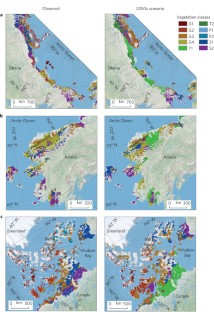
Figure 1: Observed and predicted distributions of vegetation.
The alternative text for this image may have been generated using AI.
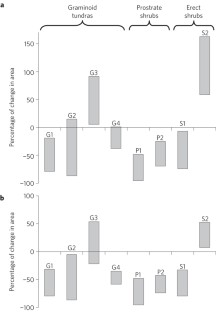
Figure 2: Predicted changes in area by vegetation class for the 2050s.
The alternative text for this image may have been generated using AI.
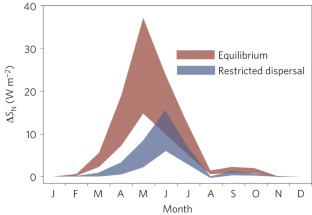
Figure 3: Predicted monthly changes in surface net short-wave radiation for the 2050s.
The alternative text for this image may have been generated using AI.
References
- Tape, K., Sturm, M. & Racine, C. The evidence for shrub expansion in Northern Alaska and the Pan-Arctic. Glob. Change Biol. 12, 686–702 (2006).
Article Google Scholar - Goetz, S. J. et al. in Eurasian Arctic Land Cover and Land Use in a Changing Climate (eds Gutman, G. & Reissell, A.) 9–36 (Springer, 2011).
Google Scholar - Elmendorf, S. C. et al. Plot-scale evidence of tundra vegetation change and links to recent summer warming. Nature Clim. Change 2, 453–457 (2012).
Article Google Scholar - Macias-Fauria, M., Forbes, B. C., Zetterberg, P. & Kumpula, T. Eurasian Arctic greening reveals teleconnections and the potential for structurally novel ecosystems. Nature Clim. Change 2, 613–618 (2012).
Article Google Scholar - Chapin, F. S. et al. Role of land-surface changes in Arctic summer warming. Science 310, 657–660 (2005).
Article CAS Google Scholar - Lawrence, D. M. & Swenson, S. C. Permafrost response to increasing Arctic shrub abundance depends on the relative influence of shrubs on local soil cooling versus large-scale climate warming. Environ. Res. Lett. 6, 045504 (2011).
Article Google Scholar - Blok, D. et al. Shrub expansion may reduce summer permafrost thaw in Siberian tundra. Glob. Change Biol. 16, 1296–1305 (2010).
Article Google Scholar - Swann, A. L., Fung, I. Y., Levis, S., Bonan, G. B. & Doney, S. C. Changes in Arctic vegetation amplify high-latitude warming through the greenhouse effect. Proc. Natl Acad. Sci. USA 107, 1295–1300 (2010).
Article CAS Google Scholar - Schuur, E. A. G. et al. The effect of permafrost thaw on old carbon release and net carbon exchange from tundra. Nature 459, 556–559 (2009).
Article CAS Google Scholar - Loranty, M. M. & Goetz, S. J. Shrub expansion and climate feedbacks in Arctic tundra. Environ. Res. Lett. 7, 011005 (2012).
Article Google Scholar - Bonfils, C. J. W. et al. On the influence of shrub height and expansion on northern high latitude climate. Environ. Res. Lett. 7, 015503 (2012).
Article Google Scholar - IPCC Climate Change 2007: The Physical Science Basis (eds Solomon, S. et al.) (Cambridge Univ. Press, 2007).
- Peterson, A. T. et al. Ecological Niches and Geographic Distributions (Princeton Univ. Press, 2011).
Book Google Scholar - Chapin, F. S. III, Bret-Harte, M. S., Hobbie, S. E. & Zhong, H. Plant functional types as predictors of transient responses of arctic vegetation to global change. J. Veg. Sci. 7, 347–358 (1996).
Article Google Scholar - Euskirchen, E. S., McGuire, A. D., Chapin, F. S., Yi, S. & Thompson, C. C. Changes in vegetation in Northern Alaska under scenarios of climate Change, 2003–2100: Implications for climate feedbacks. Ecol. Appl. 19, 1022–1043 (2009).
Article CAS Google Scholar - Wolf, A., Callaghan, T. & Larson, K. Future changes in vegetation and ecosystem function of the Barents Region. Climatic Change 87, 51–73 (2008).
Article CAS Google Scholar - Epstein, H. E., Walker, M. D., Chapin, F. S. & Starfield, A. M. A transient, nutrient-based model of arctic plant community response to climatic warming. Ecol. Appl. 10, 824–841 (2000).
Article Google Scholar - Friedlingstein, P. et al. Climate–carbon cycle feedback analysis: Results from the C4MIP model intercomparison. J. Clim. 19, 3337–3353 (2006).
Article Google Scholar - McGuire, A. D. et al. Sensitivity of the carbon cycle in the Arctic to climate change. Ecol. Monogr. 79, 523–555 (2009).
Article Google Scholar - Alsos, I. G. et al. Frequent long-distance plant colonization in the changing arctic. Science 316, 1606–1609 (2007).
Article CAS Google Scholar - Pearson, R. G. Climate change and the migration capacity of species. Trends Ecol. Evol. 21, 111–113 (2006).
Article Google Scholar - Racine, C., Jandt, R., Meyers, C. & Dennis, J. Tundra fire and vegetation change along a hillslope on the Seward Peninsula, Alaska, USA. Arct. Antarct. Alp. Res. 36, 1–10 (2004).
Article Google Scholar - Schuur, E. A. G., Crummer, K. G., Vogel, J. G. & Mack, M. C. Plant species composition and productivity following permafrost thaw and thermokarst in Alaskan tundra. Ecosystems 10, 280–292 (2007).
Article Google Scholar - Forchhammer, M. C., Post, E., Stenseth, N. C. & Boertmann, D. M. Long-term responses in arctic ungulate dynamics to changes in climatic and trophic processes. Popul. Ecol. 44, 113–120 (2002).
Article Google Scholar - Post, E. et al. Ecological dynamics across the arctic associated with recent climate change. Science 325, 1355–1358 (2009).
Article CAS Google Scholar - Zöckler, C. Migratory bird species as indicators for the state of the environment. Biodiversity 6, 7–13 (2005).
Article Google Scholar - Sturm, M. et al. Winter biological processes could help convert Arctic tundra to shrubland. BioScience 55, 17 (2005).
Article Google Scholar - Fletcher, C. G., Zhao, H., Kushner, P. J. & Fernandes, R. Using models and satellite observations to evaluate the strength of snow albedo feedback. J. Geophys. Res. 117, D11117 (2012).
Article Google Scholar - Zhang, K., Kimball, J. S., Kim, Y. & McDonald, K. C. Changing freeze-thaw seasons in northern high latitudes and associated influences on evapotranspiration. Hydrol. Process. 25, 4142–4151 (2011).
Article Google Scholar - Walker, D. A. et al. The Circumpolar Arctic vegetation map. J. Veg. Sci. 16, 267–282 (2005).
Article Google Scholar
Acknowledgements
We thank G. Arnesen, J. Elith, A. Elvebakk, P. J. Ersts, N. Horning, M. C. Mack, J. Silverman and Y. Ryu. Supported by NSF grants IPY 0732948 to R.G.P., IPY 0732954 to S.J.G., and Expeditions 0832782 to T.D.
Author information
Author notes
- Sarah J. Knight
Present address: Present address: Food and Environment Research Agency, Sand Hutton, York YO41 1LZ, UK,
Authors and Affiliations
- Center for Biodiversity and Conservation, American Museum of Natural History, New York, New York 10024, USA
Richard G. Pearson & Sarah J. Knight - AT&T Labs-Research, 180 Park Avenue, New Jersey 07932, Florham Park, USA
Steven J. Phillips - Woods Hole Research Center, 149 Woods Hole Road, Massachusetts 02540, Falmouth, USA
Michael M. Loranty, Pieter S. A. Beck & Scott J. Goetz - Department of Geography, Colgate University, Hamilton, New York 13346, USA
Michael M. Loranty - Department of Computer Science, Cornell University, Ithaca, New York 14853, USA
Theodoros Damoulas - Department of Biology, University of York, York YO10 5DD, UK
Sarah J. Knight
Authors
- Richard G. Pearson
- Steven J. Phillips
- Michael M. Loranty
- Pieter S. A. Beck
- Theodoros Damoulas
- Sarah J. Knight
- Scott J. Goetz
Contributions
R.G.P. and S.J.G. conceived the study; R.G.P. analysed data; S.J.P. analysed data and ran Random Forests models; M.M.L. led albedo and evapotranspiration analyses; P.S.A.B. led biomass and _S_N analyses; T.D. ran multi-kernel Relevance Vector Machines models; S.J.K. ran preliminary analyses; R.G.P., M.M.L. and P.S.A.B. wrote the paper with contributions from all authors.
Corresponding author
Correspondence toRichard G. Pearson.
Ethics declarations
Competing interests
The authors declare no competing financial interests.
Supplementary information
Rights and permissions
About this article
Cite this article
Pearson, R., Phillips, S., Loranty, M. et al. Shifts in Arctic vegetation and associated feedbacks under climate change.Nature Clim Change 3, 673–677 (2013). https://doi.org/10.1038/nclimate1858
- Received: 25 July 2012
- Accepted: 25 February 2013
- Published: 31 March 2013
- Issue date: July 2013
- DOI: https://doi.org/10.1038/nclimate1858