The rate of sea-level rise (original) (raw)
- Letter
- Published: 23 March 2014
- Habib-Boubacar Dieng1,
- Benoit Meyssignac1,
- Karina von Schuckmann2,
- Bertrand Decharme3 &
- …
- Etienne Berthier1
Nature Climate Change volume 4, pages 358–361 (2014) Cite this article
- 11k Accesses
- 348 Citations
- 175 Altmetric
- Metrics details
Subjects
Abstract
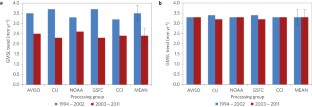
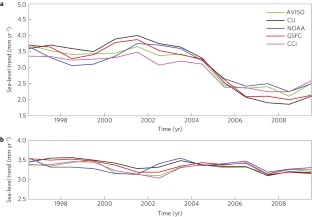
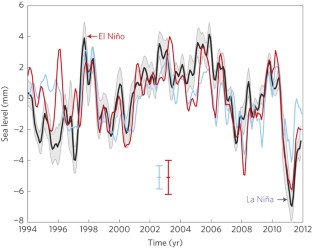
Present-day sea-level rise is a major indicator of climate change1. Since the early 1990s, sea level rose at a mean rate of ∼3.1 mm yr−1 (refs 2, 3). However, over the last decade a slowdown of this rate, of about 30%, has been recorded4,5,6,7,8. It coincides with a plateau in Earth’s mean surface temperature evolution, known as the recent pause in warming1,9,10,11,12. Here we present an analysis based on sea-level data from the altimetry record of the past ∼20 years that separates interannual natural variability in sea level from the longer-term change probably related to anthropogenic global warming. The most prominent signature in the global mean sea level interannual variability is caused by El Niño–Southern Oscillation, through its impact on the global water cycle13,14,15,16. We find that when correcting for interannual variability, the past decade’s slowdown of the global mean sea level disappears, leading to a similar rate of sea-level rise (of 3.3 ± 0.4 mm yr−1) during the first and second decade of the altimetry era. Our results confirm the need for quantifying and further removing from the climate records the short-term natural climate variability if one wants to extract the global warming signal10.
This is a preview of subscription content, access via your institution
Access options
Subscribe to this journal
Receive 12 print issues and online access
$259.00 per year
only $21.58 per issue
Buy this article
- Purchase on SpringerLink
- Instant access to the full article PDF.
USD 39.95
Prices may be subject to local taxes which are calculated during checkout
Additional access options:
Figure 1: GMSL trends during the 1994–2002 and 2003–2011 periods.
The alternative text for this image may have been generated using AI.
Figure 2: GMSL rate over five-year-long moving windows.
The alternative text for this image may have been generated using AI.
Figure 3: Detrended GMSL, interannual mass and ‘mass plus thermosteric’ components.
The alternative text for this image may have been generated using AI.
References
- IPCC, Climate Change 2013: The Physical Science Basis (eds Stocker, T. F. et al.) (Cambridge Univ. Press, 2013).
- Nerem, R. S., Chambers, D. P., Choe, C. & Mitchum, G. T. Estimating mean sea level change from the TOPEX and Jason altimeter missions. Mar. Geodesy 33, 435–446 (2010).
Article Google Scholar - Church, J. A. & White, N. J. Sea-level rise from the late 19th to the early 21st century. Surveys Geophys. 32, 585–602 (2011).
Article Google Scholar - Willis, J. K., Chambers, D. P. & Nerem, R. S. Assessing the globally averaged sea level budget on seasonal to interannual time scales. J. Geophys. Res. 10.1029/2007jc004517 (2008).
- Leuliette, E. W. & Miller, L. Closing the sea level rise budget with altimetry, Argo and GRACE. Geophys. Res. Lett. 36, L04608 (2009).
Article Google Scholar - Leuliette, E. W. & Willis, J. K. Balancing the sea level budget. Oceanography 24, 122–129 (2011).
Article Google Scholar - Chen, J. L., Wilson, C. R. & Tapley, B. D. Contribution of ice sheet and mountain glacier melt to recent sea level rise. Nature Geosci. 6, 549–552 (2013).
Article CAS Google Scholar - Hansen, J., Sato, M., Kharecha, P. & von Schuckmann, K. Earth’s energy imbalance andimplications. Atmos. Chem. Phys. 11, 13421–13449 (2011).
Article CAS Google Scholar - Trenberth, K. E. & Fasullo, J. T. Tracking Earth’s energy. Science 328, 316–317 (2010).
Article CAS Google Scholar - Foster, G. & Rahmstorf, S. Global temperature evolution 1979–2010. Environ. Res. Lett. 6, 044022 (2011).
Article Google Scholar - Kosaka, Y. & Xie, S-P. Recent global warming hiatus tied to equatorial Pacific surface cooling. Nature 501, 403–407 (2013).
Article CAS Google Scholar - Trenberth, K. E. & Fasullo, J. T. An apparent hiatus in global warming?. Earth’s Future 10.1002/2013EF000165 (2013).
- Llovel, W. et al. Terrestrial waters and sea level variations on interannual time scale. Glob. Planet. Change 75, 76–82 (2011).
Article Google Scholar - Cazenave, A. et al. ENSO influence on the global mean sea level over 1993–2010. Mar. Geodesy 35, 82–97 (2012).
Article Google Scholar - Boening, C., Willis, J. K., Landerer, F. W. & Nerem, R. S. The 2011 La Niña: So strong, the oceans fell. Geophys. Res. Lett. 39, L19602 (2012).
Google Scholar - Fasullo, J. T., Boening, C., Landerer, F. W. & Nerem, R. S. Australia’s unique influence on global sea level in 2010–2011. Geophys. Res. Lett. 40, 4368–4373 (2013).
Article Google Scholar - Nicholls, R. J. & Cazenave, A. Sea-level rise and its impact on coastal zones. Science 328, 1517–1520 (2010).
Article CAS Google Scholar - Hallegate, S., Green, C., Nicholls, R. J. & Corfee-Morlot, J. Future flood losses in major coastal cities. Nature Clim. Change 3, 802–806 (2013).
Article Google Scholar - Gergis, J. L. & Fowler, A. M. A history of ENSO events since A.D. 1525: Implications for future climate change. Clim. Change 92, 343–387 (2009).
Article Google Scholar - Gu, G. & Adler, R. F. Precipitation and temperature variations on the interannual time scale: Assessing the impact of ENSO and volcanic eruptions. J. Climate 24, 2258–2270 (2011).
Article Google Scholar - Trenberth, K., Fasullo, J. & Smith, L. Trends and variability in column-integrated atmospheric water vapor. Clim. Dynam. 24, 741–758 (2005).
Article Google Scholar - Alkama, R. et al. Global evaluation of the ISBA-TRIP continental hydrological system. Part 1: Comparison to GRACE Terrestrial Water Storage estimates and in-situ river discharges. J. Hydromet. 11, 583–600 (2010).
Article Google Scholar - Church, J. A. et al. Revisiting the Earth’s sea-level and energy budgets from 1961 to 2008. Geophys. Res. Lett. 10.1029/2011gl048794 (2011).
- Loeb, G. N. et al. Observed changes in top-of-the-atmosphere radiation and upper-ocean heating consistent within uncertainty. Nature Geosci. 5, 110–113 (2012).
Article CAS Google Scholar - Balmaseda, M. A., Trenberth, K. & Kallen, E. Distinctive climate signals in reanalysis of global ocean heat content. Geophys. Res. Lett. 40, 1–6 (2013).
Article Google Scholar - Meehl, G. A., Arblaster, J. M., Fasullo, J. T., Hu, A. & Trenberth, K. E. Model based evidence of deep-ocean heat uptake during surface-temperature hiatus periods. Nature Clim. Change 1, 360–364 (2011).
Article Google Scholar - Peltier, W. R. Global glacial isostasy and the surface of the ice-age Earth: The ICE-5G (VM2 model and GRACE). Annu. Rev. Earth Planet. Sci. 32, 111–149 (2004).
Article CAS Google Scholar - Ishii, M. & Kimoto, M. Reevaluation of historical ocean heat content variations with time-varying XBT and MBT depth bias corrections. J. Oceanogr. 65, 287–299 (2009).
Article Google Scholar - Von Schuckmann, K. & Le Traon, P. Y. How well can we derive global ocean indicators from Argo data? Ocean Sci. 7, 783–791 (2011).
Article Google Scholar - Vergnes, J-P. & Decharme, B. A simple groundwater scheme in the TRIP river routing model: Global off-line evaluation against GRACE terrestrial water storage estimates and observed river discharges. Hydrol. Earth Syst. Sci. 16, 3889–3908 (2012).
Article Google Scholar
Acknowledgements
This work was supported by CNES, CNRS, MétéoFrance, The University of Toulon and the ESA CCI project.
Author information
Authors and Affiliations
- Laboratoire d’Etudes en Géophysique et Océanographie Spatiales, 18 avenue E. Belin 31400 Toulouse, France,
Anny Cazenave, Habib-Boubacar Dieng, Benoit Meyssignac & Etienne Berthier - Mediterranean Institute of Oceanography, avenue de l’Université, 83957 La Grade, France
Karina von Schuckmann - Centre National de Recherches Météorologiques, MétéoFrance, 42 avenue G. Coriolis 31100 Toulouse, France,
Bertrand Decharme
Authors
- Anny Cazenave
- Habib-Boubacar Dieng
- Benoit Meyssignac
- Karina von Schuckmann
- Bertrand Decharme
- Etienne Berthier
Contributions
A.C. conceived the study and wrote the article. H-B.D. conducted the calculations. B.D. and K.v.S. provided the ISBA/TRIP and Argo data, respectively. B.M. and E.B. contributed to the interpretation and discussion.
Corresponding author
Correspondence toAnny Cazenave.
Ethics declarations
Competing interests
The authors declare no competing financial interests.
Supplementary information
Rights and permissions
About this article
Cite this article
Cazenave, A., Dieng, HB., Meyssignac, B. et al. The rate of sea-level rise.Nature Clim Change 4, 358–361 (2014). https://doi.org/10.1038/nclimate2159
- Received: 16 October 2013
- Accepted: 04 February 2014
- Published: 23 March 2014
- Issue date: May 2014
- DOI: https://doi.org/10.1038/nclimate2159