From local perception to global perspective (original) (raw)
- Perspective
- Published: 24 July 2015
Nature Climate Change volume 5, pages 731–734 (2015) Cite this article
- 2740 Accesses
- 66 Citations
- 121 Altmetric
- Metrics details
Subjects
Abstract
Recent sociological studies show that over short time periods the large day-to-day, month-to-month or year-to-year variations in weather at a specific location can influence and potentially bias our perception of climate change, a more long-term and global phenomenon. By weighting local temperature anomalies with the number of people that experience them and considering longer time periods, we illustrate that the share of the world population exposed to warmer-than-normal temperatures has steadily increased during the past few decades. Therefore, warming is experienced by an increasing number of individuals, counter to what might be simply inferred from global mean temperature anomalies. This behaviour is well-captured by current climate models, offering an opportunity to increase confidence in future projections of climate change irrespective of the personal local perception of weather.
This is a preview of subscription content, access via your institution
Access options
Subscribe to this journal
Receive 12 print issues and online access
$259.00 per year
only $21.58 per issue
Buy this article
- Purchase on SpringerLink
- Instant access to the full article PDF.
USD 39.95
Prices may be subject to local taxes which are calculated during checkout
Additional access options:
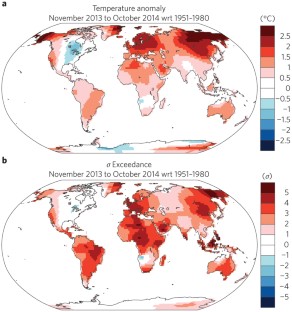
Figure 1: An example of spatial heterogeneity of temperature anomalies based on GISS surface temperature anomalies[9](/articles/nclimate2660#ref-CR9 "Hansen, J., Ruedy, R., Sato, M. & Lo, K. Global surface temperature change. Rev. Geophys. 48, http://doi.org/ckmvrz
(2010).").
The alternative text for this image may have been generated using AI.
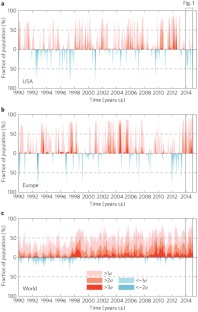
Figure 2: Time series of the fraction of population that experienced a 1_σ_, 2_σ_ or 3_σ_ exceedance with reference to 1951–1980.
The alternative text for this image may have been generated using AI.
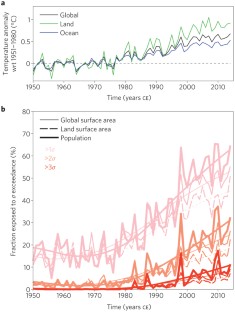
Figure 3: Annual mean temperature anomaly and temperature exceedances.
The alternative text for this image may have been generated using AI.
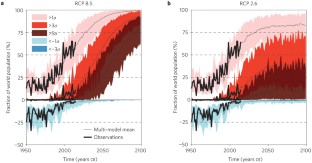
Figure 4: Fraction of the world population that experiences a specific temperature σ exceedance as simulated by the CMIP5 models.
The alternative text for this image may have been generated using AI.
References
- Herring, S. C., Hoerling, M. P., Peterson, T. C. & Stott, P. A. Explaining extreme events of 2013 from a climate perspective. Bull. Am. Meteorol. Soc. 95, Spec. Suppl. (2014).
Article Google Scholar - Stott, P. A., Stone, D. A. & Allen, M. R. Human contribution to the European heatwave of 2003. Nature 432, 610–614 (2004).
Article CAS Google Scholar - Trenberth, K. E., Fasullo, J. T. & Shepherd, T. G. Attribution of climate extreme events. Nature Clim. Change 5, 725–730 (2015).
Article Google Scholar - IPCC Managing the Risks of Extreme Events and Disasters to Advance Climate Change Adaptation (eds Field, C. B. et al.) (Cambridge Univ. Press, 2012).
- McCright, A. M., Dunlap, R. E. & Xiao, C. The impacts of temperature anomalies and political orientation on perceived winter warming. Nature Clim. Change 4, 1077–1081 (2014).
Article Google Scholar - Howe, P. D., Markowitz, E. M., Lee, T. M., Ko, C-Y. & Leiserowitz, A. Global perceptions of local temperature change. Nature Clim. Change 3, 352–356 (2013).
Article Google Scholar - Howe, P. D. & Leiserowitz, A. Who remembers a hot summer or a cold winter? The asymmetric effect of beliefs about global warming on perceptions of local climate conditions in the U.S. Glob. Environ. Change 23, 1488–1500 (2013).
Article Google Scholar - Zaval, L., Keenan, E. A., Johnson, E. J. & Weber, E. U. How warm days increase belief in global warming. Nature Clim. Change 4, 143–147 (2014).
Article Google Scholar - Hansen, J., Ruedy, R., Sato, M. & Lo, K. Global surface temperature change. Rev. Geophys. 48, http://doi.org/ckmvrz (2010).
- Collins, M. et al. in Climate Change 2013: The Physical Science Basis (eds Stocker, T. et al.) 1029–1136 (IPCC, Cambridge Univ. Press, 2013).
Google Scholar - Mahlstein, I. & Knutti, R. Early onset of significant local warming in low latitude countries. Environ. Res. Lett. 6, 034009 (2011).
Article Google Scholar - Dunne, J. P., Stouffer, R. J. & John, J. G. Reductions in labour capacity from heat stress under climate warming. Nature Clim. Change 3, 563–566 (2013).
Article CAS Google Scholar - Klein Goldewijk, K. Beusen, A. & Janssen, P. Long term dynamic modeling of global population and built-up area in a spatially explicit way, HYDE 3.1. The Holocene 20, 565–573 (2010).
Article Google Scholar - Hansen, J., Sato, M. & Ruedy, R. Perception of climate change. Proc. Natl Acad. Sci. USA 109, E2415–2423 (2012).
Article CAS Google Scholar - Seneviratne, S. I., Donat, M. G., Mueller, B. & Alexander, L. V. No pause in the increase of hot temperature extremes. Nature Clim. Change 4, 161–163 (2014).
Article Google Scholar - Coumou, D. & Robinson, A. Historic and future increase in the global land area affected by monthly heat extremes. Environ. Res. Lett. 8, 034018 (2013).
Article Google Scholar - Cowtan, K. & Way, R. G. Coverage bias in the HadCRUT4 temperature series and its impact on recent temperature trends. Q. J. R. Meteorol. Soc. 140, 1935–1944 (2014).
Article Google Scholar - van Vuuren, D. P. et al. A proposal for a new scenario framework to support research and assessment in different climate research communities. Glob. Environ. Change 22, 21–35 (2012).
Article Google Scholar - IPCC Climate Change 2013: The Physical Science Basis (eds Stocker, T. et al.) (Cambridge Univ. Press, 2014).
Acknowledgements
We are grateful to K. Klein Goldewijk for providing the population data and thank C. C. Raible, A. Pendergrass, K. Trenberth, G. Turi, L. Terray and C. Deser for discussion and constructive comments. The National Center for Atmospheric Research is sponsored by the National Science Foundation. F.L. is supported by an Early Postdoc Mobility fellowship from the Swiss National Science Foundation. T.F.S. is grateful for funding by the Swiss National Science Foundation. We acknowledge the World Climate Research Programme's Working Group on Coupled Modelling, which is responsible for CMIP, and we thank the climate modelling groups for producing and making available their model output. For CMIP, the US Department of Energy's Program for Climate Model Diagnosis and Intercomparison provides coordinating support and led development of software infrastructure in partnership with the Global Organization for Earth System Science Portals.
Author information
Authors and Affiliations
- National Center for Atmospheric Research (NCAR), 1850 Table Mesa Drive, Boulder, 80305, Colorado, USA
Flavio Lehner - Climate and Environmental Physics, University of Bern, Sidlerstrasse 5, Bern, 3012, Switzerland
Thomas F. Stocker - Oeschger Centre for Climate Change Research, University of Bern, Falkenplatz 16, Bern, 3012, Switzerland
Thomas F. Stocker
Authors
- Flavio Lehner
- Thomas F. Stocker
Contributions
F.L. and T.F.S. designed the study and wrote the article. F.L. analysed the data.
Corresponding author
Correspondence toFlavio Lehner.
Ethics declarations
Competing interests
The authors declare no competing financial interests.
Supplementary information
Rights and permissions
About this article
Cite this article
Lehner, F., Stocker, T. From local perception to global perspective.Nature Clim Change 5, 731–734 (2015). https://doi.org/10.1038/nclimate2660
- Received: 15 January 2015
- Accepted: 22 April 2015
- Published: 24 July 2015
- Issue date: August 2015
- DOI: https://doi.org/10.1038/nclimate2660