The 'best available science' to inform 1.5 °C policy choices (original) (raw)
- Commentary
- Published: 11 April 2016
Nature Climate Change volume 6, pages 646–649 (2016) Cite this article
- 5167 Accesses
- 100 Citations
- 233 Altmetric
- Metrics details
Subjects
An IPCC Special Report on 1.5 °C should focus on resolving fundamental scientific and political uncertainties, not fixate on developing unachievable mitigation pathways.
This is a preview of subscription content, access via your institution
Relevant articles
Open Access articles citing this article.
Persistent inequality in economically optimal climate policies
- Paolo Gazzotti
- , Johannes Emmerling
- … Massimo Tavoni
Nature Communications Open Access 08 June 2021
The Paris warming targets: emissions requirements and sea level consequences
- T.M.L. Wigley
Climatic Change Open Access 12 December 2017
- T.M.L. Wigley
Access options
Subscribe to this journal
Receive 12 print issues and online access
$259.00 per year
only $21.58 per issue
Buy this article
- Purchase on SpringerLink
- Instant access to the full article PDF.
USD 39.95
Prices may be subject to local taxes which are calculated during checkout
Additional access options:
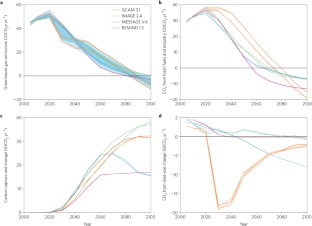
Figure 1: The ten scenarios from the IPCC AR52 and used in the UNEP Emissions Gap Report4, coloured by the model name and version.
The alternative text for this image may have been generated using AI.
References
- Adoption of the Paris Agreement FCCC/CP/2015/L.9/Rev1 (United Nations Framework Convention on Climate Change, 2015).
- Clarke, L. et al. in Climate Change 2014: Mitigation of Climate Change (eds Edenhofer, O. et al.) Ch. 6 (IPCC, Cambridge Univ. Press, 2014).
Google Scholar - Rogelj, J. et al. Nature Clim. Change 5, 519–527 (2015).
Article Google Scholar - The Emissions Gap Report 2015 (United Nations Environment Programme, 2015).
- Synthesis Report on the Aggregate Effect of the Intended Nationally Determined Contributions (United Nations Framework Convention on Climate Change, 2015).
- IPCC Climate Change 2014: Synthesis Report (eds Pachauri, R. K. & Meyer, L. A.) (Cambridge Univ. Press, 2014).
- Met Office. 2015: The Warmest Year on Record, say Scientists; www.metoffice.gov.uk/news/releases/archive/2016/2015-global-temperature (accessed 24 January 2016).
- Holthaus, E. Our Planet's Temperature Just Reached a Terrifying Milestone http://go.nature.com/kBYAgX (2016).
Google Scholar - Anderson, K. Nature Geosci. 8, 898–900 (2015).
Article CAS Google Scholar - Geden, O. Nature 521, 27–28 (2015).
Article CAS Google Scholar - Collins, M. et al. in Climate Change 2013: The Physical Science Basis (eds Stocker, T. F. et al.) 1029–1136 (IPCC, Cambridge Univ. Press, 2013).
Google Scholar - Rogelj, J. et al. Nature Clim. Change 6, 245–252 (2016).
Article Google Scholar - Fuss, S. et al. Nature Clim. Change 4, 850–853 (2014).
Article CAS Google Scholar - Houghton, R. A., Byers, B. & Nassikas, A. A. Nature Clim. Change 5, 1022–1023 (2015).
Article Google Scholar - Creutzig, F. et al. GCB Bioenergy 7, 916–944 (2014).
Article Google Scholar - de Coninck, H. & Benson, S. M. Annu. Rev. Environ. Resour. 39, 243–270 (2014).
Article Google Scholar - The Global Status of CCS: 2015 (Global CCS Institute, 2015); http://go.nature.com/aXPQAU
- van Vuuren, D. P., van Sluisveld, M. & Hof, A. F. Implications of Long-Term Scenarios for Medium-Term Targets (2050) (PBL Netherlands Environmental Assessment Agency, 2015); http://go.nature.com/16LZaH
Google Scholar - Smith, P. et al. Nature Clim. Change 6, 42–50 (2015).
Article Google Scholar - Williamson, P. Nature 530, 153–155 (2016).
Article CAS Google Scholar - Myhre, G. et al. in Climate Change 2013: The Physical Science Basis (eds Stocker, T. F. et al.) 659–740 (IPCC, Cambridge Univ. Press, 2013).
Google Scholar - Shine, K. P., Berntsen, T., Fuglestvedt, J. S., Stuber, N. & Skeie, R. B. Phil. Trans. R. Soc. A 365, 1903–1914 (2007).
Article CAS Google Scholar - Rogelj, J., McCollum, D. L., Reisinger, A., Meinshausen, M. & Riahi, K. Nature 493, 79–83 (2013).
Article Google Scholar - Hulme, M. Nature Clim. Change 6, 222–224 (2016).
Article Google Scholar - Stern, N. Nature 530, 407–409 (2016).
Article Google Scholar - Kriegler, E. et al. Clim. Change Econ. 4, 1340008 (2013).
Article Google Scholar
Acknowledgements
G.P.P. was supported by the Research Council of Norway project 209701.
Author information
Authors and Affiliations
- Glen P. Peters is at the Center for International Climate and Environmental Research – Oslo (CICERO), Norway,
Glen P. Peters
Corresponding author
Correspondence toGlen P. Peters.
Supplementary information
Rights and permissions
About this article
Cite this article
Peters, G. The 'best available science' to inform 1.5 °C policy choices.Nature Clim Change 6, 646–649 (2016). https://doi.org/10.1038/nclimate3000
- Published: 11 April 2016
- Issue date: July 2016
- DOI: https://doi.org/10.1038/nclimate3000
This article is cited by
The land–energy–water nexus of global bioenergy potentials from abandoned cropland
- Jan Sandstad Næss
- Otavio Cavalett
- Francesco Cherubini
Nature Sustainability (2021)
Persistent inequality in economically optimal climate policies
- Paolo Gazzotti
- Johannes Emmerling
- Massimo Tavoni
Nature Communications (2021)
Comparing transformation pathways across major economies
- R. Schaeffer
- A. Köberle
- V. Potashnikov
Climatic Change (2020)
Achievement of Paris climate goals unlikely due to time lags in the land system
- Calum Brown
- Peter Alexander
- Mark Rounsevell
Nature Climate Change (2019)
Politically informed advice for climate action
- Oliver Geden
Nature Geoscience (2018)
- Oliver Geden