Potential evapotranspiration and continental drying (original) (raw)
Abstract
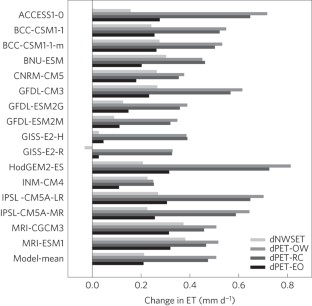
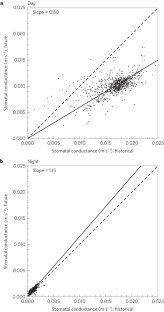
By various measures (drought area1 and intensity2, climatic aridity index3, and climatic water deficits4), some observational analyses have suggested that much of the Earth’s land has been drying during recent decades, but such drying seems inconsistent with observations of dryland greening and decreasing pan evaporation5. ‘Offline’ analyses of climate-model outputs from anthropogenic climate change (ACC) experiments portend continuation of putative drying through the twenty-first century3,6,7,8,9,10, despite an expected increase in global land precipitation9. A ubiquitous increase in estimates of potential evapotranspiration (PET), driven by atmospheric warming11, underlies the drying trends4,8,9,12, but may be a methodological artefact5. Here we show that the PET estimator commonly used (the Penman–Monteith PET13 for either an open-water surface1,2,6,7,12 or a reference crop3,4,8,9,11) severely overpredicts the changes in non-water-stressed evapotranspiration computed in the climate models themselves in ACC experiments. This overprediction is partially due to neglect of stomatal conductance reductions commonly induced by increasing atmospheric CO2 concentrations in climate models5. Our findings imply that historical and future tendencies towards continental drying, as characterized by offline-computed runoff, as well as other PET-dependent metrics, may be considerably weaker and less extensive than previously thought.
This is a preview of subscription content, access via your institution
Access options
Subscribe to this journal
Receive 12 print issues and online access
$259.00 per year
only $21.58 per issue
Buy this article
- Purchase on SpringerLink
- Instant access to the full article PDF.
USD 39.95
Prices may be subject to local taxes which are calculated during checkout
Additional access options:
Figure 1: Changes (future − historical; mm d−1) of ET.
The alternative text for this image may have been generated using AI.
Figure 2: Future versus historical stomatal conductance (m s−1), for the GFDL-ESM2M climate model.
The alternative text for this image may have been generated using AI.
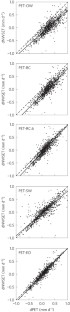
Figure 3: Scatter plot of change in non-water-stressed ET from the GFDL-ESM2M climate model (dNWSET) against change in PET (dPET).
The alternative text for this image may have been generated using AI.
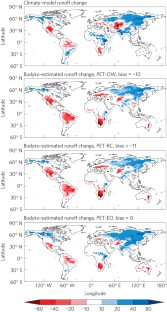
Figure 4: Multi-model median of the relative change (%) of the annual-mean runoff from the historical to the future time period.
The alternative text for this image may have been generated using AI.
References
- Dai, A. Characteristics and trends in various forms of the Palmer Drought Severity Index during 1900–2008. J. Geophys. Res. 116, D12115 (2011).
Article Google Scholar - Sheffield, J., Wood, E. F. & Roderick, M. L. Little change in global drought over the past 60 years. Nature 491, 435–438 (2012).
Article CAS Google Scholar - Feng, S. & Fu, Q. Expansion of drylands under a warming climate. Atmos. Chem. Phys. 13, 10081–10094 (2013).
Article CAS Google Scholar - McCabe, G. J. & Wolock, D. M. Increasing Northern Hemisphere water deficit. Climatic Change 132, 237–249 (2015).
Article Google Scholar - Roderick, M. L., Greve, P. & Farquhar, G. D. On the assessment of aridity with changes in atmospheric CO2 . Wat. Resour. Res. 51, 5450–5463 (2015).
Article CAS Google Scholar - Burke, E. J., Brown, S. J. & Christidis, N. Modeling the evolution of global drought and projections for the twenty-first century with the Hadley Centre climate model. J. Hydrometeor. 7, 1113–1125 (2006).
Article Google Scholar - Dai, A. Increasing drought under global warming in observations and models. Nature Clim. Change 3, 52–58 (2012).
Article Google Scholar - Cook, B. I., Smerdon, J. E., Seager, R. & Coats, S. Global warming and 21st century drying. Clim. Dyn. 43, 2607–2627 (2014).
Article Google Scholar - Fu, Q. & Feng, S. Responses of terrestrial aridity to global warming. J. Geophys. Res. Atmos. 119, 7863–7875 (2014).
Article Google Scholar - Scheff, J. & Frierson, D. M. W. Terrestrial aridity and its response to greenhouse warming across CMIP5 climate models. J. Clim. 28, 5583–5600 (2015).
Article Google Scholar - Scheff, J. & Frierson, D. M. W. Scaling potential evapotranspiration with greenhouse warming. J. Climate 27, 1539–1558 (2014).
Article Google Scholar - Dai, A. Drought under global warming: a review. WIREs Clim. Change 2, 45–65 (2011).
Article Google Scholar - Shuttleworth, W. J. Handbook of Hydrology (ed. Maidment, D. R.) Ch. 4 (McGraw-Hill, 1993).
Google Scholar - Shuttleworth, W. J. & Wallace, J. S. Evaporation from sparse crops—an energy combination theory. Q. J. R. Meteorol. Soc. 111, 839–855 (1985).
Article Google Scholar - Budyko, M. I. Climate and Life (Academic, 1974).
Google Scholar - Roderick, M. L., Sun, F., Lim, W. H. & Farquhar, G. D. A general framework for understanding the response of the water cycle to global warming over land and ocean. Hydrol. Earth Syst. Sci. 18, 1575–1589 (2014).
Article Google Scholar - Koster, R. D. & Mahanama, S. P. P. Land surface controls on hydroclimatic means and variability. J. Hydrometeor. 13, 1604–1620 (2012).
Article Google Scholar - Schewe, J. et al. Multimodel assessment of water scarcity under climate change. Proc. Natl Acad. Sci. USA 111, 3245–3250 (2014).
Article CAS Google Scholar - Chiew, F. H. S., Whetton, P. H., McMahon, T. A. & Pittock, A. B. Simulation of the impacts of climate change on runoff and soil moisture in Australian catchments. J. Hydrol. 167, 121–147 (1995).
Article Google Scholar - Milly, P. C. D., Dunne, K. A. & Vecchia, A. V. Global pattern of trends in streamflow and water availability in a changing climate. Nature 438, 347–350 (2005).
Article CAS Google Scholar - Cook, B. I., Ault, T. R. & Smerdon, J. E. Unprecedented 21st century drought risk in the American Southwest and Central Plains. Sci. Adv. 1, e1400082 (2015).
Article Google Scholar - Sherwood, S. & Fu, Q. A drier future? Science 343, 737–739 (2014).
Article CAS Google Scholar - Milly, P. C. D. & Dunne, K. A. Macroscale water fluxes 2. Water and energy supply control of their interannual variability. Wat. Resour. Res. 38, 24-1–24-9 (2002).
Article Google Scholar - Allen, R. G., Periera, L. S., Raes, D. & Smith, M. Crop Evapotranspiration—Guidelines for Computing Crop Water Requirements Irrigation and Drainage Paper 56, 15 (Food and Agricultural Organization of the United Nations, 1998).
Acknowledgements
The World Climate Research Programme’s Working Group on Coupled Modelling is responsible for CMIP; the climate modelling groups listed in Supplementary Table 1 produced, and made available, their model output. For CMIP, the US Department of Energy’s Program for Climate Model Diagnosis and Intercomparison provides coordinating support and led development of software infrastructure in partnership with the Global Organization for Earth System Science Portals. A. Berg, S. Kapnick, M. Roderick, J. Scheff and G. Wang gave helpful reviews of our manuscript.
Author information
Authors and Affiliations
- US Geological Survey and NOAA/Geophysical Fluid Dynamics Laboratory, Princeton, New Jersey 08540, USA
P. C. D. Milly & K. A. Dunne
Authors
- P. C. D. Milly
- K. A. Dunne
Contributions
P.C.D.M. conceived and led the study, interpreted the data and prepared the manuscript. K.A.D. carried out all computations, prepared all figures and assisted with manuscript preparation.
Corresponding author
Correspondence toP. C. D. Milly.
Ethics declarations
Competing interests
The authors declare no competing financial interests.
Supplementary information
Rights and permissions
About this article
Cite this article
Milly, P., Dunne, K. Potential evapotranspiration and continental drying.Nature Clim Change 6, 946–949 (2016). https://doi.org/10.1038/nclimate3046
- Received: 30 September 2015
- Accepted: 03 May 2016
- Published: 06 June 2016
- Issue date: October 2016
- DOI: https://doi.org/10.1038/nclimate3046