The increasing importance of atmospheric demand for ecosystem water and carbon fluxes (original) (raw)
- Letter
- Published: 05 September 2016
- Darren L. Ficklin2,
- Paul C. Stoy ORCID: orcid.org/0000-0002-6053-62323,
- Christopher A. Williams4,
- Gil Bohrer ORCID: orcid.org/0000-0002-9209-95405,
- A. Christopher Oishi6,
- Shirley A. Papuga7,
- Peter D. Blanken8,
- Asko Noormets9,
- Benjamin N. Sulman10,
- Russell L. Scott11,
- Lixin Wang12 &
- …
- Richard P. Phillips13
Nature Climate Change volume 6, pages 1023–1027 (2016) Cite this article
- 22k Accesses
- 1297 Citations
- 125 Altmetric
- Metrics details
Subjects
Abstract
Soil moisture supply and atmospheric demand for water independently limit—and profoundly affect—vegetation productivity and water use during periods of hydrologic stress1,2,3,4. Disentangling the impact of these two drivers on ecosystem carbon and water cycling is difficult because they are often correlated, and experimental tools for manipulating atmospheric demand in the field are lacking. Consequently, the role of atmospheric demand is often not adequately factored into experiments or represented in models5,6,7. Here we show that atmospheric demand limits surface conductance and evapotranspiration to a greater extent than soil moisture in many biomes, including mesic forests that are of particular importance to the terrestrial carbon sink8,9. Further, using projections from ten general circulation models, we show that climate change will increase the importance of atmospheric constraints to carbon and water fluxes in all ecosystems. Consequently, atmospheric demand will become increasingly important for vegetation function, accounting for >70% of growing season limitation to surface conductance in mesic temperate forests. Our results suggest that failure to consider the limiting role of atmospheric demand in experimental designs, simulation models and land management strategies will lead to incorrect projections of ecosystem responses to future climate conditions.
This is a preview of subscription content, access via your institution
Access options
Subscribe to this journal
Receive 12 print issues and online access
$259.00 per year
only $21.58 per issue
Buy this article
- Purchase on SpringerLink
- Instant access to the full article PDF.
USD 39.95
Prices may be subject to local taxes which are calculated during checkout
Additional access options:
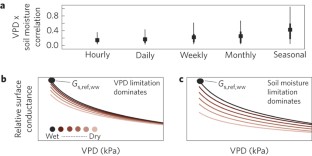
Figure 1: Conceptual framework.
The alternative text for this image may have been generated using AI.
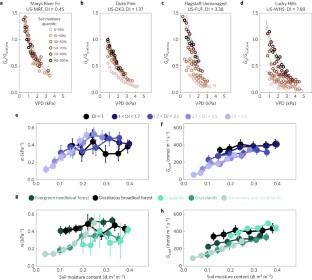
Figure 2: How the relationship between surface conductance and vapour pressure deficit varies with soil moisture.
The alternative text for this image may have been generated using AI.
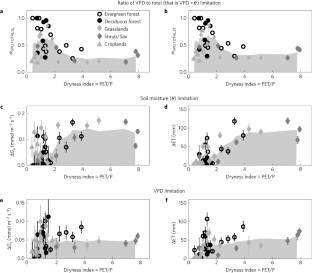
Figure 3: Growing season limitations to _G_S and ET.
The alternative text for this image may have been generated using AI.
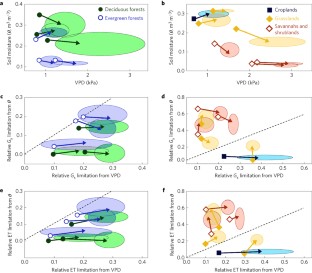
Figure 4: The projected shifts in key study variables from present to future climate conditions.
The alternative text for this image may have been generated using AI.
References
- McDowell, N. G. & Allen, C. D. Darcy’s law predicts widespread forest mortality under climate warming. Nat. Clim. Change 5, 669–672 (2015).
Article Google Scholar - Williams, A. P. et al. Temperature as a potent driver of regional forest drought stress and tree mortality. Nat. Clim. Change 3, 292–297 (2013).
Article Google Scholar - Jung, M. et al. Recent decline in the global land evapotranspiration trend due to limited moisture supply. Nature 467, 951–954 (2010).
Article CAS Google Scholar - Schaefer, K. et al. A model-data comparison of gross primary productivity: results from the North American Carbon Program site synthesis. J. Geophys. Res. 117, G01010 (2012).
Article Google Scholar - Bonan, G., Williams, M., Fisher, R. & Oleson, K. Modeling stomatal conductance in the earth system: linking leaf water-use efficiency and water transport along the soil–plant–atmosphere continuum. Geosci. Model Dev. 7, 2193–2222 (2014).
Article Google Scholar - Matheny, A. M. et al. Characterizing the diurnal patterns of errors in the prediction of evapotranspiration by several land-surface models: an NACP analysis. J. Geophys. Res. 119, 1458–1473 (2014).
Article Google Scholar - Sato, H., Kumagai, T., Takahashi, A. & Katul, G. G. Effects of different representations of stomatal conductance response to humidity across the African continent under warmer CO2-enriched climate conditions. J. Geophys. Res. 120, 979–988 (2015).
Article CAS Google Scholar - Peters, W. et al. An atmospheric perspective on North American carbon dioxide exchange: CarbonTracker. Proc. Natl Acad. Sci. USA 104, 18925–18930 (2007).
Article CAS Google Scholar - Pan, Y. et al. A large and persistent carbon sink in the world’s forests. Science 333, 988–993 (2011).
Article CAS Google Scholar - Beier, C. et al. Precipitation manipulation experiments–challenges and recommendations for the future. Ecol. Lett. 15, 899–911 (2012).
Article Google Scholar - Rodriguez-Iturbe, I. & Porporato, A. Ecohydrology of Water-Controlled Ecosystems - Soil Moisture and Plant Dynamics (Cambridge Univ. Press, 2004).
Google Scholar - Tyree, M. T. & Sperry, J. S. Vulnerability of xylem to cavitation and embolism. Annu. Rev. Plant Biol. 40, 19–36 (1989).
Article Google Scholar - Oren, R. et al. Survey and synthesis of intra- and interspecific variation in stomatal sensitivity to vapour pressure deficit. Plant Cell Environ. 22, 1515–1526 (1999).
Article Google Scholar - Cowan, I. R. & Farquhar, G. D. Stomatal function in relation to leaf metabolism and environment. Symp. Soc. Exp. Biol. 31, 471–505 (1977).
CAS Google Scholar - McAdam, S. A. & Brodribb, T. J. The evolution of mechanisms driving the stomatal response to vapor pressure deficit. Plant Physiol. 167, 833–843 (2015).
Article CAS Google Scholar - Lendzion, J. & Leuschner, C. Growth of European beech (Fagus sylvatica L.) saplings is limited by elevated atmospheric vapour pressure deficits. For. Ecol. Manage. 256, 648–655 (2008).
Article Google Scholar - Katul, G., Manzoni, S., Palmroth, S. & Oren, R. A stomatal optimization theory to describe the effects of atmospheric CO2 on leaf photosynthesis and transpiration. Ann. Botany 105, 431–442 (2010).
Article Google Scholar - Ainsworth, E. A. & Rogers, A. The response of photosynthesis and stomatal conductance to rising [CO2]: mechanisms and environmental interactions. Plant Cell Environ. 30, 258–270 (2007).
Article CAS Google Scholar - Medlyn, B. E. et al. Reconciling the optimal and empirical approaches to modelling stomatal conductance. Glob. Change Biol. 17, 2134–2144 (2011).
Article Google Scholar - Greve, P. et al. Global assessment of trends in wetting and drying over land. Nat. Geosci. 7, 716–721 (2014).
Article CAS Google Scholar - Burke, E. J. & Brown, S. J. Evaluating uncertainties in the projection of future drought. J. Hydrometeorol. 9, 292–299 (2008).
Article Google Scholar - Budyko, M. I. Climate and Life (Academic, 1974).
Google Scholar - Williams, C. A. et al. Climate and vegetation controls on the surface water balance: synthesis of evapotranspiration measured across a global network of flux towers. Wat. Resour. Res. 48, W06523 (2012).
Article Google Scholar - Monteith, J. L. in The State and Movement of Water in Living Organisms, Symposium of the Society of Experimental Biology Vol. 19 (ed. Fogg, B. D.) 205–234 (Cambridge Univ. Press, 1965).
Google Scholar - Granier, A., Loustau, D. & Breda, N. A generic model of forest canopy conductance dependent on climate, soil water availability and leaf area index. Ann. For. Sci. 57, 755–765 (2000).
Article Google Scholar - Jarvis, P. The interpretation of the variations in leaf water potential and stomatal conductance found in canopies in the field. Phil. Trans. R. Soc. Lond. B 273, 593–610 (1976).
Article CAS Google Scholar - Novick, K. A., Miniat, C. F. & Vose, J. M. Drought limitations to leaf-level gas exchange: results from a model linking stomatal optimization and cohesion–tension theory. Plant Cell Environ. 39, 583–596 (2016).
Article CAS Google Scholar - Ruehr, N. K., Martin, J. G. & Law, B. E. Effects of water availability on carbon and water exchange in a young ponderosa pine forest: above-and belowground responses. Agric. For. Meteorol. 164, 136–148 (2012).
Article Google Scholar - Zhu, Z. et al. Greening of the Earth and its drivers. Nat. Clim. Change 6, 791–795 (2016).
Article CAS Google Scholar - Bréda, N., Granier, A. & Aussenac, G. Effects of thinning on soil and tree water relations, transpiration and growth in an oak forest (Quercus petraea (Matt.) Liebl.). Tree Physiol. 15, 295–306 (1995).
Article Google Scholar
Acknowledgements
We acknowledge the US Department of Energy for its support of the Ameriflux Management Project administered by Lawrence Berkeley National Lab, and for its support of the Climate Model Diagnosis and Intercomparison Project. We thank the Ameriflux site teams for sharing their data, and the individual climate modelling groups for sharing their model output. We acknowledge the World Climate Research Programme’s Working Group on Coupled Modelling, which is responsible for the Coupled Model Intercomparison Project (CMIP). K.A.N. acknowledges National Science Foundation (NSF) grant DEB 1552747. P.C.S. acknowledges NSF grants DEB 1552976 and EF 1241881. S.A.P. acknowledges NSF grant EAR 125501. L.W. acknowledges NSF grant EAR 155489. B.N.S. acknowledges support from NOAA/GFDL-Princeton University Cooperative Institute for Climate Science.
Author information
Authors and Affiliations
- Indiana University, School of Public and Environmental Affairs, Bloomington, Indiana 47405, USA
Kimberly A. Novick - Department of Geography, Indiana University, Bloomington, Indiana 47405, USA
Darren L. Ficklin - Department of Land Resources and Environmental Sciences, Montana State University, Bozeman, Montana 59717, USA
Paul C. Stoy - Clark University, Graduate School of Geography, Worcester, Massachusetts 01610, USA
Christopher A. Williams - Department of Civil, The Ohio State University, Environmental & Geodetic Engineering, Columbus, Ohio 43210, USA
Gil Bohrer - USDA Forest Service, Southern Research Station, Coweeta Hydrologic Laboratory, Otto, North Carolina 28763, USA
A. Christopher Oishi - University of Arizona, School of Natural Resources and the Environment, Tucson, Arizona 85721, USA
Shirley A. Papuga - Department of Geography, University of Colorado, Boulder, Colorado 80309-0260, USA
Peter D. Blanken - Department of Forestry and Natural Resources, North Carolina State University, Raleigh, North Carolina 27695, USA
Asko Noormets - Department of Geosciences, Princeton University, Princeton, New Jersey 08544, USA
Benjamin N. Sulman - Southwest Watershed Research Center, USDA-ARS, Tucson, Arizona 85719, USA
Russell L. Scott - Department of Earth Sciences, Indiana University-Purdue University Indianapolis (IUPUI), Indianapolis, Indiana 46202, USA
Lixin Wang - Department of Biology, Indiana University, Bloomington, Indiana 47405, USA
Richard P. Phillips
Authors
- Kimberly A. Novick
- Darren L. Ficklin
- Paul C. Stoy
- Christopher A. Williams
- Gil Bohrer
- A. Christopher Oishi
- Shirley A. Papuga
- Peter D. Blanken
- Asko Noormets
- Benjamin N. Sulman
- Russell L. Scott
- Lixin Wang
- Richard P. Phillips
Contributions
K.A.N. designed the study and methodology, with substantial input from all co-authors, especially D.L.F., C.A.W. and R.P.P. D.L.F. obtained and processed the future climate projections. K.A.N., G.B., S.A.P., P.D.B., A.N., B.N.S., R.L.S., R.P.P. and P.C.S. contributed ecosystem flux data. All authors contributed to data analysis and interpretation. K.A.N. and D.L.F. drafted the manuscript. All authors commented on and approved the final manuscript.
Corresponding author
Correspondence toKimberly A. Novick.
Ethics declarations
Competing interests
The authors declare no competing financial interests.
Supplementary information
Rights and permissions
About this article
Cite this article
Novick, K., Ficklin, D., Stoy, P. et al. The increasing importance of atmospheric demand for ecosystem water and carbon fluxes.Nature Clim Change 6, 1023–1027 (2016). https://doi.org/10.1038/nclimate3114
- Received: 05 February 2016
- Accepted: 01 August 2016
- Published: 05 September 2016
- Issue date: November 2016
- DOI: https://doi.org/10.1038/nclimate3114