Patterns of the seasonal response of tropical rainfall to global warming (original) (raw)
- Letter
- Published: 14 April 2013
Nature Geoscience volume 6, pages 357–361 (2013) Cite this article
- 8778 Accesses
- 350 Citations
- 29 Altmetric
- Metrics details
Subjects
Abstract
Tropical convection is an important factor in regional climate variability and change around the globe 1,2. The response of regional precipitation to global warming is spatially variable, and state-of-the-art model projections suffer large uncertainties in the geographic distribution of precipitation changes 3,4,[5](/articles/ngeo1792#ref-CR5 "Ma, J. & Xie, S-P. Regional patterns of sea surface temperature change: A source of uncertainty in future projections of precipitation and atmospheric circulation. J. Clim. http://dx.doi.org/10.1175/JCLI-D-1112-00283.00281
             (in the press, 2013)."). Two views exist regarding tropical rainfall change: one predicts increased rainfall in presently rainy regions (wet-get-wetter) [6](/articles/ngeo1792#ref-CR6 "Neelin, J., Chou, C. & Su, H. Tropical drought regions in global warming and El Nino teleconnections. Geophys. Res. Lett. 30, 2275 (2003)."),[7](/articles/ngeo1792#ref-CR7 "Held, I. M. & Soden, B. J. Robust responses of the hydrological cycle to global warming. J. Clim. 19, 5686–5699 (2006)."),[8](/articles/ngeo1792#ref-CR8 "Chou, C., Neelin, J., Chen, C. & Tu, J. Evaluating the ‘rich-get-richer’ mechanism in tropical precipitation change under global warming. J. Clim. 22, 1982–2005 (2009)."), and the other suggests increased rainfall where the rise in sea surface temperature exceeds the mean surface warming in the tropics (warmer-get-wetter)[9](/articles/ngeo1792#ref-CR9 "Xie, S-P. et al. Global warming pattern formation: Sea surface temperature and rainfall. J. Clim. 23, 966–986 (2010)."),[10](/articles/ngeo1792#ref-CR10 "Johnson, N. C. & Xie, S-P. Changes in the sea surface temperature threshold for tropical convection. Nature Geosci. 3, 842–845 (2010)."),[11](/articles/ngeo1792#ref-CR11 "Sobel, A. H. & Camargo, S. J. Projected future seasonal changes in tropical summer climate. J. Clim. 24, 473–487 (2011)."),[12](/articles/ngeo1792#ref-CR12 "Chadwick, R., Boutle, I. & Martin, G. Spatial patterns of precipitation change in CMIP5: Why the rich don’t get richer in the tropics. J. Clim.
              http://dx.doi.org/10.1175/JCLI-D-1112-00543.00541

             (in the press, 2013)."). Here we analyse simulations with 18 models from the Coupled Model Intercomparison Project (CMIP5), and present a unifying view for seasonal rainfall change. We find that the pattern of ocean warming induces ascending atmospheric flow at the Equator and subsidence on the flanks, anchoring a band of annual mean rainfall increase near the Equator that reflects the warmer-get-wetter view. However, this climatological ascending motion marches back and forth across the Equator with the Sun, pumping moisture upwards from the boundary layer and causing seasonal rainfall anomalies to follow a wet-get-wetter pattern. The seasonal mean rainfall, which is the sum of the annual mean and seasonal anomalies, thus combines the wet-get-wetter and warmer-get-wetter trends. Given that precipitation climatology is well observed whereas the pattern of ocean surface warming is poorly constrained [13](/articles/ngeo1792#ref-CR13 "Tokinaga, H., Xie, S. P., Deser, C., Kosaka, Y. & Okumura, Y. M. Slowdown of the Walker circulation driven by tropical Indo-Pacific warming. Nature 491, 439–443 (2012)."),[14](/articles/ngeo1792#ref-CR14 "Vecchi, G. & Soden, B. Global warming and the weakening of the tropical circulation. J. Clim. 20, 4316–4340 (2007)."), our results suggest that projections of tropical seasonal mean rainfall are more reliable than the annual mean.
This is a preview of subscription content, access via your institution
Access options
Subscribe to this journal
Receive 12 print issues and online access
$259.00 per year
only $21.58 per issue
Buy this article
- Purchase on SpringerLink
- Instant access to the full article PDF.
USD 39.95
Prices may be subject to local taxes which are calculated during checkout
Additional access options:
Figure 1: Seasonal cycle of precipitation and SST change.
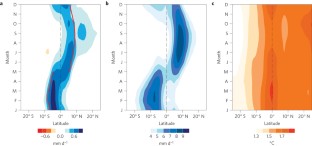
The alternative text for this image may have been generated using AI.
Figure 2: Seasonal cycle of precipitation and circulation changes in SUSI and SPSI runs.
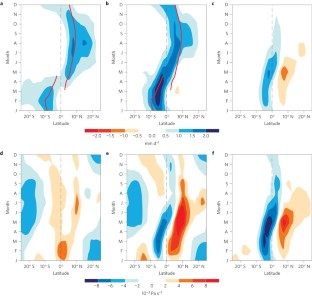
The alternative text for this image may have been generated using AI.
Figure 3: Circulation change and decomposition of precipitation change.
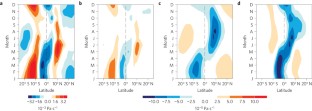
The alternative text for this image may have been generated using AI.
Figure 4: Relationship of precipitation change to mean precipitation, SST change pattern and their linear combination.
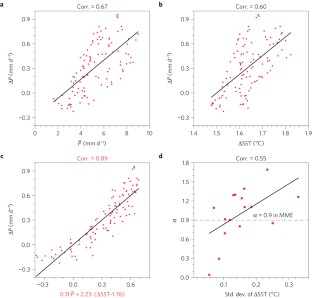
The alternative text for this image may have been generated using AI.
References
- Alexander, M. A. et al. The atmospheric bridge: The influence of ENSO teleconnections on air–sea interaction over the global oceans. J. Clim. 15, 2205–2231 (2002).
Article Google Scholar - Shin, S-I. & Sardeshmukh, P. D. Critical influence of the pattern of Tropical Ocean warming on remote climate trends. Clim. Dyn. 36, 1577–1591 (2011).
Article Google Scholar - Meehl, G. A. et al. in Climate Change 2007: The Physical Science Basis (eds Solomon, S. et al.) Ch. 10, 747–845 (Global Climate Projections, Cambridge Univ. Press, 2007).
Google Scholar - Zhang, X. et al. Detection of human influence on twentieth-century precipitation trends. Nature 448, 461–465 (2007).
Article Google Scholar - Ma, J. & Xie, S-P. Regional patterns of sea surface temperature change: A source of uncertainty in future projections of precipitation and atmospheric circulation. J. Clim.http://dx.doi.org/10.1175/JCLI-D-1112-00283.00281 (in the press, 2013).
- Neelin, J., Chou, C. & Su, H. Tropical drought regions in global warming and El Nino teleconnections. Geophys. Res. Lett. 30, 2275 (2003).
Article Google Scholar - Held, I. M. & Soden, B. J. Robust responses of the hydrological cycle to global warming. J. Clim. 19, 5686–5699 (2006).
Article Google Scholar - Chou, C., Neelin, J., Chen, C. & Tu, J. Evaluating the ‘rich-get-richer’ mechanism in tropical precipitation change under global warming. J. Clim. 22, 1982–2005 (2009).
Article Google Scholar - Xie, S-P. et al. Global warming pattern formation: Sea surface temperature and rainfall. J. Clim. 23, 966–986 (2010).
Article Google Scholar - Johnson, N. C. & Xie, S-P. Changes in the sea surface temperature threshold for tropical convection. Nature Geosci. 3, 842–845 (2010).
Article Google Scholar - Sobel, A. H. & Camargo, S. J. Projected future seasonal changes in tropical summer climate. J. Clim. 24, 473–487 (2011).
Article Google Scholar - Chadwick, R., Boutle, I. & Martin, G. Spatial patterns of precipitation change in CMIP5: Why the rich don’t get richer in the tropics. J. Clim.http://dx.doi.org/10.1175/JCLI-D-1112-00543.00541 (in the press, 2013).
- Tokinaga, H., Xie, S. P., Deser, C., Kosaka, Y. & Okumura, Y. M. Slowdown of the Walker circulation driven by tropical Indo-Pacific warming. Nature 491, 439–443 (2012).
Article Google Scholar - Vecchi, G. & Soden, B. Global warming and the weakening of the tropical circulation. J. Clim. 20, 4316–4340 (2007).
Article Google Scholar - Vecchi, G. A. & Soden, B. J. Effect of remote sea surface temperature change on tropical cyclone potential intensity. Nature 450, 1066–1070 (2007).
Article Google Scholar - Taylor, K. E., Stouffer, R. J. & Meehl, G. A. An overview of CMIP5 and the experiment design. Bull. Am. Meteorol. Soc. 93, 485–498 (2012).
Article Google Scholar - Chou, C. & Tu, J. Y. Hemispherical asymmetry of tropical precipitation in ECHAM5/MPI-OM during El Niño and under global warming. J. Clim. 21, 1309–1332 (2008).
Article Google Scholar - Tan, P-H., Chou, C. & Tu, J-Y. Mechanisms of global warming impacts on robustness of tropical precipitation asymmetry. J. Clim. 21, 5585–5602 (2008).
Article Google Scholar - Liu, Z., Vavrus, S., He, F., Wen, N. & Zhong, Y. Rethinking tropical ocean response to global warming: The enhanced equatorial warming. J. Clim. 18, 4684–4700 (2005).
Article Google Scholar - Cess, R. D. et al. Intercomparison and interpretation of climate feedback processes in 19 atmospheric general circulation models. J. Geophys. Res. 95, 601216 (1990).
Google Scholar - Bony, S. et al. CFMIP: Towards a better evaluation and understanding of clouds and cloud feedbacks in CMIP5 models. CLIVAR Exchanges 56, 20–24 (2011).
Google Scholar - Watanabe, M. & Jin, F. F. A moist linear baroclinic model: Coupled dynamical-convective response to El Nino. J. Clim. 16, 1121–1139 (2003).
Article Google Scholar - Lau, K. M. & Wu, H. T. Detecting trends in tropical rainfall characteristics, 1979–2003. Int. J. Climatol. 27, 979–988 (2007).
Article Google Scholar - Wentz, F. J., Ricciardulli, L., Hilburn, K. & Mears, C. How much more rain will global warming bring? Science 317, 233–235 (2007).
Article Google Scholar - Allan, R. P., Soden, B. J., John, V. O., Ingram, W. & Good, P. Current changes in tropical precipitation. Environ. Res. Lett. 5, 025205 (2010).
Article Google Scholar - Lu, J. & Zhao, B. The role of oceanic feedback in the climate response to doubling CO2 . J. Clim. 25, 7544–7563 (2012).
Article Google Scholar - Deser, C., Phillips, A. & Alexander, M. Twentieth century tropical sea surface temperature trends revisited. Geophys. Res. Lett. 37, L10701 (2010).
Article Google Scholar - Hsu, P. C. et al. Increase of global monsoon area and precipitation under global warming: A robust signal? Geophys. Res. Lett. 39, L06701 (2012).
Google Scholar - Kitoh, A. et al. Monsoons in a changing world: a regional perspective in a global context. J. Geophys. Res.http://dx.doi.org/10.1002/jgrd.50258 (2013).
Acknowledgements
The work was supported by the National Basic Research Program of China (2012CB955604 and 2010CB950403), the Natural Science Foundation of China (41105047 and 41275083) and the US National Science Foundation. We wish to thank C. Chou for helpful discussions, and X. Qu for data processing. We acknowledge the World Climate Research Programme’s Working Group on Coupled Modelling, which is responsible for CMIP5, and we thank the climate modeling groups (listed in the Methods of this paper) for producing and making available their model output.
Author information
Authors and Affiliations
- Center for Monsoon System Research, Institute of Atmospheric Physics, Chinese Academy of Sciences, Beijing 100190, China
Ping Huang, Kaiming Hu & Ronghui Huang - Scripps Institution of Oceanography, University of California at San Diego, La Jolla, California 92093, USA
Shang-Ping Xie - Physical Oceanography Laboratory, Ocean University of China, Qingdao 266003, China
Shang-Ping Xie - International Pacific Research Center, University of Hawaii at Manoa, Honolulu, Hawaii 96822, USA
Shang-Ping Xie - Key Laboratory of Regional Climate-Environment Research for Temperate East Asia, Institute of Atmospheric Physics, Chinese Academy of Sciences, Beijing 100190, China
Gang Huang
Authors
- Ping Huang
- Shang-Ping Xie
- Kaiming Hu
- Gang Huang
- Ronghui Huang
Contributions
P.H. designed and performed the analysis. S-P.X. contributed to improving the analysis and interpretation. K.H. and G.H. prepared part of the data. P.H. and S-P.X. wrote the paper. All authors discussed and commented on the paper.
Corresponding authors
Correspondence toPing Huang or Shang-Ping Xie.
Ethics declarations
Competing interests
The authors declare no competing financial interests.
Supplementary information
Rights and permissions
About this article
Cite this article
Huang, P., Xie, SP., Hu, K. et al. Patterns of the seasonal response of tropical rainfall to global warming.Nature Geosci 6, 357–361 (2013). https://doi.org/10.1038/ngeo1792
- Received: 30 October 2012
- Accepted: 06 March 2013
- Published: 14 April 2013
- Issue date: May 2013
- DOI: https://doi.org/10.1038/ngeo1792