Declining uncertainty in transient climate response as CO2 forcing dominates future climate change (original) (raw)
- Letter
- Published: 23 February 2015
Nature Geoscience volume 8, pages 181–185 (2015) Cite this article
- 3777 Accesses
- 45 Citations
- 47 Altmetric
- Metrics details
Subjects
Abstract
Carbon dioxide has exerted the largest portion of radiative forcing and surface temperature change over the industrial era, but other anthropogenic influences have also contributed1,2. However, large uncertainties in total forcing make it difficult to derive climate sensitivity from historical observations3,4,5,6,7. Anthropogenic forcing has increased between the Fourth and Fifth Assessment Reports of the Intergovernmental Panel of Climate Change (IPCC; refs 1, 8), although its relative uncertainty has decreased. Here we show, based on data from the two reports, that this evolution towards lower uncertainty can be expected to continue into the future. Because it is easier to reduce air pollution than carbon dioxide emissions and because of the long lifetime of carbon dioxide, the less uncertain carbon dioxide forcing is expected to become increasingly dominant. Using a statistical model, we estimate that the relative uncertainty in anthropogenic forcing of more than 40% quoted in the latest IPCC report for 2011 will be almost halved by 2030, even without better scientific understanding. Absolute forcing uncertainty will also decline for the first time, provided projected decreases in aerosols occur. Other factors being equal, this stronger constraint on forcing will bring a significant reduction in the uncertainty of observation-based estimates of the transient climate response, with a 50% reduction in its uncertainty range expected by 2030.
This is a preview of subscription content, access via your institution
Access options
Subscribe to this journal
Receive 12 print issues and online access
$259.00 per year
only $21.58 per issue
Buy this article
- Purchase on SpringerLink
- Instant access to the full article PDF.
USD 39.95
Prices may be subject to local taxes which are calculated during checkout
Additional access options:
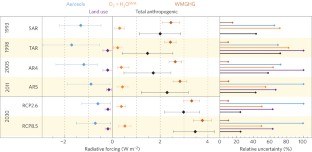
Figure 1: Anthropogenic forcing for four phases of IPCC reports and two RCPs.
The alternative text for this image may have been generated using AI.
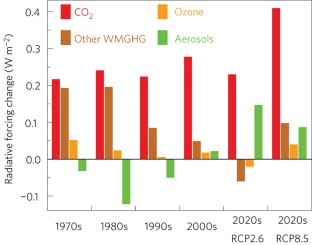
Figure 2: Decadal RF change between 1970 and 2010 and for 2020 to 2030 for two RCPs.
The alternative text for this image may have been generated using AI.
Figure 3: Time evolution in RF and standard deviation in RF.

The alternative text for this image may have been generated using AI.
Figure 4: Uncertainty in TCR with RF and temperature change.

The alternative text for this image may have been generated using AI.
References
- Myhre, G. et al. in Climate Change 2013: The Physical Science Basis (eds Stocker, T. F. et al.) 659–740 (IPCC, Cambridge Univ. Press, 2013).
Google Scholar - IPCC Climate Change 2013: The Physical Science Basis (eds Stocker, T. F. et al.) (Cambridge Univ. Press, 2013).
Google Scholar - Aldrin, M. et al. Bayesian estimation of climate sensitivity based on a simple climate model fitted to observations of hemispheric temperatures and global ocean heat content. Environmetrics 23, 253–271 (2012).
Article Google Scholar - Andreae, M. O., Jones, C. D. & Cox, P. M. Strong present-day aerosol cooling implies a hot future. Nature 435, 1187–1190 (2005).
Article Google Scholar - Knutti, R. & Hegerl, G. C. The equilibrium sensitivity of the Earth’s temperature to radiation changes. Nature Geosci. 1, 735–743 (2008).
Article Google Scholar - Otto, A. et al. Energy budget constraints on climate response. Nature Geosci. 6, 415–416 (2013).
Article Google Scholar - Roe, G. H. & Armour, K. C. How sensitive is climate sensitivity? Geophys. Res. Lett. 38, L14708 (2011).
Article Google Scholar - Forster, P. et al. in Climate Change 2007: The Physical Science Basis (eds Solomon, S. et al.) 129–134 (IPCC, Cambridge Univ. Press, 2007).
Google Scholar - Urban, N. M. et al. Historical and future learning about climate sensitivity. Geophys. Res. Lett. 41, 2543–2552 (2014).
Article Google Scholar - Isaksen, I. S. A. et al. Atmospheric composition change: Climate–chemistry interactions. Atmos. Environ. 43, 5138–5192 (2009).
Article Google Scholar - Raes, F., Liao, H., Chen, W. T. & Seinfeld, J. H. Atmospheric chemistry–climate feedbacks. J. Geophys. Res. 115, D12121 (2010).
Article Google Scholar - Shindell, D. T. et al. Improved attribution of climate forcing to emissions. Science 326, 716–718 (2009).
Article Google Scholar - Crook, J. A. & Forster, P. M. A balance between radiative forcing and climate feedback in the modeled 20th century temperature response. J. Geophys. Res. 116, D17108 (2011).
Article Google Scholar - Huber, M. & Knutti, R. Anthropogenic and natural warming inferred from changes in Earth’s energy balance. Nature Geosci. 5, 31–36 (2012).
Article Google Scholar - Hansen, J., Sato, M., Kharecha, P. & von Schuckmann, K. Earth’s energy imbalance and implications. Atmos. Chem. Phys. 11, 13421–13449 (2011).
Article Google Scholar - Ramanathan, V., Crutzen, P. J., Kiehl, J. T. & Rosenfeld, D. Atmosphere—aerosols, climate, and the hydrological cycle. Science 294, 2119–2124 (2001).
Article Google Scholar - Boucher, O. et al. in Climate Change 2013: The Physical Science Basis (eds Stocker, T. F. et al.) 571–657 (IPCC, Cambridge Univ. Press, 2013).
Google Scholar - Haywood, J. & Schulz, M. Causes of the reduction in uncertainty in the anthropogenic radiative forcing of climate between IPCC (2001) and IPCC (2007). Geophys. Res. Lett. 34, L20701 (2007).
Article Google Scholar - Boucher, O. & Haywood, J. On summing the components of radiative forcing of climate change. Clim. Dynam. 18, 297–302 (2001).
Article Google Scholar - Forest, C. E. et al. Quantifying uncertainties in climate system properties with the use of recent climate observations. Science 295, 113–117 (2002).
Article Google Scholar - Knutti, R., Stocker, T. F., Joos, F. & Plattner, G. K. Constraints on radiative forcing and future climate change from observations and climate model ensembles. Nature 416, 719–723 (2002).
Article Google Scholar - Peters, G. P. et al. The challenge to keep global warming below 2 degrees C. Nature Clim. Change 3, 4–6 (2013).
Article Google Scholar - Murphy, D. M. Little net clear-sky radiative forcing from recent regional redistribution of aerosols. Nature Geosci. 6, 258–262 (2013).
Article Google Scholar - Shindell, D. T. Inhomogeneous forcing and transient climate sensitivity. Nature Clim. Change 4, 274–277 (2014).
Article Google Scholar - Forster, P. M. et al. Evaluating adjusted forcing and model spread for historical and future scenarios in the CMIP5 generation of climate models. J. Geophys. Res. 118, 1139–1150 (2013).
Google Scholar - Meinshausen, M. et al. Greenhouse-gas emission targets for limiting global warming to 2 degrees C. Nature 458, 1158–1162 (2009).
Article Google Scholar - Prather, M. et al. in Climate Change 2013: The Physical Science Basis (eds Stocker, T. F. et al.) 1395–1445 (IPCC, Cambridge Univ. Press, 2013).
Google Scholar - Van Vuuren, D. P. et al. The representative concentration pathways: An overview. Climatic Change 109, 5–31 (2011).
Article Google Scholar - Skeie, R. B. et al. Anthropogenic radiative forcing time series from pre-industrial times until 2010. Atmos. Chem. Phys. 11, 11827–11857 (2011).
Article Google Scholar - Shindell, D. T. et al. Radiative forcing in the ACCMIP historical and future climate simulations. Atmos. Chem. Phys. 13, 2939–2974 (2013).
Article Google Scholar
Acknowledgements
G.M. was supported by the Norwegian Research Council project SLAC (208277). Norwegian Research Council project number 230619 supported a personal visit for P.F.
Author information
Authors and Affiliations
- Center for International Climate and Environmental Research—Oslo (CICERO), Pb. 1129 Blindern, N-0318 Oslo, Norway
Gunnar Myhre - Laboratoire de Météorologie Dynamique, IPSL, CNRS/UPMC, 75252 Paris, France
Olivier Boucher - Laboratoire des Sciences du Climat et de l’Environnement, IPSL, CEA/CNRS/UVSQ, 91191 Gif sur Yvette, France
François-Marie Bréon - School of Earth and Environment, University of Leeds, Leeds LS2 9JT, UK
Piers Forster - Nicholas School of the Environment, Duke University, Durham, North Carolina 27708, USA
Drew Shindell
Authors
- Gunnar Myhre
- Olivier Boucher
- François-Marie Bréon
- Piers Forster
- Drew Shindell
Contributions
G.M., F-M.B. and D.S. initiated the study with additional contributions on the design of the study from P.F. and O.B. G.M., O.B., F-M.B., P.F. and D.S. performed the analysis and wrote the paper.
Corresponding author
Correspondence toGunnar Myhre.
Ethics declarations
Competing interests
The authors declare no competing financial interests.
Supplementary information
Rights and permissions
About this article
Cite this article
Myhre, G., Boucher, O., Bréon, FM. et al. Declining uncertainty in transient climate response as CO2 forcing dominates future climate change.Nature Geosci 8, 181–185 (2015). https://doi.org/10.1038/ngeo2371
- Received: 04 July 2014
- Accepted: 20 January 2015
- Published: 23 February 2015
- Issue date: March 2015
- DOI: https://doi.org/10.1038/ngeo2371
This article is cited by
Weak hydrological sensitivity to temperature change over land, independent of climate forcing
- B. H. Samset
- G. Myhre
- A. Voulgarakis
npj Climate and Atmospheric Science (2018)
The Radiative Forcing of Aerosol–Cloud Interactions in Liquid Clouds: Wrestling and Embracing Uncertainty
- Johannes Mülmenstädt
- Graham Feingold
Current Climate Change Reports (2018)
Beyond equilibrium climate sensitivity
- Reto Knutti
- Maria A. A. Rugenstein
- Gabriele C. Hegerl
Nature Geoscience (2017)
Climate goals and computing the future of clouds
- Tapio Schneider
- João Teixeira
- A. Pier Siebesma
Nature Climate Change (2017)
Committed warming inferred from observations
- Thorsten Mauritsen
- Robert Pincus
Nature Climate Change (2017)