Committed warming inferred from observations (original) (raw)
Abstract
Due to the lifetime of CO2, the thermal inertia of the oceans1,2, and the temporary impacts of short-lived aerosols3,4,5 and reactive greenhouse gases6, the Earth’s climate is not equilibrated with anthropogenic forcing. As a result, even if fossil-fuel emissions were to suddenly cease, some level of committed warming is expected due to past emissions as studied previously using climate models6,7,8,9,10,11. Here, we provide an observational-based quantification of this committed warming using the instrument record of global-mean warming12, recently improved estimates of Earth’s energy imbalance13, and estimates of radiative forcing from the Fifth Assessment Report of the Intergovernmental Panel on Climate Change14. Compared with pre-industrial levels, we find a committed warming of 1.5 K (0.9–3.6, 5th–95th percentile) at equilibrium, and of 1.3 K (0.9–2.3) within this century. However, when assuming that ocean carbon uptake cancels remnant greenhouse gas-induced warming on centennial timescales, committed warming is reduced to 1.1 K (0.7–1.8). In the latter case there is a 13% risk that committed warming already exceeds the 1.5 K target set in Paris15. Regular updates of these observationally constrained committed warming estimates, although simplistic, can provide transparent guidance as uncertainty regarding transient climate sensitivity inevitably narrows16 and the understanding of the limitations of the framework11,17,18,19,20,21 is advanced.
This is a preview of subscription content, access via your institution
Access options
Access Nature and 54 other Nature Portfolio journals
Get Nature+, our best-value online-access subscription
$32.99 / 30 days
cancel any time
Subscribe to this journal
Receive 12 print issues and online access
$259.00 per year
only $21.58 per issue
Buy this article
- Purchase on SpringerLink
- Instant access to the full article PDF.
USD 39.95
Prices may be subject to local taxes which are calculated during checkout
Additional access options:
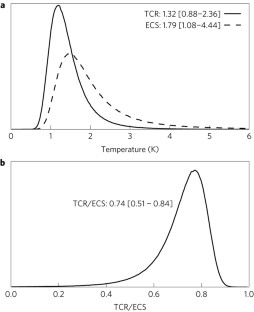
Figure 1: Probabilities of transient climate response (TCR) and equilibrium climate sensitivity (ECS).
The alternative text for this image may have been generated using AI.
Figure 2: Estimates of committed warming under five different sets of assumptions.

The alternative text for this image may have been generated using AI.
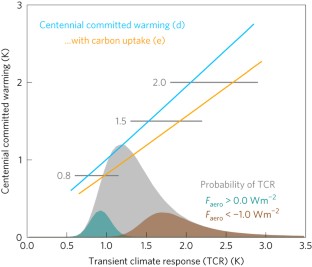
Figure 3: Commitment as a function of transient climate response.
The alternative text for this image may have been generated using AI.
Overconfidence in climate overshoot
Article Open access 09 October 2024
References
- Bryan, K., Komro, F. G., Manabe, S. & Spelman, M. J. Transient climate response to increasing atmospheric carbon dioxide. Science 215, 56–58 (1982).
Article CAS Google Scholar - Wigley, T. M. L. The climate change commitment. Science 307, 1766–1769 (2005).
Article CAS Google Scholar - Wigley, T. M. L. Could reducing fossil-fuel emissions cause global warming? Nature 349, 503–506 (1991).
Article CAS Google Scholar - Hare, B. & Meinshausen, M. How much warming are we committed to and how much can be avoided? Climatic Change 75, 111–149 (2006).
Article CAS Google Scholar - Ramanathan, V. & Feng, Y. On avoiding dangerous anthropogenic interference with the climate system: formidable challenges ahead. Proc. Natl Acad. Sci. USA 105, 14245–14250 (2008).
Article CAS Google Scholar - Matthews, H. D. & Zickfeld, K. Climate response to zeroed emissions of greenhouse gases and aerosols. Nat. Clim. Change 2, 338–341 (2012).
Article CAS Google Scholar - Archer, D. & Brovkin, V. The millennial atmospheric lifetime of anthropogenic CO2 . Climatic Change 90, 283–297 (2008).
Article CAS Google Scholar - Solomon, S., Plattner, G.-K., Knutti, R. & Friedlingstein, P. Irreversible climate change due to carbon dioxide emissions. Proc. Natl Acad. Sci. USA 106, 1704–1709 (2009).
Article CAS Google Scholar - Gillett, N. P., Arora, V. K., Zickfeld, K., Marshall, S. J. & Merryfield, W. J. Ongoing climate change following a complete cessation of carbon dioxide emissions. Nat. Geosci. 4, 83–87 (2011).
Article CAS Google Scholar - Collins, M. et al. in Climate Change 2013: The Physical Science Basis (eds Stocker, T. F. et al.) (IPCC, Cambridge Univ. Press, 2013).
Google Scholar - Frölicher, T. L., Winton, M. & Sarmiento, J. L. Continued global warming after CO2 emissions stoppage. Nat. Clim. Change 4, 40–44 (2014).
Article Google Scholar - Morice, C. P., Kennedy, J. J., Rayner, N. A. & Jones, P. D. Quantifying uncertainties in global and regional temperature change using an ensemble of observational estimates: the HadCRUT4 data set. J. Geophys. Res. 117, D08101 (2012).
Article Google Scholar - Johnson, G. C., Lyman, J. M. & Loeb, N. G. Improving estimates of Earth’s energy imbalance. Nat. Clim. Change 6, 639–640 (2016).
Article Google Scholar - IPCC Climate Change 2013: The Physical Science Basis 1395–1446 (Cambridge Univ. Press, 2013).
- Adoption of the Paris Agreement Tech. Rep. FCCC/CP/2015/L.9/Rev.1 (UNFCC, 2015).
- Myhre, G., Boucher, O., Breon, F.-M., Forster, P. & Shindell, D. Declining uncertainty in transient climate response as CO2 forcing dominates future climate change. Nat. Geosci. 8, 181–185 (2015).
Article CAS Google Scholar - Stevens, B. Rethinking the lower bound on aerosol radiative forcing. J. Clim. 28, 4794–4819 (2015).
Article Google Scholar - Richardson, M., Cowtan, K., Hawkins, E. & Stolpe, M. B. Reconciled climate response estimates from climate models and the energy budget of Earth. Nat. Clim. Change 6, 931–935 (2016).
Article Google Scholar - Marvel, K., Schmidt, G. A., Miller, R. L. & Nazarenko, L. S. Implications for climate sensitivity from the response to individual forcings. Nat. Clim. Change 6, 386–389 (2016).
Article Google Scholar - Gregory, J. M. & Andrews, T. Variation in climate sensitivity and feedback parameters during the historical period. Geophys. Res. Lett. 43, 3911–3920 (2016).
Article Google Scholar - Armour, K. C. Energy budget constraints on climate sensitivity in light of inconstant climate feedbacks. Nat. Clim. Change 7, 331–335 (2017).
Article Google Scholar - Gregory, J. M., Stouffer, R. J., Raper, S. C. B., Stott, P. A. & Rayner, N. A. An observationally based estimate of the climate sensitivity. J. Clim. 15, 3117–3121 (2002).
Article Google Scholar - Otto, A. et al. Energy budget constraints on climate response. Nat. Geosci. 6, 415–416 (2013).
Article CAS Google Scholar - Lewis, N. & Curry, J. A. The implications for climate sensitivity of AR5 forcing and heat uptake estimates. Clim. Dynam. 45, 1009–1023 (2014).
Article Google Scholar - Bindoff, N. et al. in Climate Change 2013: The Physical Science Basis (eds Stocker, T. F. et al.) (IPCC, Cambridge Univ. Press, 2013).
Google Scholar - Myhre, G. et al. in Climate Change 2013: The Physical Science Basis (eds Stocker, T. F. et al.) (IPCC, Cambridge Univ. Press, 2013).
Google Scholar - Armour, K. C. & Roe, G. H. Climate commitment in an uncertain world. Geophys. Res. Lett. 38, L01707 (2011).
Article Google Scholar - Hansen, J. et al. Climate response times: dependence on climate sensitivity and ocean mixing. Science 229, 857–859 (1985).
Article CAS Google Scholar - Sabine, C. L. et al. The oceanic sink for anthropogenic CO2 . Science 305, 367–371 (2004).
Article CAS Google Scholar - Frölicher, T. L. et al. Dominance of the southern ocean in anthropogenic carbon and heat uptake in CMIP5 models. J. Clim. 28, 862–886 (2015).
Article Google Scholar - Sherwood, S. C. et al. Adjustments in the forcing-feedback framework for understanding climate change. Bull. Am. Meteorol. Soc. 96, 217–228 (2015).
Article Google Scholar - Gregory, J. M., Andrews, T., Good, P., Mauritsen, T. & Forster, P. M. Small global-mean cooling due to volcanic radiative forcing. Clim. Dynam. 47, 3979–3991 (2016).
Article Google Scholar - Ciais, P. et al. in Climate Change 2013: The Physical Science Basis (eds Stocker, T. F. et al.) (IPCC, Cambridge Univ. Press, 2013).
Google Scholar - Geoffroy, O. et al. Transient climate response in a two-layer energy-balance model. Part I: analytical solution and parameter calibration using CMIP5 AOGCM experiments. J. Clim. 26, 1841–1857 (2013).
Article Google Scholar - Gregory, J. M. et al. Climate models without preindustrial volcanic forcing underestimate historical ocean thermal expansion. Geophys. Res. Lett. 40, 1600–1604 (2013).
Article Google Scholar
Acknowledgements
The work of T.M. is supported by the Max-Planck-Gesellschaft (MPG). R.P. is supported by the Regional and Global Climate Modeling Program of the US Department of Energy under grant DE-SC0012549 and by the National Science Foundation under grant ATM-1138394. The original motivation for this study arose at a preparation meeting for the IPCC special report on the 1.5 degree target (SR1.5) arranged by C. Textor and R. von Kuhlmann on behalf of the Federal Ministry for Education and Research in Germany (BMBF). The study benefited from comments and input from A. Dessler, J. Gregory, N. Lewis, V. Brovkin and P. Lanschützer.
Author information
Authors and Affiliations
- Max Planck Institute for Meteorology, Bundesstrasse 53, 20146, Hamburg, Germany
Thorsten Mauritsen - University of Colorado, Boulder, Colorado, 80309, USA
Robert Pincus - Physical Sciences Division, NOAA Earth System Research Lab, Boulder, Colorado, 80305, USA
Robert Pincus
Authors
- Thorsten Mauritsen
- Robert Pincus
Contributions
The original idea for this study was conceived by T.M. R.P. and T.M. developed the methodology and wrote the manuscript.
Corresponding author
Correspondence toThorsten Mauritsen.
Ethics declarations
Competing interests
The authors declare no competing financial interests.
Supplementary information
Rights and permissions
About this article
Cite this article
Mauritsen, T., Pincus, R. Committed warming inferred from observations.Nature Clim Change 7, 652–655 (2017). https://doi.org/10.1038/nclimate3357
- Received: 17 January 2017
- Accepted: 30 July 2017
- Published: 31 July 2017
- Issue date: 01 September 2017
- DOI: https://doi.org/10.1038/nclimate3357