China's post-coal growth (original) (raw)
- Commentary
- Published: 25 July 2016
Nature Geoscience volume 9, pages 564–566 (2016) Cite this article
- 5568 Accesses
- 180 Citations
- 352 Altmetric
- Metrics details
Subjects
Slowing GDP growth, a structural shift away from heavy industry, and more proactive policies on air pollution and clean energy have caused China's coal use to peak. It seems that economic growth has decoupled from growth in coal consumption.
This is a preview of subscription content, access via your institution
Relevant articles
Open Access articles citing this article.
Global declarations on electric vehicles, carbon life cycle and Nash equilibrium
- Baher Bakhtyar
- , Zhang Qi
- … Salim Rashid
Clean Technologies and Environmental Policy Open Access 19 September 2022
Cultural models of and for urban sustainability: assessing beliefs about Green-Win
- Thomas F. Thornton
- , Diana Mangalagiu
- … Abdel Maoula Chaar
Climatic Change Open Access 11 October 2019
Access options
Subscribe to this journal
Receive 12 print issues and online access
$259.00 per year
only $21.58 per issue
Buy this article
- Purchase on SpringerLink
- Instant access to the full article PDF.
USD 39.95
Prices may be subject to local taxes which are calculated during checkout
Additional access options:
Figure 1

The alternative text for this image may have been generated using AI.
© ALEX SEGRE / ALAMY STOCK PHOTO
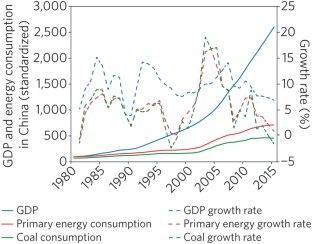
Figure 2: China's economy, primary energy and coal consumption (setting 1980 values as 100), and their respective growth rates.
The alternative text for this image may have been generated using AI.
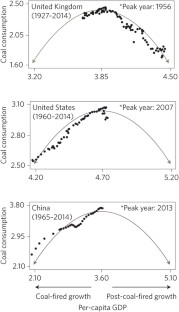
Figure 3: Historical trajectories of economic development and coal consumption for the United Kingdom, the United States and China (data normalized for comparison; note differences in values on both axes).
The alternative text for this image may have been generated using AI.
References
- World Energy Outlook 2015 (International Energy Agency, 2015).
- National Bureau of Statistics China Energy Statistical Yearbook 2014 (China Statistics Press, 2015).
- Qi, Y., Wu, T., He, J. & King, D. A. Nature Geosci. 6, 507–509 (2013).
Article Google Scholar - Wang, J., Feng, L., Davidsson, S. & Höök, M. Energy 60, 204–214 (2013).
Article Google Scholar - Liu, Z. et al. Nature 524, 335–338 (2015).
Article Google Scholar - Korsbakken, J. I., Peters, G. P. & Andrew, R. M. Nature Clim. Change 6, 687–690 (2016).
Article Google Scholar - Jevons, W. S. The Coal Question: An Inquiry Concerning the Progress of the Nation, and the Probable Exhaustion of Our Coal-Mines (Macmillan & Co., 1865).
Google Scholar - Qi, Y. Annual Review of Low-Carbon Development in China (2014) (Social Sciences Academic Press, 2014).
Google Scholar - Qi, Y. et al. Annual Review of Low-Carbon Development in China (2015–2016) (Social Sciences Academic Press, 2016).
Google Scholar - Du, B. China's Coal Supply and Future Development (National Energy Administration, 2015).
Google Scholar - Liu, Z. et al. Nature Clim. Change 6, 201–206 (2016).
Article Google Scholar - China 2030: Building a Modern, Harmonious, and Creative Society (World Bank and the Development Research Center of the State Council, 2013).
- Qi, Y. & Wu, T. WIREs Clim. Change 4, 301–313 (2013).
Google Scholar - Green, F. & Stern, N. Clim. Pol. http://doi.org/bdmm (2016).
- Rifkin, J. The Third Industrial Revolution: How Lateral Power Is Transforming Energy, the Economy, and the World (Palgrave Macmillan, 2011).
Google Scholar - Stern, N. Why Are We Waiting? The Logic, Urgency, and Promise of Tackling Climate Change (MIT Press, 2015).
Google Scholar - Sinn, H.-W. Int. Tax Public Finan. 15, 360–394 (2008).
Article Google Scholar - Sinn, H.-W. The Green Paradox: A Supply-Side Approach to Global Warming (MIT Press, 2012).
Book Google Scholar
Author information
Authors and Affiliations
- School of Public Policy and Management, Tsinghua University, Beijing, 100084, China
Ye Qi & Tong Wu - Brookings-Tsinghua Center for Public Policy, Tsinghua University, Beijing, 100084, China
Ye Qi & Jiaqi Lu - Grantham Research Institute on Climate Change and the Environment, London School of Economics and Political Science, Houghton Street, London, WC2A 2AE, UK
Nicholas Stern & Fergus Green - ecoSERVICES Group, School of Life Sciences, Arizona State University, Tempe, 85287, Arizona, USA
Tong Wu
Authors
- Ye Qi
- Nicholas Stern
- Tong Wu
- Jiaqi Lu
- Fergus Green
Corresponding author
Correspondence toTong Wu.
Rights and permissions
About this article
Cite this article
Qi, Y., Stern, N., Wu, T. et al. China's post-coal growth.Nature Geosci 9, 564–566 (2016). https://doi.org/10.1038/ngeo2777
- Published: 25 July 2016
- Issue date: August 2016
- DOI: https://doi.org/10.1038/ngeo2777