A non-volatile organic electrochemical device as a low-voltage artificial synapse for neuromorphic computing (original) (raw)
- Letter
- Published: 20 February 2017
- Ewout Lubberman1,2 na1,
- Elliot J. Fuller3,
- Scott T. Keene1,
- Grégorio C. Faria1,4,
- Sapan Agarwal3,
- Matthew J. Marinella5,
- A. Alec Talin3 &
- …
- Alberto Salleo1
Nature Materials volume 16, pages 414–418 (2017)Cite this article
- 70k Accesses
- 1755 Citations
- 633 Altmetric
- Metrics details
Subjects
Abstract
The brain is capable of massively parallel information processing while consuming only ∼1–100 fJ per synaptic event[1](/articles/nmat4856#ref-CR1 "Merkle, R. Energy limits to the computational power of the human brain. Foresight Update 6 (Foresight Institute, 1989); https://www.foresight.org/Updates/Update06/Update06.1.html
"),[2](/articles/nmat4856#ref-CR2 "Laughlin, S. B., de Ruyter van Steveninck, R. R. & Anderson, J. C. The metabolic cost of neural information. Nat. Neurosci. 1, 36–41 (1998)."). Inspired by the efficiency of the brain, CMOS-based neural architectures[3](/articles/nmat4856#ref-CR3 "Merolla, P. A. et al. A million spiking-neuron integrated circuit with a scalable communication network and interface. Science 345, 668–673 (2014).") and memristors[4](/articles/nmat4856#ref-CR4 "Strukov, D. B., Snider, G. S., Stewart, D. R. & Williams, R. S. The missing memristor found. Nature 453, 80–83 (2008)."),[5](/articles/nmat4856#ref-CR5 "Kim, S. et al. Experimental demonstration of a second-order memristor and its ability to biorealistically implement synaptic plasticity. Nano Lett. 15, 2203–2211 (2015).") are being developed for pattern recognition and machine learning. However, the volatility, design complexity and high supply voltages for CMOS architectures, and the stochastic and energy-costly switching of memristors complicate the path to achieve the interconnectivity, information density, and energy efficiency of the brain using either approach. Here we describe an electrochemical neuromorphic organic device (ENODe) operating with a fundamentally different mechanism from existing memristors. ENODe switches at low voltage and energy (<10 pJ for 103 μm2 devices), displays >500 distinct, non-volatile conductance states within a ∼1 V range, and achieves high classification accuracy when implemented in neural network simulations. Plastic ENODes are also fabricated on flexible substrates enabling the integration of neuromorphic functionality in stretchable electronic systems[6](/articles/nmat4856#ref-CR6 "Chortos, A., Liu, J. & Bao, Z. Pursuing prosthetic electronic skin. Nat. Mater. 15, 937–950 (2016)."),[7](/articles/nmat4856#ref-CR7 "Yokota, T. et al. Ultra-flexible organic photonic skin. Sci. Adv. 2, e1501856 (2016)."). Mechanical flexibility makes ENODes compatible with three-dimensional architectures, opening a path towards extreme interconnectivity comparable to the human brain.This is a preview of subscription content, access via your institution
Access options
Access Nature and 54 other Nature Portfolio journals
Get Nature+, our best-value online-access subscription
$32.99 / 30 days
cancel any time
Subscribe to this journal
Receive 12 print issues and online access
$259.00 per year
only $21.58 per issue
Buy this article
- Purchase on SpringerLink
- Instant access to the full article PDF.
USD 39.95
Prices may be subject to local taxes which are calculated during checkout
Additional access options:
Figure 1: Structure and electronic states of an organic neuromorphic device.
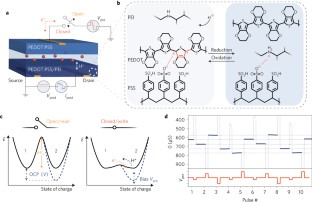
The alternative text for this image may have been generated using AI.
Figure 2: Neuromorphic behaviour.
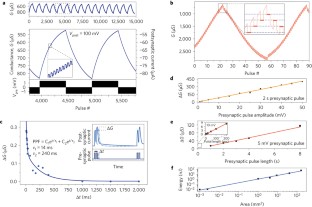
The alternative text for this image may have been generated using AI.
Figure 3: Flexible all solid-state neuromorphic device.
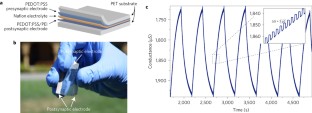
The alternative text for this image may have been generated using AI.
Figure 4: Learning circuit and image recognition simulations.
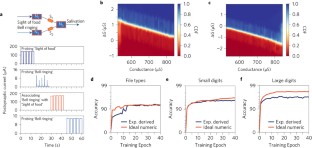
The alternative text for this image may have been generated using AI.
References
- Merkle, R. Energy limits to the computational power of the human brain. Foresight Update 6 (Foresight Institute, 1989); https://www.foresight.org/Updates/Update06/Update06.1.html
Google Scholar - Laughlin, S. B., de Ruyter van Steveninck, R. R. & Anderson, J. C. The metabolic cost of neural information. Nat. Neurosci. 1, 36–41 (1998).
Article CAS Google Scholar - Merolla, P. A. et al. A million spiking-neuron integrated circuit with a scalable communication network and interface. Science 345, 668–673 (2014).
Article CAS Google Scholar - Strukov, D. B., Snider, G. S., Stewart, D. R. & Williams, R. S. The missing memristor found. Nature 453, 80–83 (2008).
Article CAS Google Scholar - Kim, S. et al. Experimental demonstration of a second-order memristor and its ability to biorealistically implement synaptic plasticity. Nano Lett. 15, 2203–2211 (2015).
Article CAS Google Scholar - Chortos, A., Liu, J. & Bao, Z. Pursuing prosthetic electronic skin. Nat. Mater. 15, 937–950 (2016).
Article CAS Google Scholar - Yokota, T. et al. Ultra-flexible organic photonic skin. Sci. Adv. 2, e1501856 (2016).
Article Google Scholar - Burr, G. W. et al. Experimental demonstration and tolerancing of a large-scale neural network (165,000 synapses) using phase-change memory as the synaptic weight element. IEEE Trans. Electron Devices 62, 3498–3507 (2015).
Article Google Scholar - Prezioso, M. et al. Training and operation of an integrated neuromorphic network based on metal-oxide memristors. Nature 521, 61–64 (2015).
Article CAS Google Scholar - Yang, J. J., Strukov, D. B. & Stewart, D. R. Memristive devices for computing. Nat. Nanotech. 8, 13–24 (2013).
Article CAS Google Scholar - Wong, H. S. P. et al. Phase change memory. Proc. IEEE 98, 2201–2227 (2010).
Article Google Scholar - Zhou, Y. & Ramanathan, S. Mott memory and neuromorphic devices. Proc. IEEE 103, 1289–1310 (2015).
Article CAS Google Scholar - Gkoupidenis, P., Schaefer, N., Garlan, B. & Malliaras, G. G. Neuromorphic functions in PEDOT:PSS organic electrochemical transistors. Adv. Mater. 27, 7176–7180 (2015).
Article CAS Google Scholar - Xu, W., Min, S.-Y., Hwang, H. & Lee, T.-W. Organic core-sheath nanowire artificial synapses with femtojoule energy consumption. Sci. Adv. 2, e1501326 (2016).
Article Google Scholar - Alibart, F. et al. A memristive nanoparticle/organic hybrid synapstor for neuroinspired computing. Adv. Funct. Mater. 22, 609–616 (2012).
Article CAS Google Scholar - Jonsson, A. et al. Bioelectronic neural pixel: chemical stimulation and electrical sensing at the same site. Proc. Natl Acad. Sci. USA 113, 9440–9445 (2016).
Article CAS Google Scholar - Larsson, K. C., Kjäll, P. & Richter-Dahlfors, A. Organic bioelectronics for electronic-to-chemical translation in modulation of neuronal signaling and machine-to-brain interfacing. Biochim. Biophys. Acta 1830, 4334–4344 (2013).
Article CAS Google Scholar - Simon, D. T. et al. An organic electronic biomimetic neuron enables auto-regulated neuromodulation. Biosens. Bioelectron. 71, 359–364 (2015).
Article CAS Google Scholar - Thakoor, S., Moopenn, A., Daud, T. & Thakoor, A. P. Solid-state thin-film memistor for electronic neural networks. J. Appl. Phys. 67, 3132–3135 (1990).
Article CAS Google Scholar - Xuan, Y., Sandberg, M., Berggren, M. & Crispin, X. An all-polymer-air PEDOT battery. Org. Electron. Phys. Mater. Appl. 13, 632–637 (2012).
CAS Google Scholar - Bi, G. Q. & Poo, M. M. Synaptic modifications in cultured hippocampal neurons: dependence on spike timing, synaptic strength, and postsynaptic cell type. J. Neurosci. 18, 10464–10472 (1998).
Article CAS Google Scholar - Jain, V., Yochum, H. M., Montazami, R. & Heflin, J. R. Millisecond switching in solid state electrochromic polymer devices fabricated from ionic self-assembled multilayers. Appl. Phys. Lett. 92, 33304 (2008).
Article Google Scholar - Zucker, R. S. & Regehr, W. G. Short-term synaptic plasticity. Annu. Rev. Physiol. 64, 355–405 (2002).
Article CAS Google Scholar - Ohno, T. et al. Short-term plasticity and long-term potentiation mimicked in single inorganic synapses. Nat. Mater. 10, 591–595 (2011).
Article CAS Google Scholar - Kim, I. S. et al. High performance PRAM cell scalable to sub-20 nm technology with below 4F2 cell size, extendable to DRAM applications. 2010 Symposium on VLSI Technology 203–204 (IEEE, 2010).
Chapter Google Scholar - Zhang, Y. et al. 30 nm channel length pentacene transistors. Adv. Mater. 15, 1632–1635 (2003).
Article CAS Google Scholar - Ziegler, M. et al. An electronic version of Pavlov’s dog. Adv. Funct. Mater. 22, 2744–2749 (2012).
Article CAS Google Scholar - Bache, K. & Lichman, M. UCI Machine Learning Repository (University of California, School of Information and Computer Science, 2016).
Google Scholar - Lecun, Y., Cortes, C. & Burges, C. J. C. Gradient-based learning applied to document recognition. Proc. IEEE 86, 2278–2324 (1998).
Article Google Scholar - Cox, J. A., James, C. D. & Aimone, J. B. A signal processing approach for cyber data classification with deep neural networks. Proc. Comput. Sci. 61, 349–354 (2015).
Article Google Scholar - Bichler, O. et al. Visual pattern extraction using energy-efficient ‘2-PCM Synapse’; Neuromorphic Architecture. IEEE Trans. Electron Devices 59, 2206–2214 (2012).
Article Google Scholar - Stavrinidou, E. et al. Direct measurement of ion mobility in a conducting polymer. Adv. Mater. 25, 4488–4493 (2013).
Article CAS Google Scholar
Acknowledgements
A.S. gratefully acknowledges financial support from the National Science Foundation (Award #DMR 1507826). Y.v.d.B. was supported by the Keck Faculty Scholar Funds and the Neurofab at Stanford. S.T.K. was supported by the Stanford Graduate Fellowship fund. Help from J. Rivnay in making small devices is gratefully acknowledged. This work was supported in part by Sandia’s Laboratory-Directed Research and Development (LDRD) Program under the Hardware Acceleration of Adaptive Neural Algorithms (HAANA) Grand Challenge. E.J.F. and A.A.T. were also supported by Nanostructures for Electrical Energy Storage (NEES-II), an Energy Frontier Research Center funded by the US Department of Energy, Office of Science, Basic Energy Sciences under Award number DESC0001160. Sandia National Laboratories is a multi-mission laboratory managed and operated by Sandia Corporation, a wholly owned subsidiary of Lockheed Martin Corporation, for the US Department of Energy’s National Nuclear Security Administration under contract DE-AC0494AL85000. E.L. also acknowledges the support of Holland Scholarship, University of Groningen Scholarship for Excellent Students, Hendrik Muller Vaderlandschfonds, Schimmel Schuurman van Outerenstichting, Fundatie Vrijvrouwe van Renswoude te Delft, Fundatie Vrijvrouwe van Renswoude te ’s Gravenhage, Marco Polo fund. G.C.F. acknowledges INCT/INEO, the Fundação de Amparo à Pesquisa do Estado de São Paulo (FAPESP) and the Brazilian National Council (CNPq/Science without Borders Project) for financial support through project numbers 2013/21034-0 and 201753/2014-6.
Author information
Author notes
- Yoeri van de Burgt
Present address: Present address: Microsystems and Institute for Complex Molecular Systems, Eindhoven University of Technology, 5612AJ Eindhoven, The Netherlands., - Yoeri van de Burgt and Ewout Lubberman: These authors contributed equally to this work.
Authors and Affiliations
- Department of Materials Science and Engineering, Stanford University, Stanford, California 94305, USA
Yoeri van de Burgt, Ewout Lubberman, Scott T. Keene, Grégorio C. Faria & Alberto Salleo - Zernike Institute for Advanced Materials, University of Groningen, 9747AG Gronigen, The Netherlands
Ewout Lubberman - Sandia National Laboratories, Livermore, California 94551, USA
Elliot J. Fuller, Sapan Agarwal & A. Alec Talin - Instituto de Física de São Carlos, Universidade de São Paulo, 13566-590 São Carlos, SP, Brasil
Grégorio C. Faria - Sandia National Laboratories, Albuquerque, New Mexico 87123, USA
Matthew J. Marinella
Authors
- Yoeri van de Burgt
- Ewout Lubberman
- Elliot J. Fuller
- Scott T. Keene
- Grégorio C. Faria
- Sapan Agarwal
- Matthew J. Marinella
- A. Alec Talin
- Alberto Salleo
Contributions
Y.v.d.B., E.L., A.A.T. and A.S. designed the experiments. Y.v.d.B., E.L., E.J.F., S.T.K. and G.C.F. collected and analysed data. S.A. and M.J.M. designed the back-propagation simulations. All authors discussed the results and contributed to the manuscript preparation. Y.v.d.B., E.L., E.J.F., A.A.T. and A.S. wrote the manuscript.
Corresponding authors
Correspondence toA. Alec Talin or Alberto Salleo.
Ethics declarations
Competing interests
The authors declare no competing financial interests.
Supplementary information
Rights and permissions
About this article
Cite this article
van de Burgt, Y., Lubberman, E., Fuller, E. et al. A non-volatile organic electrochemical device as a low-voltage artificial synapse for neuromorphic computing.Nature Mater 16, 414–418 (2017). https://doi.org/10.1038/nmat4856
- Received: 21 September 2016
- Accepted: 12 January 2017
- Published: 20 February 2017
- Issue date: April 2017
- DOI: https://doi.org/10.1038/nmat4856