Towards demand-side solutions for mitigating climate change (original) (raw)
- Comment
- Published: 03 April 2018
- Joyashree Roy3,
- William F. Lamb1,
- Inês M. L. Azevedo4,
- Wändi Bruine de Bruin4,5,
- Holger Dalkmann6,
- Oreane Y. Edelenbosch7,
- Frank W. Geels8,
- Arnulf Grubler9,
- Cameron Hepburn10,
- Edgar G. Hertwich11,
- Radhika Khosla12,
- Linus Mattauch10,
- Jan C. Minx1,5,
- Anjali Ramakrishnan1,2,
- Narasimha D. Rao9,
- Julia K. Steinberger5,
- Massimo Tavoni7,
- Diana Ürge-Vorsatz13 &
- …
- Elke U. Weber14
Nature Climate Change volume 8, pages 260–263 (2018) Cite this article
- 22k Accesses
- 794 Citations
- 352 Altmetric
- Metrics details
Subjects
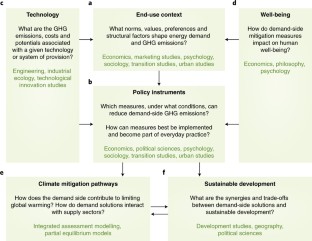
Research on climate change mitigation tends to focus on supply-side technology solutions. A better understanding of demand-side solutions is missing. We propose a transdisciplinary approach to identify demand-side climate solutions, investigate their mitigation potential, detail policy measures and assess their implications for well-being.
This is a preview of subscription content, access via your institution
Relevant articles
Open Access articles citing this article.
The behavioral dimension of transport decarbonization
- Moshe Ben-Akiva
- , Michel Bierlaire
- … Linda Steg
npj Sustainable Mobility and Transport Open Access 20 January 2026
Reviewing the 95 sociotechnical barriers to the decarbonization of buildings
- Erin Heinz
- , Benjamin K. Sovacool
- … Vincent Petit
Nature Communications Open Access 13 November 2025
African e-mobility startups’ perceptions and use of information systems, challenges, and opportunities
- Judith Adem Owigar
- & Oliver Lah
Sustainable Earth Reviews Open Access 11 September 2025
Access options
Access Nature and 54 other Nature Portfolio journals
Get Nature+, our best-value online-access subscription
$32.99 / 30 days
cancel any time
Subscribe to this journal
Receive 12 print issues and online access
$259.00 per year
only $21.58 per issue
Buy this article
- Purchase on SpringerLink
- Instant access to the full article PDF.
USD 39.95
Prices may be subject to local taxes which are calculated during checkout
Additional access options:
Fig. 1
The alternative text for this image may have been generated using AI.
References
- Wilson, C., Grubler, A., Gallagher, K. S. & Nemet, G. F. Marginalization of end-use technologies in energy innovation for climate protection. Nat. Clim. Change 2, 780–788 (2012).
Article Google Scholar - Roy, J., Dowd, A.-M., Muller, A., Pal, S. & Prata, N. in Global Energy Assessment (GEA) 1527–1548 (Cambridge Univ. Press, 2012).
- Anderson, K., Quéré, C. L. & Mclachlan, C. Radical emission reductions: the role of demand reductions in accelerating full decarbonization. J. Carbon Manage. 5, 321–323 (2014).
Article CAS Google Scholar - Stern, P. C., Sovacool, B. K. & Dietz, T. Towards a science of climate and energy choices. Nat. Clim. Change 6, 547–555 (2016).
Article Google Scholar - Creutzig, F. et al. Beyond technology: demand-side solutions for climate change mitigation. Annu. Rev. Environ. Resour. 41, 173–198 (2016).
Article Google Scholar - Minx, J., Callaghan, M. W., Lamb, W. F., Kowarsch, M. & Edenhofer, O. Learning about climate change solutions in the IPCC and beyond. Environ. Sci. Policy 77, 252–259 (2017).
Article Google Scholar - von Stechow, C. et al. 2° C and SDGs: united they stand, divided they fall? Environ. Res. Lett. 11, 034022 (2016).
Article Google Scholar - Mattioli, G. Transport needs in a climate-constrained world. A novel framework to reconcile social and environmental sustainability in transport. Energy Res. Soc. Sci 18, 118–128 (2016).
Article Google Scholar - Kunreuther, H. et al. in Climate Change 2014: Mitigation of Climate Change (eds Edenhofer, O. et al.) 151–192 (IPCC, Cambridge Univ. Press, 2014).
- Ebeling, F. & Lotz, S. Domestic uptake of green energy promoted by opt-out tariffs. Nat. Clim. Change 5, 868–871 (2015).
Article Google Scholar - Shove, E. Beyond the ABC: climate change policy and theories of social change. Environ. Plan. A 42, 1273–1285 (2010).
Article Google Scholar - Geels, F. W. Ontologies, socio-technical transitions (to sustainability), and the multi-level perspective. Res. Policy 39, 495–510 (2010).
Article Google Scholar - Nyborg, K. et al. Social norms as solutions. Science 354, 42–43 (2016).
Article CAS Google Scholar - Lichtenstein, S. & Slovic, P. The Construction of Preference (Cambridge Univ. Press, Cambridge, 2006).
- Wood, R. et al. Prioritizing consumption-based carbon policy based on the evaluation of mitigation potential using input–output methods. J. Ind. Ecol. https://doi.org/10.1111/jiec.12702 (2017).
- Azevedo, I. M. Consumer end-use energy efficiency and rebound effects. Annu. Rev. Environ. Resour. 39, 393–418 (2014).
Article Google Scholar - Steinberger, J. K., Roberts, J. T., Peters, G. P. & Baiocchi, G. Pathways of human development and carbon emissions embodied in trade. Nat. Clim. Change 2, 81–85 (2012).
Article CAS Google Scholar - Lamb, W. F. & Steinberger, J. K. Human well-being and climate change mitigation. WIRES Clim. Change 8, e485 (2017).
Article Google Scholar - Mattauch, L., Ridgway, M. & Creutzig, F. Happy or liberal? Making sense of behavior in transport policy design. Transp. Res. D 45, 64–83 (2016).
Article Google Scholar - Gough, I. & McGregor, J. A. Wellbeing in Developing Countries: From Theory to Research (Cambridge Univ. Press, New York, 2007).
- Mastrucci, A. & Rao, N. D. Decent housing in the developing world: reducing life-cycle energy requirements. Energy Build 152, 629–642 (2017).
Article Google Scholar - Sovacool, B. K. The political economy of energy poverty: a review of key challenges. Energy Sustain. Dev. 16, 272–282 (2012).
Article Google Scholar - Dalkmann, H. & Brannigan, C. Transport and Climate Change. Module 5e. Sustainable Transport: A Sourcebook for Policy-Makers in Developing Cities (GTZ, 2007).
Acknowledgements
W.B.d.B. acknowledges financial support from the Swedish Foundation for the Humanities and the Social Sciences; J.K.S. and F.W.G. from the UK ESRC (ES/K006576/1 and EP/K011790/1); C.H. from the Oxford Martin School; O.Y.E. and M.T. from the EU ERC (no. 154 336155) and N.D.R. from the EU ERC (no. 637462); I.M.L.A. from the Center for Climate and Energy Decision Making (SES-1463492); J.C.M. from the German Ministry of Research and Education (03EK3046B) and L.M. from the German Academic Exchange Service.
Author information
Authors and Affiliations
- Mercator Research Institute on Global Commons and Climate Change, Berlin, Germany
Felix Creutzig, William F. Lamb, Jan C. Minx & Anjali Ramakrishnan - Sustainability Economics of Human Settlements, Technische Universität Berlin, Berlin, Germany
Felix Creutzig & Anjali Ramakrishnan - Jadavpur University, Kolkata, India
Joyashree Roy - Carnegie Mellon University, Pittsburgh, PA, USA
Inês M. L. Azevedo & Wändi Bruine de Bruin - University of Leeds, Leeds, UK
Wändi Bruine de Bruin, Jan C. Minx & Julia K. Steinberger - Partnership on Sustainable, Low-Carbon Transport, Berlin, Germany
Holger Dalkmann - Fondazione Eni Enrico Mattei, Milan, Italy
Oreane Y. Edelenbosch & Massimo Tavoni - University of Manchester, Manchester, UK
Frank W. Geels - International Institute for Advanced Systems Analysis, Laxenburg, Austria
Arnulf Grubler & Narasimha D. Rao - University of Oxford, Oxford, UK
Cameron Hepburn & Linus Mattauch - School of Forestry and Environmental Studies, Yale University, New Haven, CT, USA
Edgar G. Hertwich - Centre for Policy Research, New Delhi, India
Radhika Khosla - Central European University, Budapest, Hungary
Diana Ürge-Vorsatz - Princeton University, Princeton, NJ, USA
Elke U. Weber
Authors
- Felix Creutzig
- Joyashree Roy
- William F. Lamb
- Inês M. L. Azevedo
- Wändi Bruine de Bruin
- Holger Dalkmann
- Oreane Y. Edelenbosch
- Frank W. Geels
- Arnulf Grubler
- Cameron Hepburn
- Edgar G. Hertwich
- Radhika Khosla
- Linus Mattauch
- Jan C. Minx
- Anjali Ramakrishnan
- Narasimha D. Rao
- Julia K. Steinberger
- Massimo Tavoni
- Diana Ürge-Vorsatz
- Elke U. Weber
Corresponding author
Correspondence toFelix Creutzig.
Ethics declarations
Competing interests
The authors declare no competing interests.
Rights and permissions
About this article
Cite this article
Creutzig, F., Roy, J., Lamb, W.F. et al. Towards demand-side solutions for mitigating climate change.Nature Clim Change 8, 260–263 (2018). https://doi.org/10.1038/s41558-018-0121-1
- Published: 03 April 2018
- Version of record: 03 April 2018
- Issue date: April 2018
- DOI: https://doi.org/10.1038/s41558-018-0121-1