Stem cell-associated genes are extremely poor prognostic factors for soft-tissue sarcoma patients (original) (raw)
- Short Communication
- Published: 21 May 2007
- P Würl2 na1,
- T Greither1,
- M Kappler3,
- M Bache3,
- F Bartel1,4,
- A Kehlen5,
- C Lautenschläger6,
- L C Harris7,
- D Kaushal8,
- S Füssel9,
- A Meye9,
- A Böhnke1,
- H Schmidt1,
- H-J Holzhausen1 &
- …
- S Hauptmann1
Oncogene volume 26, pages 7170–7174 (2007)Cite this article
- 692 Accesses
- 46 Citations
- 9 Altmetric
- Metrics details
Abstract
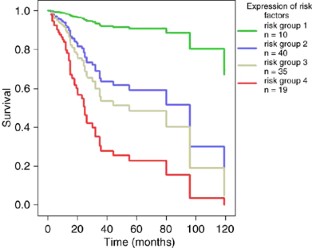
Cancer stem cells can play an important role in tumorigenesis and tumor progression. However, it is still difficult to detect and isolate cancer stem cells. An alternative approach is to analyse stem cell-associated gene expression. We investigated the coexpression of three stem cell-associated genes, Hiwi, hTERT and survivin, by quantitative real-time–PCR in 104 primary soft-tissue sarcomas (STS). Multivariate Cox's proportional hazards regression analyses allowed correlating gene expression with overall survival for STS patients. Coexpression of all three stem cell-associated genes resulted in a significantly increased risk of tumor-related death. Importantly, tumors of patients with the poorest prognosis were of all four tumor stages, suggesting that their risk is based upon coexpression of stem cell-associated genes rather than on tumor stage.
This is a preview of subscription content, access via your institution
Access options
Subscribe to this journal
Receive 50 print issues and online access
$259.00 per year
only $5.18 per issue
Buy this article
- Purchase on SpringerLink
- Instant access to the full article PDF.
USD 39.95
Prices may be subject to local taxes which are calculated during checkout
Additional access options:
Figure 1
Abbreviations
ag:
attogram
LMS:
leiomyosarcoma
MFH:
malignant fibrous histiocytoma
NS:
neurogenic sarcoma
RMS:
rhabdomyosarcoma
RR:
relative risk
STS:
soft-tissue sarcoma(s)
References
- Altieri DC . (2003). Validating survivin as a cancer therapeutic target. Nat Rev Cancer 3: 46–54.
Article CAS Google Scholar - Aravin A, Gaidatzis D, Pfeffer S, Lagos-Quintana M, Landgraf P, Iovino N et al. (2006). A novel class of small RNAs bind to MILI protein in mouse testes. Nature 442: 203–207.
Article CAS Google Scholar - Endoh T, Tsuji N, Asanuma K, Yagihashi A, Watanabe N . (2005). Survivin enhances telomerase activity via up-regulation of specificity protein 1- and c-Myc-mediated human telomerase reverse transcriptase gene transcription. Exp Cell Res 305: 300–311.
Article CAS Google Scholar - Girard A, Sachidanandam R, Hannon GJ, Carmell MA . (2006). A germline-specific class of small RNAs binds mammalian Piwi proteins. Nature 442: 199–202.
Article Google Scholar - Hill RP . (2006). Identifying cancer stem cells in solid tumors: case not proven. Cancer Res 66: 1891–1895.
Article CAS Google Scholar - Ju Z, Rudolph KL . (2006). Telomeres and telomerase in cancer stem cells. Eur J Cancer 42: 1197–1203.
Article CAS Google Scholar - Kirkpatrick KL, Mokbel K . (2001). The significance of human telomerase reverse transcriptase (hTERT) in cancer. Eur J Surg Oncol 27: 754–760.
Article CAS Google Scholar - Lee JH, Schutte D, Wulf G, Fuzesi L, Radzun HJ, Schweyer S et al. (2006). Stem- cell protein Piwil2 is widely expressed in tumors and inhibits apoptosis through activation of Stat3/Bcl-XL pathway. Hum Mol Genet 15: 201–211.
Article CAS Google Scholar - Lingel A, Sattler M . (2005). Novel modes of protein-RNA recognition in the RNAi pathway. Curr Opin Struct Biol 15: 107–115.
Article CAS Google Scholar - Liu X, Sun Y, Guo J, Ma H, Li J, Dong B et al. (2006). Expression of hiwi gene in human gastric cancer was associated with proliferation of cancer cells. Int J Cancer 118: 1922–1929.
Article CAS Google Scholar - Morrison SJ, Prowse KR, Ho P, Weissman IL . (1996). Telomerase activity in hematopoietic cells is associated with self-renewal potential. Immunity 5: 207–216.
Article CAS Google Scholar - Nguyen HG, Ravid K . (2006). Tetraploidy/aneuploidy and stem cells in cancer promotion: the role of chromosome passenger proteins. J Cell Physiol 208: 12–22.
Article CAS Google Scholar - Pendino F, Tarkanyi I, Dudognon C, Hillion J, Lanotte M, Aradi J et al. (2006). Telomeres and telomerase: Pharmacological targets for new anticancer strategies? Curr Cancer Drug Targets 6: 147–180.
Article CAS Google Scholar - Polyak K, Hahn WC . (2006). Roots and stems: stem cells in cancer. Nat Med 12: 296–300.
Article CAS Google Scholar - Qiao D, Zeeman AM, Deng W, Looijenga LH, Lin H . (2002). Molecular characterization of hiwi, a human member of the piwi gene family whose overexpression is correlated to seminomas. Oncogene 21: 3988–3999.
Article CAS Google Scholar - Smith LL, Coller HA, Roberts JM . (2003). Telomerase modulates expression of growth-controlling genes and enhances cell proliferation. Nat Cell Biol 5: 474–479.
Article CAS Google Scholar - Soltysova A, Altanerova V, Altaner C . (2005). Cancer stem cells. Neoplasma 52: 435–440.
CAS PubMed Google Scholar - Taubert H, Greither T, Kaushal D, Wurl P, Bache M, Bartel F et al. (2007). Expression of the stem cell self-renewal gene Hiwi and risk of tumour-related death in patients with soft-tissue sarcoma. Oncogene 26: 1098–1100.
Article CAS Google Scholar - Würl P, Kappler M, Meye A, Bartel F, Köhler T, Lautenschläger C et al. (2002). Co-expression of survivin and TERT and risk of tumour-related death in patients with soft-tissue sarcoma. Lancet 359: 943–945.
Article Google Scholar - Zhu CQ, Cutz JC, Liu N, Lau D, Shepherd FA, Squire JA et al. (2006). Amplification of telomerase (hTERT) gene is a poor prognostic marker in non-small-cell lung cancer. Br J Cancer 94: 1452–1459.
Article CAS Google Scholar
Acknowledgements
This work was supported by a grant from the Deutsche Forschungsgemeinschaft Project no. TA 145/8–19 and a grant from the Deutsche Krebshilfe no. 107590. Furthermore, FB was supported by the Wilhelm-Roux-Programm of the University of Halle (grant 12/40), MK by a grant from the Land Saxony Anhalt (FKZ: 3584B/1104M) and AB by a grant from the Wilhelm-Sander-Stiftung. We thank Deanna Naeve and Dr Clayton Naeve from St. Jude Children's Research Hospital Memphis (TN, USA) for continuous support and helpful discussions. The funding source had no role in study design, data collection, data analysis, data interpretation or writing of the report.
Author information
Author notes
- H Taubert and P Würl: These authors contributed equally to this work.
Authors and Affiliations
- Institute of Pathology, Martin-Luther-University Halle-Wittenberg, Halle, Germany
H Taubert, T Greither, F Bartel, A Böhnke, H Schmidt, H-J Holzhausen & S Hauptmann - Clinic of General and Transplantation Surgery, University Ulm, Ulm, Germany
P Würl - Department of Radiotherapy, Martin-Luther-University Halle-Wittenberg, Halle, Germany
M Kappler & M Bache - Junior Research Group, Institute of Pathology, Martin-Luther-University Halle-Wittenberg, Halle, Germany
F Bartel - Probiodrug AG, Halle, Germany
A Kehlen - Institute of Medical Biometry and Informatics, University Halle-Wittenberg, Halle, Germany
C Lautenschläger - Molecular Pharmacology, St. Jude Children's Research Hospital, Memphis, TN, USA
L C Harris - Hartwell Center for Bioinformatics and Biotechnology, St. Jude Children's Research Hospital, Memphis, TN, USA
D Kaushal - Department of Urology, Technical University Dresden, Dresden, Germany
S Füssel & A Meye
Authors
- H Taubert
- P Würl
- T Greither
- M Kappler
- M Bache
- F Bartel
- A Kehlen
- C Lautenschläger
- L C Harris
- D Kaushal
- S Füssel
- A Meye
- A Böhnke
- H Schmidt
- H-J Holzhausen
- S Hauptmann
Corresponding author
Correspondence toH Taubert.
Rights and permissions
About this article
Cite this article
Taubert, H., Würl, P., Greither, T. et al. Stem cell-associated genes are extremely poor prognostic factors for soft-tissue sarcoma patients.Oncogene 26, 7170–7174 (2007). https://doi.org/10.1038/sj.onc.1210530
- Received: 23 February 2007
- Revised: 13 April 2007
- Accepted: 13 April 2007
- Published: 21 May 2007
- Issue date: 01 November 2007
- DOI: https://doi.org/10.1038/sj.onc.1210530