Thousands of scientists publish a paper every five days (original) (raw)
- COMMENT
- 12 September 2018
To highlight uncertain norms in authorship, John P. A. Ioannidis, Richard Klavans and Kevin W. Boyack identified the most prolific scientists of recent years.
By
- John P. A. Ioannidis
- John P. A. Ioannidis is a professor of medicine at the Meta-Research Innovation Center at Stanford (METRICS), Stanford University, California.
- Richard Klavans
- Richard Klavans is a researcher at SciTech Strategies in Philadelphia, Pennsylvania, and New Mexico.
- Kevin W. Boyack
- Kevin W. Boyack is a researcher at SciTech Strategies in Philadelphia, Pennsylvania, and New Mexico.
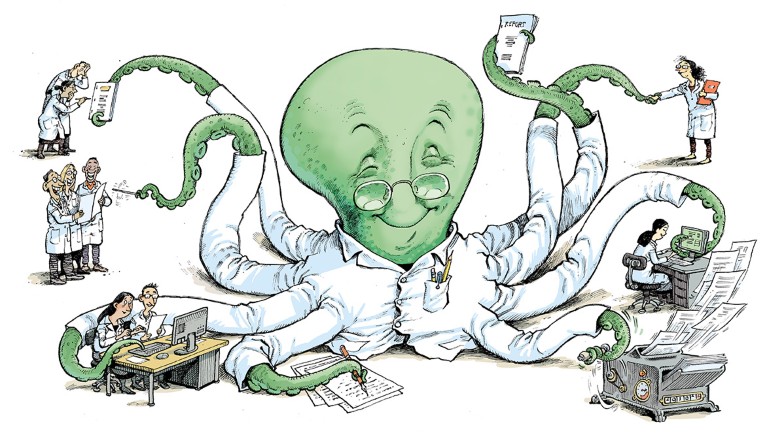
Illustration by David Parkins
Authorship is the coin of scholarship — and some researchers are minting a lot. We searched Scopus for authors who had published more than 72 papers (the equivalent of one paper every 5 days) in any one calendar year between 2000 and 2016, a figure that many would consider implausibly prolific1. We found more than 9,000 individuals, and made every effort to count only ‘full papers’ — articles, conference papers, substantive comments and reviews — not editorials, letters to the editor and the like. We hoped that this could be a useful exercise in understanding what scientific authorship means.
Access options
Access Nature and 54 other Nature Portfolio journals
Get Nature+, our best-value online-access subscription
$32.99 / 30 days
cancel any time
Subscribe to this journal
Receive 52 print issues and online access
$199.00 per year
only $3.83 per issue
Rent or buy this article
Prices vary by article type
from$1.95
to$39.95
Prices may be subject to local taxes which are calculated during checkout
Additional access options:
Nature 561, 167-169 (2018)
doi: https://doi.org/10.1038/d41586-018-06185-8
References
- Wager, E., Singhvi, S. & Kleinert, S. PeerJ 3, e1154 (2015).
Article PubMed Google Scholar - Quan, W., Chen, B. & Shu, F. Preprint at https://arxiv.org/abs/1707.01162 (2017).
- Hvistendahl, M. Science 342, 1035–1039 (2013).
Article PubMed Google Scholar - Nature 483, 246 (2012).
- Abritis, A., McCook, A. & Retraction Watch. Science 357, 541 (2017).
Article PubMed Google Scholar - Patience, G. S., Galli, F., Patience, P. A. & Boffito, D. C. Preprint at https://doi.org/10.1101/323519 (2018).
- Drenth, J. J. Am. Med. Assoc. 280, 219–221 (1998).
Article Google Scholar - Sauermann, H, & Haeussler, C. Sci. Adv. 3, e1700404 (2017).
Article PubMed Google Scholar - Kim, S. K. PLoS One 13, e0200785 (2018).
Article PubMed Google Scholar - Papatheodorou, S. I., Trikalinos, T. A. & Ioannidis, J. P. J. Clin. Epidemiol. 61, 546–551 (2008).
Article PubMed Google Scholar
Related Articles
-
 Digital badges aim to clear up politics of authorship
 -
 Who gets credit? Survey digs into the thorny question of authorship
 - Authorship position should not serve as a proxy metric
Subjects
Latest on:
 What’s behind China’s historically high counts of corresponding authors? Nature Index 04 JUN 26
  White House proposes vast overhaul of US science funding: what you need to know News 03 JUN 26
  First and last authors more likely to be men in leading science journals Nature Index 02 JUN 26
  Tool flags suspicious journals before researchers submit papers News 11 JUN 26
  Seven steps for critically analysing research papers Career Column 09 JUN 26
 ‘Student Geng’ ignites research-integrity scandal in China after calling out senior academics Career News 12 JUN 26