Old-growth forests as global carbon sinks (original) (raw)
- Letter
- Published: 11 September 2008
- E. -Detlef Schulze3,
- Annett Börner3,
- Alexander Knohl4,
- Dominik Hessenmöller3,
- Beverly E. Law2,
- Philippe Ciais5 &
- …
- John Grace6
Nature volume 455, pages 213–215 (2008) Cite this article
- 31k Accesses
- 1640 Citations
- 768 Altmetric
- Metrics details
Abstract
Old-growth forests remove carbon dioxide from the atmosphere1,2 at rates that vary with climate and nitrogen deposition3. The sequestered carbon dioxide is stored in live woody tissues and slowly decomposing organic matter in litter and soil4. Old-growth forests therefore serve as a global carbon dioxide sink, but they are not protected by international treaties, because it is generally thought that ageing forests cease to accumulate carbon5,6. Here we report a search of literature and databases for forest carbon-flux estimates. We find that in forests between 15 and 800 years of age, net ecosystem productivity (the net carbon balance of the forest including soils) is usually positive. Our results demonstrate that old-growth forests can continue to accumulate carbon, contrary to the long-standing view that they are carbon neutral. Over 30 per cent of the global forest area is unmanaged primary forest, and this area contains the remaining old-growth forests7. Half of the primary forests (6 × 10⁸ hectares) are located in the boreal and temperate regions of the Northern Hemisphere. On the basis of our analysis, these forests alone sequester about 1.3 ± 0.5 gigatonnes of carbon per year. Thus, our findings suggest that 15 per cent of the global forest area, which is currently not considered when offsetting increasing atmospheric carbon dioxide concentrations, provides at least 10 per cent of the global net ecosystem productivity8. Old-growth forests accumulate carbon for centuries and contain large quantities of it. We expect, however, that much of this carbon, even soil carbon9, will move back to the atmosphere if these forests are disturbed.
This is a preview of subscription content, access via your institution
Access options
Subscribe to this journal
Receive 52 print issues and online access
$199.00 per year
only $3.83 per issue
Buy this article
- Purchase on SpringerLink
- Instant access to the full article PDF.
USD 39.95
Prices may be subject to local taxes which are calculated during checkout
Additional access options:
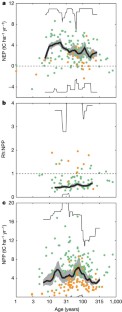
Figure 1: Changes in carbon fluxes as a function of age.
The alternative text for this image may have been generated using AI.
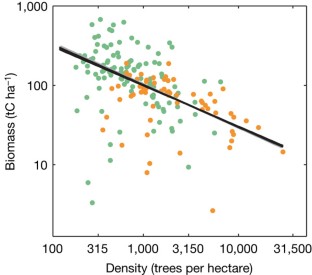
Figure 2: Biomass accumulation as a function of stand density.
The alternative text for this image may have been generated using AI.
References
- Carey, E. V., Sala, A., Keane, R. & Callaway, R. M. Are old forests underestimated as global carbon sinks? Glob. Change Biol. 7, 339–344 (2001)
Article ADS Google Scholar - Pregitzer, K. S. & Euskirchen, E. S. Carbon cycling and storage in world forests: biome patterns related to forest age. Glob. Change Biol. 10, 2052–2077 (2004)
Article ADS Google Scholar - Magnani, F. et al. The human footprint in the carbon cycle of temperate and boreal forests. Nature 447, 848–850 (2007)
Article ADS Google Scholar - Zhou, G. Y. et al. Old-growth forests can accumulate carbon in soils. Science 314, 1417 (2006)
Article CAS ADS Google Scholar - Kira, T. & Sihdei, T. Primary production and turnover of organic matter in different forest ecosystems of the western pacific. Jpn. J. Ecol. 17, 70–87 (1967)
Google Scholar - Odum, E. P. The strategy of ecosystem development. Science 164, 262–270 (1969)
Article CAS ADS Google Scholar - FAO. Global Forest Resources Assessment 2005. Progress towards sustainable forest management. Forestry Paper 147 (Food and Agriculture Organization of the United Nations, 2006)
- Bolin, B. et al. in IPCC, Land Use, Land-Use Change, and Forestry. A Special Report of the IPCC (eds Watson, R. T. et al.) 23–51 (Cambridge Univ. Press, 2000)
Google Scholar - Fontaine, S. et al. Stability of organic carbon in deep soil layers controlled by fresh carbon supply. Nature 450, 277–280 (2007)
Article CAS ADS Google Scholar - Acker, S. A., Halpern, C. B., Harmon, M. E. & Dyrness, C. T. Trends in bole biomass accumulation, net primary production and tree mortality in Pseudotsuga menziesii forests of contrasting age. Tree Physiol. 22, 213–217 (2002)
Article CAS Google Scholar - Knohl, A., Schulze, E. D., Kolle, O. & Buchmann, N. Large carbon uptake by an unmanaged 250-year-old deciduous forest in Central Germany. Agric. For. Meteorol. 118, 151–167 (2003)
Article ADS Google Scholar - Law, B. E. et al. Changes in carbon storage and fluxes in a chronosequence of ponderosa pine. Glob. Change Biol. 9, 510–524 (2003)
Article ADS Google Scholar - Desai, A. R. et al. Comparing net ecosystem exchange of carbon dioxide between an old-growth and mature forest in the upper Midwest, USA. Agric. For. Meteorol. 128, 33–55 (2005)
Article ADS Google Scholar - Gower, S. T., McMurtrie, R. E. & Murty, D. Aboveground net primary production decline with stand age: Potential causes. Trends Ecol. Evol. 11, 378–382 (1996)
Article CAS Google Scholar - Binkley, D. et al. Age-related decline in forest ecosystem growth: an individual-tree, stand-structure hypothesis. Ecosystems 5, 58–67 (2002)
Article Google Scholar - Van Tuyl, S., Law, B. E., Turner, D. P. & Gitelman, A. I. Variability in net primary production and carbon storage in biomass across Oregon forests—an assessment integrating data from forest inventories, intensive sites, and remote sensing. For. Ecol. Manage. 209, 273–291 (2005)
Article Google Scholar - Harmon, M. E., Ferrell, W. K. & Franklin, J. F. Effects on carbon storage of conversion of old-growth forests to young forests. Science 247, 699–702 (1990)
Article CAS ADS Google Scholar - Janish, J. E. & Harmon, M. E. Successional changes in live and dead wood carbon stores: implications for net ecosystem productivity. Tree Physiol. 22, 77–89 (2002)
Article Google Scholar - Wirth, C., Czimczik, C. I. & Schulze, E. D. Beyond annual budgets: carbon flux at different temporal scales in fire-prone Siberian Scots pine forests. Tellus 54, 611–630 (2002)
Article Google Scholar - Knohl, A. et al. Carbon dioxide exchange of a Russian boreal forest after disturbance by wind throw. Glob. Change Biol. 8, 231–246 (2002)
Article ADS Google Scholar - Kowalski, A. S. et al. Paired comparisons of carbon exchange between undisturbed and regenerating stands in four managed forests in Europe. Glob. Change Biol. 10, 1707–1723 (2004)
Article ADS Google Scholar - Irvine, J., Law, B. E. & Hibbard, K. A. Postfire carbon pools and fluxes in semiarid ponderosa pine in Central Oregon. Glob. Change Biol. 13, 1748–1760 (2007)
Article ADS Google Scholar - Yoda, K., Kira, T., Ogawa, H. & Hozumi, K. Self-thinning in overcrowded pure stands under cultivated and natural conditions. J. Biol. Osaka City Univ. 14, 107–132 (1963)
Google Scholar - Mladenoff, D. J., White, M. A., Pastor, J. & Crow, T. R. Comparing spatial pattern in unaltered old-growth and disturbed forest landscapes. Ecol. Appl. 3, 294–306 (1993)
Article Google Scholar - Chapin, F. S. et al. Reconciling carbon-cycle concepts, terminology and methodology. Ecosystems 9, 1041–1050 (2005)
Article Google Scholar - Ciais, P. et al. in The Carbon Balance of Forest Biomes (eds Griffith, H. & Jarvis, P.) 109–150 (Taylor and Francis, 2005)
Google Scholar - Jomura, M. et al. The carbon budget of coarse woody debris in a temperate broad-leaved secondary forest in Japan. Tellus B 59, 211–222 (2007)
Article ADS Google Scholar - Preston, C. M. & Schmidt, M. W. I. Black (pyrogenic) carbon: a synthesis of current knowledge and uncertainties with special consideration of boreal regions. Biogeosciences 3, 397–420 (2006)
Article CAS ADS Google Scholar - Luyssaert, S. et al. CO2-balance of boreal, temperate and tropical forest derived from a global database. Glob. Change Biol. 13, 2509–2537 (2007)
Article ADS Google Scholar
Acknowledgements
We thank all site investigators, their funding agencies and the various regional flux networks (Afriflux, AmeriFlux, AsiaFlux, CarboAfrica, CarboEuropeIP, ChinaFlux, Fluxnet-Canada, KoFlux, LBA, NECC, OzFlux, TCOS-Siberia and USCCC), and the Fluxnet project, whose support was essential for obtaining our measurements. S.L. was supported by CoE ECO UA-Methusalem and the Research Foundation - Flanders (FWO-Vlaanderen) with a post-doctoral fellowship and a research grant. A.K. was supported by the European Union with a Marie Curie fellowship, and B.E.L. was supported by the regional North American Carbon Program project ORCA (US Department of Energy, Terrestrial Carbon Program, award number DE-FG02-04ER63917). E.-D.S. was supported by DFG-Exploratories. Additional funding for this study was received from CarboEuropeIP (project number GOCE-CT-2003-505572) and Ameriflux.
Author Contributions S.L., B.E.L., A.K. and P.C. compiled the data set. S.L., A.B. and D.H wrote code and analysed the data. S.L., E.-D.S., A.K., B.E.L., P.C. and J.G. designed the analyses and wrote the manuscript.
Author information
Authors and Affiliations
- Department of Biology, University of Antwerp, 2610 Wilrijk, Belgium
Sebastiaan Luyssaert - College of Forestry, Oregon State University, Corvallis, Oregon 97331-5752, USA ,
Sebastiaan Luyssaert & Beverly E. Law - Max-Planck Institute for Biogeochemistry, 07701 Jena, Germany
E. -Detlef Schulze, Annett Börner & Dominik Hessenmöller - ETH Zürich, Institute of Plant Sciences, CH-8092 Zürich, Switzerland
Alexander Knohl - Laboratoire des Sciences du Climat et de l’Environnement, IPSL-LSCE, CEA-CNRS-UVSQ, 91191 Gif sur Yvette Cedex, France ,
Philippe Ciais - School of GeoSciences, The University of Edinburgh, Edinburgh EH9 3JN, UK
John Grace
Authors
- Sebastiaan Luyssaert
- E. -Detlef Schulze
- Annett Börner
- Alexander Knohl
- Dominik Hessenmöller
- Beverly E. Law
- Philippe Ciais
- John Grace
Corresponding author
Correspondence toSebastiaan Luyssaert.
Supplementary information
PowerPoint slides
Rights and permissions
About this article
Cite this article
Luyssaert, S., Schulze, ED., Börner, A. et al. Old-growth forests as global carbon sinks.Nature 455, 213–215 (2008). https://doi.org/10.1038/nature07276
- Received: 18 January 2008
- Accepted: 07 July 2008
- Issue date: 11 September 2008
- DOI: https://doi.org/10.1038/nature07276
This article is cited by
Comments
Commenting on this article is now closed.
- Antonello Lobianco 25 April 2018, 13:04
Hello, I think the main question is to find where the carbon is going ?
No-one claims that "forests" are carbon neutral. The biomass that forest produces is used by insects, animals and other heterotrophic organisms of the ecosystem. It is at that level that the ecosystem is almost neutral.
"Almost", because some carbon is stored in the soil for longer periods. But how much? The study you cite (Zhou et al) measured soil organic carbon on a "mature" forest and (figure 1) they got ~2800 gC/m^2 in 1980 and ~4000 gC/m^2 in 2003. That corresponds to a sequestration of ~0.5 tC/ha/y.
How this compare to a growing forest ?
Let's take the example of French forests.. at national level inventoried data tell us that they growth at about 6 m^3/ha, that if we use a 0.25 tC/t m^3 wood conversion factor, it leads us to a sequestration of 1.5 tC/ha/y.
While this value includes only the main tree trunks (no branches, roots, soil organic carbon) and "national level" means all kind of forests (including old and Mediterranean low productivity ones) it is still at least 3 times higher than the organic carbon stored in the soil by old forests.
Editorial Summary
Don't cut into old wood
It has long been assumed that ageing forests cease to accumulate carbon, and become carbon neutral. They are therefore not recognized for 'forest credits' in treaties such as the Kyoto Protocol. Now an extensive literature and database search for forest carbon-flux estimates shows that the net carbon balance of ageing forests is usually positive. The findings suggest that old-growth forests can continue to accumulate carbon, and that they contribute at least 10% of global net ecosystem productivity. Much of this carbon, even soil carbon, will move back to the atmosphere if these forests are disturbed, so it would make sense for carbon accounting rules to give credit for leaving old forests intact.