Saturn's largest ring (original) (raw)
- Letter
- Published: 07 October 2009
Nature volume 461, pages 1098–1100 (2009)Cite this article
- 1486 Accesses
- 134 Citations
- 82 Altmetric
- Metrics details
Abstract
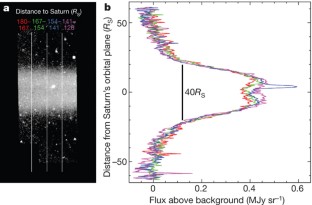
Most planetary rings in the Solar System lie within a few radii of their host body, because at these distances gravitational accelerations inhibit satellite formation. The best known exceptions are Jupiter’s gossamer rings1 and Saturn’s E ring, broad sheets of dust that extend outward until they fade from view at five to ten planetary radii. Source satellites continuously supply the dust, which is subsequently lost in collisions or by radial transport. Here we report that Saturn has an enormous ring associated with its outer moon Phoebe, extending from at least 128_R_S to 207_R_S (Saturn’s radius _R_S is 60,330 km). The ring’s vertical thickness of 40_R_S matches the range of vertical motion of Phoebe along its orbit. Dynamical considerations argue that these ring particles span the Saturnian system from the main rings to the edges of interplanetary space. The ring’s normal optical depth of ∼2 × 10⁻⁸ is comparable to that of Jupiter’s faintest gossamer ring, although its particle number density is several hundred times smaller. Repeated impacts on Phoebe, from both interplanetary and circumplanetary particle populations, probably keep the ring populated with material. Ring particles smaller than centimetres in size slowly migrate inward2,3 and many of them ultimately strike the dark leading face of Iapetus.
This is a preview of subscription content, access via your institution
Access options
Subscribe to this journal
Receive 51 print issues and online access
$199.00 per year
only $3.90 per issue
Buy this article
- Purchase on SpringerLink
- Instant access to the full article PDF.
USD 39.95
Prices may be subject to local taxes which are calculated during checkout
Additional access options:
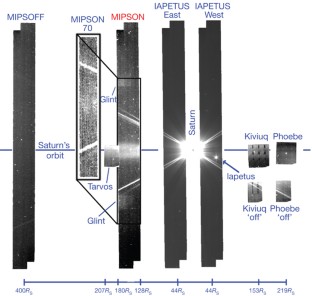
Figure 1: Spitzer MIPS imaging in the vicinity of Saturn.
The alternative text for this image may have been generated using AI.
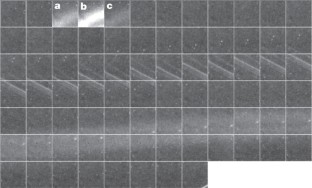
Figure 2: A subset of the Spitzer MIPS 24 μm Basic Calibrated Data images, comprising a MIPSON scan.
The alternative text for this image may have been generated using AI.
Figure 3: Vertical profiles through the Phoebe dust structure.
The alternative text for this image may have been generated using AI.
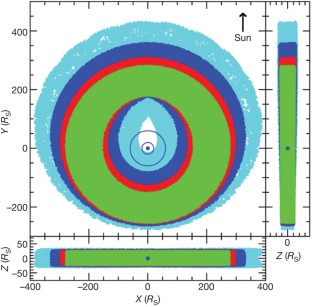
Figure 4: The orbital distribution of dust grains launched from Phoebe followed for 2,000 years.
The alternative text for this image may have been generated using AI.
References
- Burns, J. A. et al. The formation of Jupiter’s faint rings. Science 284, 1146–1150 (1999)
Article ADS CAS Google Scholar - Soter, S. Remarks on origin of Iapetus’ photometric asymmetry. IAU Colloq. 28, abstract (1974)
- Burns, J. A., Hamilton, D. P., Mignard, F. & Soter, S. The contamination of Iapetus by Phoebe dust. Astron. Soc. Pacif. Conf. Ser. 104B, 179–182 (1996)
ADS Google Scholar - Porco, C. C. et al. Cassini imaging science: initial results on Phoebe and Iapetus. Science 307, 1237–1242 (2005)
Article ADS CAS Google Scholar - Hamilton, D. P. Motion of dust in a planetary magnetosphere–orbit-averaged equations for oblateness, electromagnetic, and radiation forces with application to Saturn’s E ring. Icarus 101, 244–264 (1993)
Article ADS Google Scholar - Cruikshank, D. P. et al. The dark side of Iapetus. Icarus 53, 90–104 (1983)
Article ADS CAS Google Scholar - Buratti, B. J. & Mosher, J. A. The dark side of Iapetus: additional evidence for an exogenous origin. Icarus 115, 219–227 (1995)
Article ADS Google Scholar - Vilas, F., Larsen, S. M., Stockstill, K. R. & Gaffey, M. J. Unraveling the zebra: clues to the Iapetus dark material composition. Icarus 124, 262–267 (1996)
Article ADS Google Scholar - Jarvis, K. S., Vilas, F., Larsen, S. M. & Gaffey, M. J. Are Hyperion and Phoebe linked to Iapetus? Icarus 146, 125–132 (2000)
Article ADS CAS Google Scholar - Buratti, B. J., Hicks, M. D., Tryka, K. A., Sittig, M. S. & Newburn, R. L. High resolution 0.33–0.92 μm spectra of Iapetus, Hyperion, Phoebe, Rhea, Dione, and D-type asteroids: How are they related? Icarus 155, 375–381 (2002)
Article ADS CAS Google Scholar - Buratti, B. J., Hicks, M. D. & Davies, A. Spectrophotometry of the small satellites of Saturn and their relationship to Iapetus, Phoebe, and Hyperion. Icarus 175, 490–495 (2005)
Article ADS Google Scholar - Cruikshank, D. P. et al. Hydrocarbons on Saturn’s satellites Iapetus and Phoebe. Icarus 193, 334–343 (2008)
Article ADS CAS Google Scholar - Clark, R. N. et al. Compositional mapping of Saturn’s moon Phoebe with imaging spectroscopy. Nature 435, 66–69 (2005)
Article ADS CAS Google Scholar - Nesvorný, D. Alvarellos, J. L. A., Dones, L. & Levison, H. F. Orbital and collisional evolution of the irregular satellites. Astron. J. 126, 398–429 (2003)
Article ADS Google Scholar - Hamilton, D. P. &. Krüger, H. The sculpting of Jupiter’s gossamer rings by its shadow. Nature 453, 72–75 (2008)
Article ADS CAS Google Scholar - Hamilton, D. P. The asymmetric time-variable rings of Mars. Icarus 119, 153–172 (1996)
Article ADS Google Scholar
Acknowledgements
This work is based on observations made with the Spitzer Space Telescope, which is operated by the Jet Propulsion Laboratory, California Institute of Technology under a contract with NASA. Support for this work was provided by NASA through an award issued by JPL/Caltech.
Author Contributions All authors contributed substantially to this work. A.J.V. and M.F.S. did most of the observation planning, data reduction, and associated write-up. D.P.H. contributed most of the dynamical interpretations and write-up.
Author information
Authors and Affiliations
- Department of Astronomy, University of Virginia, Charlottesville, Virginia, 22904-4325, USA,
Anne J. Verbiscer & Michael F. Skrutskie - Department of Astronomy, University of Maryland, College Park, Maryland 20742-2421, USA,
Douglas P. Hamilton
Authors
- Anne J. Verbiscer
- Michael F. Skrutskie
- Douglas P. Hamilton
Corresponding author
Correspondence toAnne J. Verbiscer.
Supplementary information
PowerPoint slides
Rights and permissions
About this article
Cite this article
Verbiscer, A., Skrutskie, M. & Hamilton, D. Saturn's largest ring.Nature 461, 1098–1100 (2009). https://doi.org/10.1038/nature08515
- Received: 21 August 2009
- Accepted: 18 September 2009
- Published: 07 October 2009
- Issue date: 22 October 2009
- DOI: https://doi.org/10.1038/nature08515
This article is cited by
Spitzer’s Solar System studies of asteroids, planets and the zodiacal cloud
- David E. Trilling
- Carey Lisse
- Anne Verbiscer
Nature Astronomy (2020)
A new moon for Neptune
- Anne J. Verbiscer
Nature (2019)
- Anne J. Verbiscer
Circumplanetary Dust Populations
- Frank Spahn
- Manuel Sachse
- Mihály Horányi
Space Science Reviews (2019)
Dust Emission by Active Moons
- J. K. Hillier
- J. Schmidt
- F. Postberg
Space Science Reviews (2018)
Dust Phenomena Relating to Airless Bodies
- J. R. Szalay
- A. R. Poppe
- F. Spahn
Space Science Reviews (2018)
Editorial Summary
Saturn's giant surprise
Saturn's main ring system is a familiar image, but it's only part of the story. Most Solar System rings lie within a few radii of their planet, where gravitational accelerations inhibit satellite formation. Saturn's faint E ring is an exception, made up of sheets of dust that extend out to about 10 planetary radii. Beyond that, Spitzer Space Telescope observations of Saturn's most distant moon Phoebe reveal an enormous and previously unknown saturnian ring, extending from at least 128 to 207 planetary radii. The ring's vertical thickness of 40 planetary radii matches the up-and-down motion of Phoebe along its orbit, and the ring may be composed of material ejected from Phoebe. These ring particles appear to span the saturnian system from the main rings to the edges of interplanetary space.