Grazing-induced reduction of natural nitrous oxide release from continental steppe (original) (raw)
- Letter
- Published: 08 April 2010
- Xunhua Zheng2,
- Nicolas Brüggemann1,
- Weiwei Chen2,
- Michael Dannenmann1,
- Xingguo Han3,
- Mark A. Sutton4,
- Honghui Wu3,
- Zhisheng Yao2 &
- …
- Klaus Butterbach-Bahl1
Nature volume 464, pages 881–884 (2010) Cite this article
- 5511 Accesses
- 287 Citations
- 17 Altmetric
- Metrics details
Subjects
Abstract
Atmospheric concentrations of the greenhouse gas nitrous oxide (N2O) have increased significantly since pre-industrial times owing to anthropogenic perturbation of the global nitrogen cycle1,2, with animal production being one of the main contributors3. Grasslands cover about 20 per cent of the temperate land surface of the Earth and are widely used as pasture. It has been suggested that high animal stocking rates and the resulting elevated nitrogen input increase N2O emissions4,5,6,7. Internationally agreed methods to upscale the effect of increased livestock numbers on N2O emissions are based directly on per capita nitrogen inputs8. However, measurements of grassland N2O fluxes are often performed over short time periods9, with low time resolution and mostly during the growing season. In consequence, our understanding of the daily and seasonal dynamics of grassland N2O fluxes remains limited. Here we report year-round N2O flux measurements with high and low temporal resolution at ten steppe grassland sites in Inner Mongolia, China. We show that short-lived pulses of N2O emission during spring thaw dominate the annual N2O budget at our study sites. The N2O emission pulses are highest in ungrazed steppe and decrease with increasing stocking rate, suggesting that grazing decreases rather than increases N2O emissions. Our results show that the stimulatory effect of higher stocking rates on nitrogen cycling4,7 and, hence, on N2O emission is more than offset by the effects of a parallel reduction in microbial biomass, inorganic nitrogen production and wintertime water retention. By neglecting these freeze–thaw interactions, existing approaches may have systematically overestimated N2O emissions over the last century for semi-arid, cool temperate grasslands by up to 72 per cent.
This is a preview of subscription content, access via your institution
Access options
Subscribe to this journal
Receive 52 print issues and online access
$199.00 per year
only $3.83 per issue
Buy this article
- Purchase on SpringerLink
- Instant access to the full article PDF.
USD 39.95
Prices may be subject to local taxes which are calculated during checkout
Additional access options:
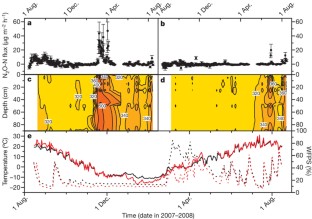
Figure 1: Dynamics of N 2 O fluxes, soil air concentrations and environmental parameters.
The alternative text for this image may have been generated using AI.
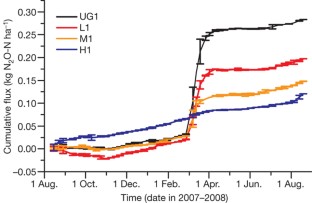
Figure 2: Effect of stocking rate on cumulative N 2 O fluxes, as recorded using the manual-chamber approach.
The alternative text for this image may have been generated using AI.
Figure 3: Annual N 2 O emissions and livestock numbers between 1890 and 2000 for situation S1.

The alternative text for this image may have been generated using AI.
References
- Solomon, S. et al. (eds) Climate Change 2007: The Physical Science Basis 143–145 (Cambridge Univ. Press, 2007)
Google Scholar - Mosier, A. et al. Closing the global N2O budget: nitrous oxide emissions through the agricultural nitrogen cycle - OECD/IPCC/IEA phase II development of IPCC guidelines for national greenhouse gas inventory methodology. Nutr. Cycl. Agroecosyst. 52, 225–248 (1998)
Article CAS Google Scholar - Davidson, E. A. The contribution of manure and fertilizer nitrogen to atmospheric nitrous oxide since 1860. Nature Geosci. 2, 659–662 (2009)
Article ADS CAS Google Scholar - Ma, X. Z. et al. Short-term effects of sheep excrement on carbon dioxide, nitrous oxide and methane fluxes in typical grassland of Inner Mongolia. N. Zeal. J. Agric. Res. 49, 285–297 (2006)
Article CAS Google Scholar - Oenema, O., Velthof, G. L., Yamulki, S. & Jarvis, S. C. Nitrous oxide emissions from grazed grassland. Soil Use Manage. 13, 288–295 (1997)
Article Google Scholar - Saggar, S., Hedley, C. B., Giltrap, D. L. & Lambie, S. M. Measured and modelled estimates of nitrous oxide emission and methane consumption from a sheep-grazed pasture. Agric. Ecosyst. Environ. 122, 357–365 (2007)
Article CAS Google Scholar - Yamulki, S., Jarvis, S. C. & Owen, P. Nitrous oxide emissions from excreta applied in a simulated grazing pattern. Soil Biol. Biochem. 30, 491–500 (1998)
Article CAS Google Scholar - Eggleston, S., Buendia, L., Miwa, K., Ngara, T. & Tanabe, K. (eds) 2006 IPCC Guidelines for National Greenhouse Gas Inventories 10.53–11.54 (Institute for Global Environmental Strategies, 2006)
Google Scholar - Matzner, E. & Borken, W. Do freeze-thaw events enhance C and N losses from soils of different ecosystems? A review. Eur. J. Soil Sci. 59, 274–284 (2008)
Article Google Scholar - Groffman, P. M., Hardy, J. P., Driscoll, C. T. & Fahey, T. J. Snow depth, soil freezing, and fluxes of carbon dioxide, nitrous oxide and methane in a northern hardwood forest. Glob. Change Biol. 12, 1748–1760 (2006)
Article ADS Google Scholar - Papen, H. & Butterbach-Bahl, K. A 3-year continuous record of nitrogen trace gas fluxes from untreated and limed soil of a N-saturated spruce and beech forest ecosystem in Germany - 1. N2O emissions. J. Geophys. Res. 104, 18487–18503 (1999)
Article ADS CAS Google Scholar - Rover, M., Heinemeyer, O. & Kaiser, E. A. Microbial induced nitrous oxide emissions from an arable soil during winter. Soil Biol. Biochem. 30, 1859–1865 (1998)
Article CAS Google Scholar - Hoffmann, C. et al. Effects of grazing and topography on dust flux and deposition in the Xilingele grassland, Inner Mongolia. J. Arid Environ. 72, 792–807 (2008)
Article ADS Google Scholar - Essery, R. & Pomeroy, J. Vegetation and topographic control of wind-blown snow distributions in distributed and aggregated simulations for an Arctic tundra basin. J. Hydrom. 5, 735–744 (2004)
Article Google Scholar - Brooks, P. D., Williams, M. W. & Schmidt, S. K. Inorganic nitrogen and microbial biomass dynamics before and during spring snowmelt. Biogeochemistry 43, 1–15 (1998)
Article Google Scholar - Rivkina, E. M., Friedmann, E. I., McKay, C. P. & Gilichinsky, D. A. Metabolic activity of permafrost bacteria below the freezing point. Appl. Environ. Microbiol. 66, 3230–3233 (2000)
Article ADS CAS Google Scholar - Sharma, S. et al. Influence of freeze-thaw stress on the structure and function of microbial communities and denitrifying populations in soil. Appl. Environ. Microbiol. 72, 2148–2154 (2006)
Article ADS CAS Google Scholar - Koponen, H. T. & Martikainen, P. J. Soil water content and freezing temperature affect freeze-thaw related N2O production in organic soil. Nutr. Cycl. Agroecosyst. 69, 213–219 (2004)
Article CAS Google Scholar - Teepe, R., Vor, A., Beese, F. & Ludwig, B. Emissions of N2O from soils during cycles of freezing and thawing and the effects of soil water, texture and duration of freezing. Eur. J. Soil Sci. 55, 357–365 (2004)
Article CAS Google Scholar - Mosier, A. R. et al. CH4 and N2O fluxes in the Colorado shortgrass steppe. 2. Long-term impact of land use change. Glob. Biogeochem. Cycles 11, 29–42 (1997)
Article ADS CAS Google Scholar - Ramankutty, N., Evan, A. T., Monfreda, C. & Foley, J. A. Farming the planet: 1. Geographic distribution of global agricultural lands in the year 2000. Glob. Biogeochem. Cycles 22, GB1003 (2008)
Article ADS Google Scholar - New, M., Lister, D., Hulme, M. & Makin, I. A high-resolution data set of surface climate over global land areas. Clim. Res. 21, 1–25 (2002)
Article Google Scholar - FertiStat Fertilizer use by crop statistics. Food Agric. Org. UN 〈http://www.fao.org/ag/agl/fertistat/index_en.htm〉 (2007)
- FAOSTAT. Food Agric. Org. UN 〈http://faostat.fao.org/site/573/default.aspx#ancor〉 (2008)
- Mitchell, B. R. International Historical Statistics: Europe 1750–1988 3rd edn, 325–370 (Stockton, 1992)
Book Google Scholar - Mitchell, B. R. International Historical Statistics: The Americas 1750–1988 2nd edn, Ch. C (Stockton, 1993)
Book Google Scholar - Mitchell, B. R. International Historical Statistics: Africa, Asia and Oceania 1750–1988 2nd rev. edn, Ch. C (Stockton, 1995)
Book Google Scholar - Crutzen, P. J., Mosier, A. R., Smith, K. A. & Winiwarter, W. N2O release from agro-biofuel production negates global warming reduction by replacing fossil fuels. Atmos. Chem. Phys. 8, 389–395 (2008)
Article ADS CAS Google Scholar - Dannenmann, M., Gasche, R., Ledebuhr, A. & Papen, H. Effects of forest management on soil N cycling in beech forests stocking on calcareous soils. Plant Soil 287, 279–300 (2006)
Article CAS Google Scholar
Acknowledgements
This work has been supported by the German Research Foundation (DFG research group 536, ‘Matter fluxes in grasslands of Inner Mongolia as influenced by stocking rate’) and the National Natural Science Foundation of China (grant number 40805061), with co-funding from the NitroEurope Integrated Project of the European Commission. We thank K. K. Goldewijk for providing livestock data for the years before 1961, and Z. Yu, K. Müller, L. Lin, P. Schoenbach, G. Willibald, R. Kiese, C. Werner and C. Liu for support with field measurements.
Author Contributions K.B.-B., N.B., X.Z. and M.D. designed the experiment. B.W., W.C. and Z.Y. carried out the flux measurements. H.W. conducted the microbiological measurements. B.W., W.C., H.W. and M.D. performed data analysis. B.W. carried out the upscaling for temperate grasslands. M.A.S., K.B.-B., N.B., M.D. and B.W. drafted the manuscript.
Author information
Authors and Affiliations
- Institute for Meteorology and Climate Research, Karlsruhe Institute of Technology, Kreuzeckbahnstrasse 19, 82467 Garmisch-Partenkirchen, Germany ,
Benjamin Wolf, Nicolas Brüggemann, Michael Dannenmann & Klaus Butterbach-Bahl - State Key Laboratory of Atmospheric Boundary Layer Physics and Atmospheric Chemistry, Institute of Atmospheric Physics, Chinese Academy of Sciences, 100029 Beijing, China
Xunhua Zheng, Weiwei Chen & Zhisheng Yao - State Key Laboratory of Vegetation and Environmental Change, Institute of Botany, Chinese Academy of Sciences, 100093 Beijing, China
Xingguo Han & Honghui Wu - Centre for Ecology and Hydrology, Bush Estate, Penicuik EH26 0QB, UK ,
Mark A. Sutton
Authors
- Benjamin Wolf
- Xunhua Zheng
- Nicolas Brüggemann
- Weiwei Chen
- Michael Dannenmann
- Xingguo Han
- Mark A. Sutton
- Honghui Wu
- Zhisheng Yao
- Klaus Butterbach-Bahl
Corresponding author
Correspondence toKlaus Butterbach-Bahl.
Ethics declarations
Competing interests
The authors declare no competing financial interests.
Supplementary information
Supplementary Information (download PDF )
This file contains Supplementary Figures S1-S9 with legends, Supplementary Table S1, Supplementary Methods and Data, Supplementary Discussions and Supplementary References. (PDF 917 kb)
PowerPoint slides
Rights and permissions
About this article
Cite this article
Wolf, B., Zheng, X., Brüggemann, N. et al. Grazing-induced reduction of natural nitrous oxide release from continental steppe.Nature 464, 881–884 (2010). https://doi.org/10.1038/nature08931
- Received: 28 April 2009
- Accepted: 15 February 2010
- Published: 08 April 2010
- Issue date: 08 April 2010
- DOI: https://doi.org/10.1038/nature08931
This article is cited by
Editorial Summary
Grazing cuts N2O emission
Levels of the greenhouse gas nitrous oxide have increased since pre-industrial times, mainly because of agricultural activities. Among these changes it has been reported that livestock grazing substantially increases nitrous oxide emissions from temperate grasslands. New data obtained from year-round monitoring at ten steppe grassland sites in Inner Mongolia, China, challenge this view by highlighting a previously overlooked interaction. The measurements made using the automatic chamber system show that nitrous oxide release is dominated by pulses during springtime thawing, is highest in ungrazed steppe and decreases with increasing stocking rate. So surprisingly, grazing decreases rather than increases nitrous oxide emissions by changing the soil water balance and microbial activity.