A salt-water reservoir as the source of a compositionally stratified plume on Enceladus (original) (raw)
- Letter
- Published: 22 June 2011
Nature volume 474, pages 620–622 (2011)Cite this article
- 6897 Accesses
- 491 Citations
- 131 Altmetric
- Metrics details
Subjects
Abstract
The discovery of a plume of water vapour and ice particles emerging from warm fractures (‘tiger stripes’) in Saturn's small, icy moon Enceladus1,2,3,4,5,6 raised the question of whether the plume emerges from a subsurface liquid source6,7,8 or from the decomposition of ice9,10,11,12. Previous compositional analyses of particles injected by the plume into Saturn's diffuse E ring have already indicated the presence of liquid water8, but the mechanisms driving the plume emission are still debated13. Here we report an analysis of the composition of freshly ejected particles close to the sources. Salt-rich ice particles are found to dominate the total mass flux of ejected solids (more than 99 per cent) but they are depleted in the population escaping into Saturn's E ring. Ice grains containing organic compounds are found to be more abundant in dense parts of the plume. Whereas previous Cassini observations were compatible with a variety of plume formation mechanisms, these data eliminate or severely constrain non-liquid models and strongly imply that a salt-water reservoir with a large evaporating surface7,8 provides nearly all of the matter in the plume.
This is a preview of subscription content, access via your institution
Access options
Subscribe to this journal
Receive 51 print issues and online access
$199.00 per year
only $3.90 per issue
Buy this article
- Purchase on SpringerLink
- Instant access to the full article PDF.
USD 39.95
Prices may be subject to local taxes which are calculated during checkout
Additional access options:
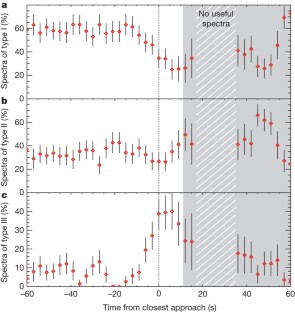
Figure 1: Proportions of particles of different spectral type detected during the central period of the E5 fly-by.
The alternative text for this image may have been generated using AI.
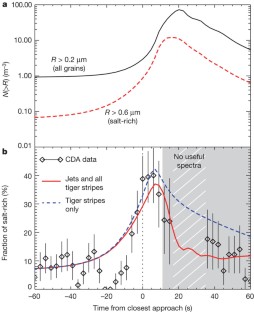
Figure 2: Modelling of the E5 measurements.
The alternative text for this image may have been generated using AI.
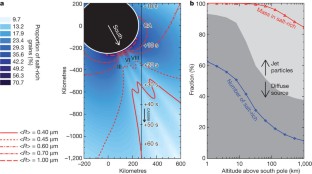
Figure 3: Compositional and size profile of the ice plume.
The alternative text for this image may have been generated using AI.
References
- Spahn, F. et al. Cassini dust measurements at Enceladus and implications for the origin of the E ring. Science 311, 1416–1418 (2006)
Article ADS CAS Google Scholar - Dougherty, M. K. et al. Identification of a dynamic atmosphere at Enceladus with the Cassini magnetometer. Science 311, 1406–1409 (2006)
Article ADS CAS Google Scholar - Hansen, C. J. et al. Enceladus' water vapor plume. Science 311, 1422–1425 (2006)
Article ADS CAS Google Scholar - Waite, J. H. et al. Cassini Ion and Neutral Mass Spectrometer: Enceladus plume composition and structure. Science 311, 1419–1422 (2006)
Article ADS CAS Google Scholar - Spencer, J. R. et al. Cassini encounters Enceladus: background and the discovery of a south polar hot spot. Science 311, 1401–1405 (2006)
Article ADS CAS Google Scholar - Porco, C. C. et al. Cassini observes the active south pole of Enceladus. Science 311, 1393–1401 (2006)
Article ADS CAS Google Scholar - Schmidt, J., Brillantov, N., Spahn, F. & Kempf, S. Slow dust in Enceladus' plume from condensation and wall collisions in tiger stripe fractures. Nature 451, 685–688 (2008)
Article ADS CAS Google Scholar - Postberg, F. et al. Sodium salts in E ring ice grains from an ocean below the surface of Enceladus. Nature 459, 1098–1101 (2009)
Article ADS CAS Google Scholar - Kieffer, S. W. et al. A clathrate reservoir hypothesis for Enceladus' south polar plume. Science 314, 1764–1766 (2006)
Article ADS CAS Google Scholar - Gioia, G., Chakraborty, P., Marshak, S. & Kieffer, W. Unified model of tectonics and heat transport in a frigid Enceladus. Proc. Natl Acad. Sci. USA 104, 13578–13581 (2007)
Article ADS CAS Google Scholar - Nimmo, F., Spencer, J. R., Pappalardo, R. T. & Mullen, M. E. Shear heating as the origin of the plumes and heat flux on Enceladus. Nature 447, 289–291 (2007)
Article ADS CAS Google Scholar - Kieffer, S. et al. A redetermination of the ice/vapor ratio of Enceladus’ plumes: implications for sublimation and the lack of a liquid water reservoir. Icarus 203, 238–241 (2009)
Article ADS CAS Google Scholar - Schneider, N. M. et al. No sodium in the vapour plumes of Enceladus. Nature 459, 1102–1104 (2009)
Article ADS CAS Google Scholar - Srama, R. et al. The Cassini cosmic dust analyzer. Space Sci. Rev. 114, 465–518 (2004)
Article ADS CAS Google Scholar - Hillier, J. K. et al. The composition of Saturn's E ring. Mon. Not. R. Astron. Soc. 388, 1588–1596 (2007)
Article ADS Google Scholar - Postberg, F. et al. The E-ring in the vicinity of Enceladus II. Probing the moon’s interior — the composition of E-ring particles. Icarus 193, 438–454 (2008)
Article ADS CAS Google Scholar - Zolotov, M. Y. An oceanic composition on early and today's Enceladus. Geophys. Res. Lett. 34, L23203 (2007)
Article ADS Google Scholar - Kempf, S. et al. Enceladus dust production — new insights from Cassini. Am. Geophys. Union Fall Meet. abstr. P33A–1562. (2010)
- Hedman, M. et al. Spectral observations of the Enceladus plume with Cassini-VIMS. Astrophys. J. 693, 1749–1762 (2009)
Article ADS Google Scholar - Sremcevic, M. et al. Impact-generated dust clouds around planetary satellites: asymmetry effects. Planet. Space Sci. 51 (issue 7–8). 455–471 (2003)
Article ADS Google Scholar - Hansen, C. J. et al. The composition and structure of the Enceladus plume. Geophys. Res. Lett. 38, L11202 (2011)
Article ADS Google Scholar - Spitale, J. N. & Porco, C. C. Association of jets on Enceladus with the warmest regions on its south-polar fractures. Nature 449, 695–697 (2007)
Article ADS CAS Google Scholar - Halevy, I. & Stewart, S. T. Is Enceladus' plume tidally controlled? Geophys. Res. Lett. 35 L12203 10.1029/2008GL034349 (2008)
Article ADS Google Scholar - Waite, J. H. et al. Liquid water on Enceladus from observations of ammonia and 40Ar in the plume. Nature 460, 487–490 (2009)
Article ADS CAS Google Scholar - Waite, J. H., Jr, Magee, B. & Brockwell, T. The effect of flyby velocity on the composition of the Enceladus gas torus as measured by Cassini INMS. Proc. Lunar Planet. Sci. Conf. 42, 2818 (2011)
ADS Google Scholar - Tian, F., Stewart, A. I. F., Toon, O. B., Larsen, K. W. & Esposito, L. W. Monte Carlo simulations of water vapour plumes on Enceladus. Icarus 188, 154–161 (2007)
Article ADS CAS Google Scholar
Acknowledgements
We thank G. Moragas-Klostermeyer and S. Helfert for their efforts in preparing the CDA plume observations. We acknowledge the work of the scientists and engineers of the Cassini Team at JPL. This work was supported by Deutsches Zentrum für Luft und Raumfahrt (DLR) and Deutsche Forschungs Gemeinschaft (DFG programme ‘The first 10 million years of the solar system’). J.H. was supported by the UK Science and Technology Facilities Council.
Author information
Authors and Affiliations
- Institut für Geowissenschaften, Universität Heidelberg, 69120 Heidelberg, Germany ,
F. Postberg - Max-Planck-Institut für Kernphysik, 69117 Heidelberg, Germany
F. Postberg, S. Kempf & R. Srama - Institut für Physik und Astronomie, Universität Potsdam, 14476 Potsdam-Golm, Germany ,
J. Schmidt - Planetary and Space Sciences Research Institute, The Open University, Milton Keynes MK7 6AA, UK ,
J. Hillier - IGEP,Technische Universität Braunschweig, 38106 Braunschweig, Germany ,
S. Kempf - LASP, University of Colorado, Boulder, 80303, Colorado, USA
S. Kempf - IRS, Universität Stuttgart, 70569 Stuttgart, Germany ,
R. Srama
Authors
- F. Postberg
- J. Schmidt
- J. Hillier
- S. Kempf
- R. Srama
Contributions
F.P. led the analysis and write-up of the manuscript. J.S. led the dynamical modelling and contributed to data analysis and text. J.H. and S.K. contributed to data analysis and text. S.K. and R.S. designed the CDA plume measurement.
Corresponding author
Correspondence toF. Postberg.
Ethics declarations
Competing interests
The authors declare no competing financial interests.
Supplementary information
PowerPoint slides
Rights and permissions
About this article
Cite this article
Postberg, F., Schmidt, J., Hillier, J. et al. A salt-water reservoir as the source of a compositionally stratified plume on Enceladus.Nature 474, 620–622 (2011). https://doi.org/10.1038/nature10175
- Received: 18 January 2011
- Accepted: 05 May 2011
- Published: 22 June 2011
- Issue date: 30 June 2011
- DOI: https://doi.org/10.1038/nature10175
This article is cited by
Editorial Summary
Salty origin for the Enceladus plume
Saturn's icy moon Enceladus is emitting a plume of water vapour and ice particles from warm fractures near its south pole known as tiger stripes. This plume material is thought to originate either from subsurface liquids or through the decomposition of ice. Postberg et al. report the first measurements of the compositions of freshly ejected particles, carried out by Cassini's dust detector during plume crossings. Salt-rich ice particles are found to dominate the total mass flux of ejected solids (>99%), which suggests that a salt-water reservoir with a large evaporating surface provides nearly all of the matter in the plume.