Reaching peak emissions (original) (raw)
- Commentary
- Published: 07 December 2015
- Josep G. Canadell2,
- Corinne Le Quéré3,
- Robbie M. Andrew4,
- Jan Ivar Korsbakken4,
- Glen P. Peters4 &
- …
- Nebojsa Nakicenovic5
Nature Climate Change volume 6, pages 7–10 (2016) Cite this article
- 11k Accesses
- 232 Citations
- 1104 Altmetric
- Metrics details
Subjects
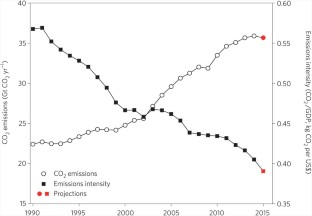
Rapid growth in global CO2 emissions from fossil fuels and industry ceased in the past two years, despite continued economic growth. Decreased coal use in China was largely responsible, coupled with slower global growth in petroleum and faster growth in renewables.
This is a preview of subscription content, access via your institution
Relevant articles
Open Access articles citing this article.
Statistical characterization of urban CO2 emission signals observed by commercial airliner measurements
- Taku Umezawa
- , Hidekazu Matsueda
- … Shamil Maksyutov
Scientific Reports Open Access 14 May 2020
Alternative Strategies Toward Sustainable Ammonia Synthesis
- Chengcheng Li
- , Tuo Wang
- & Jinlong Gong
Transactions of Tianjin University Open Access 13 March 2020
China CO2 emission accounts 2016–2017
- Yuli Shan
- , Qi Huang
- … Klaus Hubacek
Scientific Data Open Access 13 February 2020
Access options
Subscribe to this journal
Receive 12 print issues and online access
$259.00 per year
only $21.58 per issue
Buy this article
- Purchase on SpringerLink
- Instant access to the full article PDF.
USD 39.95
Prices may be subject to local taxes which are calculated during checkout
Additional access options:
Figure 1: Global CO2 emissions from fossil-fuel use and industry since 1990 and emissions intensity CO2/GDP.
The alternative text for this image may have been generated using AI.
Figure 2: Change in CO2 emissions from fossil-fuel use and industry since 2011.

The alternative text for this image may have been generated using AI.
Figure 3: Energy consumption by fuel source from 2000 to 2014, with growth rates indicated for the more recent period of 2010 to 2014.

The alternative text for this image may have been generated using AI.
References
- January–June 2015 Hottest on Record: NOAA (World Meteorological Organization, accessed 1 September 2015); http://go.nature.com/5yynV1
- Friedlingstein, P. et al. Nature Geosci. 7, 709–715 (2014).
Article CAS Google Scholar - Jackson, R. B., Friedlingstein, P., Canadell, J. G. & Andrew, R. M. The Bridge 45, 16–21 (2015).
Google Scholar - Le Quéré et al. Earth Syst. Sci. Data 7, 349–396 (2015).
Article Google Scholar - Statistical Review of World Energy 2015 (BP, 2015); http://go.nature.com/KxRNK9
- Pacala, S. & Socolow, R. Science 305, 968–972 (2004).
Article CAS Google Scholar - Global Wind Report Annual Market Update 2014 (Global Wind Energy Council, accessed 21 August 2015); http://go.nature.com/soCk1e
- Snapshot of Global PV Markets 2014 (International Energy Agency, accessed 21 August, 2015); http://go.nature.com/9BFh4O
- Smith, P. et al. Climate Change 2014: Mitigation of Climate Change (eds Edenhofer, O. et al.) Ch. 11 (IPCC, Cambridge Univ. Press, 2014).
Google Scholar - Federici, S. et al. Forest Ecol. Manage. 352, 89–98 (2015).
Article Google Scholar - Achard, F. et al. Glob. Change Biol. 20, 2540–2554 (2014).
Google Scholar - Davis, S. J. & Socolow, R. H. Environ. Res. Lett. 9, 084018 (2014).
Article Google Scholar - Peters, G. P. et al. Nature Clim. Change 2, 2–4 (2012).
Article CAS Google Scholar - Adjusting to Lower Commodity Prices (International Monetary Fund, accessed 10 October 2015); http://go.nature.com/YAbczX
- National Bureau of Statistics of China. 2015 China Statistical Yearbook (China Statistics Press, 2015).
- Liu, Z. et al. Nature 524, 335–338 (2015).
Article CAS Google Scholar - National Bureau of Statistics of China. China Energy Statistical Yearbook 2014 (China Statistics Press, 2015).
- Peters, G. P., Andrew, R. M., Solomon, S. & Friedlingstein, P. Environ. Res. Lett. 10, 105004 (2015).
Article Google Scholar - Energy from Renewable Resources (European Commission, accessed 20 October 2015); http://go.nature.com/f4IGkb
Acknowledgements
This work is a collaborative effort of the Global Carbon Project, part of the International Geosphere-Biosphere Program and Future Earth, to provide regular analyses of the main global carbon emissions and sinks (www.globalcarbonproject.org). The authors wish to thank the US Carbon Cycle Science Program and Stanford University (R.B.J.), the Australian Climate Change Science Program (J.G.C.), Research Council of Norway projects 236296 and 209701 (R.M.A., J.I.K. and G.P.P.), and the UK Natural Environment Research Council International Opportunities Fund (NE/103002X/1) (C.L.Q.) for their support. We thank the Jackson lab for comments on the manuscript.
Author information
Authors and Affiliations
- School of Earth, Energy, and Environmental Sciences, Woods Institute for the Environment, and Precourt Institute for Energy, Stanford University, Stanford, 94305, California, USA
Robert B. Jackson - Global Carbon Project, CSIRO Oceans and Atmosphere, Canberra, ACT 2601, Australia
Josep G. Canadell - Tyndall Centre for Climate Change Research, University of East Anglia, Norwich Research Park, Norwich, NR4 7TJ, UK
Corinne Le Quéré - Center for International Climate and Environmental Research – Oslo, PO Box 1129 Blindern, Oslo, 0318, Norway
Robbie M. Andrew, Jan Ivar Korsbakken & Glen P. Peters - International Institute for Applied Systems Analysis, Schlossplatz 1, Laxenburg, 2361, Austria
Nebojsa Nakicenovic
Authors
- Robert B. Jackson
- Josep G. Canadell
- Corinne Le Quéré
- Robbie M. Andrew
- Jan Ivar Korsbakken
- Glen P. Peters
- Nebojsa Nakicenovic
Corresponding author
Correspondence toRobert B. Jackson.
Supplementary information
Rights and permissions
About this article
Cite this article
Jackson, R., Canadell, J., Le Quéré, C. et al. Reaching peak emissions.Nature Clim Change 6, 7–10 (2016). https://doi.org/10.1038/nclimate2892
- Published: 07 December 2015
- Issue date: January 2016
- DOI: https://doi.org/10.1038/nclimate2892