Fast and slow parietal pathways mediate spatial attention (original) (raw)
- Brief Communication
- Published: 22 February 2004
Nature Neuroscience volume 7, pages 217–218 (2004) Cite this article
- 2192 Accesses
- 219 Citations
- Metrics details
Abstract
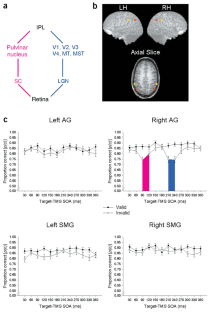
Mechanisms of selective attention are vital for guiding human behavior. The parietal cortex has long been recognized as a neural substrate of spatial attention, but the unique role of distinct parietal subregions has remained unclear. Using single-pulse transcranial magnetic stimulation, we found that the angular gyrus of the right parietal cortex mediates spatial orienting during two distinct time periods after the onset of a behaviorally relevant event. The biphasic involvement of the angular gyrus suggests that both fast and slow visual pathways are necessary for orienting spatial attention.
This is a preview of subscription content, access via your institution
Access options
Subscribe to this journal
Receive 12 print issues and online access
$259.00 per year
only $21.58 per issue
Buy this article
- Purchase on SpringerLink
- Instant access to the full article PDF.
USD 39.95
Prices may be subject to local taxes which are calculated during checkout
Additional access options:
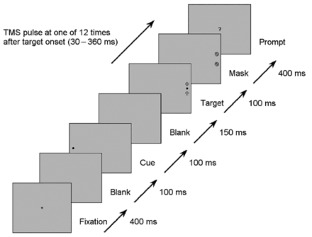
Figure 1: Typical display sequence for an invalidly cued trial.
The alternative text for this image may have been generated using AI.
Figure 2: Neural pathways, parietal stimulation sites and cueing results for the single-pulse TMS experiment.
The alternative text for this image may have been generated using AI.
References
- Bisley, J.W. & Goldberg, M.E. Science 299, 81–86 (2003).
Article CAS Google Scholar - Rushworth, M.F.S., Ellison, A. & Walsh, V. Nat. Neurosci. 4, 656–661 (2001).
Article CAS Google Scholar - Ashbridge, E., Walsh, V. & Cowey, A. Neuropsychologia 35, 1121–1131 (1997).
Article CAS Google Scholar - Müri, R.M. et al. Exp. Brain Res. 143, 426–430 (2002).
Article Google Scholar - Mort, D.J. et al. Brain 126, 1986–1997 (2003).
Article Google Scholar - Robinson, D.L. & Bowman, E.M. & Kertzman, C. J. Neurophysiol. 74, 698–712 (1995).
Article CAS Google Scholar - Wright, M.J., Geffen, G.M. & Geffen, L.B. Biol. Psychol. 41, 183–202 (1995).
Article CAS Google Scholar - Gottlieb, J.P., Kusonoki, M. & Goldberg, M.E. Nature 391, 481–484 (1998).
Article CAS Google Scholar - Clower, D.M. et al. J. Neurosci. 21, 6283–6291 (2001).
Article CAS Google Scholar - Schmolesky, M.T. et al. J. Neurophysiol. 79, 3272–3278 (1998).
Article CAS Google Scholar - Corbetta, M. & Shulman, G.L. Nat. Rev. Neurosci. 3, 201–215 (2002).
Article CAS Google Scholar
Acknowledgements
This research was supported by the National Health & Medical Research Council (J.B.M.). We thank J. Driver, J. Duncan, I. Harris, A. Kritikos, A. Morris, M. O'Boyle, A. Rich, C. Spence, G. Stuart and M. Williams for discussions.
Author information
Authors and Affiliations
- Department of Psychology, Cognitive Neuroscience Laboratory, University of Melbourne, Victoria, 3010, Australia
Christopher D Chambers, Jonathan M Payne, Mark G Stokes & Jason B Mattingley
Authors
- Christopher D Chambers
- Jonathan M Payne
- Mark G Stokes
- Jason B Mattingley
Corresponding author
Correspondence toChristopher D Chambers.
Ethics declarations
Competing interests
The authors declare no competing financial interests.
Supplementary information
Rights and permissions
About this article
Cite this article
Chambers, C., Payne, J., Stokes, M. et al. Fast and slow parietal pathways mediate spatial attention.Nat Neurosci 7, 217–218 (2004). https://doi.org/10.1038/nn1203
- Received: 24 October 2003
- Accepted: 03 February 2004
- Published: 22 February 2004
- Issue date: 01 March 2004
- DOI: https://doi.org/10.1038/nn1203