Mapping time-course mitochondrial adaptations in the kidney in experimental diabetes (original) (raw)
Article navigation

Cover Image
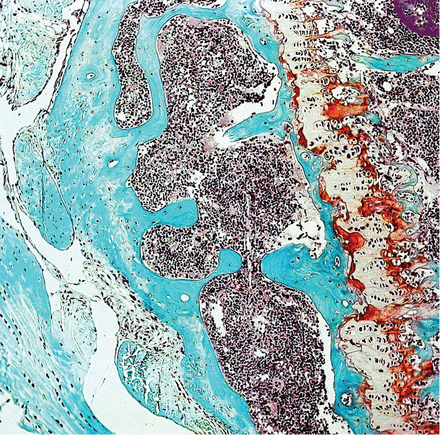
Paraffin section of knee joint from CIA mouse model. Safranin-O/fast green staining showed significant cartilage degeneration and bone erosion in femorotibial joint. For further details see pp. 667-681. Image kindly provided by Dr. Chih-Hsin Tang.
Research Article| March 18 2016
*Glycation, Nutrition & Metabolism Laboratory, Baker IDI Heart & Diabetes Institute, Melbourne, Victoria 8008, Australia
†Department of Medicine, Central Clinical School, Monash University, Alfred Medical Research & Education Precinct, Melbourne, Victoria 3004, Australia
‡Department of Epidemiology & Preventive Medicine, Monash University, Alfred Medical Research & Education Precinct, Melbourne, Victoria 3004, Australia
Search for other works by this author on:
*Glycation, Nutrition & Metabolism Laboratory, Baker IDI Heart & Diabetes Institute, Melbourne, Victoria 8008, Australia
Search for other works by this author on:
*Glycation, Nutrition & Metabolism Laboratory, Baker IDI Heart & Diabetes Institute, Melbourne, Victoria 8008, Australia
Search for other works by this author on:
*Glycation, Nutrition & Metabolism Laboratory, Baker IDI Heart & Diabetes Institute, Melbourne, Victoria 8008, Australia
§Department of Biochemistry & Molecular Biology, Monash University, Clayton, Victoria 3800, Australia
Search for other works by this author on:
*Glycation, Nutrition & Metabolism Laboratory, Baker IDI Heart & Diabetes Institute, Melbourne, Victoria 8008, Australia
Search for other works by this author on:
*Glycation, Nutrition & Metabolism Laboratory, Baker IDI Heart & Diabetes Institute, Melbourne, Victoria 8008, Australia
†Department of Medicine, Central Clinical School, Monash University, Alfred Medical Research & Education Precinct, Melbourne, Victoria 3004, Australia
Search for other works by this author on:
║Centre for Eye Research Australia, Eye and Ear Hospital, East Melbourne, Victoria 3002, Australia
Search for other works by this author on:
*Glycation, Nutrition & Metabolism Laboratory, Baker IDI Heart & Diabetes Institute, Melbourne, Victoria 8008, Australia
†Department of Medicine, Central Clinical School, Monash University, Alfred Medical Research & Education Precinct, Melbourne, Victoria 3004, Australia
Search for other works by this author on:
¶Murdoch Children's Research Institute, Royal Children's Hospital, Parkville, Victoria 3052, Australia
Search for other works by this author on:
¶Murdoch Children's Research Institute, Royal Children's Hospital, Parkville, Victoria 3052, Australia
Search for other works by this author on:
║Centre for Eye Research Australia, Eye and Ear Hospital, East Melbourne, Victoria 3002, Australia
Search for other works by this author on:
*Glycation, Nutrition & Metabolism Laboratory, Baker IDI Heart & Diabetes Institute, Melbourne, Victoria 8008, Australia
†Department of Medicine, Central Clinical School, Monash University, Alfred Medical Research & Education Precinct, Melbourne, Victoria 3004, Australia
Search for other works by this author on:
*Glycation, Nutrition & Metabolism Laboratory, Baker IDI Heart & Diabetes Institute, Melbourne, Victoria 8008, Australia
**Glycation and Diabetes, Mater Research Institute-The University of Queensland, TRI, South Brisbane, QLD 4102, Australia
††School of Medicine, Mater Clinical School, The University of Queensland, St Lucia, QLD 4067, Australia
Search for other works by this author on:

Publisher: Portland Press Ltd
Received: November 26 2015
Revision Received: January 14 2016
Accepted: February 01 2016
Accepted Manuscript online: February 01 2016
Online ISSN: 1470-8736
Print ISSN: 0143-5221
© 2016 Authors; published by Portland Press Limited
2016
Clin Sci (Lond) (2016) 130 (9): 711–720.
Received:
November 26 2015
Revision Received:
January 14 2016
Accepted:
February 01 2016
Accepted Manuscript online:
February 01 2016
Citation
Melinda T. Coughlan, Tuong-Vi Nguyen, Sally A. Penfold, Gavin C. Higgins, Vicki Thallas-Bonke, Sih Min Tan, Nicole J. Van Bergen, Karly C. Sourris, Brooke E. Harcourt, David R. Thorburn, Ian A. Trounce, Mark E. Cooper, Josephine M. Forbes; Mapping time-course mitochondrial adaptations in the kidney in experimental diabetes. _Clin Sci (Lond) 1 May 2016; 130 (9): 711–720. doi: https://doi.org/10.1042/CS20150838
Download citation file:
Oxidative phosphorylation (OXPHOS) drives ATP production by mitochondria, which are dynamic organelles, constantly fusing and dividing to maintain kidney homoeostasis. In diabetic kidney disease (DKD), mitochondria appear dysfunctional, but the temporal development of diabetes-induced adaptations in mitochondrial structure and bioenergetics have not been previously documented. In the present study, we map the changes in mitochondrial dynamics and function in rat kidney mitochondria at 4, 8, 16 and 32 weeks of diabetes. Our data reveal that changes in mitochondrial bioenergetics and dynamics precede the development of albuminuria and renal histological changes. Specifically, in early diabetes (4 weeks), a decrease in ATP content and mitochondrial fragmentation within proximal tubule epithelial cells (PTECs) of diabetic kidneys were clearly apparent, but no changes in urinary albumin excretion or glomerular morphology were evident at this time. By 8 weeks of diabetes, there was increased capacity for mitochondrial permeability transition (mPT) by pore opening, which persisted over time and correlated with mitochondrial hydrogen peroxide (H2O2) generation and glomerular damage. Late in diabetes, by week 16, tubular damage was evident with increased urinary kidney injury molecule-1 (KIM-1) excretion, where an increase in the Complex I-linked oxygen consumption rate (OCR), in the context of a decrease in kidney ATP, indicated mitochondrial uncoupling. Taken together, these data show that changes in mitochondrial bioenergetics and dynamics may precede the development of the renal lesion in diabetes, and this supports the hypothesis that mitochondrial dysfunction is a primary cause of DKD.
© 2016 Authors; published by Portland Press Limited
2016
You do not currently have access to this content.
Sign in
Sign in to your personal account
You could not be signed in. Please check your email address / username and password and try again.
Email address / Username ?
Password
Could not validate captcha. Please try again.