Age written in teeth by nuclear tests (original) (raw)
- Brief Communication
- Published: 14 September 2005
Forensics
Nature volume 437, pages 333–334 (2005) Cite this article
- 3130 Accesses
- 194 Citations
- 30 Altmetric
- Metrics details
A legacy from above-ground testing provides a precise indicator of the year in which a person was born.
Abstract
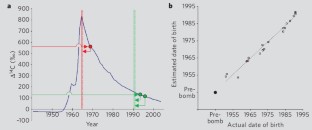
Establishing the age at death of individuals is an important step in their identification and can be done with high precision up to adolescence by analysis of dentition, but it is more difficult in adults. Here we show that the amount of radiocarbon present in tooth enamel as a result of nuclear bomb testing during 1955–63 is a remarkably accurate indicator of when a person was born. Age is determined to within 1.6 years, whereas the commonly used morphological evaluation of skeletal remains and tooth wear is sensitive to within 5–10 years in adults.
This is a preview of subscription content, access via your institution
Access options
Subscribe to this journal
Receive 51 print issues and online access
$199.00 per year
only $3.90 per issue
Buy this article
- Purchase on SpringerLink
- Instant access to the full article PDF.
USD 39.95
Prices may be subject to local taxes which are calculated during checkout
Additional access options:
Figure 1: Date of birth determined from 14C in teeth.
The alternative text for this image may have been generated using AI.
References
- De Vries, H. Science 128, 250–251 (1958).
Article ADS CAS Google Scholar - Nydal, R. & Lovseth, K. Nature 206, 1029–1031 (1965).
Article ADS CAS Google Scholar - Levin, I. & Kromer, B. Radiocarbon 46, 1261–1272 (2004).
Article CAS Google Scholar - Libby, W. F., Berger, R., Mead, J. F., Alexander, G. V. & Ross, J. F. Science 146, 1170–1172 (1964).
Article ADS CAS Google Scholar - Harkness, D. D. Nature 240, 302–303 (1972).
Article ADS CAS Google Scholar - Spalding, K. L., Bhardwaj, R. D., Buchholz, B. A., Druid, H. & Frisén, J. Cell 122, 133–143 (2005).
Article CAS Google Scholar - Nolla, C. M. J. Dent. Child. 27, 254–266 (1960).
Google Scholar - Bolanos, M. V., Manrique, M. C., Bolanos, M. J. & Briones, M. T. Foren. Sci. Int. 110, 97–106 (2000).
Article CAS Google Scholar - Ritz-Timme, S. et al. Int. J. Legal Med. 113, 129–136 (2000).
Article CAS Google Scholar - Otlet, R. L., Walker, A. J., Fulker, M. J. & Collins, C. J. Envir. Radioact. 34, 91–101 (1997).
Article CAS Google Scholar
Author information
Authors and Affiliations
- Department of Cell and Molecular Biology, Medical Nobel Institute, Stockholm, 17177, Sweden
Kirsty L. Spalding & Jonas Frisén - Department of Forensic Medicine, Karolinska Institute, Stockholm, 17177, Sweden
Lars-Eric Bergman & Henrik Druid - Center for Accelerator Mass Spectrometry, Lawrence Livermore National Laboratory, Livermore, 94551, California, USA
Bruce A. Buchholz
Authors
- Kirsty L. Spalding
- Bruce A. Buchholz
- Lars-Eric Bergman
- Henrik Druid
- Jonas Frisén
Corresponding author
Correspondence toJonas Frisén.
Ethics declarations
Competing interests
We have filed a patent application for the described method. We do not have any link to any commercial entity regarding this. However, a patent, if granted, may have value in the future that could be influenced by this publication.
Supplementary information
Rights and permissions
About this article
Cite this article
Spalding, K., Buchholz, B., Bergman, LE. et al. Age written in teeth by nuclear tests.Nature 437, 333–334 (2005). https://doi.org/10.1038/437333a
- Published: 14 September 2005
- Issue date: 15 September 2005
- DOI: https://doi.org/10.1038/437333a
This article is cited by
Editorial Summary
Long in the tooth
The amount of carbon-14 isotope in the atmosphere was relatively stable until 1955, when above-ground nuclear-bomb tests caused a rapid rise. This provides an unexpected tool for those facing the task of identifying dead bodies: an accurate measure of age. During the years 1955–63, when atmospheric tests took place, carbon-14 accumulated in tooth enamel. The amount deposited is a good indication of when a person was born, accurate to within 1.6 years compared with the 5–10 year sensitivity of other techniques.