BK-tree (original) (raw)
From Wikipedia, the free encyclopedia
Tree data structure for metric spaces
A BK-tree (short for Burkhard-Keller tree) is a metric tree suggested by Walter Austin Burkhard and Robert M. Keller[1] specifically adapted to discrete metric spaces. For simplicity, given a way to measure the distance between any two elements of a set, a BK-tree is built with a single root node and several subtrees, each connected to the root as a child. All nodes in a subtree have an equal distance to the root node, and the edge weight of the edge connecting the subtree to the root is equal to the distance. As shown in the picture. Also, each subtree of a BK-tree is a BK-tree.

The structure of the BK-tree is shown in the diagram: every node in a subtree is equidistant from the root
BK-trees can be used for approximate string matching in a dictionary [2]. The problem is formulated as follows: Given a pattern string P = p 1 p 2 . . . p m {\displaystyle P=p_{1}p_{2}...p_{m}} 

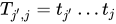


An ordinary way using BK-tree is to insert all Θ ( n 2 ) {\displaystyle \Theta (n^{2})} 


An example of BK-tree
This picture depicts the BK-tree for the set W {\displaystyle W} 
The BK-tree is built so that:
- for all node u {\displaystyle u}
of the BK-tree, the weight assigned to its egress arcs are distinct;
- for all arc e = ( u , v ) {\displaystyle e=(u,v)}
labeled by k {\displaystyle k}
, each descendant v ′ {\displaystyle v'}
of v {\displaystyle v}
satisfies the following equation: d ( w u , w v ′ ) = k {\displaystyle d(w_{u},w_{v'})=k}
:
- Example 1: Consider the arc from "book" to "books". The distance between "book" and any word in {"books", "boo", "boon", "cook"} is equal to 1;
- Example 2: Consider the arc from "books" to "boo". The distance between "books" and any word in {"boo", "boon", "cook"} is equal to 2.
The insertion primitive is used to populate a BK-tree t {\displaystyle t} 

Input:
Output:
Algorithm:
Given a searched element w {\displaystyle w} 
Input:
Output:
Algorithm:
Example of the lookup algorithm
[edit]
Consider the example 8-node B-K Tree shown above and set w = {\displaystyle w=} 


Next the node containing "books" is popped from S {\displaystyle S} 




Finally each of the two last elements in S {\displaystyle S} 

The efficiency of BK-trees depends strongly on the structure of the tree and the distribution of distances between stored elements.
In the average case, both insertion and lookup operations take Θ ( log n ) {\displaystyle \Theta (\log n)} 
In the worst case, when the data or distance function causes the tree to become highly unbalanced (for example, when many elements are at similar distances), both insertion and lookup can degrade to Θ ( n ) {\displaystyle \Theta (n)} 
In practical applications, the actual performance depends on the choice of distance metric (e.g., the Levenshtein distance) and on the allowed search radius during approximate matching.[7]
- Levenshtein distance – the distance metric commonly used when building a BK-tree
- Damerau–Levenshtein distance – a modified form of Levenshtein distance that allows transpositions
- ^ W. Burkhard and R. Keller. Some approaches to best-match file searching, CACM, 1973
- ^ R. Baeza-Yates, W. Cunto, U. Manber, and S. Wu. Proximity matching using fixed queries trees. In M. Crochemore and D. Gusfield, editors, 5th Combinatorial Pattern Matching, LNCS 807, pages 198–212, Asilomar, CA, June 1994.
- ^ Ricardo Baeza-Yates and Gonzalo Navarro. Fast Approximate String Matching in a Dictionary. Proc. SPIRE'98
- ^ W. A. Burkhard and R. M. Keller. Some approaches to best match file searching. Communications of the ACM, 16(4):230–236, 1973.
- ^ R. Baeza-Yates and G. Navarro. Fast Approximate String Matching in a Dictionary. In Proceedings of SPIRE'98, 1998.
- ^ H. Hyyro. Explaining and Extending the Burkhard–Keller Tree for Fast String Searching. In Proceedings of the 7th Symposium on String Processing and Information Retrieval (SPIRE), pages 1–10, 2003.
- ^ S. Mihov and K. Schulz. Fast approximate search in large dictionaries. Computational Linguistics, 30(4):451–477, 2004.
- A BK-tree implementation in Common Lisp with test results and performance graphs.
- An explanation of BK-Trees and their relationship to metric spaces [8]
- An explanation of BK-Trees with an implementation in C# [9]
- A BK-tree implementation in Lua [10]
- A BK-tree implementation in Python [11]