3.4 Trade (original) (raw)
Imports are computed based on total consumption, including food and non-food human consumption, food waste, and feed consumption. The parameter which allows the computation of future imports is the share of the total consumption which is satisfied by imports. Exports are computed differently: targeted exports are purely exogenous and expressed in 1,000 tons because the determinants of the demand outside the country are not represented in the model. The final exports can be reduced if there is not enough land (cf. Feasible production, trade and consumption).
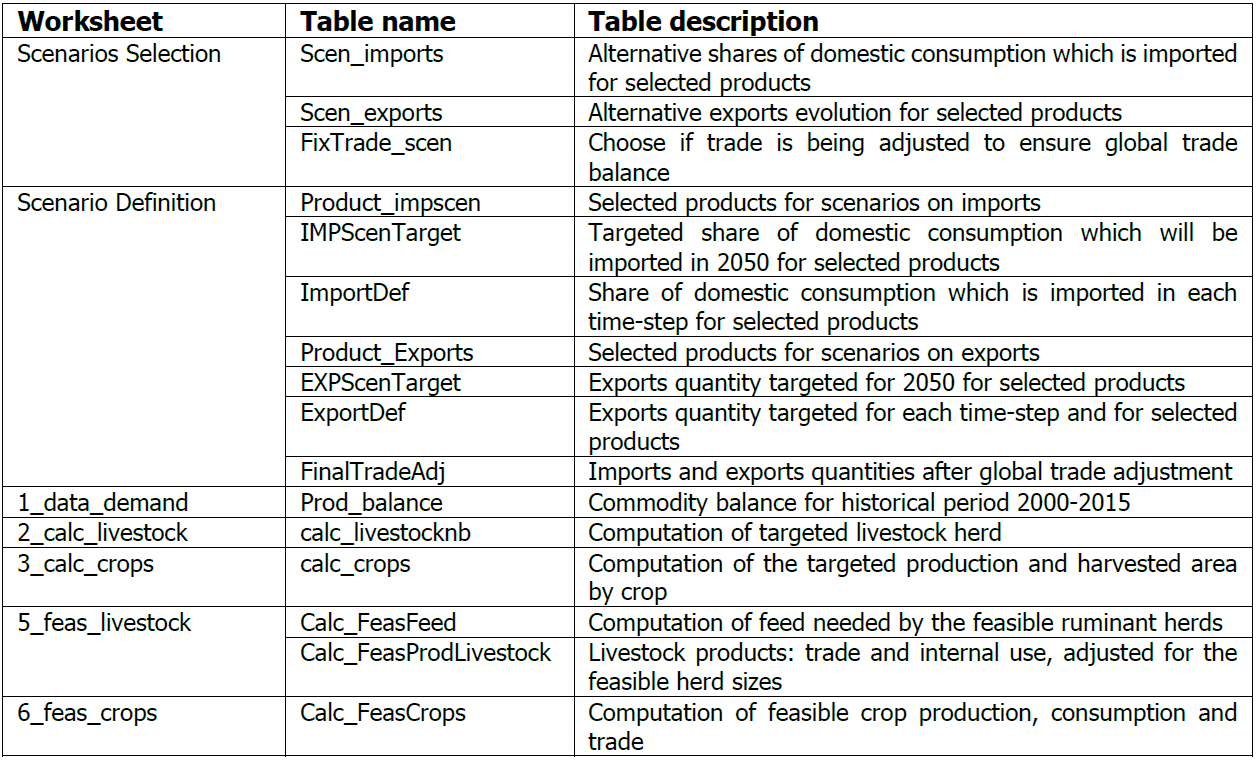
The default assumption is that the share of the total consumption which is imported, and the level of exports, remain constant at the 2010 level, as reported by the FAO in the Commodity Balances (FAOSTAT, 2020). The “Exports” and “Imports” scenarios make it possible to change this assumption but only for the products which are selected in the export and import scenarios tables. Users can specify by how much the 2010 exports or the 2010 share of consumption which is imported will vary by 2050 for each selected product using a shifter (2010=1) and the implementation rate of the target. By default, three scenarios are defined for the imports (I1, I2, and I3) and 3 scenarios are defined for the exports (E1, E2, E3) with no change, reduced, and increased trade assumptions.
One scenario makes it possible to fix trade to certain values i.e. overwriting the previous imports and exports scenarios and impeding trade adjustment due to the land constraint (Fix Trade scenario). This scenario is used during the Scenathon for the global trade harmonization stage after the national and regional net trade have been adjusted to solve global trade imbalances.
Table 7. List of tables related to the exports and imports scenarios