Advances in Land Surface Modelling (original) (raw)
Abstract
Land surface models have an increasing scope. Initially designed to capture the feedbacks between the land and the atmosphere as part of weather and climate prediction, they are now used as a critical tool in the urgent need to inform policy about land-use and water-use management in a world that is changing physically and economically. This paper outlines the way that models have evolved through this change of purpose and what might the future hold. It highlights the importance of distinguishing between advances in the science within the modelling components, with the advances of how to represent their interaction. This latter aspect of modelling is often overlooked but will increasingly manifest as an issue as the complexity of the system, the time and space scales of the system being modelled increase. These increases are due to technology, data availability and the urgency and range of the problems being studied.
Introduction
We are approaching an interesting junction with Land Surface Models (LSMs). Early models such as the Biosphere-Atmosphere Transfer Scheme (BATS) [[37](/article/10.1007/s40641-021-00171-5#ref-CR37 "Dickinson RE, Henderson-Sellers A, Kennedy J, & Wilson F (1986). Biosphere-atmosphere Transfer Scheme (BATS) for the NCAR Community Climate Model. https://doi.org/10.5065/D6668B58
            "), [38](/article/10.1007/s40641-021-00171-5#ref-CR38 "Dickinson RE, Henderson-Sellers A, & Kennedy PJ (1993). Biosphere-Atmosphere Transfer Scheme (BATS) version le as coupled to the NCAR community climate model. Technical note. [NCAR (National Center for Atmospheric Research)] (PB-94-106150/XAB; NCAR/TN-387+STR). National Center for Atmospheric Research, Boulder, CO (United States). Scientific Computing Div.
              https://www.osti.gov/biblio/5733868

            ")\] and the Simple Biosphere Model (SIB) \[[122](/article/10.1007/s40641-021-00171-5#ref-CR122 "Sellers PJ, Mintz Y, Sud YC, Dalcher A. A simple biosphere model (SIB) for use within general circulation models. J Atmos Sci. 1986;43(6):505–31.
              https://doi.org/10.1175/1520-0469(1986)043<0505:ASBMFU>2.0.CO;2

            ."), [123](/article/10.1007/s40641-021-00171-5#ref-CR123 "Sellers PJ, Randall D, Collatz G, Berry J, Field C, Dazlich D, et al. A revised land surface parameterization (SiB2) for atmospheric GCMs .1. Model formulation. J Clim. 1996;9(4):676–705.
              https://doi.org/10.1175/1520-0442(1996)009<0676:ARLSPF>2.0.CO;2

            .")\] pioneered the use of linked soils and vegetation to describe the energy and water exchanges with the atmosphere. Since then, after decades of research, much is known about the land as a system and how to model it \[[109](/article/10.1007/s40641-021-00171-5#ref-CR109 "Pitman AJ. The evolution of, and revolution in, land surface schemes designed for climate models. Int J Climatol. 2003;23(5):479–510.
              https://doi.org/10.1002/joc.893

            .")\].
While originally the models were designed to capture the essential features of land-atmosphere interactions, we have learnt that provision of our food and energy also depends on these interactions between climate, soil, water and the vegetation. The models we have built to describe these interactions are being urgently re-cast to help us make decisions about the management of our environment to build resilience to a changing climate.
But, there is complexity both within the land-system, and how it interacts with other systems such as the atmosphere and the human system. To make progress, we need to address the challenges of heterogeneity, of complexity and of human-interaction. In their ‘Perspectives’ paper, [[49](/article/10.1007/s40641-021-00171-5#ref-CR49 "Fisher RA, Koven CD. Perspectives on the future of land surface models and the challenges of representing complex terrestrial systems. J Adv Model Earth Syste. 2020;12(4):e2018MS001453. https://doi.org/10.1029/2018MS001453
.")\] acknowledge the challenges of heterogeneity and complexity and propose some practical ways forward using the current LSM framework.In this paper, we present a review of land surface modelling: its history, recent advances and issues that are limiting or inspiring a way forward, in particular to bring in the human-interaction dimension. We focus on two important aspects to modelling:
- Processes within a component of the land-system.
- Exchanges between components dealing with scale mismatch and heterogeneity.
This paper aims to provide a review of how these two aspects of land surface models have evolved and how an understanding of their separate role may help us to provide a robust future for land surface modelling.
In writing this review, we worked with a selection of modelling groups from around the world to represent the various approaches to Land Surface Modelling. All of the models are part of a climate or earth system model, but some have a greater focus on land-use and carbon, while others focus more on the global water cycle. It is not possible to capture all the papers and model developments that have resulted from the massive scientific effort taking this subject forward. In the appendix, there is a table that includes the 11 of the main land surface models in current use in climate modelling. Table 1 highlights the Climate/Earth System Models with which these 11 models are associated. The shared model developments of these 11 models are summarised.
Table 1 Eleven land surface models and their associated Climate/Earth System Model
Basic Concepts Used in This Paper
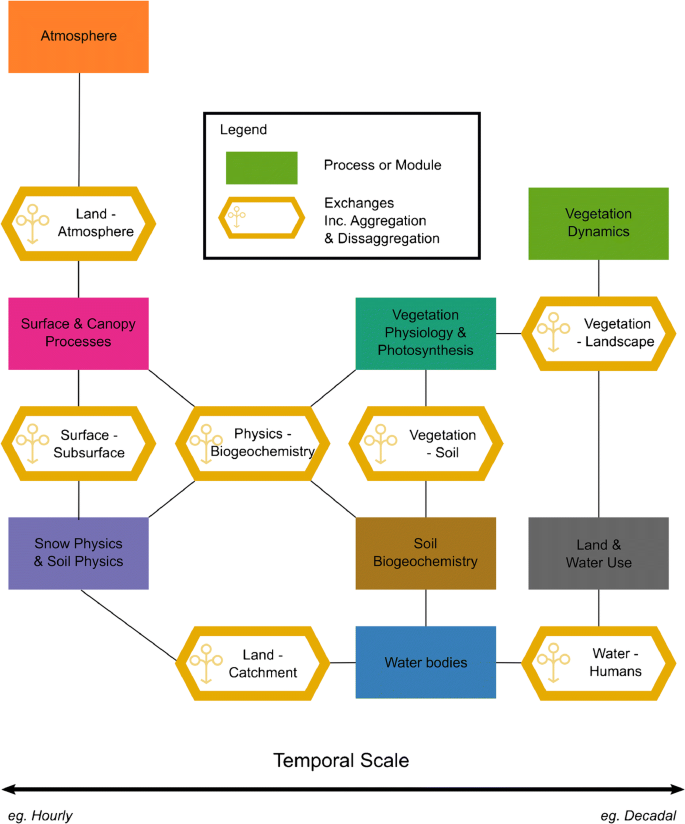
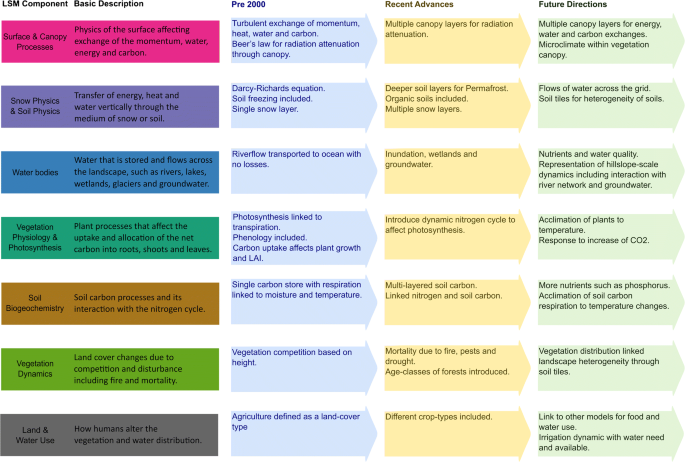
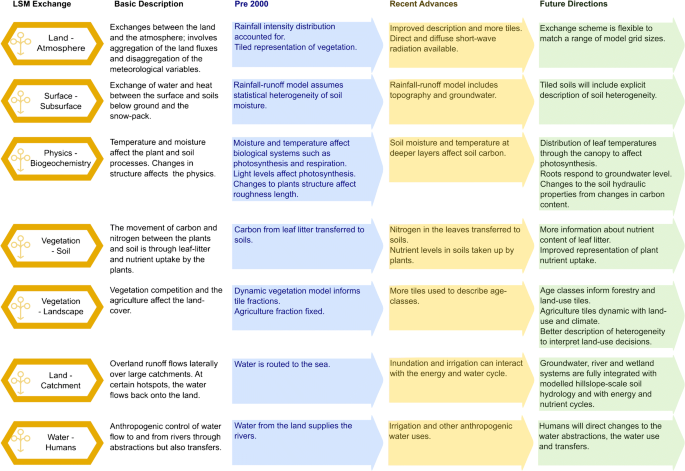
The following schematic (Fig. 1) summarises the ideas presented in the paper. The processes are arranged in the horizontal from left to right representing the different timescales: roughly hourly to decadal. This highlights the huge range of timescales that the land surface models perform in. The exchanges are clearly critical in moving across this temporal range. In the vertical, the processes are working at different spatial scales and the exchange schemes are designed to deal with heterogeneity. The schematic is a generalisation of the current model structures while every model is slightly different. Figures 2 and 3 summarise the developments of the components (2) and exchanges (3) in three categories: historic (pre 2000), recent and future. A summary of the papers describing how each model treats these processes and exchanges is given in the Appendix.
Fig. 1
The alternative text for this image may have been generated using AI.
Schematic of Land Surface Model showing Components (process or module) and the exchanges between components across temporal scales (hourly to decadal)
Fig. 2
The alternative text for this image may have been generated using AI.
Land Surface Model Component development for pre 2000, recent advances and future directions
Fig. 3
The alternative text for this image may have been generated using AI.
Land Surface Model Exchange developments for pre 2000, recent advances and future directions
In the next 5 sections, history and development of the processes and linkages are explored. They are grouped together as follows:
- Section 2: Canopy Processes with Land-Atmosphere Exchange
- Section 3: Snow and Soil Physics with Surface-Subsurface Exchange
- Section 4: Water Bodies with Land-Catchment and Water-People Exchanges
- Section 5: Vegetation Physiology and Soil Biogeochemistry with Physics-Biogeochemistry Exchange
- Section 6: Vegetation Dynamics and Land-Use with Vegetation-Landscape Exchange
We will make some conclusions in the final section (7).
Surface and Canopy Processes with Land-Atmosphere Exchange
This section addresses the physics of the exchange of momentum, water, energy and carbon between the land and the atmosphere. The processes include turbulence, evaporation and radiation transfers while the exchange critically involves techniques to accommodate the different spatial and temporal scales of the land (small spatial scale, long time scale) and atmosphere (long spatial scale, short time scale) through aggregation of the land fluxes and disaggregation of the meteorological variables. Figure 4 gives an overview of the processes discussed in this section.
Fig. 4

The alternative text for this image may have been generated using AI.
Schematic of surface and canopy processes represented in LSMs
History
Momentum transfer is a fundamental part of weather forecasting and research goes back to the early 1900s (for a review see Anderson [[2](/article/10.1007/s40641-021-00171-5#ref-CR2 "Anderson JD. Ludwig Prandtl’s boundary layer. Phys Today. 2005;58(12):42–8. https://doi.org/10.1063/1.2169443
.")\]). The turbulent transfer of momentum was represented using a bulk transfer equation with a roughness length that depended on the surface. In the 1970s, it became common practice to use this approach for the latent and sensible heat transfers, but with a smaller (× 0.1) roughness length. To simplify the problem, the same roughness length was used for both water and heat (and now carbon) fluxes.Inclusion of carbon exchanges in LSMs was introduced in the 1990s. The sensitivity of photosynthesis to light levels meant that LSMs needed to represent the filtration of light through the plant canopy. The first attempts to do this used Beer’s Law [[123](/article/10.1007/s40641-021-00171-5#ref-CR123 "Sellers PJ, Randall D, Collatz G, Berry J, Field C, Dazlich D, et al. A revised land surface parameterization (SiB2) for atmospheric GCMs .1. Model formulation. J Clim. 1996;9(4):676–705. https://doi.org/10.1175/1520-0442(1996)009<0676:ARLSPF>2.0.CO;2
            .")\] and then an improved ‘two-leaf’ model which represents a sunlit and shaded canopy (\[[26](/article/10.1007/s40641-021-00171-5#ref-CR26 "Dai Y, Dickinson R, Wang Y. A two-big-leaf model for canopy temperature, photosynthesis, and stomatal conductance. J Clim. 2004;17(12):2281–99.
              https://doi.org/10.1175/1520-0442(2004)017<2281:ATMFCT>2.0.CO;2

            ."), [36](/article/10.1007/s40641-021-00171-5#ref-CR36 "dePury D, Farquhar G. Simple scaling of photosynthesis from leaves to canopies without the errors of big-leaf models. Plant Cell Environ. 1997;20(5):537–57.
              https://doi.org/10.1111/j.1365-3040.1997.00094.x

            .")\]; Y. \[[139](/article/10.1007/s40641-021-00171-5#ref-CR139 "Wang Y, Leuning R. A two-leaf model for canopy conductance, photosynthesis and partitioning of available energy I: model description and comparison with a multi-layered model. Agric For Meteorol. 1998;91(1–2):89–111.
              https://doi.org/10.1016/S0168-1923(98)00061-6

            .")\]).
One of the great challenges for the land-atmosphere exchange is the contrast of the spatial and temporal scales involved. The land has a fine spatial structure with variations in land cover at scales of 100 m, but evolves relatively slowly (weekly), while due to the mixing of the air, the atmosphere has dominant spatial scales of 10 km or 1 km for convective systems, with a temporal scale of hours or even minutes for convective systems. The exchange of key variables such as rainfall, radiation, evaporation and momentum need to accommodate these different scales. Many of the assumptions used to aggregate and disaggregate the variables are implicit and buried within the model code. It is important that we understand these assumptions and make them explicit so that when the models change their scale (for instance as we move into convective permitting models), we can continue to correctly represent these exchanges. In the following, two examples of how models accommodate these differences in scale are described.
Precipitation given by a weather or climate model is the hourly-average over a large area (up to 100 km2). Over this time-space, it appears to be drizzling all the time [[110](/article/10.1007/s40641-021-00171-5#ref-CR110 "Pitman AJ, Henderson-Sellers A, Yang Z-L. Sensitivity of regional climates to localized precipitation in global models. Nature. 1990;346(6286):734–7. https://doi.org/10.1038/346734a0
            .")\]. The exchange scheme needs to account for this misrepresentation of the true heterogeneous, spikey nature of precipitation. Dolman and Gregory \[[39](/article/10.1007/s40641-021-00171-5#ref-CR39 "Dolman AJ, Gregory D. The parametrization of rainfall interception In GCMs. Q J R Meteorol Soc. 1992;118(505):455–67.
              https://doi.org/10.1002/qj.49711850504

            .")\] used a statistical description of rainfall intensity distribution to counteract the drizzle effect in the JULES model \[[9](/article/10.1007/s40641-021-00171-5#ref-CR9 "Best MJ, Pryor M, Clark DB, Rooney GG, Essery RLH, Menard CB, et al. The Joint UK Land Environment Simulator (JULES), model description—Part 1: energy and water fluxes. Geosci Model Dev. 2011;4(3):677–99.
              https://doi.org/10.5194/gmd-4-677-2011

            .")\] to improve the representation of infiltration and interception.
Up until the 1990s, each grid box had only one dominant land-cover type. The first breakthrough for representing the true heterogeneity of the land-surface came with the use of tiles, so that each land-cover occupied a fraction of the grid box with a separate energy balance equation for each. This approach was pioneered by Koster and Suarez [[75](/article/10.1007/s40641-021-00171-5#ref-CR75 "Koster RD, Suarez MJ. Modeling the land surface boundary in climate models as a composite of independent vegetation stands. J Geophys Res-Atmos. 1992;97(D3):2697–715. https://doi.org/10.1029/91JD01696
            .")\] and now tiling schemes are commonly used, aided by the availability of high-resolution remote sensing datasets (1 km or finer) (e.g. \[[3](/article/10.1007/s40641-021-00171-5#ref-CR3 "Arino O, Bicheron P, Achard F, Latham J, Witt R, Weber J-L. GLOBCOVER The most detailed portrait of Earth. ESA Bull - Eur Space Agency. 2008;136:24–31."), [45](/article/10.1007/s40641-021-00171-5#ref-CR45 "Faroux S, Tchuente ATK, Roujean J-L, Masson V, Martin E, Le Moigne P. ECOCLIMAP-II/Europe: a twofold database of ecosystems and surface parameters at 1 km resolution based on satellite information for use in land surface, meteorological and climate models. Geosci Model Dev. 2013;6(2):563–82.
              https://doi.org/10.5194/gmd-6-563-2013

            ."), [54](/article/10.1007/s40641-021-00171-5#ref-CR54 "Friedl M, & Sulla-Menashe D (2019). MCD12Q1 MODIS/Terra+Aqua Land Cover Type Yearly L3 Global 500m SIN Grid V006 [Data set]. NASA EOSDIS Land Processes DAAC. 1.
              https://lpdaac.usgs.gov/node/1260

            "), [61](/article/10.1007/s40641-021-00171-5#ref-CR61 "Hansen M, Defries R, Townshend J, Sohlberg R. Global land cover classification at 1km spatial resolution using a classification tree approach. Int J Remote Sens. 2000;21(6–7):1331–64.
              https://doi.org/10.1080/014311600210209

            ."), [87](/article/10.1007/s40641-021-00171-5#ref-CR87 "Loveland T, Reed B, Brown J, Ohlen D, Zhu Z, Yang L, et al. Development of a global land cover characteristics database and IGBP DISCover from 1 km AVHRR data. Int J Remote Sens. 2000;21(6–7):1303–30.
              https://doi.org/10.1080/014311600210191

            .")\]).
Recent Advances
Direct light throws hard shadows unlike diffuse light, which, coming from many angles reaches down further into a tree canopy. A recent improvement in LSMs is to replace the Beer’s Law or the ‘two-leaf’ model with a ‘multi-layer’ scheme [[12](#ref-CR12 "Bonan GB, Lawrence PJ, Oleson KW, Levis S, Jung M, Reichstein M, Lawrence DM, & Swenson SC (2011). Improving canopy processes in the Community Land Model version 4 (CLM4) using global flux fields empirically inferred from FLUXNET data. J Geophysical Res: Biogeosciences, 116. https://doi.org/10.1029/2010JG001593
            "),[13](#ref-CR13 "Bonan GB, Patton EG, Harman IN, Oleson KW, Finnigan JJ, Lu Y, et al. Modeling canopy-induced turbulence in the Earth system: a unified parameterization of turbulent exchange within plant canopies and the roughness sublayer (CLM-ml v0). Geosci Model Dev. 2018;11(4):1467–96.
              https://doi.org/10.5194/gmd-11-1467-2018

            ."),[14](/article/10.1007/s40641-021-00171-5#ref-CR14 "Bonan GB, Williams M, Fisher RA, Oleson KW. Modeling stomatal conductance in the earth system: linking leaf water-use efficiency and water transport along the soil-plant-atmosphere continuum. Geosci Model Dev. 2014;7(5):2193–222.
              https://doi.org/10.5194/gmd-7-2193-2014

            .")\]. The impact of this on the carbon balance is notable \[[96](/article/10.1007/s40641-021-00171-5#ref-CR96 "Mercado LM, Bellouin N, Sitch S, Boucher O, Huntingford C, Wild M, et al. Impact of changes in diffuse radiation on the global land carbon sink. Nature. 2009;458(7241):1014–U87.
              https://doi.org/10.1038/nature07949

            .")\]. The new ‘multi-layer’ models need the direct and diffuse components of incoming shortwave radiation to be quantified.
Recently, tiling schemes have been improved by using new data on ecological trait databases [[70](/article/10.1007/s40641-021-00171-5#ref-CR70 "Kattge J, Boenisch G, Diaz S, Lavorel S, Prentice IC, Leadley P, et al. TRY plant trait database—enhanced coverage and open access. Glob Chang Biol. 2020;26(1):119–88. https://doi.org/10.1111/gcb.14904
            ."), [71](/article/10.1007/s40641-021-00171-5#ref-CR71 "Kattge, J., Diaz, S., Lavorel, S., Prentice, C., Leadley, P., Boenisch, G., Garnier, E., Westoby, M., Reich, P. B., Wright, I. J., Cornelissen, J. H. C., Violle, C., Harrison, S. P., van Bodegom, P. M., Reichstein, M., Enquist, B. J., Soudzilovskaia, N. A., Ackerly, D. D., Anand, M., … Wirth, C. (2011). TRY—a global database of plant traits. Glob Chang Biol, 17(9), 2905–2935.
              https://doi.org/10.1111/j.1365-2486.2011.02451.x

            ")\] to increase the number of Plant Functional Types (PFTs) \[[62](/article/10.1007/s40641-021-00171-5#ref-CR62 "Harper AB, Wiltshire AJ, Cox PM, Friedlingstein P, Jones CD, Mercado LM, et al. Vegetation distribution and terrestrial carbon cycle in a carbon cycle configuration of JULES4.6 with new plant functional types. Geosci Model Dev. 2018;11(7):2857–73.
              https://doi.org/10.5194/gmd-11-2857-2018

            ."), [141](/article/10.1007/s40641-021-00171-5#ref-CR141 "Wang YP, Lu XJ, Wright IJ, Dai YJ, Rayner PJ, Reich PB. Correlations among leaf traits provide a significant constraint on the estimate of global gross primary production. Geophys Res Lett. 2012;39:19405.
              https://doi.org/10.1029/2012GL053461

            .")\]. In addition, the most advanced LSMs have included soil tiles as well as vegetation tiles \[[33](/article/10.1007/s40641-021-00171-5#ref-CR33 "de Vrese P, Hagemann S. Explicit representation of spatial subgrid-scale heterogeneity in an ESM. J Hydrometeorol. 2016;17(5):1357–71.
              https://doi.org/10.1175/JHM-D-15-0080.1

            ."), [48](/article/10.1007/s40641-021-00171-5#ref-CR48 "Feddema J, Oleson K, Bonan G, Mearns L, Washington W, Meehl G, et al. A comparison of a GCM response to historical anthropogenic land cover change and model sensitivity to uncertainty in present-day land cover representations. Clim Dyn. 2005;25(6):581–609.
              https://doi.org/10.1007/s00382-005-0038-z

            ."), [63](/article/10.1007/s40641-021-00171-5#ref-CR63 "Hartley AJ, MacBean N, Georgievski G, Bontemps S. Uncertainty in plant functional type distributions and its impact on land surface models. Remote Sens Environ. 2017;203:71–89.
              https://doi.org/10.1016/j.rse.2017.07.037

            ."), [114](/article/10.1007/s40641-021-00171-5#ref-CR114 "Poulter B, Frank DC, Hodson EL, Zimmermann NE. Impacts of land cover and climate data selection on understanding terrestrial carbon dynamics and the CO2 airborne fraction. Biogeosciences. 2011;8(8):2027–36.
              https://doi.org/10.5194/bg-8-2027-2011

            ."), [116](/article/10.1007/s40641-021-00171-5#ref-CR116 "Quaife T, Quegan S, Disney M, Lewis P, Lomas M, Woodward FI. Impact of land cover uncertainties on estimates of biospheric carbon fluxes. Glob Biogeochem Cycles. 2008;22(4).
              https://doi.org/10.1029/2007GB003097

            .")\].
Current Limitations and Future Directions
While the momentum fluxes are well represented (having the advantage of a single boundary condition of zero wind speed), the science behind the transfer of heat and water is more complex. For instance, in a typical landscape, there are several surfaces with different energy budgets which vary in time (as leaves wet up and dry out, as the sun comes in and out) and space (within a canopy, below a canopy, mixtures of vegetation and soil). All these surfaces contribute to the surface temperatures which acts as the boundary condition to the atmosphere. A good summary of this issue of heterogeneity is given by Verhoef et al. [[135](/article/10.1007/s40641-021-00171-5#ref-CR135 "Verhoef A, Bruin D, H. a. R., & Van Den Hurk, B. J. J. M. Some practical notes on the Parameter kB−1 for Sparse Vegetation. J Appl Meteorol. 1997;36(5):560–72. https://doi.org/10.1175/1520-0450(1997)036<0560:SPNOTP>2.0.CO;2
.")\].Even within a canopy, there are potential improvements that can be made to represent different canopy structures and their impact on the light, temperature, momentum water and carbon exchanges. One way forward is to model the different surfaces explicitly. For instance, Ma and Liu [[89](/article/10.1007/s40641-021-00171-5#ref-CR89 "Ma Y, Liu H. An advanced multiple-layer canopy model in the WRF model with large-Eddy simulations to simulate canopy flows and scalar transport under different stability conditions. J Adv Model Earth Syst. 2019;11(7):2330–51. https://doi.org/10.1029/2018MS001347
            .")\] explore the impact of an explicit representation of the canopy. There are challenges in that the turbulence throughout and below the canopy affect the microclimatic profiles of air temperature, humidity and windspeed \[[13](/article/10.1007/s40641-021-00171-5#ref-CR13 "Bonan GB, Patton EG, Harman IN, Oleson KW, Finnigan JJ, Lu Y, et al. Modeling canopy-induced turbulence in the Earth system: a unified parameterization of turbulent exchange within plant canopies and the roughness sublayer (CLM-ml v0). Geosci Model Dev. 2018;11(4):1467–96.
              https://doi.org/10.5194/gmd-11-1467-2018

            ."), [14](/article/10.1007/s40641-021-00171-5#ref-CR14 "Bonan GB, Williams M, Fisher RA, Oleson KW. Modeling stomatal conductance in the earth system: linking leaf water-use efficiency and water transport along the soil-plant-atmosphere continuum. Geosci Model Dev. 2014;7(5):2193–222.
              https://doi.org/10.5194/gmd-7-2193-2014

            .")\]. Use of the many flux-tower data that capture sub-diurnal momentum, energy, water and carbon fluxes for different sun-angles, difference light-diffusiveness and different temperatures would enable us to quantify the role of canopy structure.
In addition to the increase in complexity of the component model, the exchanges between the land and atmosphere also need to be improved. The exchange needs to respond to the time and spatial scale of the atmosphere model. For instance, when using a convection permitting atmosphere model, the precipitation becomes more intense (no drizzle effect) and assumptions about the transfer of scales no longer apply. At smaller scales, the tiles may become obsolete. In its place, the heterogeneity of the water stores across the land may become more important (see Section 4).
Finally, as Land Surface Models are used a finer scales and feeding policy direction for human health and wellbeing, the need for improvements to the representation of Urban land-surface is becoming more urgent. Urban areas give rise to phenomena such as ‘urban islands’, and are subject to more extreme flooding conditions due to the reduced infiltration capacity. The first Model Intercomparison of Urban models is just being published and shows how varied they are [[57](/article/10.1007/s40641-021-00171-5#ref-CR57 "Grimmond, C. S. B., Blackett, M., Best, M. J., Baik, J.-J., Belcher, S. E., Beringer, J., Bohnenstengel, S. I., Calmet, I., Chen, F., Coutts, A., Dandou, A., Fortuniak, K., Gouvea, M. L., Hamdi, R., Hendry, M., Kanda, M., Kawai, T., Kawamoto, Y., Kondo, H., … Zhang, N. (2011). Initial results from Phase 2 of the international urban energy balance model comparison. Int J Climatol, 31(2), 244–272. https://doi.org/10.1002/joc.2227
")\].Snow and Soil Physics with Surface-Subsurface Exchange
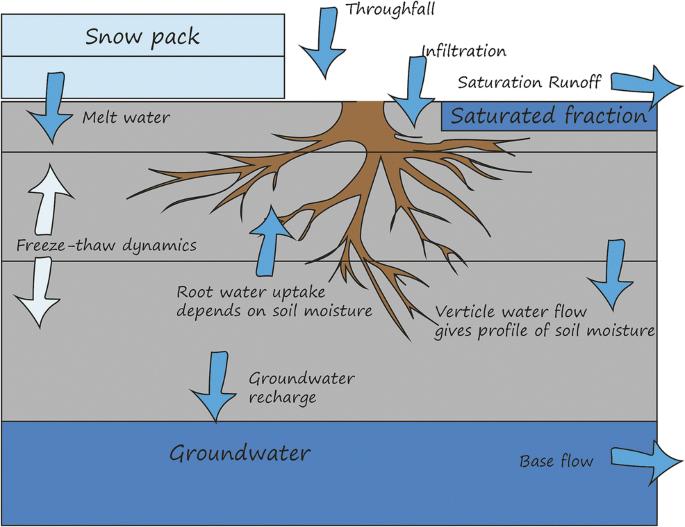
This section deals with the transfer of energy, heat and water through snow or soil. Exchanges between the surface and canopy layer and the soils need to accommodate the heterogeneity of soil properties and soil-water across the landscape and with depth. Figure 5 gives an overview of the processes discussed in this section.
Fig. 5
The alternative text for this image may have been generated using AI.
Schematic of snow and soil physics representation in LSMs
History
The water from precipitation has several possible fates. It might flow into the soil matrix where it will be stored before being lost through evapotranspiration or drainage. If the water remains on, or near, the soil surface it may evaporate, or if the ground is sloped or already saturated, it can contribute to runoff.
Since the early twentieth century, research has been undertaken to describe the flow of water through unsaturated soil. Combining the gravitational force and capillary force together, the flow of water in the soil can be summarised in one equation, known as the Darcy-Richards equation [[117](/article/10.1007/s40641-021-00171-5#ref-CR117 "Richards LA. Capillary conduction of liquids through porous mediums—NASA/ADS. Physics. 1931;1(5):318–33. https://doi.org/10.1063/1.1745010
            .")\]. This equation is widely used in LSMs, although its dependence and sensitivity to the parameters of the equations mean that its usefulness is still debated \[[47](/article/10.1007/s40641-021-00171-5#ref-CR47 "Farthing MW, Ogden FL. Numerical solution of Richards’ Equation: a review of advances and challenges. Soil Sci Soc Am J. 2017;81(6):1257–69.
              https://doi.org/10.2136/sssaj2017.02.0058

            .")\]. The parameters for the equations can be estimated using information about the soil textures through Pedotransfer Functions (PTFs).
Closely linked to the modelling of soil moisture is the soil temperature since the specific heat capacity of water is typically 5 times greater than the dry soil, so that a wet soil is a bigger heat-sink than dry soil (although still considerably less than the ocean). In addition, when the soil freezes, the conductivity of the soil massively reduces, eventually to zero.
A critical aspect of the soil water budget is how much water enters the soil matrix. This not only depends on the saturation of the soil, but also on soil characteristics such as texture, geomorphology and the presence of crusts. Most LSMs include a rainfall-runoff scheme which uses a statistical representation of soil-moisture heterogeneity linked to the mean soil moisture (which is used in the energy and evaporation exchanges) that were originally used by hydrologists [[11](/article/10.1007/s40641-021-00171-5#ref-CR11 "Beven KJ, Kirkby MJ. A physically based, variable contributing area model of basin hydrology / Un modèle à base physique de zone d’appel variable de l’hydrologie du bassin versant. Hydrol Sci Bull. 1979;24(1):43–69. https://doi.org/10.1080/02626667909491834
            ."), [84](/article/10.1007/s40641-021-00171-5#ref-CR84 "Liang X, Lettenmaier DP, Wood EF, Burges SJ. A simple hydrologically based model of land surface water and energy fluxes for general circulation models. J Geophys Res-Atmos. 1994;99(D7):14415–28.
              https://doi.org/10.1029/94JD00483

            ."), [99](/article/10.1007/s40641-021-00171-5#ref-CR99 "Moore RJ. The PDM rainfall-runoff model. Hydrol Earth Syst Sci. 2007;11(1):483–99.
              https://doi.org/10.5194/hess-11-483-2007

            ."), [132](/article/10.1007/s40641-021-00171-5#ref-CR132 "Todini E. The ARNO rainfall—runoff model. J Hydrol. 1996;175(1):339–82.
              https://doi.org/10.1016/S0022-1694(96)80016-3

            .")\].
In the Boreal and Arctic regions, one of the greatest land-based impact on the atmosphere is through the snow cover. Due to its high albedo (reflecting 80 to 90% of the sunlight), snow has a strong cooling influence. Conversely, snow also acts as a thermal insulating blanket over the soil, protecting it from cold winter conditions. Model experiments using the CLM model [[81](/article/10.1007/s40641-021-00171-5#ref-CR81 "Lawrence DM, Slater AG. The contribution of snow condition trends to future ground climate. Clim Dyn. 2010;34(7–8):969–81. https://doi.org/10.1007/s00382-009-0537-4
            .")\] for the latter half of the twentieth century showed that variations in the amount of snow accounted for as much as 50–100% of variations in soil temperature. Many of the land surface models include a layered snow model to better capture the reflectivity at different radiation wavelengths \[[9](/article/10.1007/s40641-021-00171-5#ref-CR9 "Best MJ, Pryor M, Clark DB, Rooney GG, Essery RLH, Menard CB, et al. The Joint UK Land Environment Simulator (JULES), model description—Part 1: energy and water fluxes. Geosci Model Dev. 2011;4(3):677–99.
              https://doi.org/10.5194/gmd-4-677-2011

            .")\].
In forested areas, the snow holding capacity of trees is limited so that much of the snow falls beneath the canopy. This results in a surface that is dark and relatively warm. Betts [[10](/article/10.1007/s40641-021-00171-5#ref-CR10 "Betts R. Offset of the potential carbon sink from boreal forestation by decreases in surface albedo. Nature. 2000;408(6809):187–90. https://doi.org/10.1038/35041545
.")\] showed that the darkening and warming impact of the presence of trees in a snowy-landscape outweighs the global-cooling effect of their carbon-absorption.Recent Advances
As research consistently demonstrated the importance of the changes in permafrost to the evolving, warming climate, LSM developers introduced deeper soils into their models and improved the representation of organic soils. Deepening the models improved the soil thermal and hydrologic dynamics on longer timescales [[80](/article/10.1007/s40641-021-00171-5#ref-CR80 "Lawrence DM, Slater AG. Incorporating organic soil into a global climate model. Clim Dyn. 2008;30(2–3):145–60. https://doi.org/10.1007/s00382-007-0278-1
            .")\] and allowed better representation of soil carbon processes. Further model advancements attempt to account for excess ground ice \[[6](/article/10.1007/s40641-021-00171-5#ref-CR6 "Avis, C. A. (2012). Simulating the present-day and future distribution of permafrost in the UVic Earth System Climate Model [Thesis].
              https://dspace.library.uvic.ca//handle/1828/4030

            "), [82](/article/10.1007/s40641-021-00171-5#ref-CR82 "Lee H, Swenson SC, Slater AG, Lawrence DM. Effects of excess ground ice on projections of permafrost in a warming climate. Environ Res Lett. 2014;9(12):124006.
              https://doi.org/10.1088/1748-9326/9/12/124006

            ."), [144](/article/10.1007/s40641-021-00171-5#ref-CR144 "Westermann S, Langer M, Boike J, Heikenfeld M, Peter M, Etzelmüller B, et al. Simulating the thermal regime and thaw processes of ice-rich permafrost ground with the land-surface model CryoGrid 3. Geosci Model Dev. 2016;9(2):523–46.
              https://doi.org/10.5194/gmd-9-523-2016

            .")\], whose loss through melt creates rapid surface subsidence, altered hydrologic flow \[[40](/article/10.1007/s40641-021-00171-5#ref-CR40 "Ekici A, Lee H, Lawrence DM, Swenson SC, Prigent C. Ground subsidence effects on simulating dynamic high-latitude surface inundation under permafrost thaw using CLM5. Geosci Model Dev. 2019;12(12):5291–300.
              https://doi.org/10.5194/gmd-12-5291-2019

            .")\], and enhanced soil carbon respiration \[[134](/article/10.1007/s40641-021-00171-5#ref-CR134 "Turetsky MR, Abbott BW, Jones MC, Anthony KW, Olefeldt D, Schuur EAG, et al. Carbon release through abrupt permafrost thaw. Nat Geosci. 2020;13(2):138–43.
              https://doi.org/10.1038/s41561-019-0526-0

            .")\]. Our limited knowledge about the current amounts and distribution of excess ground ice hampers modelling efforts \[[103](/article/10.1007/s40641-021-00171-5#ref-CR103 "Olefeldt D, Goswami S, Grosse G, Hayes D, Hugelius G, Kuhry P, et al. Circumpolar distribution and carbon storage of thermokarst landscapes. Nat Commun. 2016;7(1):13043.
              https://doi.org/10.1038/ncomms13043

            ."), [105](/article/10.1007/s40641-021-00171-5#ref-CR105 "O’Neill HB, Wolfe SA, Duchesne C. New ground ice maps for Canada using a paleogeographic modelling approach. Cryosphere. 2019;13(3):753–73.
              https://doi.org/10.5194/tc-13-753-2019

            .")\].
Exchanges between the soil surface and the underlying subsurface exhibit high heterogeneity over small spatial scales. To begin to address the complexity of these exchanges, LSMs have adopted different strategies. Many models have added temporary sub-grid water stores such as ponding, although models that had a focus on cold-regions had it from the beginning [[136](/article/10.1007/s40641-021-00171-5#ref-CR136 "Verseghy DL, McFarlane NA, Lazare M. CLASS—a Canadian land surface scheme for GCMS, II. Vegetation model and coupled runs. Int J Climatol. 1993;13(4):347–70. https://doi.org/10.1002/joc.3370130402
.")\].Current Limitations and Future Directions
Soil modelling is strongly affected by the parameters which are derived from the observable soil texture using Pedotransfer Functions (PTFs). Most models use a single set of PTFs for their global modelling, but it is becoming apparent that this is not adequate and regional PTFs may be needed. It may also become important to include the way that soil properties change with time [[138](/article/10.1007/s40641-021-00171-5#ref-CR138 "Wang P-L, Feddema JJ. Linking global land use/land cover to hydrologic soil groups from 850 to 2015. Glob Biogeochem Cycles. 2020;34(3):e2019GB006356. https://doi.org/10.1029/2019GB006356
            .")\]. Farming practices and changes to permafrost regions will alter the soil organic matter, impacting the hydraulic properties of the soil. In addition, changes to the topography of the land as a result of changes in the permafrost conditions will need to be accommodated if we are to correctly model the hydrology and its impacts on the carbon cycle in the rapidly warming region \[[134](/article/10.1007/s40641-021-00171-5#ref-CR134 "Turetsky MR, Abbott BW, Jones MC, Anthony KW, Olefeldt D, Schuur EAG, et al. Carbon release through abrupt permafrost thaw. Nat Geosci. 2020;13(2):138–43.
              https://doi.org/10.1038/s41561-019-0526-0

            .")\].
Sub-grid heterogeneity is one of the largest limitations we have at present. For instance, Schultz et al. [[121](/article/10.1007/s40641-021-00171-5#ref-CR121 "Schultz NM, Lee X, Lawrence PJ, Lawrence DM, Zhao L. Assessing the use of subgrid land model output to study impacts of land cover change. J Geophys Res-Atmos. 2016;121(11):6133–47. https://doi.org/10.1002/2016JD025094
            .")\] showed that heat fluxes between different land cover types (e.g., trees and grasses) that share the same soil column can strongly impact the overall water and heat budgets. The use of soil tiles is probably the best option to deal with this. Already some models include soil-tiles to explicitly model the peat soils \[[77](/article/10.1007/s40641-021-00171-5#ref-CR77 "Largeron C, Krinner G, Ciais P, Brutel-Vuilmet C. Implementing northern peatlands in a global land surface model: description and evaluation in the ORCHIDEE high-latitude version model (ORC-HL-PEAT). Geosci Model Dev. 2018;11(8):3279–97.
              https://doi.org/10.5194/gmd-11-3279-2018

            .")\], to represent variations in maximum infiltration \[[35](/article/10.1007/s40641-021-00171-5#ref-CR35 "Decharme B, Douville H. Introduction of a sub-grid hydrology in the ISBA land surface model. Clim Dyn. 2006;26(1):65–78.
              https://doi.org/10.1007/s00382-005-0059-7

            .")\], soil textures \[[95](/article/10.1007/s40641-021-00171-5#ref-CR95 "Melton JR, Sospedra-Alfonso R, McCusker KE. Tiling soil textures for terrestrial ecosystem modelling via clustering analysis: a case study with CLASS-CTEM (version 2.1). Geosci Model Dev. 2017;10(7):2761–83.
              https://doi.org/10.5194/gmd-10-2761-2017

            .")\] and irrigation \[[33](/article/10.1007/s40641-021-00171-5#ref-CR33 "de Vrese P, Hagemann S. Explicit representation of spatial subgrid-scale heterogeneity in an ESM. J Hydrometeorol. 2016;17(5):1357–71.
              https://doi.org/10.1175/JHM-D-15-0080.1

            .")\].
Water Bodies with Land-Catchment and Water-Human Exchange
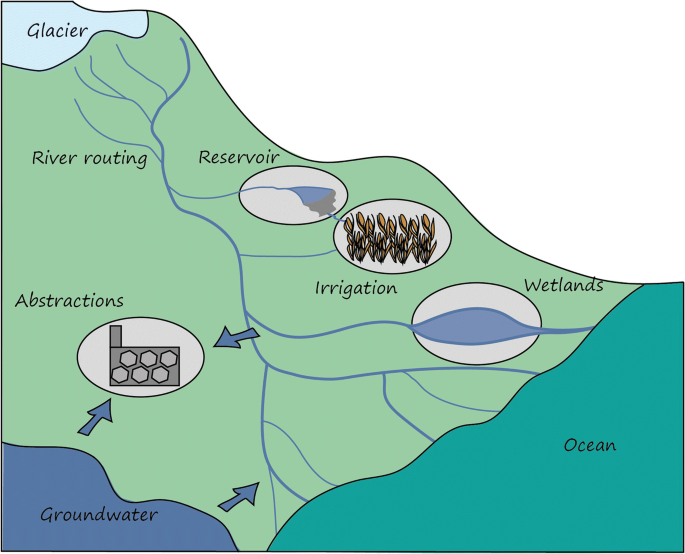
This section relates to the water that is stored or flows across the landscape, such as rivers, lakes, wetlands, glaciers and groundwater. The runoff from the land integrates over catchments and then occasionally or seasonally inundates the land. Meanwhile, there is an exchange between water and the human system: water can be used for industrial, agricultural and domestic use (abstractions) but water can be moved to create supply if needed (transfers). Figure 6 is a schematic of the processes discussed in this section.
Fig. 6
The alternative text for this image may have been generated using AI.
Schematic of the representation of water bodies in LSMs
History
In the past, most LSMs included rivers to link the precipitation runoff to the oceans. The first and widely used routing model that could be used globally was generated by Oki and Sud [[102](/article/10.1007/s40641-021-00171-5#ref-CR102 "Oki T, Sud YC. Design of Total Runoff Integrating Pathways (TRIP)—a global river channel network. Earth Interact. 1998;2(1):1–37. https://doi.org/10.1175/1087-3562(1998)002<0001:DOTRIP>2.3.CO;2
.")\]. The routing mechanism was needed to estimate the timing of the flows to the sea, but no interaction with the energy or water balance of the landscape through which it flowed was included.However, recent studies have shown that the movement of water across the land through rivers, inundation, irrigation and groundwater, under both natural and anthropogenic influence, can have a significant impact on the energy balance of the land-system. For instance, Martínez-de la Torre and Miguez-Macho [[90](/article/10.1007/s40641-021-00171-5#ref-CR90 "Martínez-de la Torre A, Miguez-Macho G. Groundwater influence on soil moisture memory and land–atmosphere fluxes in the Iberian Peninsula. Hydrol Earth Syst Sci. 2019;23(12):4909–32. https://doi.org/10.5194/hess-23-4909-2019
            .")\] show how the presence of groundwater can affect the energy balance of the Iberian region and Keune et al. \[[73](/article/10.1007/s40641-021-00171-5#ref-CR73 "Keune J, Gasper F, Goergen K, Hense A, Shrestha P, Sulis M, et al. Studying the influence of groundwater representations on land surface-atmosphere feedbacks during the European heat wave in 2003. J Geophys Res-Atmos. 2016;121(22):13,301–25.
              https://doi.org/10.1002/2016JD025426

            .")\] show that the inclusion of groundwater in a LSM can affect the atmospheric dynamics.
A review of how and why hydrology needs to be included in Earth System Models is covered in the review article of Clark et al. [[19](/article/10.1007/s40641-021-00171-5#ref-CR19 "Clark MP, Nijssen B, Lundquist JD, Kavetski D, Rupp DE, Woods RA, et al. A unified approach for process-based hydrologic modeling: 1. Modeling concept. Water Resour Res. 2015;51(4):2498–514. https://doi.org/10.1002/2015WR017198
.")\].Recent Advances
New initiatives to link hydrological models to land surface models are emerging. Fan et al. [[43](/article/10.1007/s40641-021-00171-5#ref-CR43 "Fan, Y., Clark, M., Lawrence, D. M., Swenson, S., Band, L. E., Brantley, S. L., Brooks, P. D., Dietrich, W. E., Flores, A., Grant, G., Kirchner, J. W., Mackay, D. S., McDonnell, J. J., Milly, P. C. D., Sullivan, P. L., Tague, C., Ajami, H., Chaney, N., Hartmann, A., … Yamazaki, D. (2019). Hillslope hydrology in global change research and earth system modeling. Water Resources Research, 55(2), 1737–1772. https://doi.org/10.1029/2018WR023903
            ")\] present a review of the need to improve the hydrology of LSMs. Some models have started to include explicit hill-slopes to represent flow across the landscape (see Appendix), some have large-scale (1000 km) groundwater flows. Inundation and wetlands are being introduced into LSMs, for instance, Nitta et al. \[[101](/article/10.1007/s40641-021-00171-5#ref-CR101 "Nitta T, Yoshimura K, Abe-Ouchi A. Impact of arctic wetlands on the climate system: model sensitivity simulations with the MIROC5 AGCM and a snow-fed wetland scheme. J Hydrometeorol. 2017;18(11):2923–36.
              https://doi.org/10.1175/JHM-D-16-0105.1

            .")\] implemented a simple snow-fed wetland scheme in an Earth System Model, which not only modelled better hydrology, but also improved the representation of land-atmosphere coupling strength.
Groundwater is a major water resource worldwide, and new attempts to include it in LSMs have been made. Fan et al. [[44](/article/10.1007/s40641-021-00171-5#ref-CR44 "Fan Y, Li H, Miguez-Macho G. Global Patterns of groundwater table depth. Science. 2013;339(6122):940–3. https://doi.org/10.1126/science.1229881
            .")\], de Graaf et al. \[[28](#ref-CR28 "de Graaf IEM, Gleeson T, van Beek LPHR, Sutanudjaja EH, Bierkens MFP. Environmental flow limits to global groundwater pumping. Nature. 2019;574(7776):90.
              https://doi.org/10.1038/s41586-019-1594-4

            ."),[29](#ref-CR29 "de Graaf IEM, Sutanudjaja EH, van Beek LPH, Bierkens MFP. A high-resolution global-scale groundwater model. Hydrol Earth Syst Sci. 2015;19(2):823–37.
              https://doi.org/10.5194/hess-19-823-2015

            ."),[30](/article/10.1007/s40641-021-00171-5#ref-CR30 "de Graaf IEM, van Beek RLPH, Gleeson T, Moosdorf N, Schmitz O, Sutanudjaja EH, et al. A global-scale two-layer transient groundwater model: development and application to groundwater depletion. Adv Water Resour. 2017;102:53–67.
              https://doi.org/10.1016/j.advwatres.2017.01.011

            .")\], Maxwell and Condon \[[91](/article/10.1007/s40641-021-00171-5#ref-CR91 "Maxwell RM, Condon LE. Connections between groundwater flow and transpiration partitioning. Science. 2016;353(6297):377–80.
              https://doi.org/10.1126/science.aaf7891

            .")\] and Miura and Yoshimura \[[98](/article/10.1007/s40641-021-00171-5#ref-CR98 "Miura Y, Yoshimura K. Development and Verification of a three-dimensional variably saturated flow model for assessment of future global water resources. J Adv Model Earth Syst. 2020;12(8):e2020MS002093.
              https://doi.org/10.1029/2020MS002093

            .")\] have all implemented new groundwater models to LSMs that can be used for assessing global future water resources.
Human intervention in the water cycle affects many aspects of the land-system. For instance, irrigation can substantially affect the energy budget of a region and several LSMs have implemented unlimited irrigation through a simple scheme in which irrigation is triggered when soil water drops below a critical threshold [[120](/article/10.1007/s40641-021-00171-5#ref-CR120 "Sacks WJ, Cook BI, Buenning N, Levis S, Helkowski JH. Effects of global irrigation on the near-surface climate. Clim Dyn. 2009;33(2):159–75. https://doi.org/10.1007/s00382-008-0445-z
            .")\]. With this class of irrigation implementation, one can research how enhanced evaporation due to irrigation affects local and regional weather and climate (see \[[133](/article/10.1007/s40641-021-00171-5#ref-CR133 "Tuinenburg OA, Hutjes RWA, Stacke T, Wiltshire A, Lucas-Picher P. Effects of irrigation in India on the atmospheric water budget. J Hydrometeorol. 2014;15(3):1028–50.
              https://doi.org/10.1175/JHM-D-13-078.1

            .")\]). A more complete picture of human intervention is provided by models that represent processes including water withdrawal from surface and groundwater sources, and reservoir operation (e.g. \[[151](/article/10.1007/s40641-021-00171-5#ref-CR151 "Yokohata T, Kinoshita T, Sakurai G, Pokhrel Y, Ito A, Okada M, et al. MIROC-INTEG1: a global bio-geochemical land surface model with human water management, crop growth, and land-use change. Geosci Model Dev Discuss. 2019;13:4713–47. 1–57.
              https://doi.org/10.5194/gmd-2019-184

            .")\]). This then allows us to study the global distribution of food production and world-wide food/water/energy securities through specification of irrigation water sources \[[60](/article/10.1007/s40641-021-00171-5#ref-CR60 "Hanasaki N, Yoshikawa S, Pokhrel Y, Kanae S. A global hydrological simulation to specify the sources of water used by humans. Hydrol Earth Syst Sci. 2018;22(1):789–817.
              https://doi.org/10.5194/hess-22-789-2018

            .")\].
Wetland soil physics and biogeochemical cycles (Section 5) are linked as saturated conditions slow the decomposition of organic matter in wetlands, leading to increased soil carbon, reduced hydraulic conductivity, and a substantial increase in the emission of methane [[74](/article/10.1007/s40641-021-00171-5#ref-CR74 "Kirschke, S., Bousquet, P., Ciais, P., Saunois, M., Canadell, J. G., Dlugokencky, E. J., Bergamaschi, P., Bergmann, D., Blake, D. R., Bruhwiler, L., Cameron-Smith, P., Castaldi, S., Chevallier, F., Feng, L., Fraser, A., Heimann, M., Hodson, E. L., Houweling, S., Josse, B., … Zeng, G. (2013). Three decades of global methane sources and sinks. Nat Geosci, 6(10), 813–823. https://doi.org/10.1038/NGEO1955
            "), [94](/article/10.1007/s40641-021-00171-5#ref-CR94 "Melton JR, Wania R, Hodson EL, Poulter B, Ringeval B, Spahni R, et al. Present state of global wetland extent and wetland methane modelling: conclusions from a model inter-comparison project (WETCHIMP). Biogeosciences. 2013;10(2):753–88.
              https://doi.org/10.5194/bg-10-753-2013

            ."), [147](/article/10.1007/s40641-021-00171-5#ref-CR147 "Wik M, Varner RK, Anthony KW, MacIntyre S, Bastviken D. Climate-sensitive northern lakes and ponds are critical components of methane release. Nat Geosci. 2016;9(2):99.
              https://doi.org/10.1038/NGEO2578

            .")\]. Modelling of the wetland extent is key to the modelling of the methane emission estimates, especially as the hydrology of these regions may change in a future climate \[[22](/article/10.1007/s40641-021-00171-5#ref-CR22 "Comyn-Platt E, Hayman G, Huntingford C, Chadburn SE, Burke EJ, Harper AB, et al. Carbon budgets for 1.5 and 2 degrees C targets lowered by natural wetland and permafrost feedbacks. Nat Geosci. 2018;11(8):568.
              https://doi.org/10.1038/s41561-018-0174-9

            .")\]. Recent years have seen advances in the level of integration between inundation and river models with both soil hydrology and biogeochemical cycles. For example, Guimberteau et al. \[[58](/article/10.1007/s40641-021-00171-5#ref-CR58 "Guimberteau M, Drapeau G, Ronchail J, Sultan B, Polcher J, Martinez J-M, et al. Discharge simulation in the sub-basins of the Amazon using ORCHIDEE forced by new datasets. Hydrol Earth Syst Sci. 2012;16(3):911–35.
              https://doi.org/10.5194/hess-16-911-2012

            .")\] describe an improved representation of floodplain dynamics and wetlands that is fully integrated into the modelled hydrological cycle and extended to look at riverine C transport. There have also been developments aimed at representing river-groundwater interactions, with reinfiltration of river water being required to reproduce observed soil moisture patterns across a catchment \[[153](/article/10.1007/s40641-021-00171-5#ref-CR153 "Zampieri M, Serpetzoglou E, Anagnostou EN, Nikolopoulos EI, Papadopoulos A. Improving the representation of river–groundwater interactions in land surface modeling at the regional scale: observational evidence and parameterization applied in the Community Land Model. J Hydrol. 2012;420–421:72–86.
              https://doi.org/10.1016/j.jhydrol.2011.11.041

            .")\].
Current Limitations and Future Directions
While hydrological models for catchment and even smaller scales are widely used, it is only relatively recently that attempts have been made to incorporate such detailed process understanding into land surface models. The need for LSMs to capture how the flow and storage of water across a landscape is regulated by fine-scale topographic features is identified by [[43](/article/10.1007/s40641-021-00171-5#ref-CR43 "Fan, Y., Clark, M., Lawrence, D. M., Swenson, S., Band, L. E., Brantley, S. L., Brooks, P. D., Dietrich, W. E., Flores, A., Grant, G., Kirchner, J. W., Mackay, D. S., McDonnell, J. J., Milly, P. C. D., Sullivan, P. L., Tague, C., Ajami, H., Chaney, N., Hartmann, A., … Yamazaki, D. (2019). Hillslope hydrology in global change research and earth system modeling. Water Resources Research, 55(2), 1737–1772. https://doi.org/10.1029/2018WR023903
")\]. Possible new approaches include the use of hydrological response units, and a representation of the interaction between groundwater and rivers. Although some models now include a hydrological representation of wetlands and intermittent flooding, there is still a need to better describe the effects of these on energy and nutrient cycles. A major challenge for the development of global-scale groundwater models is the difficulty in sourcing data with which to describe subsurface characteristics.Seasonal changes in land ice and glaciers are responsible for significant changes in the river flows of many high-latitude and high-altitude basins. Current land surface models include the effects of snow and land ice on terrestrial albedo and surface energy balance, but the contribution to river flow from glacier runoff is missing and the impact on the temperature of the river-water, which may be important to the ecological community. If we want to use the land surface models to address issues of water resources, it is important to include how these quantities will respond to anthropogenic global warming [[68](/article/10.1007/s40641-021-00171-5#ref-CR68 "Huss M, Hock R. Global-scale hydrological response to future glacier mass loss. Nat Clim Chang. 2018;8(2):135–40. https://doi.org/10.1038/s41558-017-0049-x
.")\] as it is likely that the glaciers will disappear from many areas in the next 50 years.Many aspects of land use and land management, including the use of agricultural fertilizers, have important consequences for water quality and ecology [[18](/article/10.1007/s40641-021-00171-5#ref-CR18 "Bussi G, Whitehead PG, Bowes MJ, Read DS, Prudhomme C, Dadson SJ. Impacts of climate change, land-use change and phosphorus reduction on phytoplankton in the River Thames (UK). Sci Total Environ. 2016;572:1507–19. https://doi.org/10.1016/j.scitotenv.2016.02.109
.")\], and these will need to be included in models. From an Earth System perspective, these riverine nutrient fluxes are important inputs to estuaries and shelf seas, and the interface between land and marine models will need to be developed accordingly.The extent of anthropogenic interventions in the water cycle in many locations now places human water use at the same order of magnitude as many of the natural fluxes in the water cycle [25, [56](/article/10.1007/s40641-021-00171-5#ref-CR56 "Gleick PH, Palaniappan M. Peak water limits to freshwater withdrawal and use. Proc Natl Acad Sci. 2010;107(25):11155–62. https://doi.org/10.1073/pnas.1004812107
            .")\]. It is important that these fluxes are represented in land-surface models \[[24](/article/10.1007/s40641-021-00171-5#ref-CR24 "Dadson S, Acreman M, Harding R. Water security, global change and land–atmosphere feedbacks. Philos Trans R Soc A Math Phys Eng Sci. 2013;371(2002):20120412.
              https://doi.org/10.1098/rsta.2012.0412

            .")\] so that future changes in water availability can be addressed. Although some models already include detailed descriptions of water management activities these often rely on the prescription of simple operating rules; future developments will need to better represent the optimal management of complex catchments and consider the economics of water use.
Vegetation Physiology and Soil Biogeochemistry and Exchanges with Physics
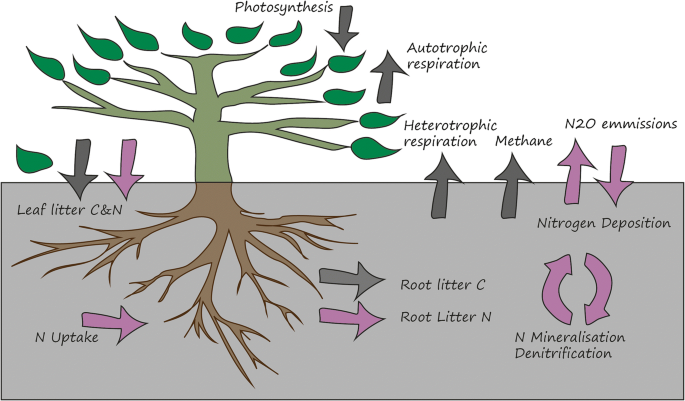
There are two primary purposes of modelling vegetation physiology and soil biogeochemistry in LSMs. First, the physical structure of vegetation and the process of photosynthesis affect the exchange of momentum, energy, water and CO2 at the land-atmosphere boundary (Section 2). Second, the vegetation and soil processes affect allocation of the Earth’s carbon to storage in the land (and oceans) compared to the atmosphere over seasonal and longer time scales. This section summarises the how the processes that govern these physical and biogeochemical interactions are modelled. Figure 7 gives an overview of the essential processes included in LSMs.
Fig. 7
The alternative text for this image may have been generated using AI.
A schematic of the biogeochemistry represented in LSMs
History
The process of leaf photosynthesis is well understood and most LSMs simulate photosynthesis based on theoretical models of C3 and C4 photosynthetic pathways [[20](/article/10.1007/s40641-021-00171-5#ref-CR20 "Collatz G, Ribas-Carbo M, Berry J. Coupled photosynthesis-stomatal conductance model for leaves of C4 plants photosynthesis-stomatal conductance model for leaves of C4 plants. Aust J Plant Physiol. 1992;19(5):519–38. https://doi.org/10.1071/PP9920519
            ."), [46](/article/10.1007/s40641-021-00171-5#ref-CR46 "Farquhar G, Schulze E, Kuppers M. Responses to humidity by stomata of Nicotiana-glauca L and Corylus-avellana L are consistent with the optimization of carbon-dioxide uptake with respect to water-loss. Aust J Plant Physiol. 1980;7(3):315–27.
              https://doi.org/10.1071/PP9800315

            .")\]. Transfer of CO2 into the plants through photosynthesis is inevitably linked with loss of water via leaf stomata. This coupling between photosynthesis and stomatal resistance is modelled via empirical relationships \[[7](/article/10.1007/s40641-021-00171-5#ref-CR7 "Ball, J. T., Woodrow, I. E., & Berry, J. A. (1987). A model predicting stomatal conductance and its contribution to the control of photosynthesis under different environmental conditions. In J. Biggins (Ed.), Progress in Photosynthesis Research: Volume 4 Proceedings of the VIIth International Congress on Photosynthesis Providence, Rhode Island, USA, August 10–15, 1986 (pp. 221–224). Springer Netherlands.
              https://doi.org/10.1007/978-94-017-0519-6_48

            "), [14](/article/10.1007/s40641-021-00171-5#ref-CR14 "Bonan GB, Williams M, Fisher RA, Oleson KW. Modeling stomatal conductance in the earth system: linking leaf water-use efficiency and water transport along the soil-plant-atmosphere continuum. Geosci Model Dev. 2014;7(5):2193–222.
              https://doi.org/10.5194/gmd-7-2193-2014

            ."), [20](/article/10.1007/s40641-021-00171-5#ref-CR20 "Collatz G, Ribas-Carbo M, Berry J. Coupled photosynthesis-stomatal conductance model for leaves of C4 plants photosynthesis-stomatal conductance model for leaves of C4 plants. Aust J Plant Physiol. 1992;19(5):519–38.
              https://doi.org/10.1071/PP9920519

            ."), [69](/article/10.1007/s40641-021-00171-5#ref-CR69 "Jarvis PG, Monteith JL, Weatherley PE. The interpretation of the variations in leaf water potential and stomatal conductance found in canopies in the field. Philos Trans R Soc London B, Biol Sci. 1976;273(927):593–610.
              https://doi.org/10.1098/rstb.1976.0035

            ."), [83](/article/10.1007/s40641-021-00171-5#ref-CR83 "Leuning R. A critical appraisal of a combined stomatal-photosynthesis model for C3 plants. Plant Cell Environ. 1995;18(4):339–55.
              https://doi.org/10.1111/j.1365-3040.1995.tb00370.x

            ."), [93](/article/10.1007/s40641-021-00171-5#ref-CR93 "Medlyn BE, Duursma RA, Eamus D, Ellsworth DS, Prentice IC, Barton CVM, et al. Reconciling the optimal and empirical approaches to modelling stomatal conductance. Glob Chang Biol. 2011;17(6):2134–44.
              https://doi.org/10.1111/j.1365-2486.2010.02375.x

            .")\].
All plant components including roots, shoots and leaves respire CO2 (referred to as the autotrophic respiration) [[128](/article/10.1007/s40641-021-00171-5#ref-CR128 "Tang X, Pei X, Lei N, Luo X, Liu L, Shi L, et al. Global patterns of soil autotrophic respiration and its relation to climate, soil and vegetation characteristics. Geoderma. 2020;369:114339. https://doi.org/10.1016/j.geoderma.2020.114339
            .")\]. The difference of the two large fluxes of photosynthesis (GPP) and autotrophic respiration is the net carbon gained by plants (Net Primary Production, NPP) that is allocated between the different plant components \[[53](/article/10.1007/s40641-021-00171-5#ref-CR53 "Franklin O, Johansson J, Dewar RC, Dieckmann U, McMurtrie RE, Brännström Å, et al. Modeling carbon allocation in trees: a search for principles. Tree Physiol. 2012;32(6):648–66.
              https://doi.org/10.1093/treephys/tpr138

            .")\]. Dynamic allocation of carbon to leaves together with leaf loss associated with cold temperatures, reduced day length, and drought allow LSMs to simulate leaf phenology as a function of environmental conditions \[[4](/article/10.1007/s40641-021-00171-5#ref-CR4 "Arora VK, Boer GJ. Fire as an interactive component of dynamic vegetation models. J Geophys Res Biogeosci. 2005;110(G2).
              https://doi.org/10.1029/2005JG000042

            ."), [111](/article/10.1007/s40641-021-00171-5#ref-CR111 "Polgar CA, Primack RB. Leaf-out phenology of temperate woody plants: from trees to ecosystems. New Phytol. 2011;191(4):926–41.
              https://doi.org/10.1111/j.1469-8137.2011.03803.x

            .")\]. The leaf phenology responds more strongly to temperature in temperate and high-latitude regions \[[145](/article/10.1007/s40641-021-00171-5#ref-CR145 "White MA, Thornton PE, Running SW. A continental phenology model for monitoring vegetation responses to interannual climatic variability. Glob Biogeochem Cycles. 1997;11(2):217–34.
              https://doi.org/10.1029/97GB00330

            .")\] and to soil moisture in tropical regions \[[51](/article/10.1007/s40641-021-00171-5#ref-CR51 "Forkel M, Migliavacca M, Thonicke K, Reichstein M, Schaphoff S, Weber U, et al. Codominant water control on global interannual variability and trends in land surface phenology and greenness. Glob Chang Biol. 2015;21(9):3414–35.
              https://doi.org/10.1111/gcb.12950

            .")\]. The seasonal cycle of leaves modulates the land-atmosphere energy, water and CO2 fluxes \[[108](/article/10.1007/s40641-021-00171-5#ref-CR108 "Piao S, Liu Q, Chen A, Janssens IA, Fu Y, Dai J, et al. Plant phenology and global climate change: current progresses and challenges. Glob Chang Biol. 2019;25(6):1922–40.
              https://doi.org/10.1111/gcb.14619

            .")\].
There is a transfer of carbon from the vegetation to the soil through leaf fall, turnover of shoots and roots, eventual mortality of plants. The soil carbon dynamics is often modelled using multiple pools with different turnover times [[131](/article/10.1007/s40641-021-00171-5#ref-CR131 "Todd-Brown KEO, Randerson JT, Hopkins F, Arora V, Hajima T, Jones C, et al. Changes in soil organic carbon storage predicted by Earth system models during the 21st century. Biogeosciences. 2014;11(8):2341–56. https://doi.org/10.5194/bg-11-2341-2014
.")\] and affected by temperature and moisture.These dynamical carbon processes were introduced into the LSMs in the early 2000s as the modelling centres started to focus on the response of climate to the carbon cycle.
Recent Advances
Understanding the link between photosynthesis and transpiration (Water Use Efficiency) is a priority for LSMs response to climate. New approaches have been explored recently. For instance, a new optimisation theory [[93](/article/10.1007/s40641-021-00171-5#ref-CR93 "Medlyn BE, Duursma RA, Eamus D, Ellsworth DS, Prentice IC, Barton CVM, et al. Reconciling the optimal and empirical approaches to modelling stomatal conductance. Glob Chang Biol. 2011;17(6):2134–44. https://doi.org/10.1111/j.1365-2486.2010.02375.x
            .")\] has been included in some LSMs \[[31](/article/10.1007/s40641-021-00171-5#ref-CR31 "De Kauwe MG, Kala J, Lin Y-S, Pitman AJ, Medlyn BE, Duursma RA, et al. A test of an optimal stomatal conductance scheme within the CABLE land surface model. Geosci Model Dev. 2015;8(2):431–52.
              https://doi.org/10.5194/gmd-8-431-2015

            ."), [78](/article/10.1007/s40641-021-00171-5#ref-CR78 "Lawrence, D. M., Fisher, R. A., Koven, C. D., Oleson, K. W., Swenson, S. C., Bonan, G., Collier, N., Ghimire, B., van Kampenhout, L., Kennedy, D., Kluzek, E., Lawrence, P. J., Li, F., Li, H., Lombardozzi, D., Riley, W. J., Sacks, W. J., Shi, M., Vertenstein, M., … Zeng, X. (2019). The Community Land Model Version 5: description of new features, benchmarking, and impact of forcing uncertainty. J Adv Model Earth Syst, 11(12), 4245–4287.
              https://doi.org/10.1029/2018MS001583

            "), [104](/article/10.1007/s40641-021-00171-5#ref-CR104 "Oliver RJ, Mercado LM, Sitch S, Simpson D, Medlyn BE, Lin Y-S, et al. Large but decreasing effect of ozone on the European carbon sink. Biogeosciences. 2018;15(13):4245–69.
              https://doi.org/10.5194/bg-15-4245-2018

            .")\] which recognises that the plants will be aiming to minimise their water loss while maximising their carbon uptake. In addition, a model that accounts for how stomatal conductance respond to root zone soil moisture through explicitly modelling the cost of the hydraulic lift of the water has been developed \[[127](/article/10.1007/s40641-021-00171-5#ref-CR127 "Sperry JS, Venturas MD, Anderegg WRL, Mencuccini M, Mackay DS, Wang Y, et al. Predicting stomatal responses to the environment from the optimization of photosynthetic gain and hydraulic cost. Plant Cell Environ. 2017;40(6):816–30.
              https://doi.org/10.1111/pce.12852

            ."), [150](/article/10.1007/s40641-021-00171-5#ref-CR150 "Wolf A, Anderegg WRL, Pacala SW. Optimal stomatal behavior with competition for water and risk of hydraulic impairment. Proc Natl Acad Sci. 2016;113(46):E7222–30.
              https://doi.org/10.1073/pnas.1615144113

            .")\], although these have yet to be fully explored in LSMs (but see \[[119](/article/10.1007/s40641-021-00171-5#ref-CR119 "Sabot MEB, Kauwe MGD, Pitman AJ, Medlyn BE, Verhoef A, Ukkola AM, et al. Plant profit maximization improves predictions of European forest responses to drought. New Phytol. 2020;226(6):1638–55.
              https://doi.org/10.1111/nph.16376

            .")\]).
Another recent advance in LSMs is to model nutrient (Nitrogen, N and Phosphorus, P) limitations on photosynthesis [[140](/article/10.1007/s40641-021-00171-5#ref-CR140 "Wang YP, Houlton BZ, Field CB. A model of biogeochemical cycles of carbon, nitrogen, and phosphorus including symbiotic nitrogen fixation and phosphatase production. Glob Biogeochem Cycles. 2007;21(1). https://doi.org/10.1029/2006GB002797
            ."), [152](/article/10.1007/s40641-021-00171-5#ref-CR152 "Zaehle S, Ciais P, Friend AD, Prieur V. Carbon benefits of anthropogenic reactive nitrogen offset by nitrous oxide emissions. Nat Geosci. 2011;4(9):601–5.
              https://doi.org/10.1038/ngeo1207

            .")\]. N cycle modules in LSMs are also able to model emissions of N2O which is a greenhouse gas \[[152](/article/10.1007/s40641-021-00171-5#ref-CR152 "Zaehle S, Ciais P, Friend AD, Prieur V. Carbon benefits of anthropogenic reactive nitrogen offset by nitrous oxide emissions. Nat Geosci. 2011;4(9):601–5.
              https://doi.org/10.1038/ngeo1207

            .")\]. LSMs are also now including emissions of the greenhouse gas methane (CH4) associated with natural wetlands and permafrost thaw \[[5](/article/10.1007/s40641-021-00171-5#ref-CR5 "Arora VK, Melton JR, Plummer D. An assessment of natural methane fluxes simulated by the CLASS-CTEM model. Biogeosciences. 2018;15(15):4683–709.
              https://doi.org/10.5194/bg-15-4683-2018

            ."), [118](/article/10.1007/s40641-021-00171-5#ref-CR118 "Riley WJ, Subin ZM, Lawrence DM, Swenson SC, Torn MS, Meng L, et al. Barriers to predicting changes in global terrestrial methane fluxes: analyses using CLM4Me, a methane biogeochemistry model integrated in CESM. Biogeosciences. 2011;8(7):1925–53.
              https://doi.org/10.5194/bg-8-1925-2011

            .")\] (see Section [4](/article/10.1007/s40641-021-00171-5#Sec11)). Anthropogenic methane emissions from paddy rice and those from ruminants are represented in some offline vegetation models (e.g. \[[76](/article/10.1007/s40641-021-00171-5#ref-CR76 "Kraus D, Weller S, Klatt S, Haas E, Wassmann R, Kiese R, et al. A new LandscapeDNDC biogeochemical module to predict CH4 and N2O emissions from lowland rice and upland cropping systems. Plant Soil. 2015;386(1):125–49.
              https://doi.org/10.1007/s11104-014-2255-x

            .")\]).
Current Limitations and Future Directions
The temperature response of photosynthesis is a key uncertainty in LSMs, especially the acclimation to slow temperature changes. Most models use instantaneous temperature responses, even in response to sustained warming which do not appropriately account for geographical variations (adaption) or acclimation to ambient temperature [[72](/article/10.1007/s40641-021-00171-5#ref-CR72 "Kattge J, Knorr W. Temperature acclimation in a biochemical model of photosynthesis: a reanalysis of data from 36 species. Plant Cell Environ. 2007;30(9):1176–90. https://doi.org/10.1111/j.1365-3040.2007.01690.x
            .")\]. LSMs that do account for photosynthetic temperature acclimation, however, find a large influence on terrestrial carbon storage with a warmer climate \[[85](/article/10.1007/s40641-021-00171-5#ref-CR85 "Lombardozzi DL, Bonan GB, Smith NG, Dukes JS, & Fisher RA (2015). Temperature acclimation of photosynthesis and respiration: a key uncertainty in the carbon cycle-climate feedback. In Geophysical Res Lett 42 20:8624–8631).
              https://doi.org/10.1002/2015GL065934

            "), [97](/article/10.1007/s40641-021-00171-5#ref-CR97 "Mercado LM, Medlyn BE, Huntingford C, Oliver RJ, Clark DB, Sitch S, et al. Large sensitivity in land carbon storage due to geographical and temporal variation in the thermal response of photosynthetic capacity. New Phytol. 2018;218(4):1462–77.
              https://doi.org/10.1111/nph.15100

            ."), [126](/article/10.1007/s40641-021-00171-5#ref-CR126 "Smith NG, Malyshev SL, Shevliakova E, Kattge J, Dukes JS. Foliar temperature acclimation reduces simulated carbon sensitivity to climate. Nat Clim Chang. 2016;6(4):407–11.
              https://doi.org/10.1038/nclimate2878

            .")\].
But, new theories that relate the essential evolutionary nature of biology are emerging which might well bring new insights into the interplay of vegetation and climate [[52](/article/10.1007/s40641-021-00171-5#ref-CR52 "Franklin, O., Harrison, S. P., Dewar, R., Farrior, C. E., Brännström, Å., Dieckmann, U., Pietsch, S., Falster, D., Cramer, W., Loreau, M., Wang, H., Mäkelä, A., Rebel, K. T., Meron, E., Schymanski, S. J., Rovenskaya, E., Stocker, B. D., Zaehle, S., Manzoni, S., … Prentice, I. C. (2020). Organizing principles for vegetation dynamics. Nat Plants, 6(5), 444–453. https://doi.org/10.1038/s41477-020-0655-x
")\].The modelling of the nitrogen cycle has been shown to be critical to understand the earth-system response to climate change. But, there is a strong anthropogenic influence that is hard to incorporate. The application of fertilizers for agriculture is an area that needs to be addressed (see Section 6).
The typical turnover rate of microbes in soil (0.05 day-1 ; [[59](/article/10.1007/s40641-021-00171-5#ref-CR59 "Hagerty SB, van Groenigen KJ, Allison SD, Hungate BA, Schwartz E, Koch GW, et al. Accelerated microbial turnover but constant growth efficiency with warming in soil. Nat Clim Chang. 2014;4(10):903–6. https://doi.org/10.1038/nclimate2361
            .")\]) implies their half-life is of the order of 15 days. Yet, soil carbon has one of the longest turnover time scales in the terrestrial carbon cycle (\~ 30–50 years or up to 1000s of years in high latitudes) since decomposing organic matter is a slow and energy intensive process. This has led LSMs to model heterotrophic respiration as a function of environmental conditions (including aerobic and anaerobic conditions), and soil carbon mass, ignoring the direct role of microbes. New studies suggest the interactions between microbes and heterotrophic respiration are complex given the large diversity of microbes and their function \[[59](/article/10.1007/s40641-021-00171-5#ref-CR59 "Hagerty SB, van Groenigen KJ, Allison SD, Hungate BA, Schwartz E, Koch GW, et al. Accelerated microbial turnover but constant growth efficiency with warming in soil. Nat Clim Chang. 2014;4(10):903–6.
              https://doi.org/10.1038/nclimate2361

            ."), [137](/article/10.1007/s40641-021-00171-5#ref-CR137 "Walker TWN, Kaiser C, Strasser F, Herbold CW, Leblans NIW, Woebken D, et al. Microbial temperature sensitivity and biomass change explain soil carbon loss with warming. Nat Clim Chang. 2018;8(10):885–9.
              https://doi.org/10.1038/s41558-018-0259-x

            .")\] and suggest that temperature sensitivity of microbial turnover may even promote soil C accumulation with warming, in contrast to reduced soil C as is predicted by traditional biogeochemical models. Wieder et al. \[[146](/article/10.1007/s40641-021-00171-5#ref-CR146 "Wieder WR, Allison SD, Davidson EA, Georgiou K, Hararuk O, He Y, et al. Explicitly representing soil microbial processes in Earth system models. Glob Biogeochem Cycles. 2015;29(10):1782–800.
              https://doi.org/10.1002/2015GB005188

            .")\] summarise how LSMs may include microbial-explicit model formulations. Modelling microbial community explicitly in LSMs is the first step toward this new functionality.
As soil-tiles are adopted (see Section 3) and canopy processes better modelled (see Section 2), then biogeochemistry can take advantage of more accurate soil moisture, temperatures, and vegetation physiology can take advantage of the range of canopy temperatures.
Vegetation Dynamics and Land-Use with Vegetation-Landscape Exchanges
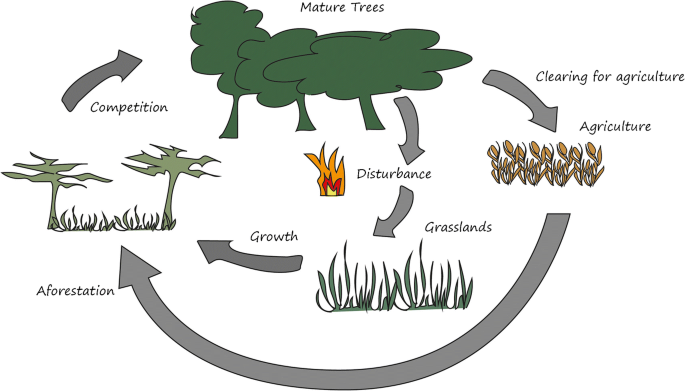
Changes in the vegetation distribution affect the exchange of the land to the atmosphere through changes in the fluxes of energy, water and carbon. Vegetation distribution is altered by both anthropogenic (agriculture, deforestation) and natural dynamics (stress, fire, insect outbreaks, or windthrow).
This section describes how the LSMs include these land cover changes. Figure 8 is an overview of the processes included in LSMs.
Fig. 8
The alternative text for this image may have been generated using AI.
A schematic of land-use and dynamical vegetation processes represented in LSMs
History
The impacts of land-use change on climate were originally assessed by imposing large-scale land cover change (e.g. [[66](/article/10.1007/s40641-021-00171-5#ref-CR66 "Henderson-Sellers A, Gornitz V. Possible climatic impacts of land cover transformations, with particular emphasis on tropical deforestation. Clim Chang. 1984;6(3):231–57. https://doi.org/10.1007/BF00142475
            .")\]). This approach was used in CMIP5, where the models were provided with historical and projected land-use forcing (e.g. \[[16](/article/10.1007/s40641-021-00171-5#ref-CR16 "Boysen LR, Brovkin V, Arora VK, Cadule P, de Noblet-Ducoudré N, Kato E, et al. Global and regional effects of land-use change on climate in 21st century simulations with interactive carbon cycle. Earth Syst Dyn. 2014;5(2):309–19.
              https://doi.org/10.5194/esd-5-309-2014

            .")\]). Natural vegetation dynamics, which were developed in stand-alone models (‘dynamic global vegetation models’, DGVMs) \[[23](/article/10.1007/s40641-021-00171-5#ref-CR23 "Cramer W, Bondeau A, Woodward FI, Prentice IC, Betts RA, Brovkin V, et al. Global response of terrestrial ecosystem structure and function to CO2 and climate change: results from six dynamic global vegetation models. Glob Chang Biol. 2001;7(4):357–73.
              https://doi.org/10.1046/j.1365-2486.2001.00383.x

            ."), [125](/article/10.1007/s40641-021-00171-5#ref-CR125 "Sitch S, Smith B, Prentice IC, Arneth A, Bondeau A, Cramer W, et al. Evaluation of ecosystem dynamics, plant geography and terrestrial carbon cycling in the LPJ dynamic global vegetation model. Glob Chang Biol. 2003;9(2):161–85.
              https://doi.org/10.1046/j.1365-2486.2003.00569.x

            .")\] were introduced into Earth System Models (ESMs) in some of the LSMs used in CMIP5 \[[17](/article/10.1007/s40641-021-00171-5#ref-CR17 "Brovkin V, Boysen L, Raddatz T, Gayler V, Loew A, Claussen M. Evaluation of vegetation cover and land-surface albedo in MPI-ESM CMIP5 simulations. J Adv Model Earth Syst. 2013;5(1):48–57.
              https://doi.org/10.1029/2012MS000169

            ."), [21](/article/10.1007/s40641-021-00171-5#ref-CR21 "Collins WJ, Bellouin N, Doutriaux-Boucher M, Gedney N, Halloran P, Hinton T, et al. Development and evaluation of an Earth-System model – HadGEM2. Geosci Model Dev. 2011;4(4):1051–75.
              https://doi.org/10.5194/gmd-4-1051-2011

            ."), [142](/article/10.1007/s40641-021-00171-5#ref-CR142 "Watanabe S, Hajima T, Sudo K, Nagashima T, Takemura T, Okajima H, et al. MIROC-ESM 2010: Model description and basic results of CMIP5-20c3m experiments. Geosci Model Dev. 2011;4(4):845–72.
              https://doi.org/10.5194/gmd-4-845-2011

            .")\].
Land-use related fluxes of carbon currently contribute about 14% of annual CO2 emissions [[55](/article/10.1007/s40641-021-00171-5#ref-CR55 "Friedlingstein, P., Jones, M. W., O’Sullivan, M., Andrew, R. M., Hauck, J., Peters, G. P., Peters, W., Pongratz, J., Sitch, S., Le Quere, C., Bakker, D. C. E., Canadell, J. G., Ciais, P., Jackson, R. B., Anthoni, P., Barbero, L., Bastos, A., Bastrikov, V., Becker, M., … Zaehle, S. (2019). Global Carbon Budget 2019. In Earth System Science Data 11, Issue 4, pp. 1783–1838. https://doi.org/10.5194/essd-11-1783-2019
            ")\] or about one quarter of emissions when other greenhouse gases such as methane (CH4) and nitrous oxide (N2O) are included (IPCC SRCCL). This biogeochemical effect is the dominant impact of land-use on climate. A smaller effect relates to the physical effect such as the cooling of irrigated areas and the darkness of trees compared to crops and grass (see Section [2](/article/10.1007/s40641-021-00171-5#Sec3)). This is called the biogeophysical effects \[[10](/article/10.1007/s40641-021-00171-5#ref-CR10 "Betts R. Offset of the potential carbon sink from boreal forestation by decreases in surface albedo. Nature. 2000;408(6809):187–90.
              https://doi.org/10.1038/35041545

            ."), [113](/article/10.1007/s40641-021-00171-5#ref-CR113 "Pongratz J, Reick CH, Raddatz T, Claussen M. Biogeophysical versus biogeochemical climate response to historical anthropogenic land cover change. Geophys Res Lett. 2010;37(8).
              https://doi.org/10.1029/2010GL043010

            .")\]. In some places and at a local scale, local temperature changes due to biogeophysical changes can be as large as the biogeochemical effect on warming \[[32](/article/10.1007/s40641-021-00171-5#ref-CR32 "de Noblet-Ducoudré N, Boisier J-P, Pitman A, Bonan GB, Brovkin V, Cruz F, et al. Determining robust impacts of land-use-induced land cover changes on surface climate over North America and Eurasia: Results from the First Set of LUCID Experiments. J Clim. 2012;25(9):3261–81.
              https://doi.org/10.1175/JCLI-D-11-00338.1

            ."), [129](/article/10.1007/s40641-021-00171-5#ref-CR129 "Thiery W, Visser AJ, Fischer EM, Hauser M, Hirsch AL, Lawrence DM, et al. Warming of hot extremes alleviated by expanding irrigation. Nat Commun. 2020;11(1):290.
              https://doi.org/10.1038/s41467-019-14075-4

            ."), [148](/article/10.1007/s40641-021-00171-5#ref-CR148 "Winckler J, Lejeune Q, Reick CH, Pongratz J. Nonlocal effects dominate the global mean surface temperature response to the biogeophysical effects of deforestation. Geophys Res Lett. 2019;46(2):745–55.
              https://doi.org/10.1029/2018GL080211

            .")\].
The overall observed trend in natural vegetation is a greening trend (with a recent evidence of a browning trend in some regions). LSMs explain these trends as a response to the physiological effects of rising CO2 concentration and a warming climate favouring plant growth in cold regions [[149](/article/10.1007/s40641-021-00171-5#ref-CR149 "Winkler AJ, Myneni RB, Alexandrov GA, Brovkin V. Earth system models underestimate carbon fixation by plants in the high latitudes. Nat Commun. 2019;10(1):885. https://doi.org/10.1038/s41467-019-08633-z
.")\].Recent Advances
Representations of land use and natural vegetation dynamics have been evolving rapidly. To better capture the full range of impacts of land use on the earth system, several LSMs have begun to represent agricultural practices in more detail, including specific crop parameterizations for the world’s major crops along with representations of crop management practices such as planting, harvesting, irrigation and fertilization (e.g. [[15](/article/10.1007/s40641-021-00171-5#ref-CR15 "Bondeau A, Smith PC, Zaehle S, Schaphoff S, Lucht W, Cramer W, et al. Modelling the role of agriculture for the 20th century global terrestrial carbon balance. Glob Chang Biol. 2007;13(3):679–706. https://doi.org/10.1111/j.1365-2486.2006.01305.x
            ."), [86](/article/10.1007/s40641-021-00171-5#ref-CR86 "Lombardozzi DL, Lu Y, Lawrence PJ, Lawrence DM, Swenson S, Oleson KW, et al. Simulating agriculture in the community land model Version 5. J Geophys Res Biogeosci. 2020;125(8):e2019JG005529.
              https://doi.org/10.1029/2019JG005529

            .")\]). In individual models, impacts from processes such as till/no-till practices have been examined by altering parameters for soil respiration (e.g. \[[115](/article/10.1007/s40641-021-00171-5#ref-CR115 "Pugh TAM, Arneth A, Olin S, Ahlström A, Bayer AD, Goldewijk KK, et al. Simulated carbon emissions from land-use change are substantially enhanced by accounting for agricultural management. Environ Res Lett. 2015;10(12):124008.
              https://doi.org/10.1088/1748-9326/10/12/124008

            .")\]) or adjusting soil albedos to account for soil turnover due to tillage \[[27](/article/10.1007/s40641-021-00171-5#ref-CR27 "Davin EL, Seneviratne SI, Ciais P, Olioso A, Wang T. Preferential cooling of hot extremes from cropland albedo management. Proc Natl Acad Sci. 2014;111(27):9757–61.
              https://doi.org/10.1073/pnas.1317323111

            .")\]. Irrigation has been implemented by adding water to eliminate plant water stress \[[34](/article/10.1007/s40641-021-00171-5#ref-CR34 "de Vrese P, Hagemann S, Claussen M. Asian irrigation, African rain: remote impacts of irrigation. Geophys Res Lett. 2016;43(8):3737–45.
              https://doi.org/10.1002/2016GL068146

            .")\], also see Section [4](/article/10.1007/s40641-021-00171-5#Sec11).
Due to the rapid development of land use models, there is a wide range of the level of comprehensiveness and the specific process implementations which confounds multi-model assessments of the impacts of historic and projected land-use change. In recognition of this divergence, the Land Use Model Intercomparison Project [[118](/article/10.1007/s40641-021-00171-5#ref-CR118 "Riley WJ, Subin ZM, Lawrence DM, Swenson SC, Torn MS, Meng L, et al. Barriers to predicting changes in global terrestrial methane fluxes: analyses using CLM4Me, a methane biogeochemistry model integrated in CESM. Biogeosciences. 2011;8(7):1925–53. https://doi.org/10.5194/bg-8-1925-2011
            .")\](LUMIP) \[[79](/article/10.1007/s40641-021-00171-5#ref-CR79 "Lawrence DM, Koven CD, Swenson SC, Riley WJ, Slater AG. Permafrost thaw and resulting soil moisture changes regulate projected high-latitude CO 2 and CH 4 emissions. Environ Res Lett. 2015;10(9):094011.
              https://doi.org/10.1088/1748-9326/10/9/094011

            .")\] includes a large factorial set of land-only-perturbations coupled to the atmosphere models. These experiments focused in on a range of important land use processes so as to enable multi-model assessment of the impacts of specific processes on the land-atmosphere exchanges.
A key to accurate simulation of the role of vegetation on the atmosphere is a representation of forest age. This enables the modelling of harvesting of specifically aged or sized trees which is needed for a detailed forestry representation (e.g. [[8](/article/10.1007/s40641-021-00171-5#ref-CR8 "Bellassen V, Le Maire G, Dhôte JF, Ciais P, Viovy N. Modelling forest management within a global vegetation model—Part 1: model structure and general behaviour. Ecol Model. 2010;221(20):2458–74. https://doi.org/10.1016/j.ecolmodel.2010.07.008
            .")\]). Some models represent sub-grid forest age structures inherently, while many depict only an average tree or plant age. These latter, simpler LSMs can represent the distribution explicitly with a tile for each age classes (e.g. \[[100](/article/10.1007/s40641-021-00171-5#ref-CR100 "Nabel JEMS, Naudts K, Pongratz J. Accounting for forest age in the tile-based dynamic global vegetation model JSBACH4 (4.20p7; git feature/forests) – a land surface model for the ICON-ESM. Geosci Model Dev. 2020;13(1):185–200.
              https://doi.org/10.5194/gmd-13-185-2020

            ."), [124](/article/10.1007/s40641-021-00171-5#ref-CR124 "Shevliakova, E., Pacala, S. W., Malyshev, S., Hurtt, G. C., Milly, P. C. D., Caspersen, J. P., Sentman, L. T., Fisk, J. P., Wirth, C., & Crevoisier, C. (2009). Carbon cycling under 300 years of land use change: importance of the secondary vegetation sink. Global Biogeochem Cycles, 23.
              https://doi.org/10.1029/2007GB003176

            ")\]). An alternative approach is to model the relationship between the distribution of the age-class and the average growth (e.g. \[[65](/article/10.1007/s40641-021-00171-5#ref-CR65 "Haverd V, Smith B, Nieradzik L, Briggs PR, Woodgate W, Trudinger CM, et al. A new version of the CABLE land surface model (Subversion revision r4601) incorporating land use and land cover change, woody vegetation demography, and a novel optimisation-based approach to plant coordination of photosynthesis. Geosci Model Dev. 2018;11(7):2995–3026.
              https://doi.org/10.5194/gmd-11-2995-2018

            .")\]). These new generation models rely on ‘cohorts’, wherein plants with similar properties (age, size, age, functional type) are grouped together (\[[64](/article/10.1007/s40641-021-00171-5#ref-CR64 "Haverd V, Smith B, Cook GD, Briggs PR, Nieradzik L, Roxburgh SH, et al. A stand-alone tree demography and landscape structure module for Earth system models. Geophys Res Lett. 2013;40(19):5234–9.
              https://doi.org/10.1002/grl.50972

            ."), [67](/article/10.1007/s40641-021-00171-5#ref-CR67 "Hurtt GC, Moorcroft PR, Pacala SW, Levin SA. Terrestrial models and global change: challenges for the future. Glob Chang Biol. 1998;4(5):581–90.
              https://doi.org/10.1046/j.1365-2486.1998.t01-1-00203.x

            ."), [143](/article/10.1007/s40641-021-00171-5#ref-CR143 "Weng ES, Malyshev S, Lichstein JW, Farrior CE, Dybzinski R, Zhang T, et al. Scaling from individual trees to forests in an Earth system modeling framework using a mathematically tractable model of height-structured competition. Biogeosciences. 2015;12(9):2655–94.
              https://doi.org/10.5194/bg-12-2655-2015

            .")\]; and see \[[50](/article/10.1007/s40641-021-00171-5#ref-CR50 "Fisher, R. A., Koven, C. D., Anderegg, W. R. L., Christoffersen, B. O., Dietze, M. C., Farrior, C. E., Holm, J. A., Hurtt, G. C., Knox, R. G., Lawrence, P. J., Lichstein, J. W., Longo, M., Matheny, A. M., Medvigy, D., Muller-Landau, H. C., Powell, T. L., Serbin, S. P., Sato, H., Shuman, J. K., … Moorcroft, P. R. (2018). Vegetation demographics in Earth System Models: a review of progress and priorities. Global Change Biol, 24(1), 35–54.
              https://doi.org/10.1111/gcb.13910

            ")\] for a review).
Limitation and Future Directions
A recent review of the changes in land-use under anthropogenic influences is given in Pongratz et al. [[112](/article/10.1007/s40641-021-00171-5#ref-CR112 "Pongratz J, Dolman H, Don A, Erb K-H, Fuchs R, Herold M, et al. Models meet data: challenges and opportunities in implementing land management in Earth system models. Glob Chang Biol. 2018;24(4):1470–87. https://doi.org/10.1111/gcb.13988
            .")\]. Among others, they show that there is now an understanding that land management can be as impactful on climate as land-cover change \[[41](/article/10.1007/s40641-021-00171-5#ref-CR41 "Erb K-H, Kastner T, Plutzar C, Bais ALS, Carvalhais N, Fetzel T, et al. Unexpectedly large impact of forest management and grazing on global vegetation biomass. Nature. 2018;553(7686):73–6.
              https://doi.org/10.1038/nature25138

            ."), [42](/article/10.1007/s40641-021-00171-5#ref-CR42 "Erb K-H, Luyssaert S, Meyfroidt P, Pongratz J, Don A, Kloster S, et al. Land management: data availability and process understanding for global change studies. Glob Chang Biol. 2017;23(2):512–33.
              https://doi.org/10.1111/gcb.13443

            ."), [88](/article/10.1007/s40641-021-00171-5#ref-CR88 "Luyssaert S, Jammet M, Stoy PC, Estel S, Pongratz J, Ceschia E, et al. Land management and land-cover change have impacts of similar magnitude on surface temperature. Nat Clim Chang. 2014;4(5):389–93.
              https://doi.org/10.1038/nclimate2196

            .")\] but they are un- or under-represented in present day LSMs.
Current LSMs typically represent crop phenology with relatively few phenological stages, but by doing so miss out on potential impacts of heat or water stress during key stages of the crop life cycle [[106](/article/10.1007/s40641-021-00171-5#ref-CR106 "Peng B, Guan K, Chen M, Lawrence DM, Pokhrel Y, Suyker A, et al. Improving maize growth processes in the community land model: implementation and evaluation. Agric For Meteorol. 2018;250–251:64–89. https://doi.org/10.1016/j.agrformet.2017.11.012
            .")\]. Further, crop modules within LSMs consider only a few of the many crop management practices in use today (i.e. mainly irrigation and fertilization). McDermid et al. \[[92](/article/10.1007/s40641-021-00171-5#ref-CR92 "McDermid SS, Mearns LO, Ruane AC. Representing agriculture in Earth System Models: approaches and priorities for development. J Adv Model Earth Syst. 2017;9(5):2230–65.
              https://doi.org/10.1002/2016MS000749

            .")\] gives a review of including agriculture in Earth System Models.
But, many other crop management practices affect food production, agricultural land sustainability and the impact of agriculture on climate. These include cropland harvest, irrigation (discussed in Section 4), and fertilization (Section 5), forest harvest, tree species selection, grazing and mowing harvest, crop species selection, artificial wetland drainage, pest management, tillage, fire management and crop residue management.
Pongratz et al. [[112](/article/10.1007/s40641-021-00171-5#ref-CR112 "Pongratz J, Dolman H, Don A, Erb K-H, Fuchs R, Herold M, et al. Models meet data: challenges and opportunities in implementing land management in Earth system models. Glob Chang Biol. 2018;24(4):1470–87. https://doi.org/10.1111/gcb.13988
            .")\] point out that for each process, there is often a basic implementation and a comprehensive implementation. To achieve a comprehensive implementation requires overcoming challenges of data limitations, and in some cases inadequate process understanding or inadequate knowledge or ability to simplify and capture specific human behaviours (e.g. farmer decisions on when to plant crops). Peng et al. \[[107](/article/10.1007/s40641-021-00171-5#ref-CR107 "Peng, B., Guan, K., Tang, J., Ainsworth, E. A., Asseng, S., Bernacchi, C. J., Cooper, M., Delucia, E. H., Elliott, J. W., Ewert, F., Grant, R. F., Gustafson, D. I., Hammer, G. L., Jin, Z., Jones, J. W., Kimm, H., Lawrence, D. M., Li, Y., Lombardozzi, D. L., … Zhou, W. (2020). Towards a multiscale crop modelling framework for climate change adaptation assessment. Nat Plants, 6(4), 338–348.
              https://doi.org/10.1038/s41477-020-0625-3

            ")\] argue that a much more deliberate and intensive effort to merge agroeconomic crop models and land-surface models is required to provide a ‘multiscale crop modelling framework \[that\] will enable gene-to-farm design of resilient and sustainable crop production systems under a changing climate at regional-to-global scales’.
Capturing the impacts of agricultural management on soils is a priority and requires improved representation of plant–soil–microbial interactions (as discussed in Section 5) and the impacts of agricultural management on these interactions, such as the long-term impacts of agricultural management (including pastureland and rangeland management) on soil degradation and/or loss [[138](/article/10.1007/s40641-021-00171-5#ref-CR138 "Wang P-L, Feddema JJ. Linking global land use/land cover to hydrologic soil groups from 850 to 2015. Glob Biogeochem Cycles. 2020;34(3):e2019GB006356. https://doi.org/10.1029/2019GB006356
.")\]. More realistic treatment of changes in soil health would allow, for example, for study of the potential impacts of agricultural practices on flood risk.One of the critical problems is how to specify the role of humans in the Earth System. A potential way forward is to link the ESMs with Integrated Assessment Models to ESMs [[1](/article/10.1007/s40641-021-00171-5#ref-CR1 "Alexander P, Rabin S, Anthoni P, Henry R, Pugh TAM, Rounsevell MDA, et al. Adaptation of global land use and management intensity to changes in climate and atmospheric carbon dioxide. Glob Chang Biol. 2018;24(7):2791–809. https://doi.org/10.1111/gcb.14110
            ."), [130](/article/10.1007/s40641-021-00171-5#ref-CR130 "Thornton PE, Calvin K, Jones AD, Di Vittorio AV, Bond-Lamberty B, Chini L, et al. Biospheric feedback effects in a synchronously coupled model of human and Earth systems. Nat Clim Chang. 2017;7(7):496–500.
              https://doi.org/10.1038/nclimate3310

            .")\], thus capturing feedbacks between climate, food, water and land-use.
The representation of vegetation dynamics is also evolving substantially, with first-generation DGVMs being replaced by demographic models based on a more realistic ecological understanding of the land system [[50](/article/10.1007/s40641-021-00171-5#ref-CR50 "Fisher, R. A., Koven, C. D., Anderegg, W. R. L., Christoffersen, B. O., Dietze, M. C., Farrior, C. E., Holm, J. A., Hurtt, G. C., Knox, R. G., Lawrence, P. J., Lichstein, J. W., Longo, M., Matheny, A. M., Medvigy, D., Muller-Landau, H. C., Powell, T. L., Serbin, S. P., Sato, H., Shuman, J. K., … Moorcroft, P. R. (2018). Vegetation demographics in Earth System Models: a review of progress and priorities. Global Change Biol, 24(1), 35–54. https://doi.org/10.1111/gcb.13910
")\]. Next-generation demographic vegetation models include processes thought to be critical for ecosystem function and composition, including canopy gap formation, vertical light competition, competitive exclusion and successional recovery from natural or anthropogenic disturbance. They will also need to be responsive to the below-ground state such as soil depth, moisture and temperatures.Conclusions
Land surface models need to balance two opposing requirements. They need to be complex enough to capture important processes and drivers of change in the real world, and parsimonious enough to be able to simulate and study a multitude of possible other worlds (new climates, new land and water uses and new locations).
One way to obtain this balance is to articulate the difference between the representation of processes within a component and the representation of the exchanges between the components. The former is critical to capture the response of ecosystems to changing climate conditions and is essentially a scientific problem. The latter is required to represent the heterogeneity of the land-system both in time and space and is essentially a modelling problem but requires scientific insight.
This review showed many examples of both these two aspects, across the 5 main modelling domains: surface and canopy exchanges, soil and snow physics, water bodies, biogeochemistry and plant physiology and vegetation dynamics. We showed how progress in one aspect may be independent (new models of stomata can be introduced without reference to other parts of the model) while others may need changes to the exchanges between components to make progress (for instance, if dynamic vegetation models need to link to sub-grid features such as soils, topography, wind stress and snow depth).
Separating out the two aspects (processes and exchanges) and making progress in both enables us to identify our priorities for delivering a model that includes both the complexity of the real world, while maintaining an appropriate level of parsimony. For instance, only components that affect the outcome of the problem being addressed need to be linked in a model configuration. Another example is that time and space scale of the application can dictate the appropriate exchanges used without affecting the representation of the components.
The future of Land Surface Modelling by the large modelling centres will probably focus on the framework for coupling components together, depending on the application. As well as the coupling across time and space scales, the framework will include the external boundary conditions and evaluation of the outputs for different applications. This will enable a marketplace for the provision of the component model which can be provided by external, academic and international researchers. Such a relationship between the central operations-focussed modelling centres and the academic sector will service one of the un-spoken but critical aspects of land-surface modelling which is the support it provides for research and intellectual enquiry.
Ultimately, the goal is that future land surface models can address key societal and scientific questions related to ecosystem resilience under a range of environmental and anthropogenic pressures. By understanding and enabling independent development of the basic building blocks of the models and how they are combined, we can ensure a healthy future of the integrity of the science of Land Surface Modelling.
References
- Alexander P, Rabin S, Anthoni P, Henry R, Pugh TAM, Rounsevell MDA, et al. Adaptation of global land use and management intensity to changes in climate and atmospheric carbon dioxide. Glob Chang Biol. 2018;24(7):2791–809. https://doi.org/10.1111/gcb.14110.
Article Google Scholar - Anderson JD. Ludwig Prandtl’s boundary layer. Phys Today. 2005;58(12):42–8. https://doi.org/10.1063/1.2169443.
Article Google Scholar - Arino O, Bicheron P, Achard F, Latham J, Witt R, Weber J-L. GLOBCOVER The most detailed portrait of Earth. ESA Bull - Eur Space Agency. 2008;136:24–31.
Google Scholar - Arora VK, Boer GJ. Fire as an interactive component of dynamic vegetation models. J Geophys Res Biogeosci. 2005;110(G2). https://doi.org/10.1029/2005JG000042.
- Arora VK, Melton JR, Plummer D. An assessment of natural methane fluxes simulated by the CLASS-CTEM model. Biogeosciences. 2018;15(15):4683–709. https://doi.org/10.5194/bg-15-4683-2018.
Article CAS Google Scholar - Avis, C. A. (2012). Simulating the present-day and future distribution of permafrost in the UVic Earth System Climate Model [Thesis]. https://dspace.library.uvic.ca//handle/1828/4030
- Ball, J. T., Woodrow, I. E., & Berry, J. A. (1987). A model predicting stomatal conductance and its contribution to the control of photosynthesis under different environmental conditions. In J. Biggins (Ed.), Progress in Photosynthesis Research: Volume 4 Proceedings of the VIIth International Congress on Photosynthesis Providence, Rhode Island, USA, August 10–15, 1986 (pp. 221–224). Springer Netherlands. https://doi.org/10.1007/978-94-017-0519-6_48
- Bellassen V, Le Maire G, Dhôte JF, Ciais P, Viovy N. Modelling forest management within a global vegetation model—Part 1: model structure and general behaviour. Ecol Model. 2010;221(20):2458–74. https://doi.org/10.1016/j.ecolmodel.2010.07.008.
Article CAS Google Scholar - Best MJ, Pryor M, Clark DB, Rooney GG, Essery RLH, Menard CB, et al. The Joint UK Land Environment Simulator (JULES), model description—Part 1: energy and water fluxes. Geosci Model Dev. 2011;4(3):677–99. https://doi.org/10.5194/gmd-4-677-2011.
Article Google Scholar - Betts R. Offset of the potential carbon sink from boreal forestation by decreases in surface albedo. Nature. 2000;408(6809):187–90. https://doi.org/10.1038/35041545.
Article CAS Google Scholar - Beven KJ, Kirkby MJ. A physically based, variable contributing area model of basin hydrology / Un modèle à base physique de zone d’appel variable de l’hydrologie du bassin versant. Hydrol Sci Bull. 1979;24(1):43–69. https://doi.org/10.1080/02626667909491834.
Article Google Scholar - Bonan GB, Lawrence PJ, Oleson KW, Levis S, Jung M, Reichstein M, Lawrence DM, & Swenson SC (2011). Improving canopy processes in the Community Land Model version 4 (CLM4) using global flux fields empirically inferred from FLUXNET data. J Geophysical Res: Biogeosciences, 116. https://doi.org/10.1029/2010JG001593
- Bonan GB, Patton EG, Harman IN, Oleson KW, Finnigan JJ, Lu Y, et al. Modeling canopy-induced turbulence in the Earth system: a unified parameterization of turbulent exchange within plant canopies and the roughness sublayer (CLM-ml v0). Geosci Model Dev. 2018;11(4):1467–96. https://doi.org/10.5194/gmd-11-1467-2018.
Article CAS Google Scholar - Bonan GB, Williams M, Fisher RA, Oleson KW. Modeling stomatal conductance in the earth system: linking leaf water-use efficiency and water transport along the soil-plant-atmosphere continuum. Geosci Model Dev. 2014;7(5):2193–222. https://doi.org/10.5194/gmd-7-2193-2014.
Article Google Scholar - Bondeau A, Smith PC, Zaehle S, Schaphoff S, Lucht W, Cramer W, et al. Modelling the role of agriculture for the 20th century global terrestrial carbon balance. Glob Chang Biol. 2007;13(3):679–706. https://doi.org/10.1111/j.1365-2486.2006.01305.x.
Article Google Scholar - Boysen LR, Brovkin V, Arora VK, Cadule P, de Noblet-Ducoudré N, Kato E, et al. Global and regional effects of land-use change on climate in 21st century simulations with interactive carbon cycle. Earth Syst Dyn. 2014;5(2):309–19. https://doi.org/10.5194/esd-5-309-2014.
Article Google Scholar - Brovkin V, Boysen L, Raddatz T, Gayler V, Loew A, Claussen M. Evaluation of vegetation cover and land-surface albedo in MPI-ESM CMIP5 simulations. J Adv Model Earth Syst. 2013;5(1):48–57. https://doi.org/10.1029/2012MS000169.
Article Google Scholar - Bussi G, Whitehead PG, Bowes MJ, Read DS, Prudhomme C, Dadson SJ. Impacts of climate change, land-use change and phosphorus reduction on phytoplankton in the River Thames (UK). Sci Total Environ. 2016;572:1507–19. https://doi.org/10.1016/j.scitotenv.2016.02.109.
Article CAS Google Scholar - Clark MP, Nijssen B, Lundquist JD, Kavetski D, Rupp DE, Woods RA, et al. A unified approach for process-based hydrologic modeling: 1. Modeling concept. Water Resour Res. 2015;51(4):2498–514. https://doi.org/10.1002/2015WR017198.
Article Google Scholar - Collatz G, Ribas-Carbo M, Berry J. Coupled photosynthesis-stomatal conductance model for leaves of C4 plants photosynthesis-stomatal conductance model for leaves of C4 plants. Aust J Plant Physiol. 1992;19(5):519–38. https://doi.org/10.1071/PP9920519.
Article Google Scholar - Collins WJ, Bellouin N, Doutriaux-Boucher M, Gedney N, Halloran P, Hinton T, et al. Development and evaluation of an Earth-System model – HadGEM2. Geosci Model Dev. 2011;4(4):1051–75. https://doi.org/10.5194/gmd-4-1051-2011.
Article Google Scholar - Comyn-Platt E, Hayman G, Huntingford C, Chadburn SE, Burke EJ, Harper AB, et al. Carbon budgets for 1.5 and 2 degrees C targets lowered by natural wetland and permafrost feedbacks. Nat Geosci. 2018;11(8):568. https://doi.org/10.1038/s41561-018-0174-9.
Article CAS Google Scholar - Cramer W, Bondeau A, Woodward FI, Prentice IC, Betts RA, Brovkin V, et al. Global response of terrestrial ecosystem structure and function to CO2 and climate change: results from six dynamic global vegetation models. Glob Chang Biol. 2001;7(4):357–73. https://doi.org/10.1046/j.1365-2486.2001.00383.x.
Article Google Scholar - Dadson S, Acreman M, Harding R. Water security, global change and land–atmosphere feedbacks. Philos Trans R Soc A Math Phys Eng Sci. 2013;371(2002):20120412. https://doi.org/10.1098/rsta.2012.0412.
Article Google Scholar - Dadson SJ, Garrick DE, Penning-Rowsell EC, Hall JW, Hope R, Hughes J. Water Science. Chichester: Policy and Management; 2019.
Book Google Scholar - Dai Y, Dickinson R, Wang Y. A two-big-leaf model for canopy temperature, photosynthesis, and stomatal conductance. J Clim. 2004;17(12):2281–99. https://doi.org/10.1175/1520-0442(2004)017<2281:ATMFCT>2.0.CO;2.
Article Google Scholar - Davin EL, Seneviratne SI, Ciais P, Olioso A, Wang T. Preferential cooling of hot extremes from cropland albedo management. Proc Natl Acad Sci. 2014;111(27):9757–61. https://doi.org/10.1073/pnas.1317323111.
Article CAS Google Scholar - de Graaf IEM, Gleeson T, van Beek LPHR, Sutanudjaja EH, Bierkens MFP. Environmental flow limits to global groundwater pumping. Nature. 2019;574(7776):90. https://doi.org/10.1038/s41586-019-1594-4.
Article CAS Google Scholar - de Graaf IEM, Sutanudjaja EH, van Beek LPH, Bierkens MFP. A high-resolution global-scale groundwater model. Hydrol Earth Syst Sci. 2015;19(2):823–37. https://doi.org/10.5194/hess-19-823-2015.
Article Google Scholar - de Graaf IEM, van Beek RLPH, Gleeson T, Moosdorf N, Schmitz O, Sutanudjaja EH, et al. A global-scale two-layer transient groundwater model: development and application to groundwater depletion. Adv Water Resour. 2017;102:53–67. https://doi.org/10.1016/j.advwatres.2017.01.011.
Article Google Scholar - De Kauwe MG, Kala J, Lin Y-S, Pitman AJ, Medlyn BE, Duursma RA, et al. A test of an optimal stomatal conductance scheme within the CABLE land surface model. Geosci Model Dev. 2015;8(2):431–52. https://doi.org/10.5194/gmd-8-431-2015.
Article Google Scholar - de Noblet-Ducoudré N, Boisier J-P, Pitman A, Bonan GB, Brovkin V, Cruz F, et al. Determining robust impacts of land-use-induced land cover changes on surface climate over North America and Eurasia: Results from the First Set of LUCID Experiments. J Clim. 2012;25(9):3261–81. https://doi.org/10.1175/JCLI-D-11-00338.1.
Article Google Scholar - de Vrese P, Hagemann S. Explicit representation of spatial subgrid-scale heterogeneity in an ESM. J Hydrometeorol. 2016;17(5):1357–71. https://doi.org/10.1175/JHM-D-15-0080.1.
Article Google Scholar - de Vrese P, Hagemann S, Claussen M. Asian irrigation, African rain: remote impacts of irrigation. Geophys Res Lett. 2016;43(8):3737–45. https://doi.org/10.1002/2016GL068146.
Article Google Scholar - Decharme B, Douville H. Introduction of a sub-grid hydrology in the ISBA land surface model. Clim Dyn. 2006;26(1):65–78. https://doi.org/10.1007/s00382-005-0059-7.
Article Google Scholar - dePury D, Farquhar G. Simple scaling of photosynthesis from leaves to canopies without the errors of big-leaf models. Plant Cell Environ. 1997;20(5):537–57. https://doi.org/10.1111/j.1365-3040.1997.00094.x.
Article Google Scholar - Dickinson RE, Henderson-Sellers A, Kennedy J, & Wilson F (1986). Biosphere-atmosphere Transfer Scheme (BATS) for the NCAR Community Climate Model. https://doi.org/10.5065/D6668B58
- Dickinson RE, Henderson-Sellers A, & Kennedy PJ (1993). Biosphere-Atmosphere Transfer Scheme (BATS) version le as coupled to the NCAR community climate model. Technical note. [NCAR (National Center for Atmospheric Research)] (PB-94-106150/XAB; NCAR/TN-387+STR). National Center for Atmospheric Research, Boulder, CO (United States). Scientific Computing Div. https://www.osti.gov/biblio/5733868
- Dolman AJ, Gregory D. The parametrization of rainfall interception In GCMs. Q J R Meteorol Soc. 1992;118(505):455–67. https://doi.org/10.1002/qj.49711850504.
Article Google Scholar - Ekici A, Lee H, Lawrence DM, Swenson SC, Prigent C. Ground subsidence effects on simulating dynamic high-latitude surface inundation under permafrost thaw using CLM5. Geosci Model Dev. 2019;12(12):5291–300. https://doi.org/10.5194/gmd-12-5291-2019.
Article CAS Google Scholar - Erb K-H, Kastner T, Plutzar C, Bais ALS, Carvalhais N, Fetzel T, et al. Unexpectedly large impact of forest management and grazing on global vegetation biomass. Nature. 2018;553(7686):73–6. https://doi.org/10.1038/nature25138.
Article CAS Google Scholar - Erb K-H, Luyssaert S, Meyfroidt P, Pongratz J, Don A, Kloster S, et al. Land management: data availability and process understanding for global change studies. Glob Chang Biol. 2017;23(2):512–33. https://doi.org/10.1111/gcb.13443.
Article Google Scholar - Fan, Y., Clark, M., Lawrence, D. M., Swenson, S., Band, L. E., Brantley, S. L., Brooks, P. D., Dietrich, W. E., Flores, A., Grant, G., Kirchner, J. W., Mackay, D. S., McDonnell, J. J., Milly, P. C. D., Sullivan, P. L., Tague, C., Ajami, H., Chaney, N., Hartmann, A., … Yamazaki, D. (2019). Hillslope hydrology in global change research and earth system modeling. Water Resources Research, 55(2), 1737–1772. https://doi.org/10.1029/2018WR023903
- Fan Y, Li H, Miguez-Macho G. Global Patterns of groundwater table depth. Science. 2013;339(6122):940–3. https://doi.org/10.1126/science.1229881.
Article CAS Google Scholar - Faroux S, Tchuente ATK, Roujean J-L, Masson V, Martin E, Le Moigne P. ECOCLIMAP-II/Europe: a twofold database of ecosystems and surface parameters at 1 km resolution based on satellite information for use in land surface, meteorological and climate models. Geosci Model Dev. 2013;6(2):563–82. https://doi.org/10.5194/gmd-6-563-2013.
Article Google Scholar - Farquhar G, Schulze E, Kuppers M. Responses to humidity by stomata of Nicotiana-glauca L and Corylus-avellana L are consistent with the optimization of carbon-dioxide uptake with respect to water-loss. Aust J Plant Physiol. 1980;7(3):315–27. https://doi.org/10.1071/PP9800315.
Article Google Scholar - Farthing MW, Ogden FL. Numerical solution of Richards’ Equation: a review of advances and challenges. Soil Sci Soc Am J. 2017;81(6):1257–69. https://doi.org/10.2136/sssaj2017.02.0058.
Article CAS Google Scholar - Feddema J, Oleson K, Bonan G, Mearns L, Washington W, Meehl G, et al. A comparison of a GCM response to historical anthropogenic land cover change and model sensitivity to uncertainty in present-day land cover representations. Clim Dyn. 2005;25(6):581–609. https://doi.org/10.1007/s00382-005-0038-z.
Article Google Scholar - Fisher RA, Koven CD. Perspectives on the future of land surface models and the challenges of representing complex terrestrial systems. J Adv Model Earth Syste. 2020;12(4):e2018MS001453. https://doi.org/10.1029/2018MS001453.
Article Google Scholar - Fisher, R. A., Koven, C. D., Anderegg, W. R. L., Christoffersen, B. O., Dietze, M. C., Farrior, C. E., Holm, J. A., Hurtt, G. C., Knox, R. G., Lawrence, P. J., Lichstein, J. W., Longo, M., Matheny, A. M., Medvigy, D., Muller-Landau, H. C., Powell, T. L., Serbin, S. P., Sato, H., Shuman, J. K., … Moorcroft, P. R. (2018). Vegetation demographics in Earth System Models: a review of progress and priorities. Global Change Biol, 24(1), 35–54. https://doi.org/10.1111/gcb.13910
- Forkel M, Migliavacca M, Thonicke K, Reichstein M, Schaphoff S, Weber U, et al. Codominant water control on global interannual variability and trends in land surface phenology and greenness. Glob Chang Biol. 2015;21(9):3414–35. https://doi.org/10.1111/gcb.12950.
Article Google Scholar - Franklin, O., Harrison, S. P., Dewar, R., Farrior, C. E., Brännström, Å., Dieckmann, U., Pietsch, S., Falster, D., Cramer, W., Loreau, M., Wang, H., Mäkelä, A., Rebel, K. T., Meron, E., Schymanski, S. J., Rovenskaya, E., Stocker, B. D., Zaehle, S., Manzoni, S., … Prentice, I. C. (2020). Organizing principles for vegetation dynamics. Nat Plants, 6(5), 444–453. https://doi.org/10.1038/s41477-020-0655-x
- Franklin O, Johansson J, Dewar RC, Dieckmann U, McMurtrie RE, Brännström Å, et al. Modeling carbon allocation in trees: a search for principles. Tree Physiol. 2012;32(6):648–66. https://doi.org/10.1093/treephys/tpr138.
Article CAS Google Scholar - Friedl M, & Sulla-Menashe D (2019). MCD12Q1 MODIS/Terra+Aqua Land Cover Type Yearly L3 Global 500m SIN Grid V006 [Data set]. NASA EOSDIS Land Processes DAAC. 1. https://lpdaac.usgs.gov/node/1260
- Friedlingstein, P., Jones, M. W., O’Sullivan, M., Andrew, R. M., Hauck, J., Peters, G. P., Peters, W., Pongratz, J., Sitch, S., Le Quere, C., Bakker, D. C. E., Canadell, J. G., Ciais, P., Jackson, R. B., Anthoni, P., Barbero, L., Bastos, A., Bastrikov, V., Becker, M., … Zaehle, S. (2019). Global Carbon Budget 2019. In Earth System Science Data 11, Issue 4, pp. 1783–1838. https://doi.org/10.5194/essd-11-1783-2019
- Gleick PH, Palaniappan M. Peak water limits to freshwater withdrawal and use. Proc Natl Acad Sci. 2010;107(25):11155–62. https://doi.org/10.1073/pnas.1004812107.
Article Google Scholar - Grimmond, C. S. B., Blackett, M., Best, M. J., Baik, J.-J., Belcher, S. E., Beringer, J., Bohnenstengel, S. I., Calmet, I., Chen, F., Coutts, A., Dandou, A., Fortuniak, K., Gouvea, M. L., Hamdi, R., Hendry, M., Kanda, M., Kawai, T., Kawamoto, Y., Kondo, H., … Zhang, N. (2011). Initial results from Phase 2 of the international urban energy balance model comparison. Int J Climatol, 31(2), 244–272. https://doi.org/10.1002/joc.2227
- Guimberteau M, Drapeau G, Ronchail J, Sultan B, Polcher J, Martinez J-M, et al. Discharge simulation in the sub-basins of the Amazon using ORCHIDEE forced by new datasets. Hydrol Earth Syst Sci. 2012;16(3):911–35. https://doi.org/10.5194/hess-16-911-2012.
Article Google Scholar - Hagerty SB, van Groenigen KJ, Allison SD, Hungate BA, Schwartz E, Koch GW, et al. Accelerated microbial turnover but constant growth efficiency with warming in soil. Nat Clim Chang. 2014;4(10):903–6. https://doi.org/10.1038/nclimate2361.
Article CAS Google Scholar - Hanasaki N, Yoshikawa S, Pokhrel Y, Kanae S. A global hydrological simulation to specify the sources of water used by humans. Hydrol Earth Syst Sci. 2018;22(1):789–817. https://doi.org/10.5194/hess-22-789-2018.
Article Google Scholar - Hansen M, Defries R, Townshend J, Sohlberg R. Global land cover classification at 1km spatial resolution using a classification tree approach. Int J Remote Sens. 2000;21(6–7):1331–64. https://doi.org/10.1080/014311600210209.
Article Google Scholar - Harper AB, Wiltshire AJ, Cox PM, Friedlingstein P, Jones CD, Mercado LM, et al. Vegetation distribution and terrestrial carbon cycle in a carbon cycle configuration of JULES4.6 with new plant functional types. Geosci Model Dev. 2018;11(7):2857–73. https://doi.org/10.5194/gmd-11-2857-2018.
Article Google Scholar - Hartley AJ, MacBean N, Georgievski G, Bontemps S. Uncertainty in plant functional type distributions and its impact on land surface models. Remote Sens Environ. 2017;203:71–89. https://doi.org/10.1016/j.rse.2017.07.037.
Article Google Scholar - Haverd V, Smith B, Cook GD, Briggs PR, Nieradzik L, Roxburgh SH, et al. A stand-alone tree demography and landscape structure module for Earth system models. Geophys Res Lett. 2013;40(19):5234–9. https://doi.org/10.1002/grl.50972.
Article Google Scholar - Haverd V, Smith B, Nieradzik L, Briggs PR, Woodgate W, Trudinger CM, et al. A new version of the CABLE land surface model (Subversion revision r4601) incorporating land use and land cover change, woody vegetation demography, and a novel optimisation-based approach to plant coordination of photosynthesis. Geosci Model Dev. 2018;11(7):2995–3026. https://doi.org/10.5194/gmd-11-2995-2018.
Article CAS Google Scholar - Henderson-Sellers A, Gornitz V. Possible climatic impacts of land cover transformations, with particular emphasis on tropical deforestation. Clim Chang. 1984;6(3):231–57. https://doi.org/10.1007/BF00142475.
Article Google Scholar - Hurtt GC, Moorcroft PR, Pacala SW, Levin SA. Terrestrial models and global change: challenges for the future. Glob Chang Biol. 1998;4(5):581–90. https://doi.org/10.1046/j.1365-2486.1998.t01-1-00203.x.
Article Google Scholar - Huss M, Hock R. Global-scale hydrological response to future glacier mass loss. Nat Clim Chang. 2018;8(2):135–40. https://doi.org/10.1038/s41558-017-0049-x.
Article Google Scholar - Jarvis PG, Monteith JL, Weatherley PE. The interpretation of the variations in leaf water potential and stomatal conductance found in canopies in the field. Philos Trans R Soc London B, Biol Sci. 1976;273(927):593–610. https://doi.org/10.1098/rstb.1976.0035.
Article CAS Google Scholar - Kattge J, Boenisch G, Diaz S, Lavorel S, Prentice IC, Leadley P, et al. TRY plant trait database—enhanced coverage and open access. Glob Chang Biol. 2020;26(1):119–88. https://doi.org/10.1111/gcb.14904.
Article Google Scholar - Kattge, J., Diaz, S., Lavorel, S., Prentice, C., Leadley, P., Boenisch, G., Garnier, E., Westoby, M., Reich, P. B., Wright, I. J., Cornelissen, J. H. C., Violle, C., Harrison, S. P., van Bodegom, P. M., Reichstein, M., Enquist, B. J., Soudzilovskaia, N. A., Ackerly, D. D., Anand, M., … Wirth, C. (2011). TRY—a global database of plant traits. Glob Chang Biol, 17(9), 2905–2935. https://doi.org/10.1111/j.1365-2486.2011.02451.x
- Kattge J, Knorr W. Temperature acclimation in a biochemical model of photosynthesis: a reanalysis of data from 36 species. Plant Cell Environ. 2007;30(9):1176–90. https://doi.org/10.1111/j.1365-3040.2007.01690.x.
Article CAS Google Scholar - Keune J, Gasper F, Goergen K, Hense A, Shrestha P, Sulis M, et al. Studying the influence of groundwater representations on land surface-atmosphere feedbacks during the European heat wave in 2003. J Geophys Res-Atmos. 2016;121(22):13,301–25. https://doi.org/10.1002/2016JD025426.
Article Google Scholar - Kirschke, S., Bousquet, P., Ciais, P., Saunois, M., Canadell, J. G., Dlugokencky, E. J., Bergamaschi, P., Bergmann, D., Blake, D. R., Bruhwiler, L., Cameron-Smith, P., Castaldi, S., Chevallier, F., Feng, L., Fraser, A., Heimann, M., Hodson, E. L., Houweling, S., Josse, B., … Zeng, G. (2013). Three decades of global methane sources and sinks. Nat Geosci, 6(10), 813–823. https://doi.org/10.1038/NGEO1955
- Koster RD, Suarez MJ. Modeling the land surface boundary in climate models as a composite of independent vegetation stands. J Geophys Res-Atmos. 1992;97(D3):2697–715. https://doi.org/10.1029/91JD01696.
Article Google Scholar - Kraus D, Weller S, Klatt S, Haas E, Wassmann R, Kiese R, et al. A new LandscapeDNDC biogeochemical module to predict CH4 and N2O emissions from lowland rice and upland cropping systems. Plant Soil. 2015;386(1):125–49. https://doi.org/10.1007/s11104-014-2255-x.
Article CAS Google Scholar - Largeron C, Krinner G, Ciais P, Brutel-Vuilmet C. Implementing northern peatlands in a global land surface model: description and evaluation in the ORCHIDEE high-latitude version model (ORC-HL-PEAT). Geosci Model Dev. 2018;11(8):3279–97. https://doi.org/10.5194/gmd-11-3279-2018.
Article CAS Google Scholar - Lawrence, D. M., Fisher, R. A., Koven, C. D., Oleson, K. W., Swenson, S. C., Bonan, G., Collier, N., Ghimire, B., van Kampenhout, L., Kennedy, D., Kluzek, E., Lawrence, P. J., Li, F., Li, H., Lombardozzi, D., Riley, W. J., Sacks, W. J., Shi, M., Vertenstein, M., … Zeng, X. (2019). The Community Land Model Version 5: description of new features, benchmarking, and impact of forcing uncertainty. J Adv Model Earth Syst, 11(12), 4245–4287. https://doi.org/10.1029/2018MS001583
- Lawrence DM, Koven CD, Swenson SC, Riley WJ, Slater AG. Permafrost thaw and resulting soil moisture changes regulate projected high-latitude CO 2 and CH 4 emissions. Environ Res Lett. 2015;10(9):094011. https://doi.org/10.1088/1748-9326/10/9/094011.
Article CAS Google Scholar - Lawrence DM, Slater AG. Incorporating organic soil into a global climate model. Clim Dyn. 2008;30(2–3):145–60. https://doi.org/10.1007/s00382-007-0278-1.
Article Google Scholar - Lawrence DM, Slater AG. The contribution of snow condition trends to future ground climate. Clim Dyn. 2010;34(7–8):969–81. https://doi.org/10.1007/s00382-009-0537-4.
Article Google Scholar - Lee H, Swenson SC, Slater AG, Lawrence DM. Effects of excess ground ice on projections of permafrost in a warming climate. Environ Res Lett. 2014;9(12):124006. https://doi.org/10.1088/1748-9326/9/12/124006.
Article Google Scholar - Leuning R. A critical appraisal of a combined stomatal-photosynthesis model for C3 plants. Plant Cell Environ. 1995;18(4):339–55. https://doi.org/10.1111/j.1365-3040.1995.tb00370.x.
Article CAS Google Scholar - Liang X, Lettenmaier DP, Wood EF, Burges SJ. A simple hydrologically based model of land surface water and energy fluxes for general circulation models. J Geophys Res-Atmos. 1994;99(D7):14415–28. https://doi.org/10.1029/94JD00483.
Article Google Scholar - Lombardozzi DL, Bonan GB, Smith NG, Dukes JS, & Fisher RA (2015). Temperature acclimation of photosynthesis and respiration: a key uncertainty in the carbon cycle-climate feedback. In Geophysical Res Lett 42 20:8624–8631). https://doi.org/10.1002/2015GL065934
- Lombardozzi DL, Lu Y, Lawrence PJ, Lawrence DM, Swenson S, Oleson KW, et al. Simulating agriculture in the community land model Version 5. J Geophys Res Biogeosci. 2020;125(8):e2019JG005529. https://doi.org/10.1029/2019JG005529.
Article Google Scholar - Loveland T, Reed B, Brown J, Ohlen D, Zhu Z, Yang L, et al. Development of a global land cover characteristics database and IGBP DISCover from 1 km AVHRR data. Int J Remote Sens. 2000;21(6–7):1303–30. https://doi.org/10.1080/014311600210191.
Article Google Scholar - Luyssaert S, Jammet M, Stoy PC, Estel S, Pongratz J, Ceschia E, et al. Land management and land-cover change have impacts of similar magnitude on surface temperature. Nat Clim Chang. 2014;4(5):389–93. https://doi.org/10.1038/nclimate2196.
Article Google Scholar - Ma Y, Liu H. An advanced multiple-layer canopy model in the WRF model with large-Eddy simulations to simulate canopy flows and scalar transport under different stability conditions. J Adv Model Earth Syst. 2019;11(7):2330–51. https://doi.org/10.1029/2018MS001347.
Article Google Scholar - Martínez-de la Torre A, Miguez-Macho G. Groundwater influence on soil moisture memory and land–atmosphere fluxes in the Iberian Peninsula. Hydrol Earth Syst Sci. 2019;23(12):4909–32. https://doi.org/10.5194/hess-23-4909-2019.
Article Google Scholar - Maxwell RM, Condon LE. Connections between groundwater flow and transpiration partitioning. Science. 2016;353(6297):377–80. https://doi.org/10.1126/science.aaf7891.
Article CAS Google Scholar - McDermid SS, Mearns LO, Ruane AC. Representing agriculture in Earth System Models: approaches and priorities for development. J Adv Model Earth Syst. 2017;9(5):2230–65. https://doi.org/10.1002/2016MS000749.
Article CAS Google Scholar - Medlyn BE, Duursma RA, Eamus D, Ellsworth DS, Prentice IC, Barton CVM, et al. Reconciling the optimal and empirical approaches to modelling stomatal conductance. Glob Chang Biol. 2011;17(6):2134–44. https://doi.org/10.1111/j.1365-2486.2010.02375.x.
Article Google Scholar - Melton JR, Wania R, Hodson EL, Poulter B, Ringeval B, Spahni R, et al. Present state of global wetland extent and wetland methane modelling: conclusions from a model inter-comparison project (WETCHIMP). Biogeosciences. 2013;10(2):753–88. https://doi.org/10.5194/bg-10-753-2013.
Article Google Scholar - Melton JR, Sospedra-Alfonso R, McCusker KE. Tiling soil textures for terrestrial ecosystem modelling via clustering analysis: a case study with CLASS-CTEM (version 2.1). Geosci Model Dev. 2017;10(7):2761–83. https://doi.org/10.5194/gmd-10-2761-2017.
Article CAS Google Scholar - Mercado LM, Bellouin N, Sitch S, Boucher O, Huntingford C, Wild M, et al. Impact of changes in diffuse radiation on the global land carbon sink. Nature. 2009;458(7241):1014–U87. https://doi.org/10.1038/nature07949.
Article CAS Google Scholar - Mercado LM, Medlyn BE, Huntingford C, Oliver RJ, Clark DB, Sitch S, et al. Large sensitivity in land carbon storage due to geographical and temporal variation in the thermal response of photosynthetic capacity. New Phytol. 2018;218(4):1462–77. https://doi.org/10.1111/nph.15100.
Article CAS Google Scholar - Miura Y, Yoshimura K. Development and Verification of a three-dimensional variably saturated flow model for assessment of future global water resources. J Adv Model Earth Syst. 2020;12(8):e2020MS002093. https://doi.org/10.1029/2020MS002093.
Article Google Scholar - Moore RJ. The PDM rainfall-runoff model. Hydrol Earth Syst Sci. 2007;11(1):483–99. https://doi.org/10.5194/hess-11-483-2007.
Article Google Scholar - Nabel JEMS, Naudts K, Pongratz J. Accounting for forest age in the tile-based dynamic global vegetation model JSBACH4 (4.20p7; git feature/forests) – a land surface model for the ICON-ESM. Geosci Model Dev. 2020;13(1):185–200. https://doi.org/10.5194/gmd-13-185-2020.
Article CAS Google Scholar - Nitta T, Yoshimura K, Abe-Ouchi A. Impact of arctic wetlands on the climate system: model sensitivity simulations with the MIROC5 AGCM and a snow-fed wetland scheme. J Hydrometeorol. 2017;18(11):2923–36. https://doi.org/10.1175/JHM-D-16-0105.1.
Article Google Scholar - Oki T, Sud YC. Design of Total Runoff Integrating Pathways (TRIP)—a global river channel network. Earth Interact. 1998;2(1):1–37. https://doi.org/10.1175/1087-3562(1998)002<0001:DOTRIP>2.3.CO;2.
Article Google Scholar - Olefeldt D, Goswami S, Grosse G, Hayes D, Hugelius G, Kuhry P, et al. Circumpolar distribution and carbon storage of thermokarst landscapes. Nat Commun. 2016;7(1):13043. https://doi.org/10.1038/ncomms13043.
Article CAS Google Scholar - Oliver RJ, Mercado LM, Sitch S, Simpson D, Medlyn BE, Lin Y-S, et al. Large but decreasing effect of ozone on the European carbon sink. Biogeosciences. 2018;15(13):4245–69. https://doi.org/10.5194/bg-15-4245-2018.
Article CAS Google Scholar - O’Neill HB, Wolfe SA, Duchesne C. New ground ice maps for Canada using a paleogeographic modelling approach. Cryosphere. 2019;13(3):753–73. https://doi.org/10.5194/tc-13-753-2019.
Article Google Scholar - Peng B, Guan K, Chen M, Lawrence DM, Pokhrel Y, Suyker A, et al. Improving maize growth processes in the community land model: implementation and evaluation. Agric For Meteorol. 2018;250–251:64–89. https://doi.org/10.1016/j.agrformet.2017.11.012.
Article Google Scholar - Peng, B., Guan, K., Tang, J., Ainsworth, E. A., Asseng, S., Bernacchi, C. J., Cooper, M., Delucia, E. H., Elliott, J. W., Ewert, F., Grant, R. F., Gustafson, D. I., Hammer, G. L., Jin, Z., Jones, J. W., Kimm, H., Lawrence, D. M., Li, Y., Lombardozzi, D. L., … Zhou, W. (2020). Towards a multiscale crop modelling framework for climate change adaptation assessment. Nat Plants, 6(4), 338–348. https://doi.org/10.1038/s41477-020-0625-3
- Piao S, Liu Q, Chen A, Janssens IA, Fu Y, Dai J, et al. Plant phenology and global climate change: current progresses and challenges. Glob Chang Biol. 2019;25(6):1922–40. https://doi.org/10.1111/gcb.14619.
Article Google Scholar - Pitman AJ. The evolution of, and revolution in, land surface schemes designed for climate models. Int J Climatol. 2003;23(5):479–510. https://doi.org/10.1002/joc.893.
Article Google Scholar - Pitman AJ, Henderson-Sellers A, Yang Z-L. Sensitivity of regional climates to localized precipitation in global models. Nature. 1990;346(6286):734–7. https://doi.org/10.1038/346734a0.
Article Google Scholar - Polgar CA, Primack RB. Leaf-out phenology of temperate woody plants: from trees to ecosystems. New Phytol. 2011;191(4):926–41. https://doi.org/10.1111/j.1469-8137.2011.03803.x.
Article Google Scholar - Pongratz J, Dolman H, Don A, Erb K-H, Fuchs R, Herold M, et al. Models meet data: challenges and opportunities in implementing land management in Earth system models. Glob Chang Biol. 2018;24(4):1470–87. https://doi.org/10.1111/gcb.13988.
Article Google Scholar - Pongratz J, Reick CH, Raddatz T, Claussen M. Biogeophysical versus biogeochemical climate response to historical anthropogenic land cover change. Geophys Res Lett. 2010;37(8). https://doi.org/10.1029/2010GL043010.
- Poulter B, Frank DC, Hodson EL, Zimmermann NE. Impacts of land cover and climate data selection on understanding terrestrial carbon dynamics and the CO2 airborne fraction. Biogeosciences. 2011;8(8):2027–36. https://doi.org/10.5194/bg-8-2027-2011.
Article CAS Google Scholar - Pugh TAM, Arneth A, Olin S, Ahlström A, Bayer AD, Goldewijk KK, et al. Simulated carbon emissions from land-use change are substantially enhanced by accounting for agricultural management. Environ Res Lett. 2015;10(12):124008. https://doi.org/10.1088/1748-9326/10/12/124008.
Article Google Scholar - Quaife T, Quegan S, Disney M, Lewis P, Lomas M, Woodward FI. Impact of land cover uncertainties on estimates of biospheric carbon fluxes. Glob Biogeochem Cycles. 2008;22(4). https://doi.org/10.1029/2007GB003097.
- Richards LA. Capillary conduction of liquids through porous mediums—NASA/ADS. Physics. 1931;1(5):318–33. https://doi.org/10.1063/1.1745010.
Article Google Scholar - Riley WJ, Subin ZM, Lawrence DM, Swenson SC, Torn MS, Meng L, et al. Barriers to predicting changes in global terrestrial methane fluxes: analyses using CLM4Me, a methane biogeochemistry model integrated in CESM. Biogeosciences. 2011;8(7):1925–53. https://doi.org/10.5194/bg-8-1925-2011.
Article CAS Google Scholar - Sabot MEB, Kauwe MGD, Pitman AJ, Medlyn BE, Verhoef A, Ukkola AM, et al. Plant profit maximization improves predictions of European forest responses to drought. New Phytol. 2020;226(6):1638–55. https://doi.org/10.1111/nph.16376.
Article Google Scholar - Sacks WJ, Cook BI, Buenning N, Levis S, Helkowski JH. Effects of global irrigation on the near-surface climate. Clim Dyn. 2009;33(2):159–75. https://doi.org/10.1007/s00382-008-0445-z.
Article Google Scholar - Schultz NM, Lee X, Lawrence PJ, Lawrence DM, Zhao L. Assessing the use of subgrid land model output to study impacts of land cover change. J Geophys Res-Atmos. 2016;121(11):6133–47. https://doi.org/10.1002/2016JD025094.
Article Google Scholar - Sellers PJ, Mintz Y, Sud YC, Dalcher A. A simple biosphere model (SIB) for use within general circulation models. J Atmos Sci. 1986;43(6):505–31. https://doi.org/10.1175/1520-0469(1986)043<0505:ASBMFU>2.0.CO;2.
Article Google Scholar - Sellers PJ, Randall D, Collatz G, Berry J, Field C, Dazlich D, et al. A revised land surface parameterization (SiB2) for atmospheric GCMs .1. Model formulation. J Clim. 1996;9(4):676–705. https://doi.org/10.1175/1520-0442(1996)009<0676:ARLSPF>2.0.CO;2.
Article Google Scholar - Shevliakova, E., Pacala, S. W., Malyshev, S., Hurtt, G. C., Milly, P. C. D., Caspersen, J. P., Sentman, L. T., Fisk, J. P., Wirth, C., & Crevoisier, C. (2009). Carbon cycling under 300 years of land use change: importance of the secondary vegetation sink. Global Biogeochem Cycles, 23. https://doi.org/10.1029/2007GB003176
- Sitch S, Smith B, Prentice IC, Arneth A, Bondeau A, Cramer W, et al. Evaluation of ecosystem dynamics, plant geography and terrestrial carbon cycling in the LPJ dynamic global vegetation model. Glob Chang Biol. 2003;9(2):161–85. https://doi.org/10.1046/j.1365-2486.2003.00569.x.
Article Google Scholar - Smith NG, Malyshev SL, Shevliakova E, Kattge J, Dukes JS. Foliar temperature acclimation reduces simulated carbon sensitivity to climate. Nat Clim Chang. 2016;6(4):407–11. https://doi.org/10.1038/nclimate2878.
Article Google Scholar - Sperry JS, Venturas MD, Anderegg WRL, Mencuccini M, Mackay DS, Wang Y, et al. Predicting stomatal responses to the environment from the optimization of photosynthetic gain and hydraulic cost. Plant Cell Environ. 2017;40(6):816–30. https://doi.org/10.1111/pce.12852.
Article CAS Google Scholar - Tang X, Pei X, Lei N, Luo X, Liu L, Shi L, et al. Global patterns of soil autotrophic respiration and its relation to climate, soil and vegetation characteristics. Geoderma. 2020;369:114339. https://doi.org/10.1016/j.geoderma.2020.114339.
Article CAS Google Scholar - Thiery W, Visser AJ, Fischer EM, Hauser M, Hirsch AL, Lawrence DM, et al. Warming of hot extremes alleviated by expanding irrigation. Nat Commun. 2020;11(1):290. https://doi.org/10.1038/s41467-019-14075-4.
Article CAS Google Scholar - Thornton PE, Calvin K, Jones AD, Di Vittorio AV, Bond-Lamberty B, Chini L, et al. Biospheric feedback effects in a synchronously coupled model of human and Earth systems. Nat Clim Chang. 2017;7(7):496–500. https://doi.org/10.1038/nclimate3310.
Article CAS Google Scholar - Todd-Brown KEO, Randerson JT, Hopkins F, Arora V, Hajima T, Jones C, et al. Changes in soil organic carbon storage predicted by Earth system models during the 21st century. Biogeosciences. 2014;11(8):2341–56. https://doi.org/10.5194/bg-11-2341-2014.
Article CAS Google Scholar - Todini E. The ARNO rainfall—runoff model. J Hydrol. 1996;175(1):339–82. https://doi.org/10.1016/S0022-1694(96)80016-3.
Article Google Scholar - Tuinenburg OA, Hutjes RWA, Stacke T, Wiltshire A, Lucas-Picher P. Effects of irrigation in India on the atmospheric water budget. J Hydrometeorol. 2014;15(3):1028–50. https://doi.org/10.1175/JHM-D-13-078.1.
Article Google Scholar - Turetsky MR, Abbott BW, Jones MC, Anthony KW, Olefeldt D, Schuur EAG, et al. Carbon release through abrupt permafrost thaw. Nat Geosci. 2020;13(2):138–43. https://doi.org/10.1038/s41561-019-0526-0.
Article CAS Google Scholar - Verhoef A, Bruin D, H. a. R., & Van Den Hurk, B. J. J. M. Some practical notes on the Parameter kB−1 for Sparse Vegetation. J Appl Meteorol. 1997;36(5):560–72. https://doi.org/10.1175/1520-0450(1997)036<0560:SPNOTP>2.0.CO;2.
Article Google Scholar - Verseghy DL, McFarlane NA, Lazare M. CLASS—a Canadian land surface scheme for GCMS, II. Vegetation model and coupled runs. Int J Climatol. 1993;13(4):347–70. https://doi.org/10.1002/joc.3370130402.
Article Google Scholar - Walker TWN, Kaiser C, Strasser F, Herbold CW, Leblans NIW, Woebken D, et al. Microbial temperature sensitivity and biomass change explain soil carbon loss with warming. Nat Clim Chang. 2018;8(10):885–9. https://doi.org/10.1038/s41558-018-0259-x.
Article CAS Google Scholar - Wang P-L, Feddema JJ. Linking global land use/land cover to hydrologic soil groups from 850 to 2015. Glob Biogeochem Cycles. 2020;34(3):e2019GB006356. https://doi.org/10.1029/2019GB006356.
Article CAS Google Scholar - Wang Y, Leuning R. A two-leaf model for canopy conductance, photosynthesis and partitioning of available energy I: model description and comparison with a multi-layered model. Agric For Meteorol. 1998;91(1–2):89–111. https://doi.org/10.1016/S0168-1923(98)00061-6.
Article Google Scholar - Wang YP, Houlton BZ, Field CB. A model of biogeochemical cycles of carbon, nitrogen, and phosphorus including symbiotic nitrogen fixation and phosphatase production. Glob Biogeochem Cycles. 2007;21(1). https://doi.org/10.1029/2006GB002797.
- Wang YP, Lu XJ, Wright IJ, Dai YJ, Rayner PJ, Reich PB. Correlations among leaf traits provide a significant constraint on the estimate of global gross primary production. Geophys Res Lett. 2012;39:19405. https://doi.org/10.1029/2012GL053461.
Article Google Scholar - Watanabe S, Hajima T, Sudo K, Nagashima T, Takemura T, Okajima H, et al. MIROC-ESM 2010: Model description and basic results of CMIP5-20c3m experiments. Geosci Model Dev. 2011;4(4):845–72. https://doi.org/10.5194/gmd-4-845-2011.
Article Google Scholar - Weng ES, Malyshev S, Lichstein JW, Farrior CE, Dybzinski R, Zhang T, et al. Scaling from individual trees to forests in an Earth system modeling framework using a mathematically tractable model of height-structured competition. Biogeosciences. 2015;12(9):2655–94. https://doi.org/10.5194/bg-12-2655-2015.
Article Google Scholar - Westermann S, Langer M, Boike J, Heikenfeld M, Peter M, Etzelmüller B, et al. Simulating the thermal regime and thaw processes of ice-rich permafrost ground with the land-surface model CryoGrid 3. Geosci Model Dev. 2016;9(2):523–46. https://doi.org/10.5194/gmd-9-523-2016.
Article Google Scholar - White MA, Thornton PE, Running SW. A continental phenology model for monitoring vegetation responses to interannual climatic variability. Glob Biogeochem Cycles. 1997;11(2):217–34. https://doi.org/10.1029/97GB00330.
Article CAS Google Scholar - Wieder WR, Allison SD, Davidson EA, Georgiou K, Hararuk O, He Y, et al. Explicitly representing soil microbial processes in Earth system models. Glob Biogeochem Cycles. 2015;29(10):1782–800. https://doi.org/10.1002/2015GB005188.
Article CAS Google Scholar - Wik M, Varner RK, Anthony KW, MacIntyre S, Bastviken D. Climate-sensitive northern lakes and ponds are critical components of methane release. Nat Geosci. 2016;9(2):99. https://doi.org/10.1038/NGEO2578.
Article CAS Google Scholar - Winckler J, Lejeune Q, Reick CH, Pongratz J. Nonlocal effects dominate the global mean surface temperature response to the biogeophysical effects of deforestation. Geophys Res Lett. 2019;46(2):745–55. https://doi.org/10.1029/2018GL080211.
Article Google Scholar - Winkler AJ, Myneni RB, Alexandrov GA, Brovkin V. Earth system models underestimate carbon fixation by plants in the high latitudes. Nat Commun. 2019;10(1):885. https://doi.org/10.1038/s41467-019-08633-z.
Article CAS Google Scholar - Wolf A, Anderegg WRL, Pacala SW. Optimal stomatal behavior with competition for water and risk of hydraulic impairment. Proc Natl Acad Sci. 2016;113(46):E7222–30. https://doi.org/10.1073/pnas.1615144113.
Article CAS Google Scholar - Yokohata T, Kinoshita T, Sakurai G, Pokhrel Y, Ito A, Okada M, et al. MIROC-INTEG1: a global bio-geochemical land surface model with human water management, crop growth, and land-use change. Geosci Model Dev Discuss. 2019;13:4713–47. 1–57. https://doi.org/10.5194/gmd-2019-184.
Article Google Scholar - Zaehle S, Ciais P, Friend AD, Prieur V. Carbon benefits of anthropogenic reactive nitrogen offset by nitrous oxide emissions. Nat Geosci. 2011;4(9):601–5. https://doi.org/10.1038/ngeo1207.
Article CAS Google Scholar - Zampieri M, Serpetzoglou E, Anagnostou EN, Nikolopoulos EI, Papadopoulos A. Improving the representation of river–groundwater interactions in land surface modeling at the regional scale: observational evidence and parameterization applied in the Community Land Model. J Hydrol. 2012;420–421:72–86. https://doi.org/10.1016/j.jhydrol.2011.11.041.
Article Google Scholar
Acknowledgments
The authors are grateful to all the model developers in reporting on their models in the building of the tables in the Appendix: Elena Shevliakova (GFDL, USA), Philippe Peylin (LSCE, France), Katherine Calvin (PNNL, USA), Gianpaulo Balsamo (ECMWF, UK), Aaron Boone (Meteo France).
Author information
Authors and Affiliations
- UK Centre for Ecology and Hydrology, Wallingford, OX10 8BB, UK
Eleanor M. Blyth, Douglas B. Clark, Simon J. Dadson & Rachael H. Turton - Canadian Centre for Climate Modelling and Analysis, Environment and Climate Change Canada, Victoria, British Columbia, Canada
Vivek K. Arora - School of Geography and the Environment, University of Oxford, South Parks Road, Oxford, OX1 3QY, UK
Simon J. Dadson - ARC Centre of Excellence for Climate Extremes, Sydney, NSW, 2052, Australia
Martin G. De Kauwe - Climate Change Research Centre, University of New South Wales, Sydney, NSW, 2052, Australia
Martin G. De Kauwe - Evolution & Ecology Research Centre, University of New South Wales, Sydney, NSW, 2052, Australia
Martin G. De Kauwe - Climate and Global Dynamics Laboratory, National Center for Atmospheric Research, Boulder, CO, USA
David M. Lawrence - Climate Research Division, Environment and Climate Change Canada, Victoria, BC, Canada
Joe R. Melton - Max Planck Institute for Meteorology, Hamburg, Germany
Julia Pongratz - Department of Geography, Ludwig-Maximilians University Munich, Luisenstrasse 37, 80333, Munich, Germany
Julia Pongratz - Institute of Industrial Science, The University of Tokyo, 5-1-5 Kashiwanoha, Kashiwa, Chiba, 277-8574, Japan
Kei Yoshimura - Guangdong Province Key Laboratory for Climate Change and Natural Disaster Studies, School of Atmospheric Sciences, Sun Yat-sen University, Guangzhou, China
Hua Yuan - Southern Marine Science and Engineering Guangdong Laboratory (Zhuhai), Zhuhai, China
Hua Yuan
Authors
- Eleanor M. Blyth
- Vivek K. Arora
- Douglas B. Clark
- Simon J. Dadson
- Martin G. De Kauwe
- David M. Lawrence
- Joe R. Melton
- Julia Pongratz
- Rachael H. Turton
- Kei Yoshimura
- Hua Yuan
Corresponding author
Correspondence toEleanor M. Blyth.
Ethics declarations
Conflict of Interest
On behalf of all the authors, the corresponding author states that there is no conflict of interest.
Additional information
Publisher’s Note
Springer Nature remains neutral with regard to jurisdictional claims in published maps and institutional affiliations.
This article is part of the Topical Collection on Advances and Future Directions in Earth System Modelling
Appendix A. List of widely used models and their developments with references.
Appendix A. List of widely used models and their developments with references.
A ‘Y’ or a paper-reference indicates the process is included in the model (although not necessarily in the operational or default version of the model), a ‘N’ indicates it is not included in the model, and blank spaces indicate no information.
The models are as follows:
- CABLE: Community Atmosphere-Biosphere Land Exchange model (Australia)
- CLASSIC: Canadian LAnd Surface Scheme Including biogeochemical Cycles (Canada)
- CLM: Community Land Model (USA)
- CoLM: Common Land Model (China)
- G/LM: Global Land Model (USA)
- ISBA: Interaction Sol-Biosphère-Atmosphère (France)
- JSBACH: Jena Scheme for Biosphere-Atmosphere Coupling in Hamburg (Germany)
- JULES: Joint UK Land Environment Simulator (UK)
- Matsiro: Minimal Advanced Treatments of Surface Integration and Runoff (Japan)
- Orchidee: Organising Carbon and Hydrology in Dynamic Ecosystems (France)
- TESSEL: Tiled ECMWF Scheme for Surface Exchanges of Land (Europe).
Table 2 Land atmosphere exchange
Table 3 Soil physics
Table 4 Water bodies and hydrology
Table 5 Soil biogeochemistry and plant physiology
Table 6 Vegetation dynamics, land and water use
References (listed by model)
CABLE
Ca1. Decker, M. (2015). Development and evaluation of a new soil moisture and runoff parameterization for the CABLE LSM including subgrid-scale processes. Journal of Advances in Modeling Earth Systems, 7(4), 1788–1809. 10.1002/2015MS000507
Ca2. Decker, M., Ma, S., & Pitman, A. (2017). Local land-atmosphere feedbacks limit irrigation demand. Environmental Research Letters, 12(5). 10.1088/1748-9326/aa65a6
Ca3. Haverd, V., Smith, B., Cook, G. D., Briggs, P. R., Nieradzik, L., Roxburgh, S. H., Liedloff, A., Meyer, C. P., & Canadell, J. G. (2013). A stand-alone tree demography and landscape structure module for Earth system models. Geophysical Research Letters, 40(19), 5234–5239. 10.1002/grl.50972
Ca4. Haverd, V., Smith, B., Nieradzik, L., Briggs, P. R., Woodgate, W., Trudinger, C. M., Canadell, J. G., & Cuntz, M. (2018). A new version of the CABLE land surface model (Subversion revision r4601) incorporating land use and land cover change, woody vegetation demography, and a novel optimisation-based approach to plant coordination of photosynthesis. Geoscientific Model Development, 11(7), 2995–3026. 10.5194/gmd-11-2995-2018
Ca5. Kowalczyk, E. A., Wang, Y. P., Law, R. M., Davies, H. L., McGregor, J. L., & Abramowitz, G. S. (2006). The CSIRO Atmosphere Biosphere Land Exchange (CABLE) model for use in climate models and as an offline model (No. 013; CSIRO Marine and Atmospheric Research Paper, p. 43). CSIRO Marine and Atmospheric Research. 10.4225/08/58615c6a9a51d
Ca6. Raupach, M. R. (1994). Simplified expressions for vegetation roughness length and zero-plane displacement as functions of canopy height and area index. Boundary-Layer Meteorology, 71(1–2), 211–216. 10.1007/BF00709229
Ca7. Wang, Y. P., Kowalczyk, E., Leuning, R., Abramowitz, G., Raupach, M. R., Pak, B., van Gorsel, E., & Luhar, A. (2011). Diagnosing errors in a land surface model (CABLE) in the time and frequency domains. Journal of Geophysical Research: Biogeosciences, 116. 10.1029/2010JG00138
Ca8. Wang, Y.P. & Leuning, R. (1998). A two-leaf model for canopy conductance, photosynthesis and partitioning of available energy I: Model description and comparison with a multi-layered model. Agricultural and Forest Meteorology, 91(1–2), 89–111. 10.1016/S0168-1923(98)00061-6
Ca9. Wang, Y. P., Law, R. M., & Pak, B. (2010). A global model of carbon, nitrogen and phosphorus cycles for the terrestrial biosphere. Biogeosciences, 7(7), 2261–2282. 10.5194/bg-7-2261-2010
CLASSIC
CL1. Arora, V. K., & Boer, G. J. (2010). Uncertainties in the 20th century carbon budget associated with land use change. Global Change Biology, 16(12), 3327–3348. 10.1111/j.1365-2486.2010.02202.x
CL2. Arora, V. K., & Boer, G. J. (2005). Fire as an interactive component of dynamic vegetation models. Journal of Geophysical Research: Biogeosciences, 110(G2). 10.1029/2005JG000042
CL3. Arora, V., & Boer, G. (1999). A variable velocity flow routing algorithm for GCMs. Journal of Geophysical Research: Atmospheres, 104(D24), 30965–30979. 10.1029/1999JD900905
CL4. Arora, V. K., Melton, J. R., & Plummer, D. (2018). An assessment of natural methane fluxes simulated by the CLASS-CTEM model. Biogeosciences, 15(15), 4683–4709. 10.5194/bg-15-4683-2018
CL5. Arora, Vivek K. (2003). Simulating energy and carbon fluxes over winter wheat using coupled land surface and terrestrial ecosystem models. Agricultural and Forest Meteorology, 118(1), 21–47. 10.1016/S0168-1923(03)00073-X
CL6. Arora, Vivek K., & Boer, G. J. (2005a). A parameterization of leaf phenology for the terrestrial ecosystem component of climate models. Global Change Biology, 11(1), 39–59. 10.1111/j.1365-2486.2004.00890.x
CL7. Asaadi, A., & Arora, V. K. (2020). Implementation of nitrogen cycle in the CLASSIC land model. Biogeosciences Discussions, 1–87. 10.5194/bg-2020-147
CL8. Letts, M., Roulet, N., Comer, N., Skarupa, M., & Verseghy, D. (2000). Parametrization of peatland hydraulic properties for the Canadian Land Surface Scheme. Atmosphere-Ocean, 38(1), 141–160. 10.1080/07055900.2000.9649643
CL9: Melton, J. R., & Arora, V. K. (2014). Sub-grid scale representation of vegetation in global land surface schemes: Implications for estimation of the terrestrial carbon sink. Biogeosciences, 11(4), 1021–1036. 10.5194/bg-11-1021-2014
CL10: Melton, J. R., & Arora, V. K. (2016). Competition between plant functional types in the Canadian Terrestrial Ecosystem Model (CTEM) v.2.0. Geoscientific Model Development, 9(1), 323–361. 10.5194/gmd-9-323-2016
CL11: Melton, J. R., Sospedra-Alfonso, R., & McCusker, K. E. (2017). Tiling soil textures for terrestrial ecosystem modelling via clustering analysis: A case study with CLASS-CTEM (version 2.1). Geoscientific Model Development, 10(7), 2761–2783. 10.5194/gmd-10-2761-2017
CL12: Melton, J.R., Verseghy, D. L., Sospedra-Alfonso, R., & Gruber, S. (2019). Improving permafrost physics in the coupled Canadian Land Surface Scheme (v.3.6.2) and Canadian Terrestrial Ecosystem Model (v.2.1) (CLASS-CTEM). Geoscientific Model Development, 12(10), 4443–4467. 10.5194/gmd-12-4443-2019
CL13: Verseghy, D., McFarlane, N., & Lazare, M. (1993). CLASS - A Canadian land surface scheme for GCMS .2. Vegetation model and coupled runs. International Journal of Climatology, 13(4), 347–370. 10.1002/joc.3370130402
CL14: Verseghy, D. (1991). CLASS - A Canadian land surface scheme for GCMS .1. Soil model. International Journal of Climatology, 11(2), 111–133. 10.1002
CL15: Wu, Y., Verseghy, D. L., & Melton, J. R. (2016). Integrating peatlands into the coupled Canadian Land Surface Scheme (CLASS) v3.6 and the Canadian Terrestrial Ecosystem Model (CTEM) v2.0. Geoscientific Model Development, 9(8), 2639–2663. 10.5194/gmd-9-2639-2016
CLM:
CM1. Bonan, G. B., Patton, E. G., Harman, I. N., Oleson, K. W., Finnigan, J. J., Lu, Y., & Burakowski, E. A. (2018). Modeling canopy-induced turbulence in the Earth system: A unified parameterization of turbulent exchange within plant canopies and the roughness sublayer (CLM-ml v0). Geoscientific Model Development, 11(4), 1467–1496. 10.5194/gmd-11-1467-2018
CM2. Brunke, M. A., Broxton, P., Pelletier, J., Gochis, D., Hazenberg, P., Lawrence, D. M., Leung, L. R., Niu, G.-Y., Troch, P. A., & Zeng, X. (2016). Implementing and Evaluating Variable Soil Thickness in the Community Land Model, Version 4.5 (CLM4.5). Journal of Climate, 29(9), 3441–3461. 10.1175/JCLI-D-15-0307.1
CM3. Cheng, Y., Huang, M., Chen, M., Guan, K., Bernacchi, C., Peng, B., & Tan, Z. (2020). Parameterizing Perennial Bioenergy Crops in Version 5 of the Community Land Model Based on Site-Level Observations in the Central Midwestern United States. Journal of Advances in Modeling Earth Systems, 12(1). 10.1029/2019MS001719
CM4. Drewniak, B., Song, J., Prell, J., Kotamarthi, V. R., & Jacob, R. (2013). Modeling agriculture in the Community Land Model. Geoscientific Model Development, 6(2), 495–515. 10.5194/gmd-6-495-2013
CM5. Fisher, R. A., Wieder, W. R., Sanderson, B. M., Koven, C. D., Oleson, K. W., Xu, C., Fisher, J. B., Shi, M., Walker, A. P., & Lawrence, D. M. (2019). Parametric Controls on Vegetation Responses to Biogeochemical Forcing in the CLM5. Journal of Advances in Modeling Earth Systems, 11(9), 2879–2895. 10.1029/2019MS001609
CM6. Fox, A. M., Hoar, T. J., Anderson, J. L., Arellano, A. F., Smith, W. K., Litvak, M. E., MacBean, N., Schimel, D. S., & Moore, D. J. P. (2018). Evaluation of a Data Assimilation System for Land Surface Models Using CLM4.5. Journal of Advances in Modeling Earth Systems, 10(10), 2471–2494. 10.1029/2018MS001362
CM7. van Kampenhout, L., Lenaerts, J. T. M., Lipscomb, W. H., Sacks, W. J., Lawrence, D. M., Slater, A. G., & van den Broeke, M. R. (2017). Improving the Representation of Polar Snow and Firn in the Community Earth System Model. Journal of Advances in Modeling Earth Systems, 9(7), 2583–2600. 10.1002/2017MS000988
CM8. Kennedy, D., Swenson, S., Oleson, K. W., Lawrence, D. M., Fisher, R., Lola da Costa, A. C., & Gentine, P. (2019). Implementing Plant Hydraulics in the Community Land Model, Version 5. Journal of Advances in Modeling Earth Systems, 11(2), 485–513. 10.1029/2018MS001500
CM9. Koven, C. D., Riley, W. J., Subin, Z. M., Tang, J. Y., Torn, M. S., Collins, W. D., Bonan, G. B., Lawrence, D. M., & Swenson, S. C. (2013). The effect of vertically resolved soil biogeochemistry and alternate soil C and N models on C dynamics of CLM4. Biogeosciences, 10(11), 7109–7131. 10.5194/bg-10-7109-2013
CM10. Lawrence, D. M., & Slater, A. G. (2008). Incorporating organic soil into a global climate model. Climate Dynamics, 30(2–3), 145–160. 10.1007/s00382-007-0278-1
CM11. ——, ——, Romanovsky, V. E., & Nicolsky, D. J. (2008). Sensitivity of a model projection of near-surface permafrost degradation to soil column depth and representation of soil organic matter. Journal of Geophysical Research: Earth Surface, 113(F2). 10.1029/2007JF000883
CM12. ——, and Coauthors (2019). The Community Land Model Version 5: Description of New Features, Benchmarking, and Impact of Forcing Uncertainty. Journal of Advances in Modeling Earth Systems, 11(12), 4245–4287. 10.1029/2018MS001583
CM13. Li, H.-Y., Leung, L. R., Getirana, A., Huang, M., Wu, H., Xu, Y., Guo, J., & Voisin, N. (2015). Evaluating Global Streamflow Simulations by a Physically Based Routing Model Coupled with the Community Land Model. Journal of Hydrometeorology, 16(2), 948–971. 10.1175/JHM-D-14-0079.1
CM14. Niu, G.-Y., Yang, Z.-L., Dickinson, R. E., Gulden, L. E., & Su, H. (2007). Development of a simple groundwater model for use in climate models and evaluation with Gravity Recovery and Climate Experiment data. Journal of Geophysical Research: Atmospheres, 112(D7). 10.1029/2006JD007522
CM15. Pelletier, J. D., Broxton, P. D., Hazenberg, P., Zeng, X., Troch, P. A., Niu, G.-Y., Williams, Z., Brunke, M. A., & Gochis, D. (2016). A gridded global data set of soil, intact regolith, and sedimentary deposit thicknesses for regional and global land surface modeling. Journal of Advances in Modeling Earth Systems, 8(1), 41–65. 10.1002/2015MS000526
CM16. Riley, W. J., Subin, Z. M., Lawrence, D. M., Swenson, S. C., Torn, M. S., Meng, L., Mahowald, N. M., & Hess, P. (2011). Barriers to predicting changes in global terrestrial methane fluxes: Analyses using CLM4Me, a methane biogeochemistry model integrated in CESM. Biogeosciences, 8(7), 1925–1953. 10.5194/bg-8-1925-2011
CM17. Subin, Z. M., Riley, W. J., & Mironov, D. (2012). An improved lake model for climate simulations: Model structure, evaluation, and sensitivity analyses in CESM1. Journal of Advances in Modeling Earth Systems, 4. 10.1029/2011MS000072
CM18. Swenson, S. C., & Lawrence, D. M. (2012). A new fractional snow-covered area parameterization for the Community Land Model and its effect on the surface energy balance. Journal of Geophysical Research: Atmospheres, 117. 10.1029/2012JD018178
CM19. Swenson, S. C., & Lawrence, D. M. (2015). A GRACE-based assessment of interannual groundwater dynamics in the Community Land Model. Water Resources Research, 51(11), 8817–8833. 10.1002/2015WR017582
CM20. ——, ——, and H. Lee, (2012). Improved simulation of the terrestrial hydrological cycle in permafrost regions by the Community Land Model. Journal of Advances in Modeling Earth Systems, 4. 10.1029/2012MS00016
CM21. Swenson, Sean C., Clark, M., Fan, Y., Lawrence, D. M., & Perket, J. (2019). Representing Intrahillslope Lateral Subsurface Flow in the Community Land Model. Journal of Advances in Modeling Earth Systems, 11(12), 4044–4065. 10.1029/2019MS001833
CM22. Thiery, W., Davin, E. L., Lawrence, D. M., Hirsch, A. L., Hauser, M., & Seneviratne, S. I. (2017). Present-day irrigation mitigates heat extremes. Journal of Geophysical Research: Atmospheres, 122(3), 1403–1422. 10.1002/2016JD025740
CM23. Niu, G.-Y., Yang, Z.-L., Dickinson, R. E., & Gulden, L. E. (2005). A simple TOPMODEL-based runoff parameterization (SIMTOP) for use in global climate models. Journal of Geophysical Research: Atmospheres, 110(D21). 10.1029/2005JD006111
CM24. Lombardozzi, D. L., Bonan, G. B., Smith, N. G., Dukes, J. S., & Fisher, R. A. (2015). Temperature acclimation of photosynthesis and respiration: A key uncertainty in the carbon cycle-climate feedback. In Geophysical Research Letters (Vol. 42, Issue 20, pp. 8624–8631). 10.1002/2015GL065934
CM25. Lombardozzi, D. L., Lu, Y., Lawrence, P. J., Lawrence, D. M., Swenson, S., Oleson, K. W., Wieder, W. R., & Ainsworth, E. A. (2020). Simulating Agriculture in the Community Land Model Version 5. Journal of Geophysical Research: Biogeosciences, 125(8), e2019JG005529. 10.1029/2019JG005529
CM26. Lawrence, P. J., Lawrence, D. M., & Hurtt, G. C. (2018). Attributing the Carbon Cycle Impacts of CMIP5 Historical and Future Land Use and Land Cover Change in the Community Earth System Model (CESM1). Journal of Geophysical Research: Biogeosciences, 123(5), 1732–1755. 10.1029/2017JG004348
CoLM
CO1. Dai, Yongjiu, & Zeng, Q. (1997). A land surface model (IAP94) for climate studies part I: Formulation and validation in off-line experiments. Advances in Atmospheric Sciences, 14(4), 433–460. 10.1007/s00376-997-0063-4
CO2. Dai, YJ, Zeng, X., Dickinson, R., Baker, I., Bonan, G., Bosilovich, M., Denning, A., Dirmeyer, P., Houser, P., Niu, G., Oleson, K., Schlosser, C., & Yang, Z. (2003). The Common Land Model. Bulletin of the American Meteorological Society, 84(8), 1013–1023. 10.1175/BAMS-84-8-1013
CO3. Dai, Y, Yuan, H., & Zhang, S. (2014). The common land model (CoLM) version 2014. Beijing Normal University. http://globalchange.bnu.edu.cn/research/models
CO4. Dai, Yongjiu, Xin, Q., Wei, N., Zhang, Y., Shangguan, W., Yuan, H., Zhang, S., Liu, S., & Lu, X. (2019). A Global High-Resolution Data Set of Soil Hydraulic and Thermal Properties for Land Surface Modeling. Journal of Advances in Modeling Earth Systems, 11(9), 2996–3023. 10.1029/2019MS001784
CO5. Dai, Yongjiu, Yuan, H., Xin, Q., Wang, D., Shangguan, W., Zhang, S., Liu, S., & Wei, N. (2019). Different representations of canopy structure-A large source of uncertainty in global land surface modeling. Agricultural and Forest Meteorology, 269, 119–135. 10.1016/j.agrformet.2019.02.006
CO6. Dai, Yongjiu, Wei, N., Yuan, H., Zhang, S., Shangguan, W., Liu, S., Lu, X., & Xin, Y. (2019). Evaluation of Soil Thermal Conductivity Schemes for Use in Land Surface Modeling. Journal of Advances in Modeling Earth Systems, 11(11), 3454–3473. 10.1029/2019MS001723
CO7. Dai, Yongjiu, Zhang, S., Yuan, H., & Wei, N. (2019). Modeling Variably Saturated Flow in Stratified Soils With Explicit Tracking of Wetting Front and Water Table Locations. Water Resources Research, 55(10), 7939–7963. 10.1029/2019WR025368
CO8. Shangguan, W., Dai, Y., Duan, Q., Liu, B., & Yuan, H. (2014). A global soil data set for earth system modeling. Journal of Advances in Modeling Earth Systems, 6(1), 249–263. 10.1002/2013MS000293
CO9. Shangguan, W., Hengl, T., de Jesus, J. M., Yuan, H., & Dai, Y. (2017). Mapping the global depth to bedrock for land surface modeling. Journal of Advances in Modeling Earth Systems, 9(1), 65–88. 10.1002/2016MS000686
CO10. Yuan, H., Dickinson, R. E., Dai, Y., Shaikh, M. J., Zhou, L., Shangguan, W., & Ji, D. (2014). A 3D Canopy Radiative Transfer Model for Global Climate Modeling: Description, Validation, and Application. Journal of Climate, 27(3), 1168–1192. 10.1175/JCLI-D-13-00155.1
GFDL/LM
LM1. Chaney, N. W., Van Huijgevoort, M. H. J., Shevliakova, E., Malyshev, S., Milly, P. C. D., Gauthier, P. P. G., & Sulman, B. N. (2018). Harnessing big data to rethink land heterogeneity in Earth system models. Hydrology and Earth System Sciences, 22(6), 3311–3330. 10.5194/hess-22-3311-2018
LM2. Gerber, S., Hedin, L. O., Oppenheimer, M., Pacala, S. W., & Shevliakova, E. (2010). Nitrogen cycling and feedbacks in a global dynamic land model. Global Biogeochemical Cycles, 24. 10.1029/2008GB00333
LM3. Lee, M., Malyshev, S., Shevliakova, E., Milly, P. C. D., & Jaffe, P. R. (2014). Capturing interactions between nitrogen and hydrological cycles under historical climate and land use: Susquehanna watershed analysis with the GFDL land model LM3-TAN. Biogeosciences, 11(20), 5809–5826. 10.5194/bg-11-5809-2014
LM4. Li, D., Malyshev, S., & Shevliakova, E. (2016). Exploring historical and future urban climate in the Earth System Modeling framework: 1. Model development and evaluation. Journal of Advances in Modeling Earth Systems, 8(2), 917–935. 10.1002/2015MS000578
LM5. Milly, P. C. D., Malyshev, S. L., Shevliakova, E., Dunne, K. A., Findell, K. L., Gleeson, T., Liang, Z., Phillipps, P., Stouffer, R. J., & Swenson, S. (2014). An Enhanced Model of Land Water and Energy for Global Hydrologic and Earth-System Studies. Journal of Hydrometeorology, 15(5), 1739–1761. 10.1175/JHM-D-13-0162.1
LM6. Rabin, S. S., Ward, D. S., Malyshev, S. L., Magi, B. I., Shevliakova, E., & Pacala, S. W. (2018). A fire model with distinct crop, pasture, and non-agricultural burning: Use of new data and a model-fitting algorithm for FINAL.1. Geoscientific Model Development, 11(2), 815–842. 10.5194/gmd-11-815-2018
LM7. Subin, Z. M., Milly, P. C. D., Sulman, B. N., Malyshev, S., & Shevliakova, E. (2014). Resolving terrestrial ecosystem processes along a subgrid topographic gradient for an earth-system model. Hydrology and Earth System Sciences, 11, 8443–8492. USGS Publications Warehouse. 10.5194/hessd-11-8443-2014
LM8. Sulman, B. N., Shevliakova, E., Brzostek, E. R., Kivlin, S. N., Malyshev, S., Menge, D. N. L., & Zhang, X. (2019). Diverse Mycorrhizal Associations Enhance Terrestrial C Storage in a Global Model. Global Biogeochemical Cycles, 33(4), 501–523. 10.1029/2018GB005973
LM9. Shevliakova, E., Pacala, S. W., Malyshev, S., Hurtt, G. C., Milly, P. C. D., Caspersen, J. P., Sentman, L. T., Fisk, J. P., Wirth, C., & Crevoisier, C. (2009). Carbon cycling under 300 years of land use change: Importance of the secondary vegetation sink. Global Biogeochemical Cycles, 23. 10.1029/2007GB003176
LM10. Ward, D. S., Shevliakova, E., Malyshev, S., & Rabin, S. (2018). Trends and Variability of Global Fire Emissions Due To Historical Anthropogenic Activities. Global Biogeochemical Cycles, 32(1), 122–142. 10.1002/2017GB005787
ISBA
IS1: Calvet, J.-C., Noilhan, J., Roujean, J.-L., Bessemoulin, P., Cabelguenne, M., Olioso, A., & Wigneron, J.-P. (1998). An interactive vegetation SVAT model tested against data from six contrasting sites. Agricultural and Forest Meteorology, 92(2), 73–95. 10.1016/S0168-1923(98)00091-4
IS2. Boone, A., Masson, V., Meyers, T., & Noilhan, J. (2000). The Influence of the Inclusion of Soil Freezing on Simulations by a Soil–Vegetation–Atmosphere Transfer Scheme. Journal of Applied Meteorology and Climatology, 39(9), 1544–1569. 10.1175/1520-0450(2000)039<1544:TIOTIO>2.0.CO;2
IS3: Boone, A, & Etchevers, P. (2001). An Intercomparison of Three Snow Schemes of Varying Complexity Coupled to the Same Land Surface Model: Local-Scale Evaluation at an Alpine Site. Journal of Hydrometeorology, 2(4), 374–394. 10.1175/1525-7541(2001)002<0374:AIOTSS>2.0.CO;2
IS4: Decharme, B., & Douville, H. (2006). Introduction of a sub-grid hydrology in the ISBA land surface model. Climate Dynamics, 26(1), 65–78. 10.1007/s00382-005-0059-7
IS5: Decharme, B., Boone, A., Delire, C., & Noilhan, J. (2011). Local evaluation of the Interaction between Soil Biosphere Atmosphere soil multilayer diffusion scheme using four pedotransfer functions. Journal of Geophysical Research: Atmospheres, 116(D20). 10.1029/2011JD016002
IS6: Decharme, B., Alkama, R., Papa, F., Faroux, S., Douville, H., & Prigent, C. (2012). Global off-line evaluation of the ISBA-TRIP flood model. Climate Dynamics, 38(7), 1389–1412. 10.1007/s00382-011-1054-9
IS7: Vionnet, V., Brun, E., Morin, S., Boone, A., Faroux, S., Le Moigne, P., Martin, E., & Willemet, J.-M. (2012). The detailed snowpack scheme Crocus and its implementation in SURFEX v7.2. Geoscientific Model Development, 5(3), 773–791. 10.5194/gmd-5-773-2012
IS8: Carrer, D., Roujean, J.-L., Lafont, S., Calvet, J.-C., Boone, A., Decharme, B., Delire, C., & Gastellu-Etchegorry, J.-P. (2013). A canopy radiative transfer scheme with explicit FAPAR for the interactive vegetation model ISBA-A-gs: Impact on carbon fluxes. Journal of Geophysical Research: Biogeosciences, 118(2), 888–903. 10.1002/jgrg.20070
IS9: Masson, V., Le Moigne, P., Martin, E., Faroux, S., Alias, A., Alkama, R., Belamari, S., Barbu, A., Boone, A., Bouyssel, F., Brousseau, P., Brun, E., Calvet, J.-C., Carrer, D., Decharme, B., Delire, C., Donier, S., Essaouini, K., Gibelin, A.-L., … Voldoire, A. (2013). The SURFEXv7.2 land and ocean surface platform for coupled or offline simulation of earth surface variables and fluxes. Geoscientific Model Development, 6(4), 929–960. 10.5194/gmd-6-929-2013
IS10: Vergnes, J.-P., Decharme, B., & Habets, F. (2014). Introduction of groundwater capillary rises using subgrid spatial variability of topography into the ISBA land surface model. Journal of Geophysical Research: Atmospheres, 119(19), 11,065-11,086. 10.1002/2014JD021573
IS11: Decharme, B., Brun, E., Boone, A., Delire, C., Le Moigne, P., & Morin, S. (2016). Impacts of snow and organic soils parameterization on northern Eurasian soil temperature profiles simulated by the ISBA land surface model. The Cryosphere, 10(2), 853–877. 10.5194/tc-10-853-2016
IS12: Boone, A, Samuelsson, P., Gollvik, S., Napoly, A., Jarlan, L., Brun, E., & Decharme, B. (2017). The interactions between soil–biosphere–atmosphere land surface model with a multi-energy balance (ISBA-MEB) option in SURFEXv8 – Part 1: Model description. Geoscientific Model Development, 10(2), 843–872. 10.5194/gmd-10-843-2017
IS13: Napoly, A., Boone, A., Samuelsson, P., Gollvik, S., Martin, E., Seferian, R., Carrer, D., Decharme, B., & Jarlan, L. (2017). The interactions between soil–biosphere–atmosphere (ISBA) land surface model multi-energy balance (MEB) option in SURFEXv8 – Part 2: Introduction of a litter formulation and model evaluation for local-scale forest sites. Geoscientific Model Development, 10(4), 1621–1644. 10.5194/gmd-10-1621-2017
IS14: Decharme, B., Delire, C., Minvielle, M., Colin, J., Vergnes, J.-P., Alias, A., Saint-Martin, D., Séférian, R., Sénési, S., & Voldoire, A. (2019). Recent Changes in the ISBA-CTRIP Land Surface System for Use in the CNRM-CM6 Climate Model and in Global Off-Line Hydrological Applications. Journal of Advances in Modeling Earth Systems, 11(5), 1207–1252. 10.1029/2018MS001545
IS15: Le Moigne, P., Besson, F., Martin, E., Boé, J., Boone, A., Decharme, B., Etchevers, P., Faroux, S., Habets, F., Lafaysse, M., Leroux, D., & Rousset-Regimbeau, F. (2020). The latest improvements with SURFEX v8.0 of the Safran–Isba–Modcou hydrometeorological model for France. Geoscientific Model Development, 13(9), 3925–3946. 10.5194/gmd-13-3925-2020
IS16: Delire, C., Séférian, R., Decharme, B., Alkama, R., Calvet, J.-C., Carrer, D., Gibelin, A.-L., Joetzjer, E., Morel, X., Rocher, M., & Tzanos, D. (2020). The Global Land Carbon Cycle Simulated With ISBA-CTRIP: Improvements Over the Last Decade. Journal of Advances in Modeling Earth Systems, 12(9), e2019MS001886. 10.1029/2019MS001886
IS17: Gibelin, A.-L., Calvet, J.-C., & Viovy, N. (2008). Modelling energy and CO2 fluxes with an interactive vegetation land surface model-Evaluation at high and middle latitudes. Agricultural and Forest Meteorology, 148(10), 1611–1628. 10.1016/j.agrformet.2008.05.013
JULES
JU1. Best, M. J., Pryor, M., Clark, D. B., Rooney, G. G., Essery, R. L. H., Menard, C. B., Edwards, J. M., Hendry, M. A., Porson, A., Gedney, N., Mercado, L. M., Sitch, S., Blyth, E., Boucher, O., Cox, P. M., Grimmond, C. S. B., & Harding, R. J. (2011). The Joint UK Land Environment Simulator (JULES), model description—Part 1: Energy and water fluxes. Geoscientific Model Development, 4(3), 677–699. 10.5194/gmd-4-677-2011
JU2. Burke, E. J., Chadburn, S. E., & Ekici, A. (2017). A vertical representation of soil carbon in the JULES land surface scheme (vn4.3_permafrost) with a focus on permafrost regions. Geoscientific Model Development, 10(2), 959–975. 10.5194/gmd-10-959-2017
JU3. Clark, D. B., Mercado, L. M., Sitch, S., Jones, C. D., Gedney, N., Best, M. J., Pryor, M., Rooney, G. G., Essery, R. L. H., Blyth, E., Boucher, O., Harding, R. J., Huntingford, C., & Cox, P. M. (2011). The Joint UK Land Environment Simulator (JULES), model description – Part 2: Carbon fluxes and vegetation dynamics. Geoscientific Model Development, 4(3), 701–722. 10.5194/gmd-4-701-2011
JU4. Dadson, S. J., Ashpole, I., Harris, P., Davies, H. N., Clark, D. B., Blyth, E., & Taylor, C. M. (2010). Wetland inundation dynamics in a model of land surface climate: Evaluation in the Niger inland delta region. Journal of Geophysical Research: Atmospheres, 115. 10.1029/2010JD014474
JU5. Essery, R., Best, M., Betts, R., Cox, P., & Taylor, C. (2003). Explicit representation of subgrid heterogeneity in a GCM land surface scheme. Journal of Hydrometeorology, 4(3), 530–543. 10.1175/1525-7541(2003)004<0530:EROSHI>2.0.CO;2
JU6. Mercado, L. M., Huntingford, C., Gash, J. H. C., Cox, P. M., & Jogireddy, V. (2007). Improving the representation of radiation interception and photosynthesis for climate model applications. Tellus B, 59(3), 553–565. 10.1111/j.1600-0889.2007.00256.x
JU7. Burton, C., Betts, R., Cardoso, M., Feldpausch, T. R., Harper, A., Jones, C. D., Kelley, D. I., Robertson, E., & Wiltshire, A. (2019). Representation of fire, land-use change and vegetation dynamics in the Joint UK Land Environment Simulator vn4.9 (JULES). Geoscientific Model Development, 12(1), 179–193. 10.5194/gmd-12-179-2019
JU8. Harper, A. B., Wiltshire, A. J., Cox, P. M., Friedlingstein, P., Jones, C. D., Mercado, L. M., Sitch, S., Williams, K., & Duran-Rojas, C. (2018). Vegetation distribution and terrestrial carbon cycle in a carbon cycle configuration of JULES4.6 with new plant functional types. Geoscientific Model Development, 11(7), 2857–2873. 10.5194/gmd-11-2857-2018
JU9. Martínez-de la Torre, A., Blyth, E. M., & Weedon, G. P. (2019). Using observed river flow data to improve the hydrological functioning of the JULES land surface model (vn4.3) used for regional coupled modelling in Great Britain (UKC2). Geoscientific Model Development, 12(2), 765–784. 10.5194/gmd-12-765-2019
JU10. Williams, K., Gornall, J., Harper, A., Wiltshire, A., Hemming, D., Quaife, T., Arkebauer, T., & Scoby, D. (2017). Evaluation of JULES-crop performance against site observations of irrigated maize from Mead, Nebraska. Geoscientific Model Development, 10(3), 1291–1320. 10.5194/gmd-10-1291-2017
JU11. Osborne, T., Gornall, J., Hooker, J., Williams, K., Wiltshire, A., Betts, R., & Wheeler, T. (2015). JULES-crop: A parametrisation of crops in the Joint UK Land Environment Simulator. Geoscientific Model Development, 8(4), 1139–1155. 10.5194/gmd-8-1139-2015
JU12. Williams, K. E., Harper, A. B., Huntingford, C., Mercado, L. M., Mathison, C. T., Falloon, P. D., Cox, P. M., & Kim, J. (2019). How can the First ISLSCP Field Experiment contribute to present-day efforts to evaluate water stress in JULESv5.0? Geoscientific Model Development, 12(7), 3207–3240. 10.5194/gmd-12-3207-2019
JU13. Harper, A. B., Cox, P. M., Friedlingstein, P., Wiltshire, A. J., Jones, C. D., Sitch, S., Mercado, L. M., Groenendijk, M., Robertson, E., Kattge, J., Bönisch, G., Atkin, O. K., Bahn, M., Cornelissen, J., Niinemets, Ü., Onipchenko, V., Peñuelas, J., Poorter, L., Reich, P. B., … Bodegom, P. van. (2016). Improved representation of plant functional types and physiology in the Joint UK Land Environment Simulator (JULES v4.2) using plant trait information. Geoscientific Model Development, 9(7), 2415–2440. 10.5194/gmd-9-2415-2016
JU14. Wiltshire, A. J., Duran Rojas, M. C., Edwards, J. M., Gedney, N., Harper, A. B., Hartley, A. J., Hendry, M. A., Robertson, E., & Smout-Day, K. (2020). JULES-GL7: The Global Land configuration of the Joint UK Land Environment Simulator version 7.0 and 7.2. Geoscientific Model Development, 13(2), 483–505. 10.5194/gmd-13-483-2020
JU15. Wiltshire, A. J., Burke, E. J., Chadburn, S. E., Jones, C. D., Cox, P. M., Davies-Barnard, T., Friedlingstein, P., Harper, A. B., Liddicoat, S., Sitch, S. A., & Zaehle, S. (2020). JULES-CN: a coupled terrestrial Carbon-Nitrogen Scheme (JULES vn5.1). Geoscientific Model Development Discussions, 2020, 1–40. 10.5194/gmd-2020-205
JSBACH
JS1. Mauritsen, T., Bader, J., Becker, T., Behrens, J., Bittner, M., Brokopf, R., Brovkin, V., Claussen, M., Crueger, T., Esch, M., Fast, I., Fiedler, S., Flaeschner, D., Gayler, V., Giorgetta, M., Goll, D. S., Haak, H., Hagemann, S., Hedemann, C., … Roeckner, E. (2019). Developments in the MPI-M Earth System Model version 1.2 (MPI-ESM1.2) and Its Response to Increasing CO2. Journal of Advances in Modeling Earth Systems, 11(4), 998–1038. 10.1029/2018MS001400
JS2. Reick, C. H., Raddatz, T., Brovkin, V., & Gayler, V. (2013). Representation of natural and anthropogenic land cover change in MPI-ESM. Journal of Advances in Modeling Earth Systems, 5(3), 459–482. 10.1002/jame.20022
JS3. Roeckner, E., Bäuml, G., Bonaventura, L., Brokopf, R., Esch, M., Giorgetta, M., Hagemann, S., Kirchner, I., Kornblueh, L., Manzini, E., Rhodin, A., Schlese, U., Schulzweida, U., & Tompkins, A. (2003). The atmospheric general circulation model ECHAM 5. PART I: model description. Max Planck Institute for Meteorology Report, 349.
JS4. Hagemann, S., & Stacke, T. (2015). Impact of the soil hydrology scheme on simulated soil moisture memory. Climate Dynamics, 44(7–8), 1731–1750. 10.1007/s00382-014-2221-6
JS5. Dümenil, L., & Todini, E. (1992). A rainfall-runoff scheme for use in the Hamburg climate model. In J. P. Kane (Ed.), Advances in Theoretical Hydrology: A tribute to James Dooge (pp. 129–157). Elsevier Science Publishers B.V.
JS6. Hagemann, S., & Dümenil, L. (1997). A parametrization of the lateral waterflow for the global scale. Climate Dynamics, 14(1), 17–31. 10.1007/s003820050205
JS7. Goll, Daniel S., Winkler, A. J., Raddatz, T., Dong, N., Prentice, I. C., Ciais, P., & Brovkin, V. (2017). Carbon–nitrogen interactions in idealized simulations with JSBACH (version 3.10). Geoscientific Model Development, 10(5), 2009–2030. 10.5194/gmd-10-2009-2017
MATSIRO
The first 4 (MA1-4) are the latest 4 “flavors” of MATSIRO-based models. In these models, MATSIRO works as a typical land surface model, and some other models are coupled to represent different features. The latter (MA5-11) are the works in which individual processes were implemented / improved. The last one (MA12) is the original version.
MA1. (MIROC6) Tatebe, H., Ogura, T., Nitta, T., Komuro, Y., Ogochi, K., Takemura, T., Sudo, K., Sekiguchi, M., Abe, M., Saito, F., Chikira, M., Watanabe, S., Mori, M., Hirota, N., Kawatani, Y., Mochizuki, T., Yoshimura, K., Takata, K., O’ishi, R., … Kimoto, M. (2019). Description and basic evaluation of simulated mean state, internal variability, and climate sensitivity in MIROC6. Geoscientific Model Development, 12(7), 2727–2765. 10.5194/gmd-12-2727-2019
MA2. Nitta, Tomoko, Arakawa, T., Hatono, M., Takeshima, A., & Yoshimura, K. (2020). Development of Integrated Land Simulator. Progress in Earth and Planetary Science, 7(1), 68. 10.1186/s40645-020-00383-7
MA3. (MIROC-ESM) Hajima, T., Watanabe, M., Yamamoto, A., Tatebe, H., Noguchi, M. A., Abe, M., Ohgaito, R., Ito, A., Yamazaki, D., Okajima, H., Ito, A., Takata, K., Ogochi, K., Watanabe, S., & Kawamiya, M. (2020). Development of the MIROC-ES2L Earth system model and the evaluation of biogeochemical processes and feedbacks. Geoscientific Model Development, 13(5), 2197–2244. 10.5194/gmd-13-2197-2020
MA4. (MIROC-INTEG) Yokohata, T., Kinoshita, T., Sakurai, G., Pokhrel, Y., Ito, A., Okada, M., Satoh, Y., Kato, E., Nitta, T., Fujimori, S., Felfelani, F., Masaki, Y., Iizumi, T., Nishimori, M., Hanasaki, N., Takahashi, K., Yamagata, Y., & Emori, S. (2019). MIROC-INTEG1: A global bio-geochemical land surface model with human water management, crop growth, and land-use change. Geoscientific Model Development Discussions, 1–57. 10.5194/gmd-2019-184
MA5. (ground water table) Koirala, S., Yeh, P. J.-F., Hirabayashi, Y., Kanae, S., & Oki, T. (2014). Global-scale land surface hydrologic modeling with the representation of water table dynamics. Journal of Geophysical Research: Atmospheres, 119(1), 75–89. 10.1002/2013JD020398
MA6. (irrigation) Pokhrel, Y., Hanasaki, N., Koirala, S., Cho, J., Yeh, P. J.-F., Kim, H., Kanae, S., & Oki, T. (2012). Incorporating Anthropogenic Water Regulation Modules into a Land Surface Model. Journal of Hydrometeorology, 13(1), 255–269. 10.1175/JHM-D-11-013.1
MA7. (3D ground water) Miura, Y., & Yoshimura, K. (2020). Development and Verification of a Three-Dimensional Variably Saturated Flow Model for Assessment of Future Global Water Resources. Journal of Advances in Modeling Earth Systems, 12(8), e2020MS002093. 10.1029/2020MS002093
MA8. (wetland) Nitta, Tomoko, Yoshimura, K., & Abe-Ouchi, A. (2017). Impact of Arctic Wetlands on the Climate System: Model Sensitivity Simulations with the MIROC5 AGCM and a Snow-Fed Wetland Scheme. Journal of Hydrometeorology, 18(11), 2923–2936. 10.1175/JHM-D-16-0105.1
MA9. (snow cover) Nitta, T., Yoshimura, K., Takata, K., O’ishi, R., Sueyoshi, T., Kanae, S., Oki, T., Abe-Ouchi, A., & Liston, G. E. (2014). Representing Variability in Subgrid Snow Cover and Snow Depth in a Global Land Model: Offline Validation. Journal of Climate, 27(9), 3318–3330. 10.1175/JCLI-D-13-00310.1
MA10. (flood inundation) Yamazaki, D., Kanae, S., Kim, H., & Oki, T. (2011). A physically based description of floodplain inundation dynamics in a global river routing model. Water Resources Research, 47(4). 10.1029/2010WR009726
MA11. (river flow) Yoshimura, K., Sakimura, T., Oki, T., Kanae, S., & Seto, S. (2008). Toward flood risk prediction: A statistical approach using a 29-year river discharge simulation over Japan. Hydrological Research Letters, 2, 22–26. 10.3178/hrl.2.22
MA12. (original) Takata, K., Emori, S., & Watanabe, T. (2003). Development of the minimal advanced treatments of surface interaction and runoff. Global and Planetary Change, 38(1), 209–222. 10.1016/S0921-8181(03)00030-4
Orchidee
OR1. https://ccdas.lsce.ipsl.fr/publications.php
OR2. Vuichard, N., Messina, P., Luyssaert, S., Guenet, B., Zaehle, S., Ghattas, J., Bastrikov, V., & Peylin, P. (2019). Accounting for carbon and nitrogen interactions in the global terrestrial ecosystem model ORCHIDEE (trunk version, rev 4999): Multi-scale evaluation of gross primary production. Geoscientific Model Development, 12(11), 4751–4779. 10.5194/gmd-12-4751-2019
OR3. Ryder, J., Polcher, J., Peylin, P., Ottle, C., Chen, Y., van Gorsel, E., Haverd, V., McGrath, M. J., Naudts, K., Otto, J., Valade, A., & Luyssaert, S. (2016). A multi-layer land surface energy budget model for implicit coupling with global atmospheric simulations. Geoscientific Model Development, 9(1), 223–245. 10.5194/gmd-9-223-2016
OR4. Vuichard, N., Messina, P., Luyssaert, S., Guenet, B., Zaehle, S., Ghattas, J., Bastrikov, V., & Peylin, P. (2019). Accounting for carbon and nitrogen interactions in the global terrestrial ecosystem model ORCHIDEE (trunk version, rev 4999): Multi-scale evaluation of gross primary production. Geoscientific Model Development, 12(11), 4751–4779. 10.5194/gmd-12-4751-2019
OR5. Wang, T., Ottle, C., Boone, A., Ciais, P., Brun, E., Morin, S., Krinner, G., Piao, S., & Peng, S. (2013). Evaluation of an improved intermediate complexity snow scheme in the ORCHIDEE land surface model. Journal of Geophysical Research: Atmospheres, 118(12), 6064–6079. 10.1002/jgrd.50395
TESSEL
T1. Arduini, G., Balsamo, G., Dutra, E., Day, J. J., Sandu, I., Boussetta, S., & Haiden, T. (2019). Impact of a Multi-Layer Snow Scheme on Near-Surface Weather Forecasts. Journal of Advances in Modeling Earth Systems, 11(12), 4687–4710. 10.1029/2019MS001725
T2. Balsamo, G., Viterbo, P., Beljaars, A., van den Hurk, B., Hirschi, M., Betts, A. K., & Scipal, K. (2009). A Revised Hydrology for the ECMWF Model: Verification from Field Site to Terrestrial Water Storage and Impact in the Integrated Forecast System. Journal of Hydrometeorology, 10(3), 623–643. 10.1175/2008JHM1068.1
T3. Balsamo, G., Albergel, C., Beljaars, A., Boussetta, S., Brun, E., Cloke, H., Dee, D., Dutra, E., Munoz-Sabater, J., Pappenberger, F., de Rosnay, P., Stockdale, T., & Vitart, F. (2015). ERA-Interim/Land: A global land surface reanalysis data set. Hydrology and Earth System Sciences, 19(1), 389–407. 10.5194/hess-19-389-2015
T4. Balsamo, G., Agusti-Panareda, A., Albergel, C., Arduini, G., Beljaars, A., Bidlot, J., Blyth, E., Bousserez, N., Boussetta, S., Brown, A., Buizza, R., Buontempo, C., Chevallier, F., Choulga, M., Cloke, H., Cronin, M. F., Dahoui, M., De Rosnay, P., Dirmeyer, P. A., … Zeng, X. (2019). Observations for Advancing Global Earth Surface Modelling: A Review (vol 10, 2038, 2018). Remote Sensing, 11(8). 10.3390/rs11080941
T5. Boussetta, S., Balsamo, G., Beljaars, A., Panareda, A.-A., Calvet, J.-C., Jacobs, C., van den Hurk, B., Viterbo, P., Lafont, S., Dutra, E., Jarlan, L., Balzarolo, M., Papale, D., & van der Werf, G. (2013). Natural land carbon dioxide exchanges in the ECMWF integrated forecasting system: Implementation and offline validation. Journal of Geophysical Research: Atmospheres, 118(12), 5923–5946. 10.1002/jgrd.50488
T6. Patricia de Rosnay, L. Isaksen, Mohamed Dahoui (2015) Snow data assimilation at ECMWF, ECMWF Newsletter, issue 143, pp. 26-31. DOI: 10.21957/lkpxq6x5
T7. Dutra, E., Viterbo, P., Miranda, P. M. A., & Balsamo, G. (2012). Complexity of Snow Schemes in a Climate Model and Its Impact on Surface Energy and Hydrology. Journal of Hydrometeorology, 13(2), 521–538. 10.1175/JHM-D-11-072.1
T8. Hogan, R. J. (2019). Flexible Treatment of Radiative Transfer in Complex Urban Canopies for Use in Weather and Climate Models. Boundary-Layer Meteorology, 173(1), 53–78. 10.1007/s10546-019-00457-0
T9. Orth, R., Dutra, E., & Pappenberger, F. (2016). Improving Weather Predictability by Including Land Surface Model Parameter Uncertainty. Monthly Weather Review, 144(4), 1551–1569. 10.1175/MWR-D-15-0283.1
T10. Orth, R., Dutra, E., Trigo, I. F., & Balsamo, G. (2017). Advancing land surface model development with satellite-based Earth observations. Hydrology and Earth System Sciences, 21(5), 2483–2495. 10.5194/hess-21-2483-2017
T11. van den Hurk, B.J.J., P. Viterbo, Anton Beljaars, A. Betts, c : Offline validation of the ERA40 surface scheme. ECMWF Technical Memoranda, Technical memorandum, ECMWF.
T12. Viterbo, P., & Beljaars, A. (1995). An improved land-surface parameterization scheme in the ECMWF model and its validation. Journal of Climate, 8(11), 2716–2748. 10.1175/1520-0442(1995)008<2716:AILSPS>2.0.CO;2
T13. Viterbo, P., Beljaars, A., Mahfouf, J., & Teixeira, J. (1999). The representation of soil moisture freezing and its impact on the stable boundary layer. Quarterly Journal of the Royal Meteorological Society, 125(559, A), 2401–2426. 10.1256/smsqj.55903
Rights and permissions
Open Access This article is licensed under a Creative Commons Attribution 4.0 International License, which permits use, sharing, adaptation, distribution and reproduction in any medium or format, as long as you give appropriate credit to the original author(s) and the source, provide a link to the Creative Commons licence, and indicate if changes were made. The images or other third party material in this article are included in the article's Creative Commons licence, unless indicated otherwise in a credit line to the material. If material is not included in the article's Creative Commons licence and your intended use is not permitted by statutory regulation or exceeds the permitted use, you will need to obtain permission directly from the copyright holder. To view a copy of this licence, visit http://creativecommons.org/licenses/by/4.0/.
About this article
Cite this article
Blyth, E.M., Arora, V.K., Clark, D.B. et al. Advances in Land Surface Modelling.Curr Clim Change Rep 7, 45–71 (2021). https://doi.org/10.1007/s40641-021-00171-5
- Accepted: 17 February 2021
- Published: 11 May 2021
- Version of record: 11 May 2021
- Issue date: June 2021
- DOI: https://doi.org/10.1007/s40641-021-00171-5