Ball (original) (raw)
Algebra Applied Mathematics Calculus and Analysis Discrete Mathematics Foundations of Mathematics Geometry History and Terminology Number Theory Probability and Statistics Recreational Mathematics Topology
Alphabetical Index New in MathWorld
The  -ball, denoted
  , is the interior of a sphere
  , and sometimes also called the
 -disk. (Although physicists often use the term "sphere" to mean the solid ball, mathematicians definitely do not!)
The ball of radius  centered at point
  is implemented in the Wolfram Language as Ball[
 x, y, z
 , _r_].
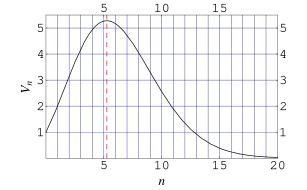
The equation for the surface area of the  -dimensional unit hypersphere
  gives the recurrence relation
 |
(1) |
|---|
Using  then gives the hypercontent of the
  -ball
-ball  of radius
  as
as
 |
(2) |
|---|
(Sommerville 1958, p. 136; Apostol 1974, p. 430; Conway and Sloane 1993). Strangely enough, the content reaches a maximum and then decreases towards 0 as  increases. The point of maximal content of a unit
  -ball satisfies
where  is the digamma function,
  is the gamma function,
  is the Euler-Mascheroni constant, and
  is a harmonic number. This equation cannot be solved analytically for
  , but the numerical solution to
 |
(6) |
|---|
is  (OEIS A074455) (Wells 1986, p. 67). As a result, the five-dimensional unit ball
  has maximal content (Le Lionnais 1983; Wells 1986, p. 60).
The following table gives the content for the unit radius  -ball (OEIS A072345 and A072346), ratio of the volume of the
  -ball to that of a circumscribed hypercube (OEIS A087299), and surface area of the
  -ball (OEIS A072478 and A072479).
Let  denote the volume of an
  -dimensional ball of radius
  . Then
so
![sum_(n=0)^inftyV_n=e^(piR^2)[1+erf(Rsqrt(pi))],](https://mathworld.wolfram.com/images/equations/Ball/NumberedEquation4.svg) |
(9) |
|---|
where  is the erf function (Freden 1993).
See also
Alexander's Horned Sphere, Ball Line Picking, Ball Point Picking, Ball Tetrahedron Picking,Ball Triangle Picking, Banach-Tarski Paradox, Bing's Theorem, Bishop's Inequality, Bounded Set, Closed Ball, Disk, Hairy Ball Theorem, Hypersphere, Open Ball, Sphere, Tennis Ball Theorem, Unit Ball, Wild Point
Explore with Wolfram|Alpha
References
Apostol, T. M. Mathematical Analysis. Reading, MA: Addison-Wesley, 1974.Conway, J. H. and Sloane, N. J. A. Sphere Packings, Lattices, and Groups, 2nd ed. New York: Springer-Verlag, p. 9, 1993.Freden, E. "Problem 10207: Summing a Series of Volumes."Amer. Math. Monthly 100, 882, 1993.Le Lionnais, F. Les nombres remarquables. Paris: Hermann, p. 58, 1983.Sloane, N. J. A. Sequences A072345, A072346,A072478, A072479,A074455, and A087299 in "The On-Line Encyclopedia of Integer Sequences."Sommerville, D. M. Y. An Introduction to the Geometry of n Dimensions. New York: Dover, p. 136, 1958.Wells, D. The Penguin Dictionary of Curious and Interesting Numbers. Middlesex, England: Penguin Books, 1986.
Referenced on Wolfram|Alpha
Cite this as:
Weisstein, Eric W. "Ball." From MathWorld--A Wolfram Resource. https://mathworld.wolfram.com/Ball.html