Eisenstein Prime (original) (raw)
Algebra Applied Mathematics Calculus and Analysis Discrete Mathematics Foundations of Mathematics Geometry History and Terminology Number Theory Probability and Statistics Recreational Mathematics Topology
Alphabetical Index New in MathWorld
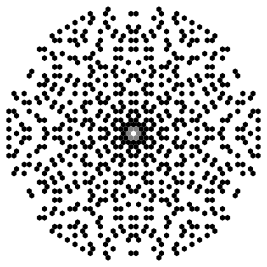
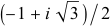
Let  be the cube root of unity
  . Then the Eisenstein primes are Eisenstein integers, i.e., numbers of the form
  for
for  and
and  integers, such that
  cannot be written as a product of other Eisenstein integers.
The Eisenstein primes  with complex modulus
  are given by
  ,
,  ,
,  ,
,  ,
,  , 2,
, 2,  ,
,  ,
,  ,
,  ,
,  ,
,  ,
,  ,
,  ,
,  ,
,  ,
,  , and
, and  . The positive Eisenstein primes with zero imaginary part are precisely the ordinary primes that are congruent to 2 (mod 3), i.e., 2, 5, 11, 17, 23, 29, 41, 47, 53, 59, ... (OEIS A003627).
In particular, there are three classes of Eisenstein primes (Cox 1989; Wagon 1991, p. 320):
1.  .
.
2. Numbers of the form  for
for  , and
, and  a prime congruent to 2 (mod 3).
3. Numbers of the form  or
or  where
where  is a prime
  congruent to 1 (mod 3). Since primes of this form always have the form
  , finding the corresponding
  and
and  gives
gives  and
and  via
via  and
and  .
.
See also
Eisenstein Integer, Eisenstein Unit, Gaussian Prime, Prime Number
Explore with Wolfram|Alpha
References
Cox, D. A. §4A in Primes of the Form _x_2+n _y_2: Fermat, Class Field Theory and Complex Multiplication. New York: Wiley, 1989.Guy, R. K. "Gaussian Primes. Eisenstein-Jacobi Primes." §A16 in Unsolved Problems in Number Theory, 2nd ed. New York: Springer-Verlag, pp. 33-36, 1994.Sloane, N. J. A. Sequence A003627/M1388 in "The On-Line Encyclopedia of Integer Sequences."Wagon, S. "Eisenstein Primes." §9.8 in Mathematica in Action. New York: W. H. Freeman, pp. 319-323, 1991.
Referenced on Wolfram|Alpha
Cite this as:
Weisstein, Eric W. "Eisenstein Prime." From MathWorld--A Wolfram Resource. https://mathworld.wolfram.com/EisensteinPrime.html