Rule 30 (original) (raw)
Algebra Applied Mathematics Calculus and Analysis Discrete Mathematics Foundations of Mathematics Geometry History and Terminology Number Theory Probability and Statistics Recreational Mathematics Topology
Alphabetical Index New in MathWorld
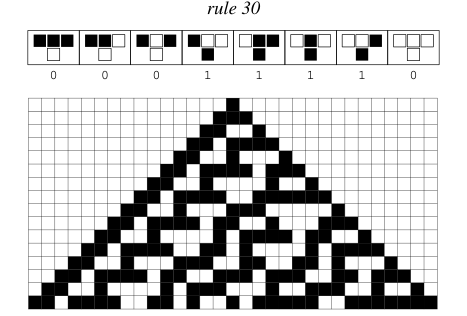
Rule 30 is one of the elementary cellular automaton rules introduced by Stephen Wolfram in 1983 (Wolfram 1983, 2002). It specifies the next color in a cell, depending on its color and its immediate neighbors. Its rule outcomes are encoded in the binary representation . This rule is illustrated above together with the evolution of a single black cell it produces after 15 steps (Wolfram 2002, p. 55).
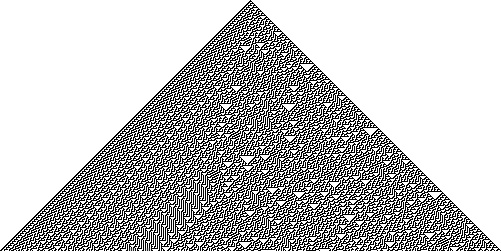
250 iterations of rule 30 are illustrated above.
Starting with a single black cell, successive generations are given by interpreting the numbers 1, 7, 25, 111, 401, 1783, 6409, 28479, 102849, ... (OEIS A110240) in binary, namely 1, 111, 11001, 1101111, 110010001, ... (OEIS A070950).
Rule 30 is the mirror image, complement, and mirror complement of rules 86, 135, and 149, respectively.
Rule 30 is of special interest because it is chaotic (Wolfram 2002, p. 871), with central column given by 1, 1, 0, 1, 1, 1, 0, 0, 1, 1, 0, 0, 0, 1, ... (OEISA051023). In fact, this rule is used as therandom number generator used for large integers in the Wolfram Language (Wolfram 2002, p. 317). Interpreting the central column as binary numbers and taking successive bits gives the sequence of numbers 1, 3, 6, 13, 27, 55, 110, 220, 441, 883, 1766, ... (OEISA092539). The members of this sequence that are prime are 3, 13, 883, 237051898781, ... (OEIS A092540).
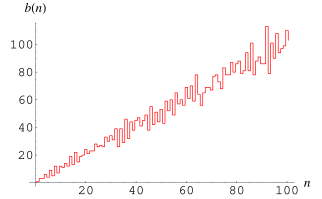
Jen (1990) proved that with the initial state of a single black cell, the sequence of colors attained in any two adjacent cells is not periodic (Gray 2003). The numbers of black cells  in consecutive generations
  , 1, ... are 1, 3, 3, 6, 4, 9, 5, 12, 7, ... (OEIS A070952), which is very closely fit by the line
  .
.
The maximum runs of white cells at generations 0, 1, 2, ... are 0, 0, 2, 1, 3, 1, 4, 2, 5, 3, 4, 4, 3, 2, ... (OEIS A100053). The high-water marks are 0, 2, 3, 4, 5, 6, 8, 9, 11, 14, 15, 23, ... (OEIS A100054), which occur at positions 0, 2, 4, 6, 8, 16, 32, 43, 46, 64, 128, 256, 512, ... (OEISA100055; Weisstein, Oct. 31, 2004) and look suspiciously like powers of 2 with a few additional values thrown in near the beginning.
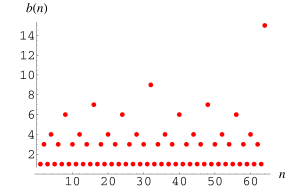
This result follows from the independent observation by E. Rowland (May 13, 2004) that the sequence of maximal black cells on the right side is 1, 3, 1, 4, 1, 3, 1, 6, 1, 3, 1, 4, 1, 3, 1, 7, 1, 3, 1, 4, ... (OEIS A094603), which have high water marks of 1, 3, 4, 6, 7, 9, 15, 16, 24, 25, 27, ... (OEIS A094604) at generations 0, 1, 3, 7, 15, ... (OEISA000225; i.e.,  ).
).
See also
Elementary Cellular Automaton, Rule 50, Rule 54,Rule 60, Rule 62, Rule 90, Rule 94, Rule 102,Rule 110, Rule 126, Rule 150, Rule 158, Rule 182,Rule 188, Rule 190, Rule 220, Rule 222
Related Wolfram sites
http://atlas.wolfram.com/01/01/30/
Explore with Wolfram|Alpha
References
Gray, L. "A Mathematician Looks at Wolfram's New Kind of Science." Not. Amer. Math. Soc. 50, 200-211, 2003.Jen, E. "Aperiodicity in One-Dimensional Cellular Automata." Physica D 45, 3-18, 1990.Sloane, N. J. A. Sequences A000225/M2655,A051023, A070950,A070952, A092539,A092540, A094603,A094604, A100053,A100054, A100055, and A110240 in "The On-Line Encyclopedia of Integer Sequences."Wolfram, S. "Statistical Mechanics of Cellular Automata." Rev. Mod. Phys. 55, 601-644, 1983.Wolfram, S. A New Kind of Science. Champaign, IL: Wolfram Media, pp. 29-30,52, 59,317, and p. 871, 2002.
Referenced on Wolfram|Alpha
Cite this as:
Weisstein, Eric W. "Rule 30." From MathWorld--A Wolfram Resource. https://mathworld.wolfram.com/Rule30.html