Plant Cell Vacuole- Definition, Structure, Types, Functions, Diagram (original) (raw)
The vacuole is a very large, fluid-filled vesicle which is present in the cytoplasm of a plant cell. The biosynthetic and endocytic pathways form it. The term ‘vacuole’ was first introduced by the French biologist Flexis Dujardin, and it represents the space of a protozoan contractile vesicle.
In a single cell, there can be many vacuoles. Tonoplast separates it from the cytoplasm, which is also a single unit membrane. Vacuole tends to be very large and occupy more than 30% of the cell volume, but they vary from 5 to 90% according to the cell types in mature plant cells.
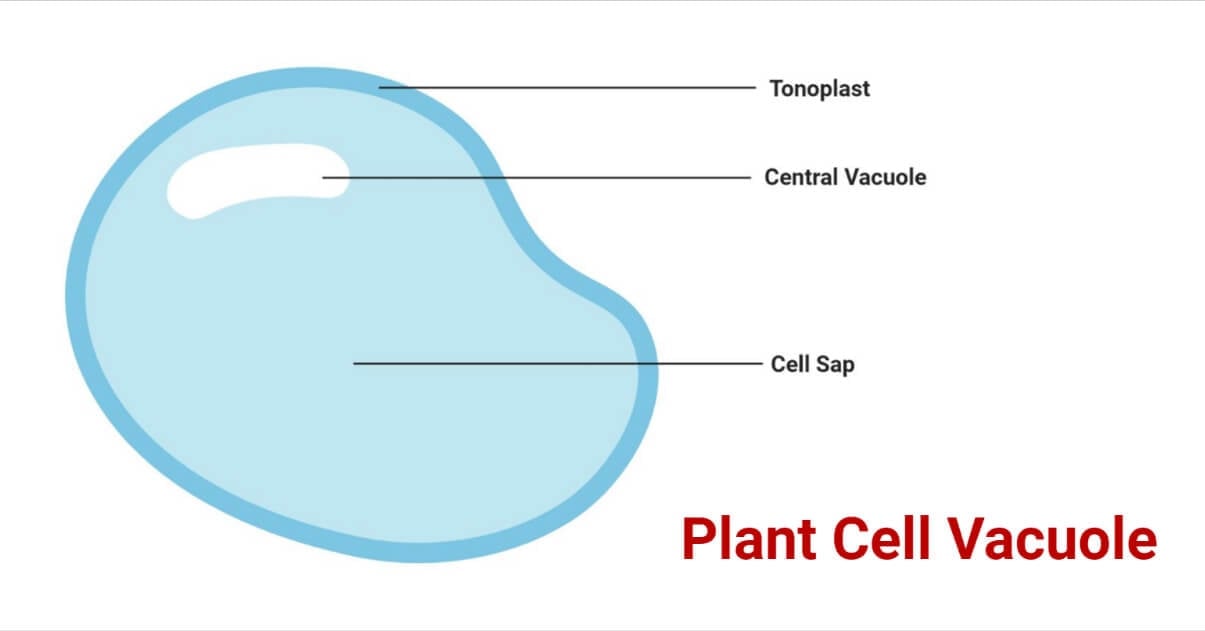
Plant Cell Vacuole
Vacuoles provide structural support. They also provide functions such as storage, maintaining water balance, and disposing of waste materials. But in immature and actively dividing plant cells, the vacuoles are quite small.
Different types of cellular components are present in vacuoles such as protein, sugar, salts, acid, nitrogenous compound (such as alkaloid and anthocyanin pigment), ions, and secondary metabolites. They play a crucial role in the plant signaling system.
A vacuole is a membrane-bound structure found in the cytoplasmic matrix cell.
Generally, they have no basic shape or size. Its structure varies according to the requirement of the cell.
The membrane surrounding the vacuole is termed the Tonoplast, separating the vacuolar content from the cell’s cytoplasm.
It is an important and highly integrated component of the plant’s internal membrane network (endomembrane).
The movement of ions is regulated by the vacuole.
It also isolates the harmful materials from the cells.
Vacuoles are functionally and structurally related to lysosomes in animal cells and may contain many hydrolytic enzymes.
In addition, they usually contain sugars, salts, acid, ions, and nitrogenous compounds such as alkaloids and anthocyanin pigment in their cell sap.
The membranes are embedded with proteins that help in transporting molecules across the membrane.
Different combination of these protein helps the vacuoles to hold different materials.
The large vacuole slowly develops as it matures by the fusion of smaller vacuoles derived from the ER and Golgi apparatus.
The pH of plant vacuole ranges from 3 to 10.
Due to an abundant quantity of alkaline substances, its pH may increase to 9-10.
Similarly, due to the presence of acids like citric acid, oxalic acid, and tartaric acids, pH can lower to 3.
Two types of vacuole appear sequentially during embryogenesis.
Types of Plant Cell Vacuole
1. Lytic Vacuoles
- It is a plant specialized vacuole equivalent to animal lysosomes or yeast vacuoles, functioning as a compartment for degradation and waste storage.
- Lytic vacuoles contain hydrolase enzymes.
- This enzyme helps unwanted cellular substances degrade.
- Lytic vacuole maintains turgor pressure, storage of metabolites, digestion of cytoplasmic components, and sequestration of xenobiotic compounds.
- γ- tonoplast intrinsic proteins have been associated with the lytic or degradative vacuole.
2. Protein storage vacuole
- Protein storage vacuole assembles a large amount of protein in the storage tissue of the plant.
- In most seeds, protein storage vacuole contains three morphologically distinct regions: the matrix, crystalloid, and globoid.
- Globoids composed of phytic acid crystal and matrix and crystalloid was known to contain storage protein.
- α- tonoplast intrinsic protein has been found in protein storage vacuoles.
- The cell sap differs from that of the surrounding cytoplasm. The membranes are composed of phospholipids.
Cell sap
- It is a fluid that is found in the plant cell vacuole.
- It contains a variable amount of food, waste material, inorganic salts, nitrogenous compound, water, amino acid, and glucose.
- That provides mechanical support and serves as a storage material, especially in non-woody plants.
- It plays a vital role in plant cell osmosis.
- Xylem sap carries soil nutrients from the root system to leaves;
- Then, water is lost through transpiration.
- Maple sap is xylem sap. In the late winter, it contains some sugar.
- Phloem or sieve tube sap is the fluid carrying sugar from leaves to another part of the plant in the summer.
Functions of Plant Cell Vacuole
- Turgor pressure created by the vacuole helps to maintain the shape of the cell.
- It also helps to cope with extreme conditions.
- Turgor pressure is the pressure that is exerted on the cell wall by the water present in the vacuoles.
- Central vacuole is used by the developing seed cells for protein storage.
- The plant vacuole stores salts, minerals, nutrients, proteins, and pigments, which help in plant growth.
- For both the nutrients and the waste products, it acts as the storage organelle.
- Vacuole plays the role in maintaining the homeostatic condition in plant cells with respect to the different alterations in the environment.
- To maintain the acidic condition in the content of the vacuole, H+ ions are pumped inside. The in and out movement is controlled by the Tonoplast or vacuolar membrane selectively.
- Inside the vacuole, the smaller vacuoles are retained, but the water can move freely.
- The trypsin inhibitors commonly found in seeds and the wound-induced protease inhibitors of leaf cells (to inhibit both insect and microbial proteases), both accumulate in the vacuole and are presumably designed to interfere with the digestive processes of herbivores.
References
- Verma, P. S., & Agrawal, V. K. (2006). Cell Biology, Genetics, Molecular Biology, Evolution & Ecology (1 ed.). S . Chand and company Ltd.
- https://www.genome.gov/geneticsglossary/Vacuole
- https://www.frontiersin.org/articles/10.3389/fpls.2014.00476/full
- https://micro.magnet.fsu.edu/cells/plants/vacuole.html
- https://academic.oup.com/plcell/article/11/4/587/6008435
- https://www.britannica.com/science/sap-plant-physiology
- https://molhort.biomedcentral.com/articles/10.1186/s43897-021-00008-7
- https://bscb.org/learning-resources/softcell-e-learning/vacuole-plants/
- Di Sansebastiano GP, Paris N, Marc-Martin S, Neuhaus JM. Regeneration of a lytic central vacuole and of neutral peripheral vacuoles can be visualized by green fluorescent proteins targeted to either type of vacuoles. Plant Physiol. 2001 May;126(1):78-86. doi: 10.1104/pp.126.1.78. PMID: 11351072; PMCID: PMC102283.
- Jiang L, Phillips TE, Hamm CA, et al. The protein storage vacuole: a unique compound organelle. J Cell Biol. 2001;155(6):991-1002. doi:10.1083/jcb.200107012
About Author

Sushmita Baniya completed her Master’s degree in Medical Microbiology from the National College of Science and Technology (NIST), Kathmandu, Nepal. She did her Bachelor’s degree in Microbiology from Birendra Multiple Campus, Chitwan, Nepal. She is interested in Genetics and Molecular Biology.