Why Always Vinícius Júnior? (original) (raw)
Why Always Vini?
The Brazilian superstar’s lonely, galvanic fight against racism in global soccer.
By ,a professor of literature at Bard. He is the author of Urban Legends: the South Bronx in Representation and Ruin.
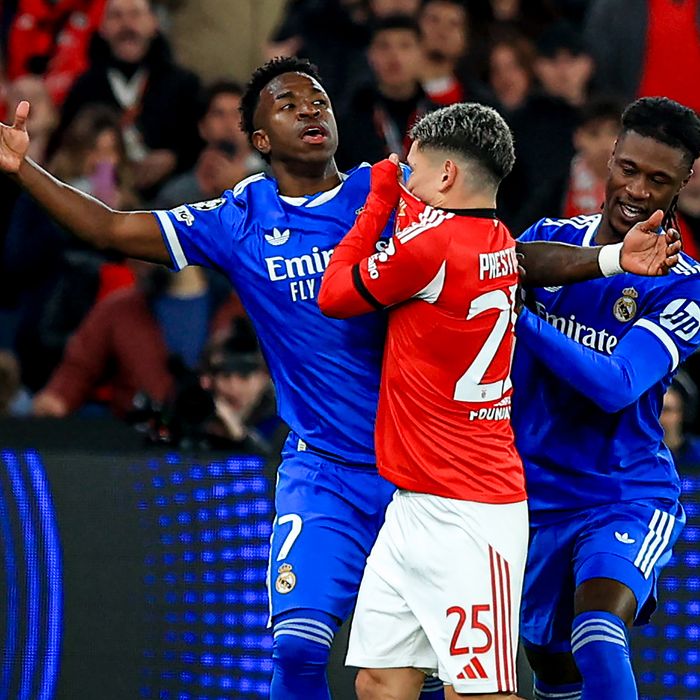
Photo: Valter Gouveia/Sports Press Photo/Getty Images
Photo: Valter Gouveia/Sports Press Photo/Getty Images
This article was featured in _New York_’s One Great Story newsletter. Sign up here.
In the 49th minute of the first leg of a Champions League knockout game between Benfica and Real Madrid in February, the Brazilian forward Vinícius Júnior received the ball on the left wing of the pitch. He took the pass in stride and gently touched the ball three times as he approached the corner of the penalty box. With his fourth touch and nary a look at the goal, he struck the ball with power and curled precision past the diving Benfica goalkeeper into the far top corner of the net. The goal was both satisfying and ludicrous: Almost no one should shoot from so awkward an angle and few from such distance. Vinícius reminded the fans in Lisbon’s Estádio da Luz that he is the exception to such rules, summarily gesturing at the abbreviated name on the back of his jersey, Vini Jr., after performing a cheekily sensual dance with the corner flag in celebration.
Goals that spectacular normally inspire countless electropop-tracked YouTube compilations and set group chats aflame. Yet the moment will probably be best remembered for what happened next.
While Vinícius’s teammates joined him in celebration around the corner flag, projectiles thrown from the stands landed near the Real Madrid players. As Vinícius made his way back to half-field, a diminutive Benfica player named Gianluca Prestianni ran to intercept him. Prestianni, an Argentine, pulled at the collar of his jersey so it covered his mouth from all eyes and cameras and seemed to direct words at the Brazilian. Vinícius was perhaps distracted, as the referee was showing him a yellow card, having deemed his celebration excessive. When the players began to gather around the center circle to restart the match, Prestianni once again approached Vinícius, covered his mouth with his collar, and said something — this time, loud enough for Vinícius to hear. He immediately ran over to the referee to report that Prestianni had racially abused him by using the word mono, “monkey” in Spanish. One of Vinícius’s teammates, the French striker Kylian Mbappé, claimed he heard Prestianni say the word five times.
None of this is new — not the player-to-player racial abuse, not the monkey chants and dances that were audible and visible from the crowd — and especially not for Vinícius, who during his eight years in Spain has been a frequent subject of racist abuse, at least 20 times, by his count. Even for those who live in Trump’s America, it can be hard to fathom the manifest visibility of anti-Black racism in European soccer, where the world’s elite players ply their trade.
Yet if you were to listen to Benfica manager José Mourinho, Vinícius himself is to blame for these incidents. “There is something wrong because it happens in every stadium,” Mourinho told reporters after the game, “every stadium where Vinícius plays. Always. I told him, ‘You score a world-class goal. Why do you celebrate like that? Why?’”
Why always Vinícius? In terms of being a focal point for racist abuse in soccer, the simple answer is he has never been the only one. As Vinícius prepares to take the field for Brazil at the World Cup — an event that will showcase on the global stage the ubiquity and virtuosity of Black footballers, representing nations as demographically different as Austria and Japan — it’s clear that soccer’s fraught relationship with race is both stuck in time and haunted by the sport’s ever more cosmopolitan future. FIFA likes to say that “football unites the world,” but Vinícius’s experience suggests football alone can do no such thing.
Through Vinícius, and Brazil at large, we can see how players with roots in the African diaspora helped create the multibillion-dollar enterprise that is soccer today. The sport’s first global superstar, Pelé, was a Black man from southeastern Brazil, but one can trace Black Brazilian excellence much further back. Brazil’s first national futebol hero, Arthur Friedenreich, who played from 1909 to 1935, was the son of a German Brazilian father and a Black Brazilian mother. Later came Leônidas da Silva, who became so popular in the wake of the 1938 World Cup that a company paid him royalties to use his Diamante Negro (“Black Diamond”) nickname to sell a chocolate bar you can still buy today. Brazil’s first World Cup win came in 1958,led by the Afro Brazilians Pelé and Garrincha, and the team won two more times in quick succession, in 1962 and in 1970. The latter tournament, hosted by Mexico, was the first World Cup to be broadcast in color, and the dual brilliance of Brazil’s canary-yellow jerseys and of Pelé, Carlos Alberto, and Jairzinho made indelible impressions on the rest of the world, virtually inventing the modern game in the process.
European clubs had been raiding Latin American clubs for talent since the late 1920s, while colonial and postcolonial territories provided rich pools of elite Black players in the years following World War II. But the 1970s and 1980s saw Black players truly break through in European domestic leagues, perhaps nowhere more prominently than in the Netherlands, where in the 1990s, Amsterdam’s Ajax teams relied heavily on players of Surinamese descent like Frank Rijkaard, Clarence Seedorf, Edgar Davids, Patrick Kluivert, Winston Bogarde, and Michael Reiziger to win domestic league titles and a European Cup.
Many interpreted Cameroon’s legendary run to the 1990 World Cup quarterfinals, led by 38-year-old Roger Milla, as the “arrival” of African soccer to the world stage. But African soccer had already landed in Europe, from colony to metropole, through the immigrant and second-generation populations of France’s working-class banlieues. Some of the players who came out of the banlieues — Marcel Desailly, Lilian Thuram, and Zinedine Zidane — would go on to form the spine of a World Cup–winning team in 1998. This victory offered a powerful cultural and political rebuke to the then-gathering forces of the far right in France under Jean-Marie Le Pen, represented by the fact that the nation at large temporarily reimagined its famous tricolor flag — bleu, blanc, et rouge — to black, blanc, et beur to publicly acknowledge the blessings of diversity. Modern football now looks exactly like Vinícius Júnior’s Real Madrid, where often half the starting squad is Black — a fact that drips with irony, given that Madrid’s nickname is Los Blancos (“The Whites”).
Perhaps no figure embodied modern soccer’s global crosscurrents more than the Italian striker Mario Balotelli, who once celebrated a goal by pulling up his jersey to reveal a T-shirt printed with the phrase “Why always me?” Born Mario Barwuah, the son of Ghanaian immigrants to Sicily, he was fostered at a young age by an Italian Jewish family from Brescia after his biological parents stopped being able to afford his care. Eventually, he became a star player for some of the biggest clubs in the world, as well as only the second Black player to be selected for the Italian national team in 2010. Like Vinícius, Balotelli faced racist abuse from fans throughout his career — except that Balotelli, who was raised in Italy and received his Italian citizenship in 2008, was being abused by his fellow Italians.
There is a clear reason Balotelli and Vinícius Júnior often get singled out for this abuse: They are both darker-skinned than many other Black footballers, a fact that underscores colorism’s place as a crucial component of racism. A 2019–20 study of English football commentary revealed that lighter-skinned players tended to be praised for their intelligence and hard work, while darker-skinned players were more often commended for their power or pace. And bear in mind these are merely examples of unconscious bias, which hardly hold a candle to the savage abuse directed at players like Vini Jr. and Balotellli. Such incidents are legion and long-standing, and they respect no borders. Cameroon’s Samuel Eto’o almost walked off the field in 2006 due to abuse in Spain. Germany’s Mesut Özil, who is of Turkish descent, once complained, “I am German when we win, but I am an immigrant when we lose.” These are but a few examples. Rather than Vinícius or Balotelli or countless others with less fame, it is the racism in soccer that has been always.
Vinícius is hardly the first player to dance after scoring a goal. For example, his countryman Ronaldinho Gaúcho quite famously danced the samba in stadia across Europe and South America during his brilliant 15-year-plus career. Despite this tradition, in September 2022, Pedro Bravo, president of a Spanish association of football agents, suggested that Vinícius’s celebrations were disrespectful: “You have to respect the opponent. When you score a goal, if you want to dance samba, you go to the Sambadrome in Brazil. But here, you have to respect you colleagues and stop playing the monkey (hacer el mono).”
Days after Bravo’s remarks, Vinícius sat calmly in front of a camera and delivered the following statement: “They say happiness is annoying. The happiness of a successful Black Brazilian in Europe is much more annoying. But my desire to win, my smile, and the sparkle in my eyes are much bigger than that. You can’t even imagine. I was the victim of xenophobia and racism in a single statement. But none of this started yesterday. Weeks ago, they started criminalizing my dances — dances that aren’t mine. They belong to Ronaldinho, Neymar, Paquetá, Pogba, Matheus Cunha, Griezmann, João Félix … They belong to Brazilian funk and samba artists, reggaeton singers, and Black Americans. They are dances to celebrate the world’s cultural diversity. Accept it. Respect it. I’m not going to stop.”
The clarity of his delivery, the historicization of the abuse he’s received, the subtle inclusion of white players who also dance but have never received such scorn, and the intercultural understanding Vinícius demonstrated in just a few sentences are, in many ways, just as impressive as his goal against Benfica. And he wasn’t finished: “The script always ends with an apology and a ‘I was misinterpreted.’” Bravo relied on the vagaries of translation and expressionistic play to explain away the controversy — essentially, he argued that in Spain, hacer el mono was the equivalent of hacer el tonto, both phrases roughly equating to “act a fool” in English. Though the expressions may have been “unfortunate and inappropriate,” he said, they were “not racist.”
One can argue endlessly about mistranslations. It is harder to rationalize Atlético Madrid fans hanging an effigy of Vinícius Júnior from a bridge near Real Madrid’s training ground, next to a banner that read “Madrid hates Real,” or fans in Albacete throwing bananas onto the pitch. Those incidents both occurred in January 2023, and in May of that year, hundreds of fans in Valencia chanted at Vinícius “You are a monkey” and other less imaginative insults. The 2025 Netflix documentary Baila, Vini (“Dance, Vini”), draws much of its dramatic tension from this Valencia incident and Vinícius’s first return visit to Valencia’s Mestalla stadium after it. Valencia prohibited the Brazilian documentarians from entering the stadium to film the match, thereby robbing the documentary of some telling footage. What they do show are social-media clips taken by fans that capture the crowd chanting “Where is Netflix? Netflix, where are you?” And still, they were not satisfied. Upon the release of the film, Valencia filed a lawsuit against Netflix, claiming Valencia fans were chanting “_tonto,_” not “_mono._”
In defense of his actions, Benfica’s Prestianni claimed that his slurs were aimed at Vinícius Júnior’s manhood, not his race. “For us Argentinians, words like maricón or cagón are common insults.” UEFA ultimately chose to punish Prestianni for his use of homophobic language, as it was all he would admit to. He was given a six-match ban. Prestianni’s “confession” is not only deplorable but thoroughly cynical: He would have faced a minimum ten-match ban from European competition if he had been found guilty of racist abuse. The farcical confession to homophobia but not racism reminds me of one of the coldest lines in all of American literature, when the mixed-race character at the heart of William Faulkner’s Absalom Absalom!, Charles Bon, provokes his half-brother, Henry Sutpen, to violence by saying, “So it’s the miscegenation, not the incest, which you can’t bear.”
If all of this racist gaslighting seems both maddening and exhausting, that is surely the point. So is ensuring a tentative response from international soccer authorities. The radical group of Atlético Madrid fans who hung Vinícius in effigy merely received suspensions, and the first criminal convictions for racist insults in a football stadium were only decided in June 2024 — for three people who racially abused Vinícius during the May 2023 return match at Valencia. Vinícius’s response, posted on Instagram, was characteristically bold: “Many people asked me to ignore it, many others said that my fight was in vain and that I should just ‘play football.’ But as I’ve always said, I’m not a victim of racism. I am a tormentor of racists. The first criminal conviction in the history of Spain is not for me. It is for all Black people.”
There is one thing that distinguishes Vinícius from previous generations of footballers subjected to racist remarks: his willingness to speak out and his ability to do so — directly and with immediacy — to his tens of millions of followers on social media. Whereas throughout Pelé’s career, Pelé allowed various establishment institutions, both political and sporting, to use his humble, often neutral image to rally national pride or present him as a global ambassador for FIFA, Vinícius has not been content to simply keep his head down and work. If all of sport retains a grand literary dimension in that our favorite teams and players become part of the stories we tell each other, then players like Vinícius Júnior, who has defied enduring racism by defining himself as an outspoken critic of it, will be the ones making sure the right stories are told.
- It’s Still Possible to Be Excited About the World Cup
- Where to Watch the World Cup With the Hungriest Fans
- How Gianni Infantino, and FIFA, Won Trump’s Heart See All
Why Always Vini? Your product is saved! You’ll receive emails when your saved products go on sale. Manage preferences.