30 Fabric Manipulation Techniques - SewGuide (original) (raw)
I used to love crafts and painting when I was young. Then my attention turned to fabric and there was no looking back. For me, nothing even comes closer to fabric and sewing in exploring creativity. While painting allowed me to explore color on a flat surface, Fabric Manipulation opened a new dimension: the ability to sculpt with cloth – it is beautiful, economical and ticks all my creative boxes.
Fabric manipulation is the art of taking a plain, flat textile and physically transforming its structure—turning it from something ordinary into a three-dimensional work of art.Tucks, pleats, smocking, and structural folds turns fabric into something else in front of my eyes.
There are some core fabric transformation techniques that add depth and sophisticated texture to your fabric which are very easy and very customisable. I love that if you try any one of the methods described below, your results will be entirely unique and different from mine, like you are creating a one-of-a-kind piece of art.
How to create texture and patterns on fabric
- How to create texture and patterns on fabric
- 1. Fabric trims
- 2. Fabric Flowers
- 3. Fabric bows
- 4. Faggotting
- 5. Insertion
- 6. Piping
- 7. Tucks
- 8. Ruffles
- 9. Decorative Edge Finishes
- 10. Decorative Hem finishes
- 11. Using roulette loops
- 12. Ruching
- 13. Decorative hems
- 14. Using roulette loops
- 15. Smocking
- 16. Shirring
- 17. Fabric origami
- 18. YoYos
- 19. Decorative pleats
- 20.Tassels
- 21. Shrinking fabric
- 22. Adding textured fabric as accent features
- 23. Distressed fabric
- 24.Embossing
- 25.Open work
- 26. Stitch and Slash technique
- 27. Scallops
- 28. Bubbling
- 29. Wrinkling
- 30. Roughening
Related post: What is textile Texture (with photos) ; Master fabric Decoration Guide
1. Fabric trims
You can make and sew the different types of fabric trims like ribbons, braids to the fabric to add texture to fabric.
Check out the Popular Fabric Trims for Sewing Craftsand 20 different types of lace and lace trims and 15 different types of ribbons and the tutorial for sewing the trims.

You can make your own fringe trims by following this tutorial here

Check out this post to make braid with 4-strands of cord 3 stranded braid tutorial 5 strand braid DIY Make a braid with seven strands
2. Fabric Flowers
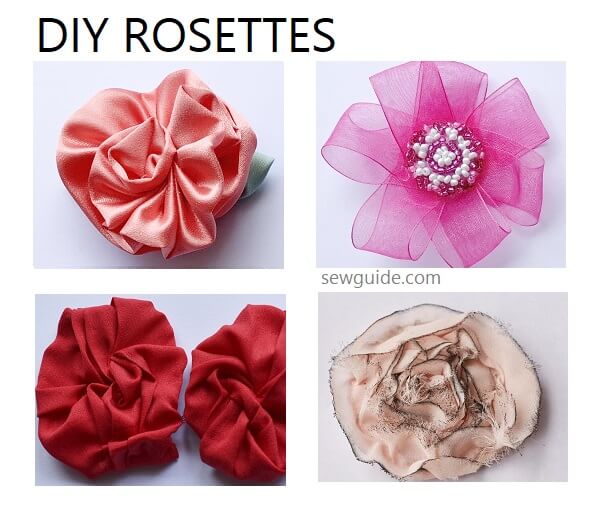
You can make beautiful flowers using fabric pieces to decorate your garments. The fabric scraps you have at hand if you have been sewing for some time can be transformed into beautiful almost real looking fabric flowers very easily. Find the tutorial to make 10 different types of fabric roses for more details. Also check out these posts on making flowers with felt How to make DIY felt roses and for making DIY flowers from fabric

3. Fabric bows
Fabric bows the same way as fabric flowers add to the beauty of clothes.Check out the 7 different ways to make bows with ribbons and also as many as 8 ways to make fabric bows

4. Faggotting
This is a technique for adding ribbons and lace trims to the fabric with pretty embroidery stitches. Hemmed edges of fabric panels are together or to trims with criss crossed stitches.Check out this post for more details on faggoting stitches.
5. Insertion
You can add lace between fabric panels check out this post on different methods for lace insertion. Lace will add transparency and texture to smooth fabric and will transform the look of ordinary fabric surface. You can join fabric pieces together decoratively with insertion stitches check out the two ways of doing insertion stitches here


6. Piping
Piping is a technique of adding a special type of trim which is made by inserting a cord inside a bias fabric strip.The piping is added to the seam as a decorative trim. Check out the post on sewing piping.
7. Tucks
Tucks are folds in fabric that are sewn in place. Pintucks are my favorite. As the name suggests these are tiny folds that are sewn in place close to the fold. They contain the fullness of fabric as well as add texture. Pintucks are made using a pintuck foot and double-needle stitching.
Check out the posts on double needle stitching and Pintucks and other 9 types of tucks
8. Ruffles
Ruffles are pleated or gathered fabric or trims used to decorate garments and accessories. Checkout this post on gathering fabric for more details. You can make them easily with a gathering foot or a ruffler foot

9. Decorative Edge Finishes
Edge finishes need not be boring. You can finish the fabric edges with embroidery loops or buttonhole stitches For easy finished Fabric edges >. And then there are the 8 different hand embroidered edges.
10. Decorative Hem finishes
You can add beauty and texture to the hem of your garment in many ways. Checkout this post on the different types of hand hemming stitches for tutorials on this. Then there are decorative hemstitching made with embroidery stitches which adds a separate beauty to ordinary hems.
11. Using roulette loops
Roulette loops are very thin fabric tubes made with fabric strips. You can easily make the roulette loops yourself and use it to decorate fabric.

12. Ruching
Ruching is basically gathering fabric so that there are patterned folds in the fabric; It is also called puffing in heirloom embroidery. Ruching is usually done along the bodice of dresses and sleeves along the centerline which is ruched creating attractive folds on either side of the center stitching line. You can ruche fabric by sewing the fabric with elastic. This is usually done with thin, sheer and transparent fabric as an overlay or a drapable cloth. Checkout the detailed tutorial for ruching fabric here.

13. Decorative hems
You can add beauty and texture to the hem of your garment in many ways. Checkout this post on the different types of hand hemming stitches for tutorials on this. Then there are decorative hemstitching made with embroidery stitches which adds a separate beauty to ordinary hems.
14. Using roulette loops
Roulette loops are very thin fabric tubes made with fabric strips. You can easily make the roulette loops yourself and use it to decorate fabric.
15. Smocking
Smocking involves stitching together gathered folds of fabric with pretty embroidery stitches in a definite pattern. Smocking is a means of controlling fullness as well as adding beautiful embroidery to the fabric.Checkout the post on smocking

16. Shirring
This is the technique of gathering fabric by using elastic thread in the bobbin. Shirring in parallel lines can produce beautiful texture to the fabric. Checkout the tutorial on the best way to do shirring .

17. Fabric origami
Fabric origami is making origami ornaments by folding fabric pieces in definite folding patterns. You can use this to decorate fabric.
18. YoYos
A fabric yoyo is a gathered circle of fabric pieceS with small running stitches. The resultant fabric yoyos which resemble flowers are great for decorating fabrics. There are many ways to make yoyos- even heart shaped ones. Check out the tutorial to make yoyos here.

Learn how to applique these yoyos on fabric so that they look incorporated into the fabric in this page – How to make yoyo applique fabric. This is the ultimate in texture.
19. Decorative pleats
Pleats like box pleats, inverted pleats are all great ways of making the fabric look beautiful. Checkout names of different pleats in the post here

20.Tassels
Tassels are loose threads gathered together at one end; They are great for embellishing the hems of scarves and shawls; Adding them to the end of drawstrings are common as well.
Checkout the different ways of making tassels on this post. The post on 8 ways to make bead tassels and other edge beading also is related.


21. Shrinking fabric
Shrinking different layers of fabric differently will produce texture on the face of the fabric. This technique is better detailed here
22. Adding textured fabric as accent features
When you have a garment with a smooth surface you can add texture to it by adding fabric pieces with texture like denim, pleather, leather, canvas, embroidered fabric to make yokes, collars or top hem of pockets, sleeve cuffs etc.
There are so many readymade fabrics with wonderful texture Out of these check out the 30 best textured fabrics here.

You can also add stiff fabrics to change the structure of the fabric.Check out the list of the 10 best stiff fabrics here.
23. Distressed fabric
Weathering or distressing fabric is a technique of making the fabric look old by using various methods like using a pumice stone or wire brush to wear the thread or using paint to make it look used. Checkout the many ways to distress fabric andmake it look old as well as the correct way to rip fabric while leaving horizontal thread intact

24.Embossing
This refers to making an impression of images or designs on the surface of a fabric with the help of heat and pressure. This is also called Blind Printing, and Relief Printing. A raised or lowered imprint of the design is made with stamps and application of heat. Checkout the post on doing embossing on velvet by yourself .

25.Open work
Drawn thread embroidery involves pulling out thread from the fabric and knotting the thread left in bundles or using decorative stitches over the drawn thread. This creates an open work with great texture on the fabric . Checkout the tutorial for drawn thread embroidery and pulled thread embroidery for more details. Cutwork, Hardanger embroidery, Borderie Anglaise are all open work which creates similar texture.

26. Stitch and Slash technique
Slashing fabric layers which are stitched together in parallel diagonal rows creates a beautiful visual and textural effect on the surface of the fabric which is unparalleled. No photo can reproduce the same impact you get when you see and feel the faux chenille fabric you have made with simple plain fabric pieces. Checkout the tutorial to make the faux chenille fabric and experience it yourself .

27. Scallops
Scallops are dome shaped stitching that is usually done along the fabric edge. You can make scallops by hand stitching with fine embroidery stitches or machine stitch the scallops with a facing or with decorative stitches in your sewing achine. Checkout the 5 ways to make scallop shaped edges.

28. Bubbling
This refers to the techniques used to create bubble-like appearance on the face of the fabric.

A simple enough way is to wet fabric, make small cotton balls and wrap these balls with the fabric very close to each other and tie them up with thread. If you leave them for a few days and then open them up, and remove the cotton balls the fabric will take on a texture of bubbles on the surface. For more methods using shibori techniques and wet and dry technique checkout this post on making bubble texture fabric
29. Wrinkling
This can create a beautiful texture on the fabric surface. One very easy method involves wet fabric and rubber bands. You will have to wet the fabric thoroughly – then wring out the full water – do this two or three times. Leave it in the wrung state, twisted and tie the fabric with rubber bands every 2 inches. Keep it the same way in a secure place to dry. Remove the rubber bands when the cloth feels dry to touch and open up.
30. Roughening
If you are seriously making real texture like the hard surface on a sculpture that you can even sketch and paint , it is not difficult with some household ingredients – Mix 3 parts PV glue and 2 parts water; add Talcum powder slowly till you get a thick consistency ( like the dough batter for cakes). Apply on fabric and use your tools and imagination to create the texture you want.When dry you will get your textured fabric.
Fabric texture is an important element of fashion. It can even affect your mood – the way your fabric looks and feels is intricately involved with our emotional wellbeing as well.
I can simply go on creating these beautiful textures with the fabric manipulation and other techniques outlined here – what do you do other than this for fabric texture? Watch these videos in the meanwhile