About Us - Benchmarks (original) (raw)
About UsSHB-admin2026-02-25T16:22:13+00:00
Our project
The Soil Health and Food (SH&F) mission board has set the goal to have 75% of European soils healthy or significantly improved by 2030. This is in line with other important European initiatives such as the Green Deal and EU Farm-to-Fork Strategy, as well as with preparations for a new EU law on the protection of Soil Health that aims to protect soils on the same legal basis as air and water. Meanwhile, the private sector too, is proposing explicit visions of sustainable food systems, such as the 1000 landscapes for 1 billion people (1000 landscapes, 2022), the 100-million farmers platform of the World Economic Forum (World Economic Forum, 2022) and the Regen10 initiative of the World Business Council on Sustainable Development (WBCSD, 2022).
Measuring the success of these public and private initiatives through the harmonised monitoring of European soils is an essential, but enormously complex task. It requires coherent yet context-specific monitoring on multiple scales for multiple land uses across all EU member states.
To address these challenges, BENCHMARKS collaborates with stakeholders in 28 European case studies to co-develop and evaluate a multi-scale and multi-user focused monitoring framework that is transparent, harmonised and cost-effective. Underpinned by the best scientific knowledge and technologies this framework aims to provide a clear soil health index for benchmarking, using indicators that are pertinent to the objective of assessment, applicable to the land use and logistically feasible.

The story behind our logo
The core idea behind our logo is the integration of the three instances that take place in this project: land uses, methodologies and scale. Each of these have three categories that interrelate to the others: agriculture, forestry and urban for the land uses; sample, states and space for the methodologies; and landscape, local and regional in the scale. This interrelation is represented in a 54 lines triangular schema, that is later simplified becoming the logo for the project. The colour selection relates to the Corine Land Cover colours assigned to the urban (red), agriculture (yellow) and forestry (green).
The story behind our logo
The core idea behind our logo is the integration of the three instances that take place in this project: land uses, methodologies and scale. Each of these have three categories that interrelate to the others: agriculture, forestry and urban for the land uses; sample, states and space for the methodologies; and landscape, local and regional in the scale. This interrelation is represented in a 54 lines triangular schema, that is later simplified becoming the logo for the project. The colour selection relates to the Corine Land Cover colours assigned to the urban (red), agriculture (yellow) and forestry (green).
Integrated Soil Health Monitoring Framework
This Integrated Soil Monitoring Framework combines a newly developed logical sieve method (Zwetsloot et al., 2022) soil health indicator selection, with sample, space (earth observation technologies) and 3 stats (existing and derived data) collection methods.
The multi-scale (local, landscape, regional and Europe) framework is developed for the land uses: agriculture, forestry and urban. Key outcomes of the project are:
- A harmonised and cost-effective framework for measuring soil health
- A review of SH&F and BENCHMARKS proposed indicators tested in the 29 Landscape Case Studies
- An integrated soil health tool demonstrating the links between indicators, soil functions and ecosystem services
- Scientific underpinning of soil health incentivisation schemes for value-chain businesses
Integrated Soil Health Monitoring Framework
This Integrated Soil Monitoring Framework combines a newly developed logical sieve method (Zwetsloot et al., 2022) soil health indicator selection, with sample, space (earth observation technologies) and 3 stats (existing and derived data) collection methods.
The multi-scale (local, landscape, regional and Europe) framework is developed for the land uses: agriculture, forestry and urban. Key outcomes of the project are:
- A harmonised and cost-effective framework for measuring soil health
- A review of SH&F and BENCHMARKS proposed indicators tested in the 29 Landscape Case Studies
- An integrated soil health tool demonstrating the links between indicators, soil functions and ecosystem services
- Scientific underpinning of soil health incentivisation schemes for value-chain businesses
Our Objectives & Work Plan
Co-develop an Integrated Soil Health Monitoring Framework
Co-develop an Integrated Soil Health Monitoring Framework with stakeholders from our Case Studies, to deliver harmonised and cost-effective indicator- and proxy measurements for the assessment of soil health, capable to demonstrate links between indicators, soil functions and ecosystem services. (Linked to work packages 1, 2, 4)
Test and validate indicators
Test and validate the SH&F mission indicators as well as other indicators proposed by BENCHMARKS for the different land uses and at different scales, and establish context specific thresholds for these indicators. (Linked to work packages 2, 4, 5)
Develop a European broad sampling framework
Develop a European broad sampling framework, methodology and protocols, which can serve to support relevant EU policy, regulation and monitoring needs. The monitoring framework will be integrated within the future LUCAS campaigns, and inform and contribute to the Soil Health law. (Linked to work packages 3, 4, 5, 6),
Co-develop a Soil Health Dashboard with the JRC
Support the Joint Research Centre (JRC) and EU Soil Observatory in development of a Soil Health Dashboard. (Linked to work packages 2, 5, 6)
Use open science principles
Use the EU open science principles to ensure that project data and protocols are Findable, Accessible, Interoperable and Reusable (FAIR) and available, that publications are open source and that (intermediary) results of the project are actively made available to the stakeholders. (Linked to work packages 1, 3, 5, 6)
Ensure long-term impact
Focus on co-development, communication, dissemination and exploitation activities from the start of the project, to ensure that the outputs of the project are relevant, understandable and applicable. Develop an exploitation plan with public and private partners to ensure long-term impact. (Linked to work packages 1, 2, 3, 4, 5, 6)
Our Objectives & Work Plan
Co-develop an Integrated Soil Health Monitoring Framework
Co-develop an Integrated Soil Health Monitoring Framework with stakeholders from our Case Studies, to deliver harmonised and cost-effective indicator- and proxy measurements for the assessment of soil health, capable to demonstrate links between indicators, soil functions and ecosystem services. (Linked to work packages 1, 2, 4)
Test and validate indicators
Test and validate the SH&F mission indicators as well as other indicators proposed by BENCHMARKS for the different land uses and at different scales, and establish context specific thresholds for these indicators. (Linked to work packages 2, 4, 5)
Develop a European broad sampling framework
Develop a European broad sampling framework, methodology and protocols, which can serve to support relevant EU policy, regulation and monitoring needs. The monitoring framework will be integrated within the future LUCAS campaigns, and inform and contribute to the Soil Health law. (Linked to work packages 3, 4, 5, 6),
Co-develop a Soil Health Dashboard with the JRC
Support the Joint Research Centre (JRC) and EU Soil Observatory in development of a Soil Health Dashboard. (Linked to work packages 2, 5, 6)
Use open science principles
Use the EU open science principles to ensure that project data and protocols are Findable, Accessible, Interoperable and Reusable (FAIR) and available, that publications are open source and that (intermediary) results of the project are actively made available to the stakeholders. (Linked to work packages 1, 3, 5, 6)
Ensure long-term impact
Focus on co-development, communication, dissemination and exploitation activities from the start of the project, to ensure that the outputs of the project are relevant, understandable and applicable. Develop an exploitation plan with public and private partners to ensure long-term impact. (Linked to work packages 1, 2, 3, 4, 5, 6)
Stakeholders
BENCHMARKS works with a range of stakeholders across Europe to define the role of soil health in our society and how we can ensure that soil health plays a central role in developing multi-functional landscapes. In this regard, BENCHMARKS considers the engagement of stakeholders a crucial component in the development, testing and validation of the Integrated Soil Health Monitoring Framework (ISHMF) and in ensuring future application of this indicator framework post-project.
Together with WP2, WP4, WP5 and WP6, WP1 coordinates, direct and activate stakeholder involvement to ensure strong communication and integration.
Active measures proposed include outreach to stakeholders such as citizen science groups and communities to understand their demands and drivers and incorporate these into the scope of the project. At the level of indicator selection (WP2), stakeholders play a crucial role in defining the needs of the ISHMF. The proposed multi-scale case studies are ideal platforms for co-design and co-creation and workshops will be organised that bring the different regional case studies together to share experiences and connect with citizen science groups.
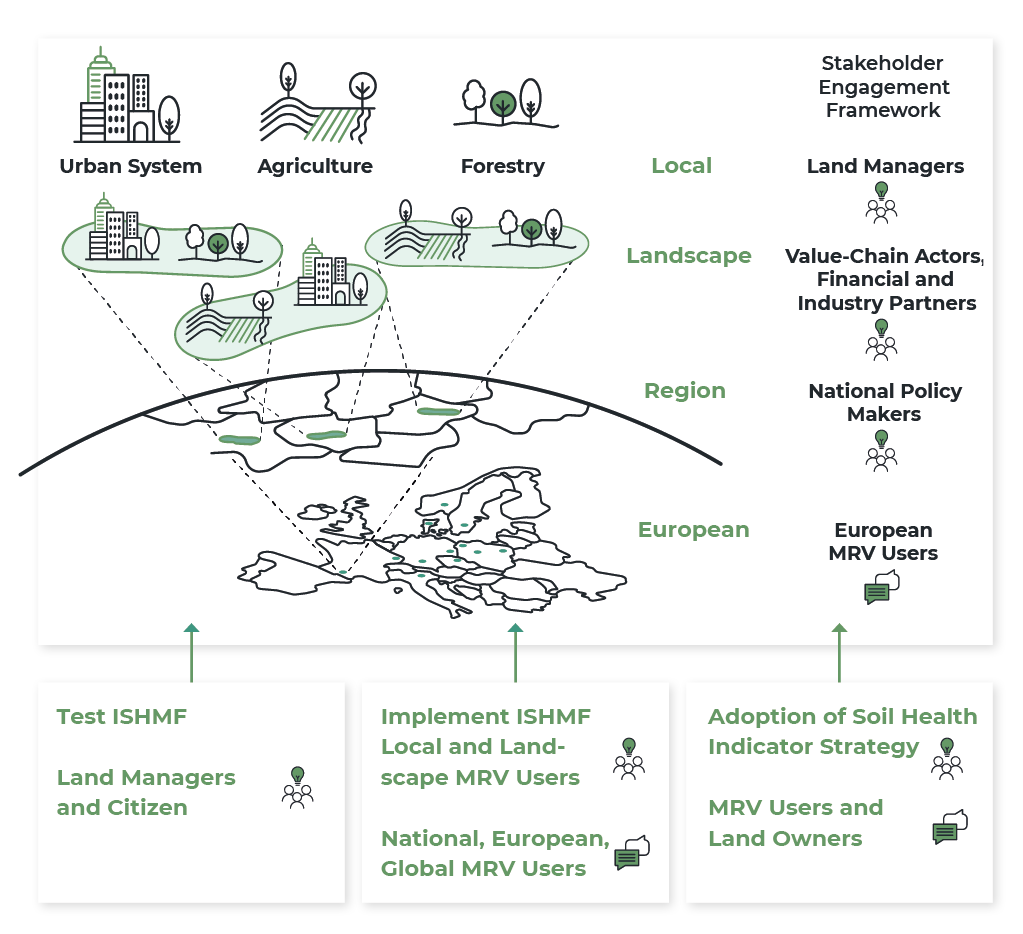
MRV Users evaluate the indicators for monitoring, reporting and verification (MRV) activities at local, national, European scales.


This project has received funding from the European Union’s Horizon Europe research and innovation program, under Grant Agreement: 101091010. © BENCHMARKS 2022
The sole responsibility for the content of this document lies with the authors. It does not necessarily reflect the opinion of the European Union.
Subscribe to the BENCHMARKS newsletter and join a community of researchers, citizens, policymakers and value chain actors working towards healthy soils.