Samarium Strontium Cobalt Oxide | AMERICAN ELEMENTS ® (original) (raw)
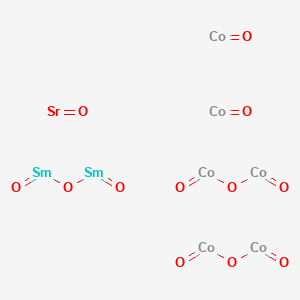
Chemical Structure

CAS#
Linear Formula:
SrO • Sm2O3 • 2Co3O4
Question? Ask an American Elements Materials Science Engineer
Samarium Strontium Cobalt Oxide (Samarium Strontium Cobaltite, SSC) is used as a cathode material in high performance solid oxide fuel cells and is generally immediately available in most volumes. High purity, submicron and nanopowder forms may be considered. American Elements produces to many standard grades when applicable, including Mil Spec (military grade); ACS, Reagent and Technical Grade; Food, Agricultural and Pharmaceutical Grade; Optical Grade, USP and EP/BP (European Pharmacopoeia/British Pharmacopoeia) and follows applicable ASTM testing standards. Typical and custom packaging is available. Additional technical, research and safety (MSDS) information is available as is a Reference Calculator for converting relevant units of measurement.
| Compound Formula | Co6O12Sm2Sr |
|---|---|
| Molecular Weight | 933.93197 |
| Appearance | Gray to Black Powder |
| Melting Point | N/A |
| Boiling Point | N/A |
| Density | N/A |
| Solubility in H2O | N/A |
| Exact Mass | 939.285699 |
| Monoisotopic Mass | 937.283222 |
Samarium Strontium Cobaltite, SSC, strontium- doped samarium cobaltite, Cobalt samarium strontium oxide , SmSrCo4Ox; 491845-26-2
| Signal Word | N/A |
|---|---|
| Hazard Statements | N/A |
| Hazard Codes | N/A |
| Risk Codes | N/A |
| Safety Statements | N/A |
| Transport Information | N/A |
| Linear Formula | SrO • Sm2O3 • 2Co3O4 |
|---|---|
| Pubchem CID | 16218317 |
| MDL Number | N/A |
| EC No. | N/A |
| IUPAC Name | oxocobalt; oxo(oxocobaltiooxy) cobalt; oxo(oxosamariooxy) samarium; oxostrontium |
| Beilstein/Reaxys No. | |
| SMILES | InChI=1S/6Co.12O.2Sm.Sr |
| InchI Identifier | O=[Co].O=[Co].O=[Co]O[Co]=O.O=[Co]O[Co]=O.O=[Sr].O=[Sm]O[Sm]=O |
| InchI Key | QNWNHKBYDISCHS-UHFFFAOYSA-N |
| Chemical Formula | |
| Molecular Weight | |
| Standard InchI | |
| Appearance | |
| Melting Point | |
| Boiling Point | |
| Density |
Customer Reviews
Typical bulk packaging includes palletized plastic 5 gallon/25 kg. pails, fiber and steel drums to 1 ton super sacks in full container (FCL) or truck load (T/L) quantities. Research and sample quantities and hygroscopic, oxidizing or other air sensitive materials may be packaged under argon or vacuum. Shipping documentation includes a Certificate of Analysis and Safety Data Sheet (SDS). Solutions are packaged in polypropylene, plastic or glass jars up to palletized 440 gallon liquid totes, and 36,000 lb. tanker trucks.

May 12, 2026 Los Angeles, CA
Each business day American Elements' scientists & engineers post their choice for the most exciting materials science news of the day
See more Samarium products. Samarium (atomic symbol: Sm, atomic number: 62) is a Block F, Group 3, Period 6 element with an atomic radius of 150.36.  The number of electrons in each of samarium's shells is 2, 8, 18, 24, 8, 2 and its electron configuration is [Xe]4f6 6s2. The samarium atom has a radius of 180 pm and a Van der Waals radius of 229 pm. In its elemental form, samarium has a silvery-white appearance.
  Samarium is not found as free element in nature. It is found in the minerals cerite, gadolinite, samarskite, monazite and bastnäsite. Samarium is classified as a rare earth element and is the 40th most abundant element in the Earth's crust. Samarium was discovered and first isolated by Lecoq de Boisbaudran in 1879. It is named after the mineral samarskite, the mineral from which it was isolated.
See more Strontium products. Strontium (atomic symbol: Sr, atomic number: 38) is a Block S, Group 2, Period 5 element with an atomic weight of 87.62 .  The number of electrons in each of Strontium's shells is [2, 8, 18, 8, 2] and its electron configuration is [Kr] 5s2. The strontium atom has a radius of 215 pm and a Van der Waals radius of 249 pm. Strontium was discovered by William Cruickshank in 1787 and first isolated by Humphry Davy in 1808. In its elemental form, strontium is a soft, silvery white metallic solid that quickly turns yellow when exposed to air.
  Cathode ray tubes in televisions are made of strontium, which are becoming increasingly displaced by other display technologies pyrotechnics and fireworks employ strontium salts to achieve a bright red color. Radioactive isotopes of strontium have been used in radioisotope thermoelectric generators (RTGs) and for certain cancer treatments. In nature, most strontium is found in celestite (as strontium sulfate) and strontianite (as strontium carbonate). Strontium was named after the Scottish town where it was discovered.
See more Cobalt products. Cobalt (atomic symbol: Co, atomic number: 27) is a Block D, Group 9, Period 4 element with an atomic weight of 58.933195.  The number of electrons in each of cobalt's shells is 2, 8, 15, 2 and its electron configuration is [Ar]3d7 4s2. The cobalt atom has a radius of 125 pm and a Van der Waals radius of 192 pm. Cobalt was first discovered by George Brandt in 1732. In its elemental form, cobalt has a lustrous gray appearance. Cobalt is found in cobaltite, erythrite, glaucodot and skutterudite ores.
  Cobalt produces brilliant blue pigments which have been used since ancient times to color paint and glass. Cobalt is a ferromagnetic metal and is used primarily in the production of magnetic and high-strength superalloys. Co-60, a commercially important radioisotope, is useful as a radioactive tracer and gamma ray source. The origin of the word Cobalt comes from the German word "Kobalt" or "Kobold," which translates as "goblin," "elf" or "evil spirit."