Characteristic Definition and Examples - Biology Online Dictionary (original) (raw)
Characteristic
n., plural: characteristics
[ˌkɛɹəktəˈɹɪstɪk]
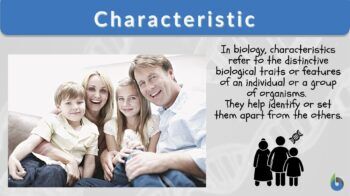
Definition: any of the distinctive biological traits or features of the organism
Table of Contents
Toggle
Characteristics Definition
We can define characteristics as qualities or features that describe the distinctive nature or features of an individual organism or of a group. Characteristics may aid in identifying a particular group that shares common distinctive features or they may help set an individual or a group apart from the others. The common synonyms for characteristics are attributes, qualities, features, and traits. However, “_trait_” is more general than “characteristic”. Traits include all attributes whereas characteristics are traits that “_characterize_“, meaning “identify” and may therefore be used to “categorize”.
Characteristics may be physical, chemical, or biological. What is a physical characteristic? A physical characteristic is a property that depicts and helps distinguish the physical nature of an entity from the others. Specific heights and weights are examples of physical characteristics. A chemical characteristic is a property of a chemical substance that helps identify it. Thus, it can be about the specific toxicity, flammability, the heat of combustion, oxidation states, chemical stability, reactivity with other chemicals, coordination number, and enthalpy of formation of a chemical substance that sets it apart from the other chemicals. Look at the figure below to help differentiate between physical and chemical properties that when specified may help characterize a chemical entity.
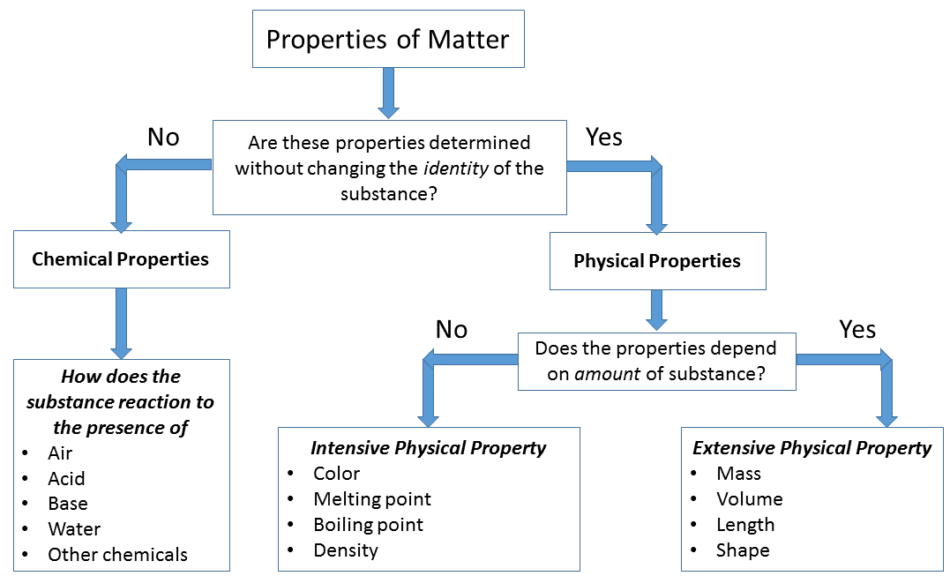
Figure 1: Physical vs. chemical: properties of matter. Image Credit: LibreTexts libraries.
How about in biology? What is a characteristic? What does it mean? In biology, characteristics mean the distinctive biological traits or features of the organism. As pointed out above, traits and characteristics may be used synonymously but there are subtle differences in usage, including in biology. In particular, a biological trait (sometimes referred to as character) refers to a particular biological attribute. For example, eye color is a biological trait and having a blue eye color is a biological characteristic.
Biological traits may be inherited or acquired. Inherited character is a trait or feature that is transferred from parents to their offspring through genes. Acquired character is a trait or character that an organism gains from the response to the environment. A character may be controlled by a single gene or by multiple genes. If few genes control characteristic traits, they are termed qualitative or oligogenic characters. Oligogenic characters show discontinuous variation. In this, the traits are discrete. Blood group type is an example of oligogenic characters. The blood group is of four types: AB, A, B, or O. If multiple genes control a character or trait, it is termed quantitative or polygenic characters. Such characters are in continuous variation.
Biology definition:
A characteristic is a distinguishing quality, trait, or feature of an individual, thing, disorder, etc. It is often a distinctive mark, feature, attribute, or property of an individual or thing. For example, a living thing has the following characteristics: made up of cell(s), capable of reproduction, growth, and development, obtains energy and utilizes it, responds, and adapts to its environment. Etymology: from Greek “charaktēristikós”, meaning “to designate” or “to characterize”. See also: trait. Synonyms: attribute; feature; trait.
There are many general characteristics and functions of a living organism that define life. They are order, sensitivity or response to the environment, reproduction, growth and development, regulation, homeostasis, energy processing, adaptation through evolution, and metabolism. These characteristics set living things apart from non-living things.
- Order: An individual or organism is made up of a cell or a group of cells. The cells are arranged in a highly organized and coordinated way. Some organisms are single-celled (made up of only one cell) or multicellular, which characteristically refers to having multiple cells. In multicellular organisms, similar cells combine and form tissues. The tissue will lead to the formation of different body organs. Organs work together and form an organ system. Multiple organ systems work in coordination and form an individual.
- Sensitivity or Response to Stimuli: an organism’s characteristic is that it is capable of responding to a stimulus. For example, bacteria show phototaxis behavior. The tendency of an organism to move towards or away from light is called phototaxis. And so for instance, based on their response to light, bacteria may then be categorized as photophilic (thriving in light, and so they move toward the light source) or photophobic (sensitive to light, thus they move away from the light source).
- Reproduction: reproduction is the characteristic of organisms to produce offspring similar to their parents. Many single-celled organisms reproduce by the duplication of their DNA and then the cell divides to form two new cells. This is binary fission, which is an example of an asexual mode of reproduction. In multicellular organisms, special cells called gametes are produced for use in a sexual mode of reproduction.
- Sensitivity or Response to Stimuli: an organism’s characteristic is that it is capable of responding to a stimulus. For example, bacteria show phototaxis behavior. The tendency of an organism to move towards or away from light is called phototaxis. And so for instance, based on their response to light, bacteria may then be categorized as photophilic (thriving in light, and so they move toward the light source) or photophobic (sensitive to light, thus they move away from the light source).
- Growth and Development: different organisms grow differently according to the instructions encoded in their genes. These genes provide the information about growth and development of the organism. The genes that they inherit from their parents account for the fundamental and common characteristics that they may share with their parents.
- Regulation and homeostasis: even unicellular organisms are complex. They need multiple regulation mechanisms to maintain the body’s functions in a coordinated and well-organized way. Organisms either unicellular or multicellular need to maintain internal body functions, respond to the stimuli, and cope with the fluctuation of the external environment. Blood flow and transportation of nutrients are two examples of internal function regulation. Organs are performing their specific function like carrying oxygen throughout the body, removing waste materials, transporting nutrients to every cell of the body, and keeping the body temperature at optimum level.
- Let’s take for example bacteria. Not all bacteria can survive high temperatures but thermophiles. Thermophiles are characterized by their ability to withstand temperatures between 41 and 122 °C, which would otherwise kill most bacteria.
- Another example is thermoregulation among animals. Some animals are cut out for a cold environment. In fact, polar bears are capable of living in cold polar regions that the other types of bears would find challenging. Polar bears can maximally conserve their body heat by having these characteristics: a greasy coat that helps reduce heat loss, black skin under the unpigmented fur that absorbs the heat of the sun (UV light), and a thick layer of blubber (4 inches) that acts as an insulator (prevents heat from letting out). On the other hand, animals that live in hot environments have other methods to dissipate body heat. For example, dogs sweat through their paws and pant to cool themselves.
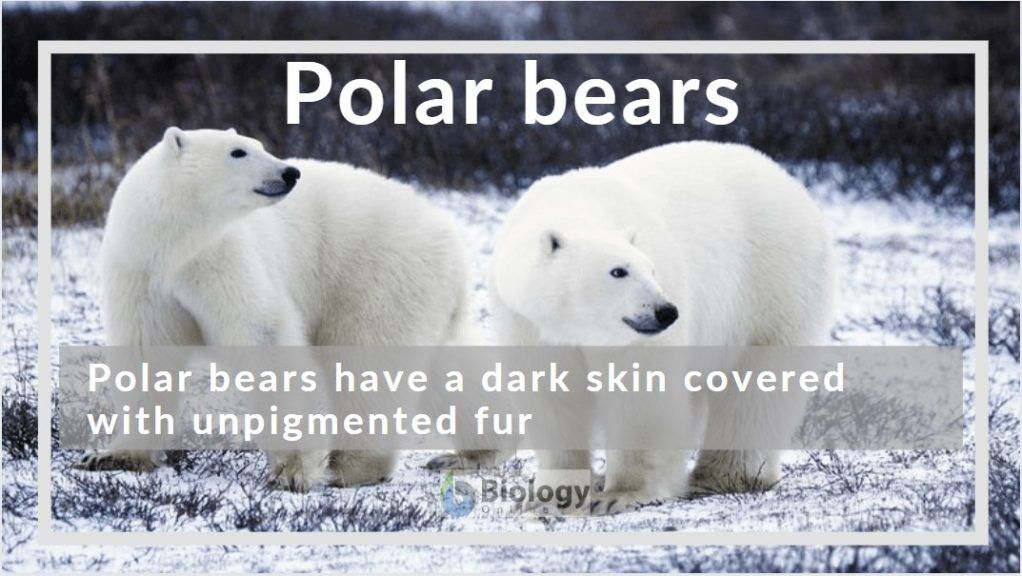
Polar bears have dark skin covered with unpigmented fur. The fur appears white because the sun’s rays are trapped and bounce inside the hollow part of the hair (called guard hair), and eventually are emitted through luminescence. The salt particles on the hair surface (which polar bears get from swimming or being near the ocean) also tend to scatter light. This leads to more luminescence.
- Another example is thermoregulation among animals. Some animals are cut out for a cold environment. In fact, polar bears are capable of living in cold polar regions that the other types of bears would find challenging. Polar bears can maximally conserve their body heat by having these characteristics: a greasy coat that helps reduce heat loss, black skin under the unpigmented fur that absorbs the heat of the sun (UV light), and a thick layer of blubber (4 inches) that acts as an insulator (prevents heat from letting out). On the other hand, animals that live in hot environments have other methods to dissipate body heat. For example, dogs sweat through their paws and pant to cool themselves.
- Energy Processing: to maintain life and metabolic activities, all organisms need energy.
- Autotrophs are characterized by having the ability to make their own food. This characteristic sets them apart from heterotrophs. Photoautotrophs, in particular, make their own food through photosynthesis. Examples are plants. They capture the energy from the sun and convert it into chemical energy (food).
- Heterotrophs take that chemical energy from autotrophs in the form of their food and use it for their survival. Examples of heterotrophs are animals.
- Adaptation through Evolution: adaptation is the unique characteristic by which organisms adapt so that they can survive according to the environment. Although adaptation is a slow process but to face the environmental challenges in a better way, various behavioral and physical features of an organism change. Organisms go through the process of natural selection. The one who adopts good characteristics will survive better. (Hershey, 2018)
- For example, earlier snakes had legs similar to lizards. They lost their legs so that they can easily go in small holes. Without legs, they can easily fit even in tighter spaces. This adaptation helps them to hide from predators.
- Metabolism: Metabolism is a set of different chemical reactions which occur in a living organism for maintaining life. The different functions of metabolism are as follows: conversion of food energy into cellular energy, conversion of food into the building blocks (nucleic acids, lipids, carbohydrates, and proteins), and elimination of waste and toxic material from the body. Metabolic reactions are of two categories. They are catabolic reactions (breaking of compounds) and anabolic reactions (synthesis of compounds).
Try to answer the quiz below to check what you have learned so far about characteristics.
Further Reading
References
- Britannica, T. E. o. E. (2021). character. Retrieved 07 Nov, 2021, from https://www.britannica.com/science/character-biology
- Hershey, A. (2018). Examples of Evolutionary Adaptation. Retrieved 07 Nov, 2021, from https://sciencing.com/examples-evolutionary-adaptation-6131133.html
- Lumen Learning. (2021). The Characteristics of Life. Retrieved 07 Nov, 2021, from https://courses.lumenlearning.com/suny-wmopen-biology1/chapter/the-characteristics-of-life/
©BiologyOnline.com. Content provided and moderated by Biology Online Editors.