Protist - Definition and Examples - Biology Online Dictionary (original) (raw)
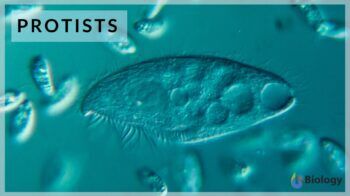
Protist
n., plural: protists
Definition: any of a group of eukaryotic organisms belonging to the Kingdom Protista.
Table of Contents
Toggle
- Protist Definition
- History of Classification
- Characteristics of Protists
- Types of Protists
- Reproduction and Life Cycle
- Habitats of Various Protists
- Evolutionary History of Protists
- Classification of Protists
- Ecological Importance of Protists
- Economic Importance of Protists
- Examples of Protists
- Quiz
- References
What is a protist? All protists are eukaryotes, i.e. organisms with a nucleus. However, they are neither fungi nor plants. They are also not animals. They are a separate group of living things. The majority of them are unicellular; however, few protists are multicellular.
Fun fact: Which are the only multicellular protists? Kelps (brown algae) are the only multicellular protists.
Protist (biology definition): Any of a group of eukaryotic organisms belonging to the Kingdom Protista. Protists include: (1) protozoa, the animal-like protists, (2) algae, the plant-like protists, and (3) slime molds and water molds, the fungus-like protists. Etymology: from Greek “protiston” + (“-a”), meaning the (most) first of all ones. Ernst Haeckel coined the term, “Protista”.
What are protists? Protists are eukaryotes. They have a highly organized nucleus and cellular organelles. Most of them are unicellular; few are primitive multicellular organisms. Some protists also possess a locomotory organ (flagella or cilia).
Usually, protists dwell in water, damp terrestrial environments, or sometimes as parasites as well. Protists are believed to be the common ancestral link between plants, animals, and fungi from which these three groups branched out in the process of evolution. They are assumed to be the predecessor to plants, animals, and fungi, and the first eukaryotes.
Protozoa, algae, and slime molds are some of the examples of the members of the Kingdom Protista, which is a highly heterogeneous collection of microbial eukaryotes. Most of the protists exhibit the least similarity amongst themselves.
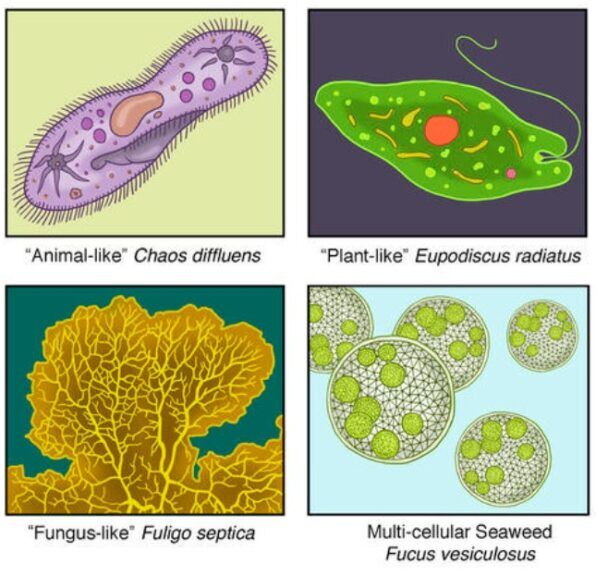
Figure 1: Different kinds of protists. Credit: LibreTexts libraries, CC BY-NC-SA 3.0.
History of Classification
As per the earliest of the classification, all the organisms were classified into three kingdoms: animal, plant, and mineral. It was John Hogg, in the early 1860s, who came up with Protoctista to include the unicellular plants and animals.
Protoctista (definition): It is the fourth kingdom of nature as proposed by John Hogg. It consists of unicellular or primitive multicellular organisms that are not plants, animals, or fungi. They do not have much in common apart from a relatively simple organization. They may occur as unicellular, multicellular, coenocytic, or colonial organisms.
The members of Protoctista were the primitive unicellular forms of both plants and animals. Later, the group “Protoctista ” was replaced by Ernst Haeckel. He coined the term “Protist”. This led to a classification system with three biological kingdoms: plants, animals, and protists. Thus, Ernst Haeckel was the first to classify organisms into the ‘kingdom of primitive forms’ or ‘Protista’ in the 1860s and included anucleated (lacking in the nucleus) microbes such as bacteria. In 1938, Herbert Copeland included nucleated eukaryotes such as diatoms, green algae, and fungi under Protista.
Later, this 3-scheme of classification system later formed the basis of Whittaker’s classification that made fungi a separate kingdom. Hence, by Whittaker’s classification system, all the organisms can be classified into four kingdoms of life: (1) Fungi, (2) Animalia, (3) Plantae, and (4) Protista. Later still, prokaryotes were separated from the kingdom Protista and were placed in a new and separate kingdom ‘Monera’. Thus, forming five kingdoms.
| Protists | The scientific name of protists |
|---|---|
| Amoeba | Amoeba proteus |
| Paramecium | Paramecium pentaurelia |
| Stentor | Stentor coeruleus |
| Euglena | Euglena gracilis |
| Volvox | Colonial volvox |
| Slime mold | Physarum polycephalum |
Characteristics of Protists
What do all protists have in common? All protists are eukaryotic organisms i.e., organisms with a membrane-enclosed nucleus. The key Protista characteristics are as follows:
- They are eukaryotes.
- Protists have mitochondrion.
- Protists can be parasitic (eg., Trypanosoma protozoa)
- Usually aquatic; however, can be present in the soil or moist environment
- Protists are primarily unicellular however, kelps that are classified as a member of Kingdom protists are multicellular and can grow up to 100 ft. in height (Giant Kelp)
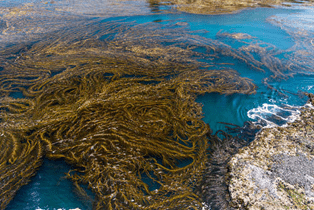
Figure 2: Multicellular protists- Kelps. Credit: NOAA Sea Grant Program, CC BY 2.0.
- Protist organisms have nucleus along with membrane-bound organelles
- Protists can be autotrophic or heterotrophic or symbiotic in nature.
- The majority of the protists have locomotory organs, such as cilia and flagella. Others have a pseudopodium for locomotion.
- Exhibit asexual means of reproduction. In the rare case or under stress, may reproduce via a sexual method.
Types of Protists
The protists are basically classified into three main types of protist (detached discussion in section: Protist Classification):
- Animal-like protists: heterotrophs and motile.
- Plant-like protists: autotrophs with the capability to carry out photosynthesis.
- Fungi-like protists: heterotrophs and characteristically have cell walls in the cells and spores formation is the reproduction method.
Owing to the diverse characteristics of protists, they can be classified into diverse groups based on shape, size, nuclear structures, cytoplasmic organelles, etc. The taxonomy of the protist kingdom is ever-changing due to the diversity of this kingdom. However, the most common approach to categorize the protist is based on nutrition and motility.
Autotrophs
Autotrophic protists are generally non-motile and can synthesize food of their own and are more like plants. Like plants, these autotrophic protists have pigments to carry out photosynthesis. These pigments render different colors to these protists. Different protists have different pigments. Some have chlorophyll as seen in green algae, fucoxanthin found in brown algae, and phycoerythrin found in red algae. Interestingly, 40% of the world’s total photosynthesis is carried out by autotrophic protists.
Heterotrophs
Heterotrophic protists cannot synthesize their own food and depend on other sources for it. Some protists of this group may be motile as well. The locomotory organ of such protists may be cilia or flagella or even pseudopodia. Many of these protists feed on bacteria.
Mixotrophs
If the entire spectrum ranges from autotrophs to heterotrophs then mixotrophs fall somewhere in between. Mixotrophs essentially utilize different sources of carbon and energy. These protists are a combination of phototroph (organisms having their own chloroplast) and phagotroph (organisms that acquire chloroplast by enslaving the chloroplast containing cell of another organism i.e. kleptoplasty).
Harriet Jones divided mixotrophs, based on dominancy and role of phototrophy and phagotrophic, into four groups:
- Heterotrophy, wherein phagotrophy is the standard mode and phototrophy is only used when prey for phagotrophy is not available or in limited numbers.
- Phototrophy, wherein phototrophy is the foremost strategy, and phagotrophy is preferred when sunlight is low or limited.
- The substances for both growth and ingestion are obtained by the process of phototrophy, however, in limited light phagotrophy is employed.
- The commonly employed mode for nutrition is phototrophy, however, during prolonged dark periods, when light is extremely limiting phagotrophy is employed.
In an alternative classification proposed by Diane K. Stoeker, mixotrophs are classified into three types:
- Type 1: These are “Ideal mixotrophs” that utilize both prey and sunlight equally.
- Type 2: Phototrophic activity is supplemented with phagotrophy
- Type 3: The organisms that change according to the surrounding conditions and availability of sunlight. These organisms primarily utilize phototrophic activity when the availability of prey is low. This group is primarily heterotrophic
Aditee Mitra et al. categorized mixotrophs into two basic groups:
- Constitutive mixotrophs: These mixotrophs are essentially phagotrophic organisms that also possess inherently ability to carry out photosynthesis
- Non-constitutive mixotrophs: These mixotrophs are essentially phagotrophic organisms, however, in order to attain the ability to photosynthesize these mixotrophs must consume prey.
Further, based on motility, protists can be classified as follows:
- Diplomonads: These protists are unicellular organisms with flagella. Typically, these protists contain two nuclei and mitosomes. For example, Giardia
- Parabasalids: These protists contain a parabasal body and hydrogenosomes
- Euglenozoans: These protists are unicellular organisms with flagella with a typical flagellar crystalline rod
- Alveolates: As the name suggests, these protists contain sacs in the cytoplasmic membrane, which are known as alveoli. These may further be classified as follows:
- Ciliates: As the name suggests, these protists have cilia as their locomotory organ at least for some part of their life; e.g., Paramecium
- Dinoflagellates: These organisms have flagella that can exhibit a spinning movement. It can be found in marine as well as freshwater
- Apicomplexans: This group of parasites are generally obligate animal parasites and are capable of causing diseases. They also contain degenerate chloroplasts called apicoplasts. The malaria-causing parasite Plasmodium is an example of this class.
- Stramenopiles: These protists are oomycetes or water molds and exemplified by diatoms, golden algae, and brown algae.
- Cercozoans: Earlier known as amoeba and radiolarians. For locomotion, these protists possess “thread-like pseudopodia”.
- Amoebozoa: These protists have lobe-shaped pseudopodia. This class includes slime molds.
Kingdom Protista is highly diverse and so, to date, no final agreement between scientists as to how to classify them into phyla.
Reproduction and Life Cycle
Reproduction
How do protists reproduce? It is very interesting to learn! Protists can reproduce asexually as well as sexually. Although the majority of the protist undergo reproduction via an asexual mode of reproduction. Asexual binary fission is the most common mode of reproduction in protists.
A. Asexual mode of reproduction in protists
This parent cell divides itself into two daughter cells each having the same genetic composition as that of the mother cell i.e. clones. In the asexual mode of reproduction, only one parent cell is there. Asexual mode of reproduction can occur via a number of methods, as described below.
- Binary Fission: the parent body divides into two equal daughter cells by undergoing mitosis. Examples: Amoeba, Euglena, and Paramecium.
- Multiple Fission: here, the parent cell divides into a number of daughter cells. Examples: Amoeba and Plasmodium.
- Plasmotomy: this mode of asexual reproduction is seen in the multinucleate protists. In this mode, the multinucleate parent cell undergoes division to form two or more multinucleate offspring. However, in this process, only the division of the cytoplasm occurs There is no division of the nucleus. Example: Opalina.
- Spore Formation: some protists form spores by asexual reproduction in order to withstand unfavorable or undesirable environmental conditions. Once spores are exposed to the optimum conditions, they germinate and form new progeny. Example: slime molds.
- Budding: a small outgrowth or protrusion develops on the body of the parent cell which eventually pinches off to form a new organism. Example: Arcella (a sarcodine)
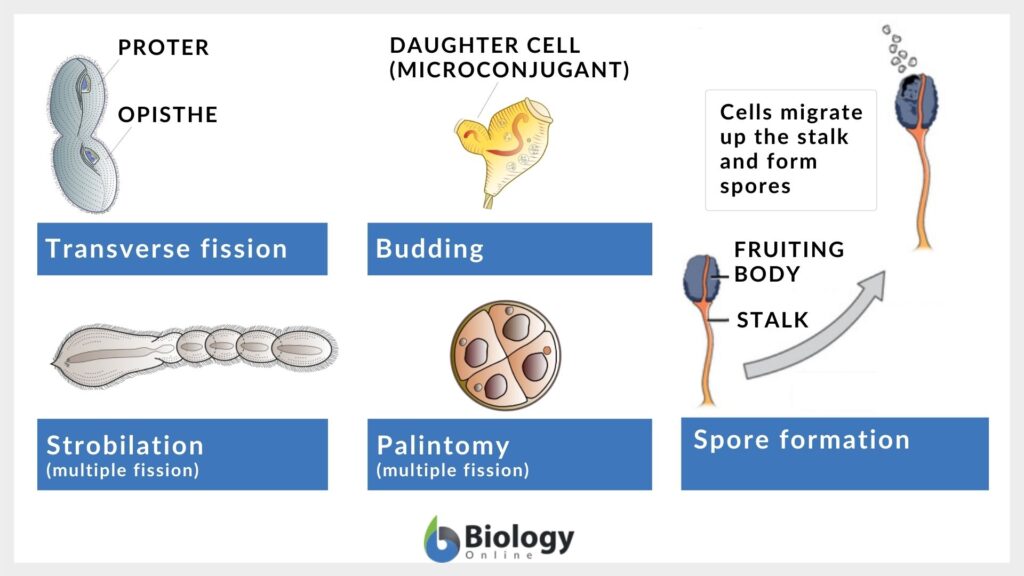
Different modes of reproduction in Protista. Source: Modified by Maria Victoria Gonzaga,BiologyOnline.com, from the works of Deuterostome, CC BY-SA 4.0. and LibreTexts libraries, CC BY-NC-SA 3.0.
B. Sexual mode of reproduction in protists
The sexual mode of reproduction actually originated in protists. This mode of reproduction involves two basic processes:
- Meiosis: It is the essential part of the sexual mode of reproduction, wherein the number of chromosomes is reduced from 2n (diploid) to n (haploid). This step of reduction of the number of chromosomes is essential to keep the number of chromosomes constant in the progeny of a species.
- Fertilization or Fusion of two chromosomes in gametes to form a zygote containing 2n chromosomes (fertilization of egg).
In protists, sexual reproduction can occur by two methods-
- Syngamy: a diploid zygote is produced by the complete fusion of two gametes. Further, syngamy can be by: (1) isogamy (fusion of two similar gametes, for eg: Monocystis), (2) anisogamy (the two gametes that fuse are dissimilar, e.g., Ceratium) and (3) oogamy where the two gametes differ in size and motility; one of the gametes is non-motile and large while the other fusing gamete is a motile small size gamete, eg: Plasmodium.
- Conjugation: in this mode of sexual reproduction, two individuals/organisms exchange their haploid pronuclear after a temporary union in order to form a zygote nucleus. Eventually, both the parents have a zygote nucleus that eventually undergoes binary fission to form daughter organisms. Example: Paramecium. Watch the video of Paramecium conjugation below.
The life cycle of Protist
Owing to the diversity of the protists, their life cycle ranges from simple to complex. Some protists undergo one periodic binary fission, while others may reproduce via asexual and sexual phases. Certain algal protists even undertake a hibernation period similar to mammals.
It has been found that protists undertake dormancy when food is not available in sufficient quantities or during low temperatures, presumably to preserve the food and energy reserve till favorable existence conditions are available again. Certain protists are parasitic and can have multiple hosts throughout their life cycle. Such parasitic protists may also spend some part of their life cycle in a carrier that transports it to the next host.
The life cycle of slime molds
There are types of life cycles that are followed by the slime molds:
A. Plasmodial type
Large multinucleated cells that move along surfaces during their feeding stage form the plasmodial type of slime molds. These slime molds lift and engulf food particles or bacteria by gliding along. Once this plasmodium matures, it forms a net-like appearance. It also has the capacity to produce fruiting bodies, or sporangia over a stalk, during stress.
Haploid spores are produced within the sporangia due to meiosis. These spores eventually disseminate through the air or water and reach the favorable environments wherein they germinate to produce progeny. The progeny could be amoeboid or flagellate haploid cells which in turn combine with each other to produce diploid zygotic slime mold.
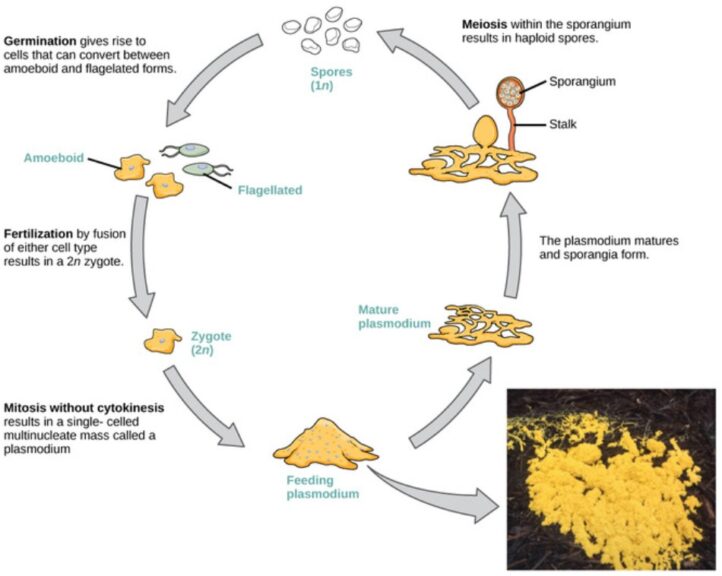
Figure 4: Plasmodial slime mold life cycle. Credit: LibreTexts libraries, CC BY-NC-SA 3.0.
B. Cellular types
These slime molds behave almost like independent amoeboid cells when there is plenty and abundant supply of nutrients. However, once the food source gets depleted, cellular slime molds collectively form a single unit called a slug. In the slug, few cells form stalks (~2-3 cm in length). At the top of these stalks, asexual fruiting bodies bearing haploid spores are formed. These spores disseminate to reach an optimal moist environment wherein they germinate. A classic example of cellular slime molds is Dictyostelium, which can be easily found in the damp soil of forests.
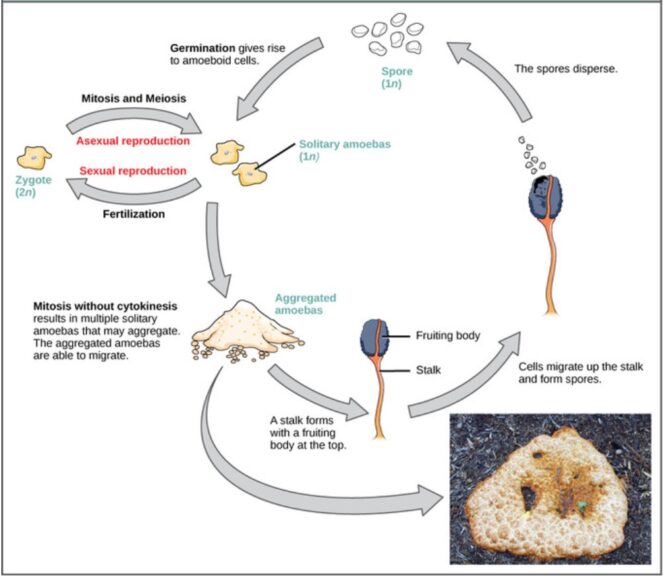
Figure 5: Cellular slime molds life cycle. Credit: LibreTexts libraries, CC BY-NC-SA 3.0..
Habitats of Various Protists
Where do protists live? Protist is a family of over 100,000 living species. The majority of the protists thrive in the aquatic environment., e.g. freshwater, marine milieu, damp soil, and some are even found in the snow. The common and classic example of aquatic protists is Paramecia. Paramecium is one of the most commonly used research organisms, especially in classrooms and laboratories. This is due to the ease and abundance of their availability. Some of the protists are parasitic and therefore they reside in host cells or organisms. Amoeba is a human parasite that can result in dysentery in the host human. Some of the protists thrive on the dead organisms or their wastes and are important scavengers of the ecology. Slime molds are the protists that live on bacteria and fungi found in rotting trees and forests.
Evolutionary History of Protists
The presence of a nucleus, especially in simple protists like paramecium and amoeba, is the striking feature due to which scientists believe that protists were the first eukaryotic cells. This is based on the ‘endosymbiotic theory, which was laid down based on the fossils and evidence found.
According to this theory, the symbiotic relationship between two or more prokaryotic cells laid the foundation for the evolution of eukaryotic cells. It is hypothesized that larger prokaryotic cells engulfed one or smaller eukaryotic cells. These two cells then established a symbiotic relationship between them. The smaller prokaryotic now became the endosymbionts. The two cells benefited from each other, the smaller cell got the protection and nutrients while the outer or the larger cell received the energy from the smaller cell. Thus, both cells got benefited from each other.
Over a period of time, the endosymbiotic cell evolved into a cell organelle and the two cells then became completely dependent on each other or survival. Thus, the protist evolved into a very diverse group of organisms, wherein depending on the endosymbiotic cell, the eventual protist acquired the specialized organelle. For example, certain endosymbiotic cells were originally aerobic bacteria and hence they evolved into mitochondria in the eukaryotic cell. Certain cyanobacteria that were endosymbiotic eventually developed into chloroplast in the eukaryotic cells.
Endosymbiotic theory is well supported by several pieces of evidence:
- Mitochondrial and chloroplasts DNA is different from the nuclear DNA of the cell. Interestingly, this DNA is circular like bacterial DNA.
- The plasma membranes around Mitochondria and chloroplasts are similar to bacterial membranes.
- Mitochondria and chloroplasts both divide by the process of binary fission, similar to bacteria.
- Chloroplasts have structural and biochemical similarities to cyanobacteria.
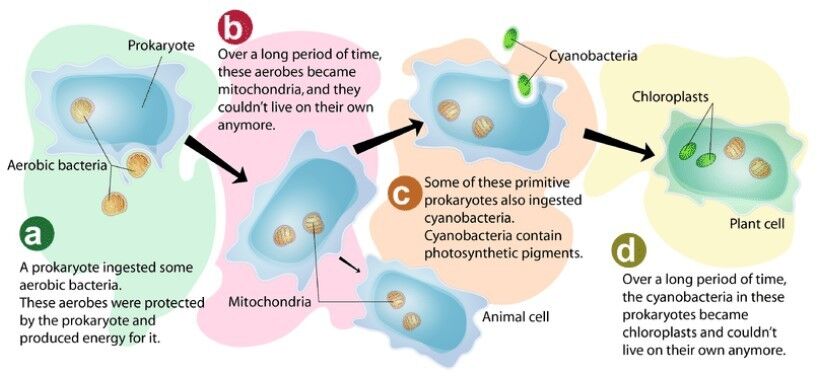
Figure 6: Evolution of protists based on the endosymbiotic theory. Credit: Mariana Ruiz Villarreal (LadyofHats) for CK-12 Foundation, CC BY-NC 3.0.
Classification of Protists
There are three types of protists:
- Animal like protist or Protozoa
- Plant like protist or Alage
- Fungi like protist or Molds
Protozoa
Protozoa are single-cell, motile, and heterotrophic organisms. Due to their motility and heterotrophic nature, they are called animal-like or protozoa. Protozoa are further classified based on their motility, as given below.
Table1: Classification of protozoa
| Type of protozoa | Name of organism | Organ for motility |
|---|---|---|
| Amoeboid | Amoeba | Pseudopodium |
| Ciliate | Paramecium | Cilia |
| Flagellate | Giardia | Flagella |
| Sporozoan | Plasmodium | The adult form is immobile |
Algae
These protists are both single cells (algae, diatoms) as well as multicellular (seaweed or kelp). These protists are called plant-like due to the autotrophic nature of these organisms. These protists possess chloroplast and synthesize their own food by the process of photosynthesis. Scientists believe that plants evolved from algae. Algae are categorized into four groups depending on the color of the pigment present in them.
Table 2: Classification of Algae
| Classification | Chloroplast type |
|---|---|
| Red algae | Red or brown color chlorophyll similar to cyanobacteria; chloroplast having two membranes |
| Green Algae | Green color chlorophyll similar to cyanobacteria; chloroplast having two membranes |
| Euglenids | Green color chlorophyll’ chloroplast having three membrane |
| Dinoflagellates | Red or brown color chlorophyll similar to cyanobacteria; chloroplast having three membranes |
Molds
These protists feed on organic decaying matter. These protists share two main similarities with fungi, i.e., these protists feed on organic decaying matter and reproduce by the formation of spores. However, they have cellulosic cell walls whereas fungi have chitin in their cell wall. These protists can have motility in a certain part of their life cycle. These protists are further divided into two classes:
- Slime mold: these are fungus-like and feed on decaying organic matter like compost and rotting logs. These protists move gradually and eat the decaying organic matter. In case the availability of the organic matter is less, these protists agglomerate to form a slimy mass and move slowly by sliding upon their own secretion and eating the organic matter. The slime molds again can be acellular and cellular. Acellular molds agglomerate to form a single cell having multiple nuclei whereas cellular molds continue to remain as distinct cells.
- Water Molds: these protists are found in moist soil and surface water. Some of the members of this class are plant pathogens, infecting, and destroying crops like grapes, lettuce, corn, and potatoes. Others are parasitic on fish and other marine animals.
In 2005, a group of 28 scientists has categorized all the protists into the following six major categories-
- Amoebozoa: amoeba-like cells. Several free-living and parasitic amoebas, as well as slime molds, are included in this category. Examples: Acanthamoeba, Entamoeba, Dictyostelium
- Opisthokonta: this category includes the fungi, the choanoflagellates, and the metazoa.
- Rhizaria: the majority of the organisms are also amoeboid i.e., amoeba-like. Examples: foraminifera and radiolaria.
- Archaeoplastida: autotrophic, photosynthetic, have plastid in their cell. Examples: red algae, green algae, and higher plants.
- Chromalveolata: a composite group, which experts have further divided into four distinct groups-
· Alveolates: includes ciliates, such as paramecium and tetrahymena, malaria parasite plasmodium, and the dinoflagellates (Interesting fact dinoflagellates are an important part of aquatic food chains and cause toxic “red tides” in the ocean).
· Stramenopiles: photosynthetic and includes diatoms and brown algae.
· Haptophytes: photosynthetic protist
· Cryptophytes: photosynthetic species - Excavata: includes parasites, such as the trypanosomes that cause African sleeping sickness, and free-living organisms, such as Euglena
Ecological Importance of Protists
Protists are a critical and essential part of the ecology. They carry out many vital activities required for the ecological balance. In fact, it is presumed, if protists vanish from the world, then it would lead to the collapse of the world ecology immediately. Some of the critical role played by the protists are as follows:
- Protists form the foundation of the food chain.
- The protist feeds upon the bacteria and microbes and thus controls the population of bacteria and microbes.
- The autotrophic protists carry out almost 40% of the world’s total photosynthesis and help in reducing global carbon dioxide and fixing carbon.
- The molds are primary decomposers in soil, especially in forests, and feed upon bacteria, fungi, etc.
- Floating microscopic algae is known as phytoplankton and it is the basic component of the marine food chain. Whales feed on phytoplankton.
- Many protists are ‘mixotrophs’ form the important component of the aquatic microbial food web.
- Algae help to build coral reefs. Red and green coralline algae produce a carbonate exoskeleton which eventually forms the part of the coral reef.
- Many protists are pathogenic and cause diseases both in human and plants
- Being decomposers, protists help in recycling nutrients in the ecosystem.
Economic Importance of Protists
Some protists carry out photosynthesis and produce oxygen. Such protists have the potential to produce biofuel.
Many protists, e.g. red alga Porphyra, etc, have been found to have medicinal value and are prescribed for the management of diseases like hypertension, arthritis, ulcers, and joint pain.
· Seaweeds are an extremely rich source of potassium, nitrogen, phosphorus, and minerals and are a very good fertilizer or cattle feed supplement. Seaweed is also consumed as food in countries like Japan.
Diatoms produce diatomite in their cell wall. This is widely used for various purposes. Cement, stucco, plaster, grouting, dental impressions, paper, asphalt, paint, and pesticides all use diatomite. Diatomite also has abrasive properties.
·
Agar-agar is a cell wall component of the red algae, especially Gelidium and Gracilaria. Agar is the primary growth media used in microbiology. It is also extensively used in the food industry as a thickener for eg., jams, bakery, etc. Agarose, purified from agar, is an essential component to carry out gel-electrophoresis in research laboratories. Agar is also used as a bulk-laxative.
Another polysaccharide cell wall component of red algae, mainly Irish moss is carrageenan. Carrageenan is extensively used in the food industry for making ice cream, fruit syrups, whipped cream, custard, evaporated milk, chocolate milk, bread, and macaroni. It is also used in manufacturing toothpaste, pharmaceutical jellies, and lotions.
Another important component of brown algae is algin. Due to its ability to hold and absorb water, algin is a natural thickener that is widely used as an additive in beer, syrup, toothpaste, hand lotion, water-based paints, textile sizing, and ceramic glaze.
Fossil fuel has been prepared from the remains of prehistoric animals and brown algae.
Examples of Protists
Protists exhibit stimuli sensitivity and respond to different environmental stimuli like light and gravity. In most photosynthetic protists, light or photostimulus also serves as direction-guiding stimuli, i.e. phototaxis. For the purpose of phototaxis, protists have developed a photoreceptor or ‘eyespots‘. Eyespots are highly developed photosensitive organs found in the family of non-photosynthetic dinoflagellates, the Warnowiaceae. The eyespot comprises a hyalosome (lens), a retinoid, and an opaque pigment cup or melanosome. This is quite interesting as this group is essentially a phagotroph, hence, the basic use of this eyespot is more as a guiding organ rather than a phototrophic organ. While other groups of protists with flagella, including many genera of green algae (like Chlamydomonas), dinoflagellates, and cryptophytes have a light antenna.
Many protists seem to have gravity sensors as well, as they move in a negative or positive gravity environment in response to the external environmental stimulus. For eg: ciliates of the genera, Loxodes and Remanella show a gravity response that is dependent on the level of the dissolved oxygen. These ciliates have gravity receptors known as Muller vesicles. These ciliates gather at the anaerobic and aerobic zones interface in the water column. These ciliates swim downwards in the oxygen-containing water, while in the anoxic environment these ciliates swim upward.
Protists like Paramecium are ciliate and motile. However, under stress conditions like high temperatures, sudden changes in pH or osmotic pressure, exposure to solvents, and other deleterious chemicals, they stop moving momentarily, go backward, and after some time again start moving in a different direction. This ‘avoidance reaction’ to avoid any undesirable stress condition is a classic ciliate feature. In each Paramecium, there are two nuclei, a macronucleus (for asexual binary fission and biological function and a micronucleus (for sexual reproduction).
Endosymbiotic combinations are highly prevalent in protists. One such endosymbiotic relation is seen almost always in green ciliate Paramecium bursaria and an algal Chlorella.
The diatoms are the unique photosynthetic unicellular protists that enclose themselves in patterned, glassy cell walls. This _glassy cell wall i_s essentially made up of silicon dioxide. These diatoms act as ‘Carbon pumps’ for supplying carbon in the ocean depths.
The presence of carotenoids in the golden algae gives them a characteristic golden color. Marine ciliate Myrionecta rubrum (formerly, Mesodinium rubrum) is photosynthetic. This marine ciliate is responsible for the formation of “red tides” (massive blooms that impart a red color to the sea). This ciliate has chloroplast-mitochondrial complexes, which are basically the endosymbiotic algal organelles being utilized by the host protist for its utility. Ciliated planktons contain “captured” chloroplasts, which retain their functionality in the host cell for an extended period.
Giant kelps or brown algae are multicellular protists, that can grow tremendously in height resembling terrestrial trees. These protists also develop root-like holdfasts, stem-like stipes, and leaf-like blades structures that resemble trees on the earth’s surface.
Parasitic protists, the Apicomplexa (formerly the Sporozoa) includes _malaria_-causing obligate intracellular parasite ‘Plasmodium‘. As the name of the class suggests, these protists have a characteristic structure- the apical complex. This apical complex is used by the protist for intrusion into the host cell. This apical complex has a secretory organelle known as rhoptries. The rhoptries release enzymes while intruding into the cell membrane of the host.
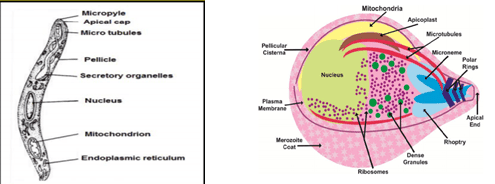
Figure 7: Apical complex in the sporozoite stage of the plasmodium. Credit: Virender, K., & Bhasin. (n.d.). ZOOLOGY Biology of Parasitism Plasmodium: Morphology and Life Cycle Development Team. Source.
Another interesting feature in parasitic apicocomplexid protists like Plasmodium is the presence of an organelle similar to the chloroplast of green algae known as ‘a_picoplastids_’. This organelle is made up of a four-layer membrane and encases short circular DNA. Although the exact function of this organelle is not yet known, it is being explored for developing drugs for targeting Plasmodium.
Phytophthora infestans is a pathogenic protist that causes diseases in plants. It caused late blight potato, which was the cause of severe Irish famine. Plasmopara viticola is the parasitic protist that causes a disease known as downy mildew in grapes. This protist was the cause of the almost collapse of the French wine industry in the 19th century. In parasitic kinetoplastids and the free-living euglenids and dinoflagellates, a complex structure is known as _paraflagellar rod (_PFR) is found. Its function seems to be a photoreceptor. However, new findings indicate its utility in the attachment to the host cell during infection.
Foraminiferans or forams resemble tiny snails and exhibit porous shells, called tests. The shell is hardened by calcium.
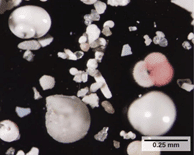
Figure 8: Shells by forams that sink to the base of the sea. Credit: Deep East 2001, NOAA/OER.
Try to answer the quiz below to check what you have learned so far about protists.
References
- Adl, S. M., Simpson, A. G., Farmer, M. A., Andersen, R. A., Anderson, O. R., … Taylor, M. F. (2005). The new higher level classification of eukaryotes with emphasis on the taxonomy of protists. The Journal of eukaryotic microbiology, 52(5), 399–451. https://doi.org/10.1111/j.1550-7408.2005.00053.x
- Bullerwell, C. E., & Gray, M. W. (2004). Evolution of the mitochondrial genome: protist connections to animals, fungi and plants. Current opinion in microbiology, 7(5), 528–534. https://doi.org/10.1016/j.mib.2004.08.008
- Fenchel, T., Finlay, B. J., & Esteban, G. F. (2019). Cosmopolitan Metapopulations?. Protist, 170(3), 314–318. https://doi.org/10.1016/j.protis.2019.05.002
- Finlay B. J. (2004). Protist taxonomy: an ecological perspective. Philosophical transactions of the Royal Society of London. Series B, Biological sciences, 359(1444), 599–610. https://doi.org/10.1098/rstb.2003.1450
- Gooday, A. J., Schoenle, A., Dolan, J. R., & Arndt, H. (2020). Protist diversity and function in the dark ocean – Challenging the paradigms of deep-sea ecology with special emphasis on foraminiferans and naked protists. European journal of protistology, 75, 125721. https://doi.org/10.1016/j.ejop.2020.125721
- Slapeta, J., Moreira, D., & López-García, P. (2005). The extent of protist diversity: insights from molecular ecology of freshwater eukaryotes. Proceedings. Biological sciences, 272(1576), 2073–2081. https://doi.org/10.1098/rspb.2005.3195
- Whittaker, R. H., & Margulis, L. (1978). Protist classification and the kingdoms of organisms. Bio Systems, 10(1-2), 3–18. https://doi.org/10.1016/0303-2647(78)90023-0
- Yurchenko, V., & Lukeš, J. (2018). Parasites and their (endo)symbiotic microbes. Parasitology, 145(10), 1261–1264.https://doi.org/10.1017/S0031182018001257
©BiologyOnline. Content provided and moderated by BiologyOnline Editors.