Sporophyte Definition and Examples - Biology Online Dictionary (original) (raw)
Sporophyte
n., plural: sporophytes
[ˈspɔːrəʊˌfaɪt]
Definition: The plant producing spores; the diploid phase in a plant life cycle
Table of Contents
Toggle
What is a sporophyte? Accordingly, the sporophyte is the plant generation that produces spores. To preserve their plant species and reproduce, the plant life cycle alternate between the haploid stage (i.e., a single set of the chromosome) and the diploid stage (i.e., two sets of the chromosome). Hence, the plant life cycle alternates between the gametophyte (sexual) stage and the sporophyte (asexual) stage. However, certain plants are sporophyte-dominant plants and some are gametophyte-dominant plants.
During the sporophyte stage, the plant produces spores with diploid or two sets of chromosomes (2n) by the process of mitosis. These spores later develop into gametophytes that produce gametes having a haploid or single set of chromosomes (n) by the process of meiosis. Through the process of fertilization, gametes give rise to sporophytes. This type of dual-phase life cycle (gametophyte and sporophyte stages) is known as the haplodiplontic life cycle.
What are spores in plants?
The spores are single nucleated propagative microscopic structures that have the primary function of spreading the plant culture and reproduction. Below are the basic types of spores in plants. They are:
- Sexual spores
- Asexual spores
- Vegetative spores
- Microspores (that eventually form male gametophytes)
- Megaspores (that eventually form female gametophyte)
The extent of dominance of these phases varies between different plant species and algae. During the evolutionary development, the sporophyte stage became the dominant phase in higher plants. As for primitive plants like bryophytes, the gametophyte stage is the dominant phase in the plant life cycle. In bryophytes, the sporophytic stage is short and is dependent upon the female parent permanently for its nutritional requirement. Conversely, in higher plants, the sporophyte stage is the predominant stage wherein the post embryological development, the sporophytic plant is an independent photosynthetic plant.
A simplified diagrammatic representation of the alternation of generation between sporophyte and gametophyte is represented below in Figure 1.
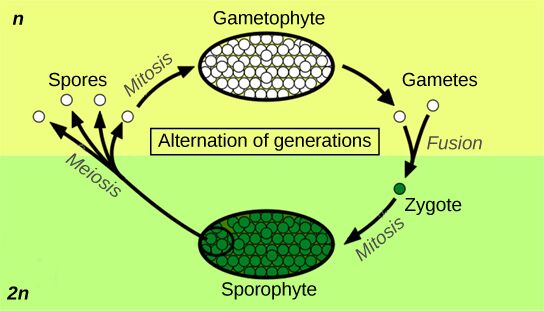
Figure 1: Simplified diagrammatic representation of alternation of generation between gametophyte and sporophyte. Image source: CNX OpenStax, CC BY-SA 4.0
Alternation of generation is the repetitive interchange of change in the life cycle from one asexual generation to the sexual generation and vice versa. Alternation of generation is also sometimes referred to as metagenesis or heterogenesis. Fungi and algae are common examples that exhibit alternation of generation. In the animal kingdom, invertebrates, such as protozoans, flatworms, jellyfish, etc, also exhibit alternation of generation.
At this stage, let us understand the difference between Gametophyte and Sporophytes (Table 1).
| Table 1: Difference between Gametophytes and Sporophytes | |
|---|---|
| Sporophytes | Gametophytes |
| Sporophytes are produced by the process of meiosis | Gametophytes are produced by the process of mitosis |
| Sporophyte generation are diploids having ‘2n’ chromosomes | Gametophyte generations are haploids having ‘n’ chromosomes |
| Sporophytes produce spores having a diploid (2n) number of chromosomes by the | The gametophyte produces gametes having haploid (n) number of chromosomes |
| Sporophyte plants reproduce asexually | Gametophyte plants reproduce sexually |
| Sporophytes are produced by the fusion of the haploid gametes | Gametophytes are produced by the process of spore germination |
Data Source: Dr. Amita Joshi of Biology Online
The above discussion will clarify critical points like, are sporophytes haploid or diploid? How many chromosomes are there in the sporophyte and gametophyte stages?
Biology definition:
A sporophyte is a diploid spore-forming plant that emerges as a result of the fusion of haploid gametes. In the alternation of generations, “sporophyte” refers to the diploid phase of the plant life cycle. __Etymology: “sporo_“, meaning “spores” and “phytate”, meaning “plant”.
Sporophyte Function
The primary function of sporophytes is to produce spores. The spores are diploid (2n) and are produced by the process of mitosis. The spores possess all the genetic information for the functioning of a mature plant and the capability to carry out asexual reproduction.
The spores containing all the genetic information germinate to form a gametophyte. The gametophytes produce gametes having the haploid number of chromosomes (n) by the process of meiosis. These haploid gametes fuse and form a diploid zygote which eventually forms an adult sporophyte having diploid chromosomes (2n).
The sporophytic stage in the plant life cycle is pertinent for bringing genetic diversity to the plant kingdom. The presence of mere asexual reproduction may not yield the formation of fruits in the plants.
Sporophyte Examples
Based on the vascular system or the material transport system of the plants, they can be further classified into non-vascular and vascular plants. Vascular plants are further subdivided into seedless vascular plants and seed-bearing vascular plants.
Non-vascular plants
Non-vascular plants are those which do not possess a vascular system i.e., xylem and phloem. Such plants absorb moisture and essential nutrients from their environment with the help of an efficient simple tissue system. As a result, such plants preferentially grow in a humid environment. These non-vascular plants have a predominantly gametophyte stage and a short-lived sporophyte stage. Examples of non-vascular plants are bryophytes and algae.
The sporophyte and gametophyte stages in the algae are similar and hence sometimes referred to as isomorphic. In algae, the sporophyte stage is limited to the diploid zygote stage only and the gametophyte stage encompasses the primary life span. However, in the bryophytes (mosses, hornworts and liverworts) the sporophytes are short-lived but are dependent upon the gametophyte for nutrition and survival.
In moss sporophyte plant, spores are produced in a capsular structure known as sporangium. The sporangium is attached to the gametophyte and obtains its nutrition with the help of a small stalk known as seta (Figure 2).
The male gametes in these plants swim through the water to reach the female gamete. The gametophyte is photosynthetic and provides nutrition to the sporophyte stage. Thus, in bryophytes, the dominant generation is the gametophyte stage wherein bryophyte sporophyte is dependent upon the gametophyte stage.
Examples of hornworts are Notothallus and Anthoceros. While the examples of liverworts are Marchantia and Riccia. Riccia sporophyte is the simplest having only a capsule and is devoid of seta and foot. Sphagnum is a bryophyte moss that shows alternation of generation.
Like other bryophytes, Marchantia sporophytes are not the predominant stage in their life cycle. Sphagnum also has a dominant gametophyte stage while sphagnum sporophyte is short-lived. Another bryophyte is Polystichum, which has a dominant gametophyte stage. Characteristically, a single Polystichum sporophyte is produced from each gametophyte. It is important to note here that pertaining to the multiplicity of spores in bryophytes, all are bryophytes homosporous.
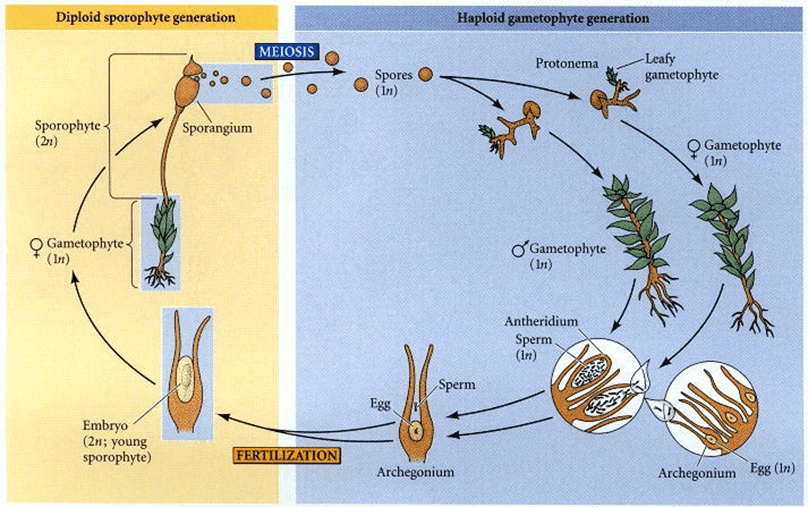
Figure 2: Sporophyte and gametophyte stages in the life cycle of Mosses. Image Credit: Gilbert, 2022.
Seedless vascular plants
As the name suggests, seedless vascular plants possess a vascular system however, such plants do not produce seeds. The life cycle of such plants alternates between the haploid (n) gametophyte stage and the diploid (2n) sporophyte stage. Even though such plants possess a vascular system, these plants require a moist environment to provide the required moisture for the motility of the male gametes to reach the female gamete. The lightweight haploid spores enable such plants to undergo asexual reproduction. This is an adaptive feature that helps these plants to spread and colonize a wide area.
Examples of such plants include:
- Horsetails. Horsetail is considered to be a living fossil plant and is the lone member of the Equisetaceae genus. Sporangiogenesis or the production of spores in such plants occur in strobili. The gametophytic stage in such plants is microscopic while the sporophytic stage is visible to naked eyes.
- Ferns. Ferns are different from mosses as they possess a vascular system. The sporophytes of ferns are macroscopic, possess a vascular system, and are photosynthetic and hence do not depend upon the gametophyte for nutrition and survival. Although gametophytes in ferns are small and devoid of a vascular system, however, they are independent and photosynthetic. The sporangia in the fern sporophyte stage produce the haploid spores by the process of meiosis. Each spore then develops into a heart-shaped gametophyte stage. Pieces of sporophyte leaves with sporangia are known as sporophylls. (Figure 3). Sporangia can be observed in sporophytes under a microscope. Pteridophytes like Selaginella exhibit alternation of generation and exhibit haplo-diplontic life cycle. Selaginella sporophyte is the dominant phase of the life cycle and characteristically, it develops true roots, stems and leaves. Also, selaginella is heterosporous that produces haploid micro-and mega-spores. Due to the presence of true roots, stems, and leaves, pteridophytes are known to have defined true sporophyte leaves.
- Club mosses. Club mosses are not considered to be real mosses. These mosses possess a vascular system and flourish in a moist environment.
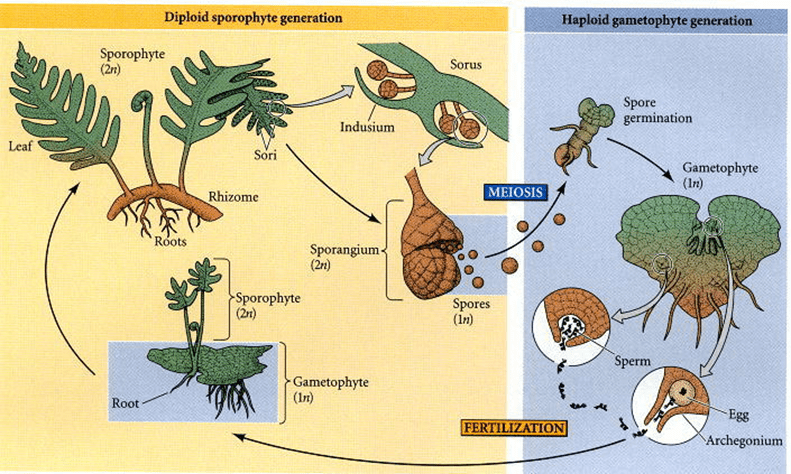
Figure 3: The sporophyte and gametophyte stages in the life cycle of ferns. Image Credit: Gilbert, 2022.
Vascular Seed-Bearing Plants
The plants that possess xylem and phloem and produce seeds fall under the category of seed-bearing vascular plants. Such plants are considered to be modern plants that have the ability to produce seeds which are often surrounded by the seed coat that provides the required nutrients to the seeds. These plants are further classified as:
- Gymnosperms. These are flower-less seed-bearing vascular plants. The life cycle of the plants possesses both gametophytes as well as sporophyte stages. However, the sporophyte stage is predominant while the gametophyte stage is short-lived. The reproductive part of gymnosperm plants is known as cones or strobili. Ginkgo, cycads, conifers (pine trees), and gnetophytes are some of the examples of the Gymnosperms. Gymnosperms are heterosporous i.e., the two types of spores are produced by the sporophyte stage namely, the megaspore that produces the female gametophyte and the microspore that produces the male gametophyte (Figure 4)
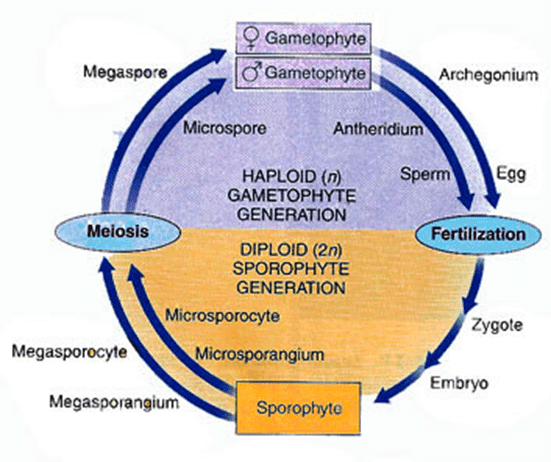
Figure 4: The life cycle of Gymnosperms. Image Credit: NCSU.edu.
- Angiosperms. Angiosperms are flower-producing, seed-bearing vascular plants. These are the most widely found plants. The sporophyte is the predominant stage in the life cycle of the angiosperms, however, male and female gametes are produced in the flowers of the sporophyte stage. In the microsporangium, microspores (male gametes) are produced by the process of meiosis. These microspores eventually form the pollen grains. While in the megasporangium, megaspores (female gametes are produced) by the process of meiosis. The meiotic division in megasporangium results in the formation of four megaspores out of which one is a large megaspore and three are small megaspores. The larger megaspore forms the embryo sac. The pollen grains germinate and fuse with the embryo sac. The sporophyte stage in angiosperm is primarily dormant protected in a seed coat (Figure 5).
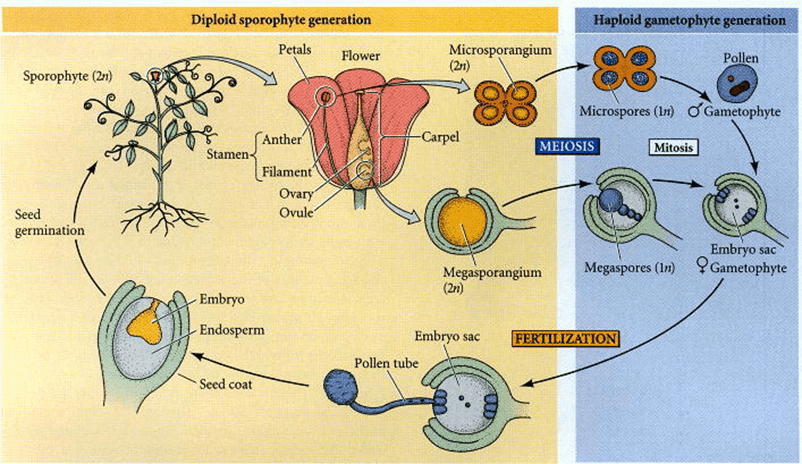
Figure 5: The life cycle of Angiosperms. Image Credit: Gilbert, 2022.
Answer the quiz below to check what you have learned so far about sprorophytes.
Further Reading
References
- Kenrick, P. (2017). How land plant life cycles first evolved. Science, 358(6370), 1538-1539.
- Gilbert, S. F., (2000). Developmental Biology. 6th edition. Sunderland (MA): Sinauer Associates. Plant Life Cycles. Available from: https://www.ncbi.nlm.nih.gov/books/NBK9980/
- Qiu, Y. L., Taylor, A. B., & McMANUS, H. A. (2012). Evolution of the life cycle in land plants. Journal of Systematics and Evolution, 50(3), 171-194.
- Stark, L. R., & Brinda, J. C. (2015). Developing sporophytes transition from an inducible to a constitutive ecological strategy of desiccation tolerance in the moss Aloina ambigua: effects of desiccation on fitness. Annals of botany, 115(4), 593–603. https://doi.org/10.1093/aob/mcu252
- Walbot, V., & Evans, M. (2003). Unique features of the plant life cycle and their consequences. Nature Reviews Genetics, 4(5), 369-379.
©BiologyOnline.com. Content provided and moderated by Biology Online Editors.