How to List Key Accomplishments on Resume (Tips & Examples) (original) (raw)
If there’s one rule you should follow when writing your résumé, it’s to show potential employers what you can do and how your previous successes can contribute to their company’s success.
But how can you do that?
By showcasing your accomplishments, of course.
It might feel uncomfortable tooting your own horn, but it’s necessary for job search success — when done right, that is.
In this guide, we’ll show you how to (and why you should) include your accomplishments in your résumé, plus examples for inspiration so you can make your résumé truly shine.
Why include accomplishments in your résumé
Including accomplishments in your résumé is crucial because, in doing so, you provide recruiters with tangible evidence of your key skills and contributions. And when you highlight the specific, measurable results you’ve achieved, your résumé becomes all the more powerful in differentiating you from other applicants.
Another reason to highlight your accomplishments here is that it helps you steer clear from talking about job responsibilities and typical duties — which only waste valuable space. (Spoiler alert: Hiring managers know what an accountant or a graphic designer does, so they don’t need an insider’s guide to the profession. What they do need is to know whether you will be successful in the job you’re applying for, and your past achievements can be the proof they need.)
Which accomplishments to highlight
There are three main types of accomplishments you can include in your résumé.
The first are professional accomplishments. These are the most valuable kind, as they’re “living proof” of what you’ve done in your career and how you can contribute to a company’s success. They include things like improving processes, generating revenue, and winning work-related awards.
Then you have educational accomplishments, which are particularly useful if you have limited or no work experience — especially achievements that demonstrate your work ethic and transferable skills. These include earning academic awards and honors, receiving grants and scholarships, and completing extra training and certifications.
Finally, you have personal accomplishments, things you have achieved in a personal capacity outside the workplace or classroom. They include volunteer or community work, impressive athletic achievements, or running a successful blog.
Which accomplishments not to highlight
Some accomplishments, unfortunately, shouldn’t be featured in your résumé at all, as they will only dilute your résumé’s impact and your overall candidacy, including:
- Old or irrelevant accomplishments that don’t add value to your job application
- Overly personal achievements, like getting married or overcoming alcohol use disorder
- Alienating topics like political and religious accomplishments
- Accomplishments that reveal sensitive information about an employer (like proprietary code), particularly without their permission
That said, there are some, very nuanced, situations where you can list such accomplishments. For example, someone who has recovered from alcohol use disorder may consider mentioning this in their résumé if they’re applying for a job at a rehabilitation center where they would be helping others overcome this same illness.
How to choose the right accomplishments
While all your accomplishments are impressive in their own right and are worth shouting about from the rooftops, you should only showcase those that are directly relevant to the job that you’re applying for. Anything else can ruin your chances for job search success.
First things first, carefully read the job description (again) and research the company to better understand their mission, values, and ideal candidate.
Then, make a list of all your achievements, dividing them up according to each position or job function. For each one, ask yourself “So what?”. Why would the hiring manager care about it? What exactly does it show them you can do? How is it relevant to the job you’re applying for?
This will effectively help you separate the “good” accomplishments from the “bad” ones, giving you a starting point of what should be highlighted — and what shouldn’t.
You should aim to showcase your accomplishments wherever you can in your résumé, but there are three places where their inclusion is non-negotiable:
Summary section
The first place you should feature your accomplishments is the very first section of your résumé: the career summary. (The career summary shouldn’t be confused with a résumé objective statement, which focuses more on career goals than anything else.)
The summary section, which is typically the first section in a résumé, is a short introductory paragraph consisting of 3–5 sentences that tells employers, at a glance, why you’re the ideal candidate.
As you write a résumé summary, you should focus on summarizing your most relevant skills, experience and qualifications to potential employers, carefully intertwined with notable achievements from across your career journey.
EXAMPLE
CAREER SUMMARY
Pulitzer Prize-winning journalist with 15+ years’ experience covering breaking stories and investigative stories for major publications. Helped cover 2016 and 2020 presidential races, and produced numerous exposés on political and corporate corruption. Committed to bringing honest and powerful news to the public, and proficient in digital production, data analysis and CMS platforms.
Experience section
Next up is the work experience section, which is often the most important part of a résumé. Here, your past achievements should take centerstage, as opposed to listing general job duties and responsibilities (which offer no real value to hiring managers).
For each position listed in the experience section, showcase your 3–6 most notable achievements in the form of a bulleted list. And try to prioritize them according to importance, relevance and impact — this means listing “Generated revenues exceeding $1b” above “Managed a team of 5 accountants”, which is less impressive.
EXAMPLE
EXPERIENCE
Senior Accountant | Accounting Corp, New York City, NY | Jan 2020–Present
- Successfully identified and implemented cost-saving strategies, resulting in a 15% reduction in operational expenses, contributing to annual savings of $150k.
- Spearheaded the automation of manual processes, increasing workflow efficiency by 20% and reducing processing time, which translated to a time-saving equivalent of 500 hours.
- Implemented effective cash flow forecasting techniques, leading to a 25% reduction in overdue receivables and an increase in available working capital by $200k.
- Ensured 100% accuracy in financial reporting by implementing rigorous reconciliation procedures, leading to the timely submission of error-free financial statements.
- Executed strategic tax planning initiatives, resulting in a 10% reduction in tax liabilities for the company, equivalent to a savings of $75k in the fiscal year.
If you’re an entry-level jobseeker, though, you likely won’t have any work experience to share with potential employers. And if that’s the case, then you can instead focus on your academic achievements in the education section.
Accomplishments section
A dedicated accomplishments section isn’t always necessary, especially if you can integrate this information elsewhere in your résumé (particularly in the experience section) or if you don’t have room for one (remember: résumés should, in most cases, be one page long).
That said, this section can be incredibly useful if you have achievements outside the workplace or you’re at a more senior level in your career and have extensive experience, and is typically placed immediately after the summary section.
Unlike the accomplishments listed in your experience section, which are specific to a particular position, those listed here can — and should — be a mixture of 3–5 achievements spanning your entire career.
EXAMPLE
CAREER HIGHLIGHTS
- Performed 1,144 shows during 2 concert residencies at The Colosseum at Caesars Palace, A New Day… and Celine, showcasing a versatile vocal range and engaging stage presence.
- Released 6 Billboard No 1 albums, receiving positive reviews and achieving 400+ million downloads on major streaming platforms.
- Collaborated with Peabo Bryson, Barbra Streisand, Garou, Diane Warren and David Foster on hit singles, contributing to chart success and expanding fan base.
How to write accomplishment statements
Next up: how to effectively write about your accomplishments in your résumé:
1. Use the PAR method
Perhaps the biggest trick to employ when writing about your accomplishments in your résumé is the PAR method, which calls for addressing three things:
- The Problem you faced
- The Action you took
- The Result of your action
For example, instead of saying that you “managed social media campaigns”, you could say something like “Increased brand awareness by 52% by creating and managing social media campaigns”. This effectively shows the problem (little to no brand awareness), the action (managing social media campaigns), and the result (increasing awareness by 52%).
On that note, make it a point to use numbers and percentages when you can, as this provides hiring managers with tangible evidence of your accomplishments.
2. Incorporate keywords
An important part of writing a résumé is to tailor it to the job you’re applying for. And one of the best ways to do this is to carefully intertwine important keywords from the job description into your résumé.
For example, if the position requires a “strong understanding of SEO”, you could mention something like: “Leveraged strong understanding of SEO to generate over 1m unique users on CareerAddict.com on a monthly basis.”
Not only does this help your résumé pass through applicant tracking systems (specialized software that parse résumés based on preset criteria and keywords), but it also makes your accomplishments that more memorable and impactful.
Indeed, it makes hiring managers stop and think: “This candidate has achieved this impressive accomplishment using the specific skill that we’re looking for.” And this inevitably sways them in your favor.
3. Use action verbs
To make your accomplishment statements all the more impactful and memorable, it’s a good idea to start them off with powerful action verbs like “orchestrated”, “spearheaded”, “transformed”, “rehabilitated” and “implemented”. Not only do they spice up your résumé, but they also create a persuasive tone.
Meanwhile, do try to avoid using buzzwords and other clichés like “proven track record”, “results-oriented” and “results-driven” in accomplishment statements, as they’ve been so overused that they’ve lost their meaning — and they offer little evidence to back up your claims.
Accomplishment examples for top professions
Need a little inspiration? Here are some examples of accomplishments for 10 professions:
1. Digital marketing specialist
- Executed targeted digital campaigns that led to a 30% increase in online engagement, exceeding the industry average and contributing to a 25% growth in overall website traffic.
- Implemented data-driven strategies, resulting in a 20% improvement in conversion rates for online advertisements and a 15% increase in ROI for paid media channels.
- Developed and executed a social media content calendar that boosted brand awareness, garnering a 50% growth in follower base and generating a 40% increase in organic reach within 6 months.
2. Registered nurse
- Implemented a streamlined patient care protocol, reducing average response time to medical emergencies by 20%, enhancing overall departmental efficiency.
- Spearheaded a successful health education initiative, conducting workshops for 100+ patients, resulting in a 15% improvement in medication adherence and preventive care compliance.
- Collaborated in the development of a comprehensive training program for new nursing staff, leading to a 30% reduction in onboarding time and increased team cohesion.
3. Customer service representative
- Achieved a consistent 95% customer satisfaction rating by resolving complex issues with empathy and efficiency, surpassing the company’s benchmark for service excellence.
- Implemented a proactive communication strategy, resulting in a 20% decrease in customer complaints and a 15% increase in positive feedback over a 6-month period.
- Played a key role in the successful launch of a new customer support ticketing system, contributing to a 25% reduction in response times and overall improvement in service delivery.
4. Civil engineer
- Managed the successful completion of a major infrastructure project, delivering it 3 months ahead of schedule and 10% under budget, showcasing effective project management and resource optimization skills.
- Implemented innovative design modifications on a bridge construction project, improving structural integrity by 15% and receiving commendation from regulatory authorities for adherence to safety standards.
- Led a cross-functional team in resolving complex technical challenges during a municipal water supply project, ensuring uninterrupted water access for the community and earning recognition for problem solving and leadership.
5. Accountant
- Identified and implemented streamlined processes, resulting in a $50k reduction in operational costs, contributing to overall company savings.
- Led initiatives to enhance financial reporting accuracy by implementing new software tools and conducting rigorous reconciliations, reducing errors by 20% and ensuring compliance with auditing standards.
- Developed and executed tax planning strategies, resulting in a 10% reduction in tax liabilities for the company while ensuring full compliance with relevant tax laws and regulations.
6. Web designer
- Redesigned website interface, improving user experience and increasing customer engagement, leading to a 25% boost in user interaction and positive feedback.
- Implemented performance optimizations, resulting in a 40% reduction in website loading times, enhancing overall site speed and responsiveness for a better user experience.
- Conducted A/B testing on key website elements, such as call-to-action buttons and navigation, leading to a 15% increase in conversion rates.
7. Research assistant
- Collaborated with a research team to conduct experiments, analyze data and contribute significantly to a published research paper in Journal of ABC.
- Developed and implemented streamlined data collection and analysis procedures, reducing research project timelines by 20%, improving efficiency and ensuring the timely completion of projects.
- Successfully wrote and submitted grant proposals, securing $75k in funding for a research project focused on Alzheimer’s disease, demonstrating grant-writing skills and financial acumen.
8. Veterinarian
- Established and implemented a comprehensive preventive care program for ABC Health Clinic, resulting in a 39% decrease in preventable health issues among pets.
- Successfully conducted and led a team in performing complex surgical procedures, achieving a 96% success rate and earning recognition for surgical expertise and patient care.
- Developed and delivered educational materials for clients on topics such as pet nutrition, behavior and preventive care, leading to a 20% increase in client compliance and satisfaction with veterinary services.
9. College professor
- Developed and implemented an innovative curriculum for the BSc Archeology course, integrating real-world applications and cutting-edge research, resulting in a 17% improvement in student engagement and understanding.
- Published multiple research articles in renowned journals such as Journal of Colleges, contributing to the academic field of mathematics and establishing a reputation as a thought leader.
- Mentored students who received recognition and awards, including Student of the Year, showcasing a commitment to student success and fostering a supportive learning environment.
10. Retail associate
- Consistently exceeded monthly sales targets by 34%, demonstrating strong product knowledge, effective upskilling techniques and exceptional customer service skills.
- Initiated and executed visual merchandising improvements, resulting in a 15% increase in product visibility and attracting more customer attention, ultimately boosting sales for featured products.
- Received recognition for outstanding customer service, earning the Customer Service Excellence Award for maintaining a high level of customer satisfaction through effective communication and problem resolution.
Résumé example
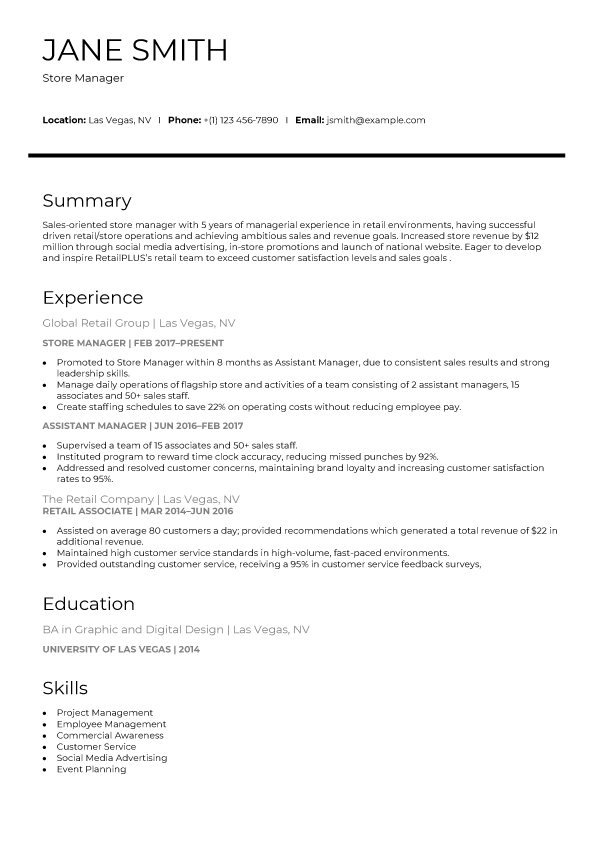
Let’s see it all in action with an accomplishment-driven résumé example, specially created from one of our professionally designed résumé templates:
Key takeaways
It can sometimes feel uncomfortable tooting our own horn, but when it comes to writing a résumé, it’s a necessity — especially if you want a fighting chance at impressing the hiring manager and getting invited to a job interview.
When writing about your accomplishments in your résumé, remember these pointers:
- Choose those that are relevant to your target job and industry. These include professional, educational and personal achievements.
- Steer clear of old, irrelevant, controversial and overly personal achievements.
- Include them wherever possible, particularly in the summary and work experience sections.
- Make sure the experience section focuses on your achievements — and not your job responsibilities.
- Use the PAR method when talking about accomplishments, always addressing a problem, an action and a result.
Got a question? Let us know in the comments section below.
Originally published on December 20, 2018.